
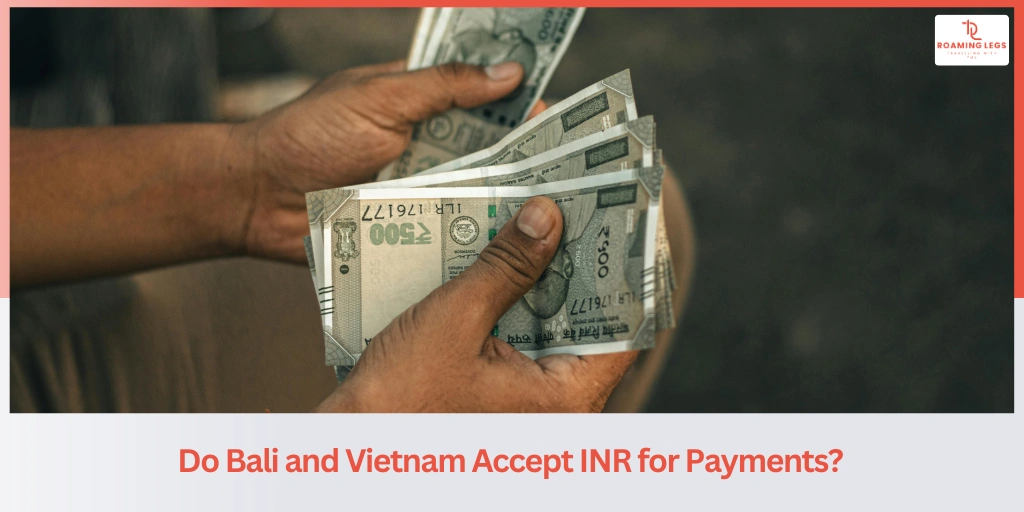
So you’ve booked your Bali or Vietnam trip, and now you’re staring at your wallet wondering — can I just carry rupees and exchange them there?
Or do I need to figure this out before I leave?
Short answer: yes, you need to sort this before you go.
Indian Rupees (INR) are not accepted for payments in either Bali or Vietnam.
Not at restaurants, not at hotels, not at markets. The moment you land, you are dealing with a completely different currency — and if you haven’t planned for it, your first few hours in either country can get genuinely stressful.
This guide tells you exactly what currency to carry, the cheapest ways to get it, which cards actually save you money, what the current exchange rates look like, and the mistakes Indian travellers make that cost them real money.
What Currency Is Used in Bali and Vietnam?
Two different countries, two different currencies — and both of them have a learning curve.
Bali (Indonesia) uses the Indonesian Rupiah (IDR), symbol Rp.
The numbers are large — a casual lunch might cost Rp 80,000, a cab ride Rp 50,000, and a hotel Rp 1,500,000 per night.
As of July 2026, 1 Indian Rupee = approximately 183–190 Indonesian Rupiah.
So that Rp 1,500,000 hotel room is roughly ₹8,000.
Once you get the hang of dividing by 185, you’re fine.
Vietnam uses the Vietnamese Dong (VND).
The denominations are even more extreme — ₹100 gets you roughly 283 VND.
A street food meal in Hanoi might cost 60,000 VND, which is just ₹212.
The confusing part: the 20,000 VND and 500,000 VND notes look similar, and polymer notes stick together.
Count every time.
Neither destination accepts INR at shops, restaurants, taxis, or markets.
A few high-end hotels might quote in USD, but even then, they won’t take rupees.
How Much Does INR Actually Get You?
| Currency Pair | Approximate Rate (July 2026) |
|---|---|
| 1 INR → Indonesian Rupiah (IDR) | ~183–190 IDR |
| 1 INR → Vietnamese Dong (VND) | ~280–295 VND |
| ₹10,000 → IDR | ~18,30,000–19,00,000 IDR |
| ₹10,000 → VND | ~28,00,000–29,50,000 VND |
1 INR → ~183–190 IDR
Example₹10,000 → ~18,30,000–19,00,000 IDR
1 INR → ~280–295 VND
Example₹10,000 → ~28,00,000–29,50,000 VND
Planning Bali or Vietnam? Get Your Real Daily Budget Breakdown
Not sure how much you should actually budget for your trip? Share your travel dates, trip duration, and travel style on WhatsApp, and we will prepare a realistic per-day cost breakdown based on your plans.
Get clear numbers for stays, food, transport, activities, and daily expenses — without unnecessary extras or confusing estimates.
Bali Currency Guide for Indian Travellers
The biggest mistake Indian travellers make in Bali is arriving at Ngurah Rai International Airport and exchanging all their money there.
Airport counters in Bali are consistently 3–6% worse than the rates you’ll get in town.
Change just enough at the airport to cover a taxi or GrabCar to your hotel — around Rp 100,000–200,000 (₹540–₹1,080).
Sort the rest in Seminyak, Ubud, or Canggu.
Where to exchange money in Bali:
The most trusted licensed money changers in Bali are BMC (Bali Money Changer), Central Kuta Money Exchange (PT Central Kuta), and Permata Bali.
All three have Bank Indonesia licence certificates displayed on the wall — check for this before handing over your cash.
Do not exchange money at street-side, unlicensed changers even if they advertise better rates.
Scams include shortchanging, distraction tricks, and fake notes returned in the middle of a big bundle.
Can you exchange INR directly in Bali?
Yes, most licensed money changers in Bali accept Indian Rupees.
But the rate for INR is often slightly worse than for USD.
A practical move many Indian travellers use: carry a portion of your forex budget in USD, which tends to get better rates at Bali changers.
So if you have ₹30,000 to exchange, convert ₹15,000–₹20,000 to USD in India first through a forex dealer like BookMyForex or Thomas Cook, and exchange the rest in Bali as INR.
Cash or card in Bali?
Use both. The recommended split is 60–70% on a forex card loaded with IDR and 30–40% as IDR cash. Here’s why:
Cash is still king at traditional markets like Ubud Art Market and Sukawati Market, street food warungs, scooter rentals, temple entrance fees (most charge Rp 20,000–50,000), parking, and tips.
A good daily cash budget for Bali is Rp 500,000–1,500,000 (₹2,700–₹8,100) depending on your travel style.
Cards are accepted at hotels, beach clubs like Ku De Ta and Potato Head, shopping malls, larger restaurants, and tour operators booking activities like ATV rides with Mason Adventures or sunrise treks to Mount Batur.
Note: many Bali establishments add a 2–3% surcharge for card payments.
Ask before you swipe.
Best ATMs in Bali:
Use BCA or BNI ATMs — they have the most reliable withdrawal limits and lowest additional fees for foreign cards.
Avoid standalone ATMs not attached to a bank building, especially in tourist areas.
Always decline the ATM’s “Dynamic Currency Conversion” offer — it charges you an extra 3–5% to convert into INR on the spot.
Always choose to be charged in IDR.
Vietnam Currency Guide for Indian Travellers
Vietnam is slightly more cash-heavy than Bali, so plan accordingly.
Cities like Hanoi, Ho Chi Minh City (Saigon), and Da Nang have plenty of ATMs and card-accepting restaurants, but once you move to smaller towns, night markets, or street food alleys, you will need VND cash.
Load more cash than you’d carry in Bali.
Where to exchange money in Vietnam:
The best strategy most experienced travellers use: convert INR to USD in India before you fly (through BookMyForex, Orient Exchange, or your local RBI-authorised forex dealer), then exchange USD to VND at a licensed gold shop (tiem vang) in Hanoi’s Old Quarter or HCMC’s District 1.
Gold shops in Vietnam have a long tradition of currency exchange and consistently offer better USD-to-VND rates than airport counters or banks.
Avoid airport exchange counters at Tan Son Nhat (HCMC) and Noi Bai (Hanoi) for anything beyond the minimum to cover your taxi.
Vietnamese Dong is now directly purchasable in India through authorized dealers like Orient Exchange — convenient if you prefer to arrive with local currency already in hand.
Can you exchange INR directly in Vietnam?
It’s possible at some authorized money changers, but INR is not widely traded in Vietnam.
Availability is limited, and the rates are generally worse than for USD or EUR.
Don’t rely on this as your primary strategy.
Best ATMs in Vietnam:
Use VPBank ATMs — as of 2026, most Indian cards work smoothly with only your Indian bank’s fees (roughly ₹125 + 3.5% conversion per withdrawal).
Avoid TPBank (which started charging a 3.3% machine fee in late 2025) and standalone BIDV machines that charge a percentage-based fee instead of a flat one.
UPI does not work in Vietnam — MoMo, ZaloPay, and VietQR all require a Vietnamese bank account.
Cards and cash only.
Not Sure How Much Cash to Carry for Bali or Vietnam?
Managing money abroad can be confusing. We have planned hundreds of trips for Indian travelers and can help you decide the right balance between cash and cards.
Send us your itinerary on WhatsApp and we will share a practical money plan for your route — including how much cash to carry, how much to keep on card, and the best places to exchange currency.
Best Forex Cards for Indian Travellers Going to Bali or Vietnam (2026)
The forex card question comes up constantly — and the honest answer is: the right card depends on how you spend.
Niyo Global Card (DCB Bank): Zero forex markup, real-time interbank rates, and the first four international ATM withdrawals per month are free.
Best for travellers who will mix card payments and ATM withdrawals.
The app is functional, not fancy. Requires you to open a DCB savings account.
BookMyForex WOW Card: Zero cross-currency markup on supported currencies, competitive loading rates, and you can lock in the exchange rate when you load.
Best if you want rate certainty before your trip.
HDFC Multicurrency Platinum / Axis Multi-Currency: Legacy bank cards. Reliable and widely accepted, but charge 3–3.5% cross-currency markup.
Use only if you’re already banking with HDFC or Axis and don’t want to set up a new card.
Scapia Card: Worth considering if you’re booking hotels and activities through the app — the cashback offers can be significant for certain properties.
Less efficient than Niyo for pure ATM withdrawals.
For most Indian travellers heading to Bali or Vietnam, Niyo Global + BCA/VPBank ATMs is the lowest-cost combination.
Activate international transactions at least 24 hours before departure, and test your card at an Indian ATM first.
How Much Cash Should You Carry? A Realistic Budget Guide
| Trip Style | Bali — Per Day (Cash Only) | Vietnam — Per Day (Cash Only) |
|---|---|---|
| Budget traveller |
Rp 300,000–500,000 (₹1,620–₹2,700) |
VND 300,000–500,000 (₹1,060–₹1,770) |
| Mid-range traveller |
Rp 700,000–1,500,000 (₹3,780–₹8,100) |
VND 700,000–1,200,000 (₹2,470–₹4,240) |
| Comfortable traveller |
Rp 1,500,000–3,000,000 (₹8,100–₹16,200) |
VND 1,200,000–2,500,000 (₹4,240–₹8,800) |
Rp 300,000–500,000 (₹1,620–₹2,700)
Vietnam Daily CashVND 300,000–500,000 (₹1,060–₹1,770)
Rp 700,000–1,500,000 (₹3,780–₹8,100)
Vietnam Daily CashVND 700,000–1,200,000 (₹2,470–₹4,240)
Rp 1,500,000–3,000,000 (₹8,100–₹16,200)
Vietnam Daily CashVND 1,200,000–2,500,000 (₹4,240–₹8,800)
Quick Tips to Avoid Losing Money on Currency Exchange
In Bali:
- Never exchange money at the airport for large amounts — rates are 3–6% worse
- Use only licensed changers with the Bank Indonesia licence on the wall (BMC, Central Kuta, Permata Bali)
- Always count your notes at the counter before you walk away — shortchanging is the most common scam
- Ask for a mix of smaller denominations: Rp 10,000, 20,000, 50,000 — useful for taxis, tips, and temple donations
- Decline ATM Dynamic Currency Conversion — always choose to pay in IDR
In Vietnam:
- Convert INR to USD in India, then exchange USD to VND at a gold shop (tiem vang) in Hanoi or HCMC for best rates
- Use VPBank ATMs; avoid TPBank and airport standalone machines
- Watch the 20,000 VND and 500,000 VND notes — they look almost identical
- Keep a small USD reserve (around $50–100) as emergency backup for smaller towns
What Indian Travellers Actually Ask Us
Here’s what couples and families ask our team every week before a Bali or Vietnam trip:
“Nitin, we are going to Bali for 10 nights from Mumbai with our family.
Should we carry USD or INR or just use a card?”
Our answer: carry a Niyo card loaded with IDR, take enough USD to exchange at a licensed changer for your first few days’ cash, and keep your regular debit card as a BCA ATM backup.
Avoid the airport exchange counters entirely for anything over Rp 200,000.
“We are a couple going to Vietnam for 8 days. The guides say USD is better — is that true?”
Yes, in Vietnam, USD gets you a better exchange rate at gold shops than INR does.
Buy USD before you fly, exchange to VND at a reputable tiem vang in Hanoi or HCMC, and use VPBank ATMs when you need more cash mid-trip.
Testimonials
Rajan & Priya Mehta, Ahmedabad — Bali, March 2026 “We almost exchanged everything at the Bali airport until the Roaming Legs team told us not to.
We changed just Rp 200,000 at the airport and got the rest from Central Kuta Money Exchange the next morning.
The rate difference was significant — we saved almost ₹3,000 just by waiting.
The Niyo card worked perfectly at BCA ATMs.”
Sameer Kapoor, Pune — Vietnam, January 2026 “Vietnam’s currency confused me completely at first — I couldn’t tell if 500,000 VND was a lot or nothing.
The team sent us a simple conversion cheat sheet and helped us set up the cash split before we flew.
Hanoi gold shops gave us a far better rate than what the airport would have.”
