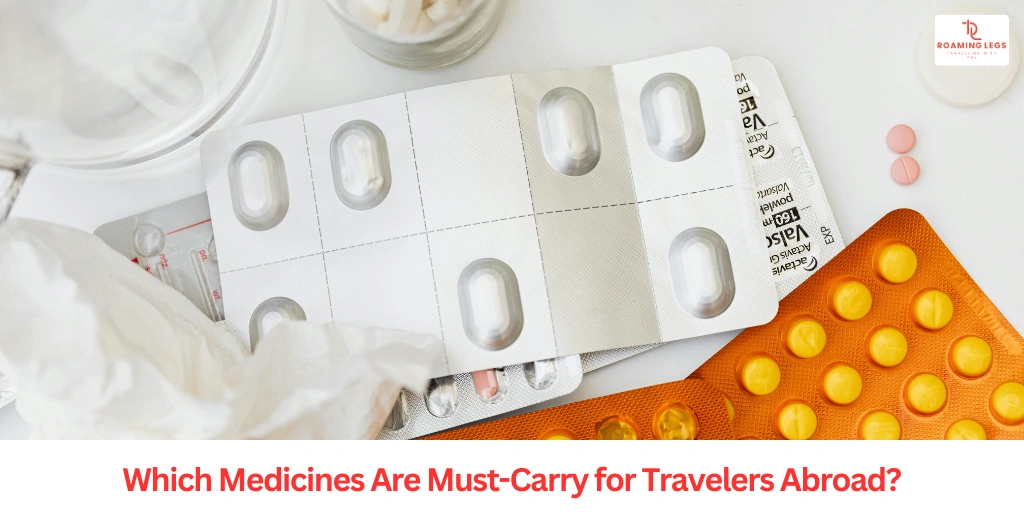

Medicines to Carry When Traveling Abroad — What Indian Travelers Actually Need (and What Gets Confiscated at the Airport)

Health Safety Tips for Travelers Visiting Vietnam​

Here’s something most travel blogs don’t tell you: the biggest medicine-related problem Indian travelers face abroad isn’t forgetting to pack Dolo 650. 

It’s carrying something completely normal back home — a cough syrup with codeine, a common sleeping pill, a strong painkiller — and getting flagged at customs. 

In Dubai alone, this happens regularly enough that lawyers in the UAE now write guides specifically warning Indian tourists about it.

So this article does two things. First, it gives you the complete medicine checklist for your trip. 

Second, it tells you what to watch out for — because carrying the wrong thing in the wrong country can ruin a vacation faster than anything else.

The Core Medicine Kit Every Indian Traveler Should Pack

This is the foundation — medicines for the most common things that go wrong on international trips. 

These are all safe to carry to most countries, including Dubai, Bali, Vietnam, and Europe.

Pain and Fever Dolo 650 (paracetamol 650mg) is the one most Indian travelers already reach for. 

It handles fever, headaches, and mild body aches. 

Carry a strip of 10–15 tablets. If you tolerate Ibuprofen (Combiflam, Brufen), pack that too — it’s more effective for muscle pain after a long flight or a day of heavy walking. 

Avoid aspirin unless your doctor has specifically recommended it.

Stomach and Acidity Traveling almost always messes with digestion. 

Different water, richer food, irregular meal timing — your stomach will let you know. 

Pack:

  • Pantoprazole or Rabeprazole (acidity, acid reflux) — Pantodac, Pan-D, or Rablet work well
  • Gelusil or Eno for quick antacid relief
  • Enterogermina (probiotic sachets) — genuinely underrated, helps your gut recover faster from food changes
  • Loperamide (Lopamide) for loose motions — use only if it’s simple traveler’s diarrhea, not if you have a fever with it

ORS (Oral Rehydration Salts) Pack at least 5–6 sachets. 

Electral or Wellyte are both fine. 

Dehydration sneaks up on you when you’re sightseeing in Dubai’s heat or doing back-to-back activities in Bali. 

ORS is cheap in India and sometimes expensive or hard to find abroad in familiar form.

Allergies and Insect Bites Cetirizine (Cetzine, Alerid) — one tablet a day controls most common travel allergies. 

Also helps with dust, pollen changes, and mild reactions to new food. 

If you’re prone to strong allergic reactions, ask your doctor about carrying a short course of Prednisolone (steroid). 

Pack a small tube of Betnovate or Soframycin cream for skin reactions and insect bites.

Motion Sickness Avomine (promethazine) is what most Indians use — take it 30 minutes before a long bus ride, boat trip, or winding mountain road. 

For those who want something gentler, Stugeron (cinnarizine) is available OTC in India and works well for mild cases. 

Don’t leave home without this if you’re going to Bali (lots of boat transfers) or Vietnam (Ha Long Bay cruises, mountain roads).

Cold, Cough, and Sore Throat Sinarest or Coldact for cold and mild congestion. 

Strepsils lozenges for sore throat. 

A nasal saline spray (Nasoclear or Otrivin saline) for dry aircraft air and climate changes — this one is surprisingly useful on long flights. 

Avoid cough syrups containing codeine — more on why in the next section.

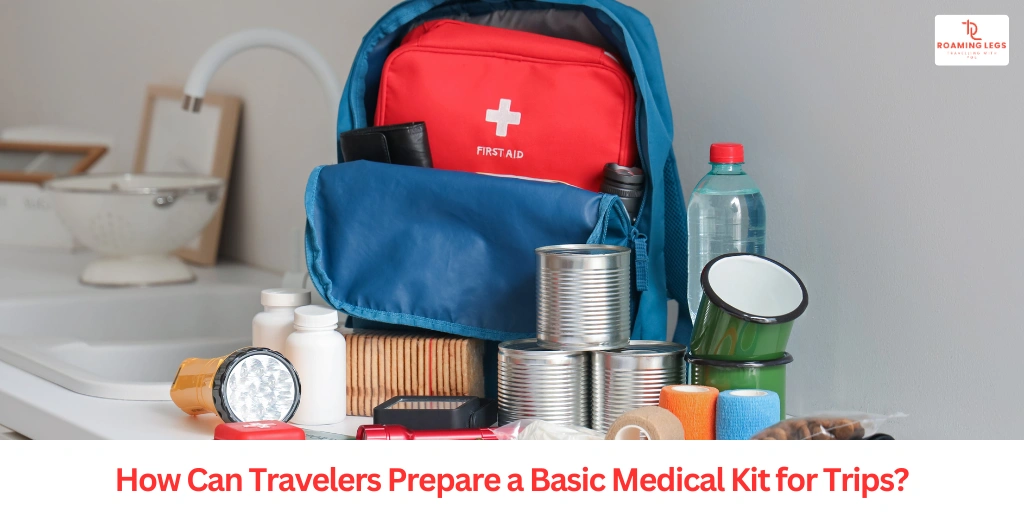
First Aid Keep a small pouch with: a digital thermometer, band-aids (multiple sizes), betadine antiseptic solution (small 15ml bottle), Soframycin or Neosporin antibiotic ointment, sterile gauze and adhesive tape, a few alcohol swabs, and a small scissors or tweezers. 

This takes up almost no space and handles 90% of minor travel injuries.

Eye Care A small bottle of lubricating eye drops (Systane or I-Fresh) — cabin air is extremely drying and many people experience irritation on long hauls. 

If you wear contact lenses, pack your glasses too.

📋 FREE TRAVEL MEDICINE CHECKLIST

Get Your Free Destination-Specific Travel Medicine Checklist on WhatsApp

Whether you are travelling to Dubai, Bali, Vietnam, Europe, or another international destination, our Travel Medicine Checklist helps you prepare with confidence. We share this guide with every traveller who books through us. It covers medicines to carry, items you should leave behind, medications that may need to be declared at customs, and trusted local pharmacy chains at your destination. It is completely free and delivered directly to WhatsApp.

💊

Medicines to Pack

Know which essential prescription and over-the-counter medicines are worth carrying for your trip.

🛄

Customs Guidance

Understand which medicines may require documentation or declaration before you travel.

🏥

Local Pharmacy Guide

Receive the names of reliable pharmacy chains and where to find them at your destination.

📲

Tailored to Your Destination

Your checklist is customised for your travel destination and delivered free on WhatsApp within minutes.

Essential Medicines for Travel​

The Medicine Rules Nobody Warns Indian Travelers About

This is the section most travel blogs skip. 

Pay attention here because this is where trips go sideways.

Dubai and UAE — Strictest Rules by Far

The UAE has one of the world’s toughest drug control systems, and the list of controlled or banned medicines is shockingly long. 

Many medicines that are completely normal in India are either banned or require a government permit to bring into Dubai.

What you absolutely cannot carry into Dubai without a MOHAP (Ministry of Health and Prevention) permit:

  • Codeine — including any cough syrup containing codeine (Corex, Phensedyl, many common Indian cold remedies contain this)
  • Tramadol — one of the most commonly prescribed painkillers across South Asia, completely banned in UAE
  • Xanax (alprazolam), Valium (diazepam) — benzodiazepine anti-anxiety medications
  • Ritalin, Adderall — ADHD medications
  • Ambien (zolpidem) — commonly prescribed sleeping pill in India
  • CBD oil or CBD products — even if legal in your home country

What is allowed freely: Paracetamol, Ibuprofen, Cetirizine, Loperamide, antacids, ORS, antibiotic ointments, eye drops. 

Standard over-the-counter stuff is fine.

For controlled medicines that have a legitimate medical need, you can apply for an import permit on the MOHAP website (mohap.gov.ae) before your trip. 

The process is free, takes about 3 working days, and the permit is valid for one trip. 

Carry the permit plus your doctor’s prescription (on letterhead, with dosage details) in a separate envelope with your travel documents.

The mistake we see most often: Indian travelers carrying a cough syrup bought from a local pharmacy — Corex, Phensedyl, or similar — because someone in the family had a cold. 

These contain codeine. 

If customs spots them, it’s not a fine situation; it’s a potential arrest situation. Just don’t.

Bali (Indonesia)

Bali is generally more relaxed than Dubai but still has specific restrictions. Narcotics, psychotropic substances, and certain controlled medications are strictly prohibited. 

What this practically means for Indian travelers:

  • Strong prescription painkillers, sleeping pills, and ADHD medications need a doctor’s note in English
  • Some asthma medications containing ephedrine or phenobarbital may be restricted — check with your doctor before packing
  • Declare all medications at customs if asked — transparency here protects you
  • Common OTC medicines (paracetamol, antacids, antihistamines, ORS) are fine

One useful thing about Bali: local pharmacies (called Apotek) are well-stocked and pharmacists are knowledgeable. 

Many common Indian medicines are available under Indonesian brand names. 

If you run out of something basic, it’s usually findable.

Vietnam

Vietnam has rules around narcotics and psychotropic medicines, similar to most Southeast Asian countries. 

A 30-day supply limit applies to controlled medicines. 

For the average Indian tourist on a 7–10 day trip with standard health needs, Vietnam is uncomplicated. 

Just keep prescriptions for anything beyond basic OTC medicines, and declare at customs if you’re carrying a larger quantity.

Europe (Schengen Countries)

Most EU countries allow personal medication without special permits as long as you have a valid prescription and carry only what’s needed for your trip (usually up to a 90-day supply for long stays). 

Rules vary slightly by country — Germany, France, and the Netherlands are generally reasonable for most Indian medicines. 

The UK (post-Brexit) follows its own system but is similarly straightforward for standard prescriptions.

Japan

Japan has the most surprising rules. 

Some common cold and allergy medications containing pseudoephedrine or codeine are controlled. 

ADHD medications like Adderall are completely illegal. 

If you’re going to Japan with any prescription medicines, specifically check the Japanese Ministry of Health’s list before packing.

Medicines for Specific Traveler Types

If You Have Diabetes Insulin and oral diabetes medication are essential to carry — but insulin needs to be kept cold. 

Pack a small insulin cooler pouch (Frio pouches work well). 

Carry your glucometer with extra strips, lancets, and a spare battery. 

Bring a signed doctor’s letter on letterhead stating you’re a diabetic and listing your medications — especially for Dubai customs.

If You Have High Blood Pressure or Heart Conditions Carry at least double the quantity you think you’ll need. 

Time zone changes, flight stress, sightseeing fatigue, and different food can affect blood pressure more than usual. 

Keep your medicines in your cabin bag, not checked luggage. 

A small BP monitor is worth packing if you travel regularly with this condition.

If You Have Asthma Always carry your inhaler in your cabin bag. 

Long flights with dry air can trigger symptoms. 

Spare inhalers are strongly recommended. 

Salbutamol (Ventolin) inhalers are generally recognized internationally, but check if your destination has any restrictions on your specific medication.

If You’re Traveling with Children Pack children’s paracetamol (Crocin DS or Calpol suspension), a liquid antihistamine (Phenergan syrup or Cetrizine drops), ORS sachets, and an ear pain reliever (Otigo or similar) — ear infections during or after flights are very common in young children. 

A digital forehead thermometer is compact and fast.

If You’re a Senior Traveler Carry a typed list of all your medications with generic names (not just Indian brand names) — this helps foreign doctors and pharmacists immediately. 

A week’s extra supply of every prescription medicine is the minimum buffer. 

Compression stockings are worth considering for long-haul flights if you have circulation concerns.

How to Pack Medicines for International Travel

Cabin bag, always. Every essential medicine goes in your cabin bag. 

Checked luggage can be delayed by 24–48 hours or lost entirely. 

If your blood pressure medicine is in your checked bag and it doesn’t arrive with you — that’s a genuine problem. 

Medicines, prescriptions, and first aid go in the cabin bag, no exceptions.

Original packaging matters. Custom officers in many countries — especially UAE, Japan, and Singapore — may check medicines. 

Loose tablets in an unlabeled container raise questions. 

Keep blister packs intact with the strip name visible. 

For liquid medicines, keep the original bottle with the pharmacy label.

Liquids rule for aircraft: Medical liquids are generally exempt from the 100ml cabin bag rule, but you may be asked to show a prescription or doctor’s note. 

Keep medicines separate from toiletries in a clear pouch for easy security checks.

Prescription letter format: Get your doctor to write a letter on clinic letterhead that includes your full name, passport number, the medicine name (generic + brand), dosage, and the reason you need it. 

This single document solves 90% of customs questions and is especially critical for Dubai and Japan.

Expiry dates: Check every medicine before packing. 

A two-year-old strip at the back of your drawer may have expired. 

This is one of those obvious things that gets overlooked until you actually need the medicine.

📅 COMPLETE PRE-DEPARTURE TRAVEL PLAN

Planning a Trip? Get Everything Sorted Before You Fly

Every traveller we help receives a complete pre-departure travel plan before departure. It includes a health and safety checklist, destination-specific medicine guidance, travel insurance advice, and important emergency contact numbers, all organised in one easy-to-use reference. It takes our team just 10 minutes to prepare and can save you hours of research and unnecessary stress. Simply tell us your destination and travel dates on WhatsApp, and we will send your personalised travel plan within 24 hours, completely free.

🩺

Health & Safety Checklist

Receive a destination-specific checklist covering health precautions and essential travel preparation.

💊

Medicine & Insurance Guide

Know what medicines to carry, insurance essentials, and important travel recommendations.

🚑

Emergency Information

Keep hospital details, emergency numbers, and other important contacts ready before your journey.

📲

Personalised in 24 Hours

Your customised pre-departure travel plan is delivered on WhatsApp within 24 hours at no cost.

Health Safety Tips for International Travelers​

What Real Travelers Say

“We were going to Dubai for 5 days and I almost packed Corex for my husband’s cold. 

Our travel agent from Roaming Legs specifically told us not to — it has codeine and can cause serious problems at Dubai customs. 

I would never have known. 

We swapped it for a plain antihistamine and were completely fine. 

Please check before you pack any cough syrup for UAE.

Rekha S., Ahmedabad — traveled March 2026

“My mother is diabetic and we were worried about her insulin on our Bali trip. T

he Roaming Legs team told us exactly how to pack it (a Frio cooler pouch), what documents to carry, and that Apotek pharmacies in Bali have insulin available as backup. 

The trip went perfectly — we were so much more confident because we were actually prepared.

Karthik M., Chennai — traveled January 2026

Medicines for International Travel FAQ

FAQ — Medicines for International Travel from India

Responsive, Elementor-ready FAQ component with embedded CSS and no JavaScript.

1. Which medicines should every Indian traveler carry abroad?

Pack paracetamol (Dolo 650), ORS, an antacid, antihistamine, anti-diarrheal medicine, motion sickness tablets, antiseptic, bandages, a thermometer, and all personal prescription medicines.

2. Is Dolo 650 allowed in Dubai?

Yes. Paracetamol, including Dolo 650, is generally permitted in the UAE.

3. Can I carry Corex or Phensedyl to Dubai?

No. These may contain codeine, a controlled substance in the UAE, and require special authorization.

4. What medicines are restricted in Bali?

Most everyday OTC medicines are fine, but narcotics, benzodiazepines, and certain prescription drugs require documentation.

5. Do I need a doctor's letter?

For prescription medicines, especially when traveling to countries with stricter rules, a doctor's letter is strongly recommended.

6. How much medicine can I carry?

Carry enough for your trip plus a few extra days, avoiding unusually large quantities.

7. Should medicines go in cabin or checked baggage?

Keep essential medicines in your cabin bag in case checked luggage is delayed.

8. What documents should I carry?

Carry prescriptions and, ideally, a doctor's letter listing generic names, dosages, and medical conditions.

9. Can I bring insulin?

Yes. Carry it in your cabin bag using an appropriate cooling solution if needed.

10. What if I run out of medicine abroad?

Visit a licensed pharmacy or local doctor for an equivalent prescription.

11. Is it safe to buy medicines overseas?

Yes, from licensed pharmacies. Avoid street vendors and unverified sellers.

12. What vaccines are recommended?

Recommendations depend on your destination. Consult a travel medicine clinic 4 to 6 weeks before departure.

13. Does travel insurance cover medicines?

Emergency medicines related to covered illnesses are usually included, but routine medications are generally not.

14. Can I carry Ayurvedic or homeopathic medicines?

Usually yes in small quantities, but always check destination-specific regulations.

15. Most important tip for Dubai?

Verify every medicine against the UAE MOHAP controlled substances list before packing.

Best Time to Visit Vietnam from India

 Best Time to Visit Vietnam from India — What Nobody Tells You About the Weather Before You Book

Vietnam is not one weather zone. 

It is three — and they run on completely different schedules.

That is the single thing most Indian travelers miss when they type “best time to visit Vietnam from India” into Google. 

They’re expecting one clean answer. 

March. 

November. 

Monsoon. 

But that’s not how this country works.

Vietnam stretches more than 1,600 km from north to south — roughly the same distance as Delhi to Kanyakumari. 

When it is 15°C and foggy in Sapa, it is 33°C and sunny in Phu Quoc. 

When Central Vietnam is getting hit by typhoons in October, North Vietnam has just entered its most beautiful season.

So the only useful answer to “when should I go” is: it depends on where in Vietnam you are going.

This guide breaks it down properly — by region, by month, by trip type — so you can actually decide your travel dates with confidence.

The Three Weather Zones You Need to Know Before Booking

Before any month-by-month breakdown, here is the single most important thing to understand about Vietnam’s climate.

North Vietnam — Hanoi, Halong Bay, Sapa, Ninh Binh

The North has four actual seasons. 

December to February is genuinely cold — Sapa can drop to 8–10°C, and Hanoi sits around 15–18°C. 

March and April are pleasant and arguably the best weather you’ll find anywhere in the country. 

May through August is hot and humid. 

September to November is mild, with some rain in September.

Central Vietnam — Da Nang, Hoi An, Hue, Hoi An

Central Vietnam runs on the opposite cycle from what most people expect. 

The dry, sunny months here are February through August. 

That is also when beaches are clean and the sea is calm. 

Then September through November brings heavy rain, flooding risk, and active typhoon season. 

This is the one region where the timing really matters — get it wrong and your beach holiday becomes a soggy hotel stay.

South Vietnam — Ho Chi Minh City, Phu Quoc, Mekong Delta

The South is the most forgiving. 

Dry season runs December to April — that is the window most Indian families and couples target. 

Wet season is May to October, but it is mostly short afternoon showers that clear quickly, not all-day rain. 

Phu Quoc in September, for example, gets rain but is still absolutely doable if you are on a budget.

Month-by-Month: Which Region is Good When

November to February — Best for South and North

This is peak travel season for Indian tourists, and it makes sense. 

North Vietnam is cool and comfortable — Hanoi sits around 18–22°C, Halong Bay has clear skies, and Sapa is cold but beautiful. 

South Vietnam is in full dry season — Phu Quoc beaches are sunny, Ho Chi Minh City is pleasant to walk around, and the Mekong Delta is at its best.

Central Vietnam in November is mostly fine. 

By December, Da Nang and Hoi An are dry and lovely.

The catch: this is also when flights are the most expensive. 

Return tickets from Delhi or Mumbai during December–January peak can run ₹30,000–₹45,000. Christmas week pushes that even higher. 

Book 8–10 weeks out minimum, or you are paying a 30–40% premium.

Who should target this window: Families traveling during school breaks, couples who want beach weather with zero rain risk, first-time international travelers who don’t want to deal with any weather surprises.

March and April — The Sweet Spot

Honestly, if someone on our team is recommending one window for an Indian traveler visiting Vietnam for the first time, it is March and April. 

No argument.

The weather is good across all three regions. 

North Vietnam is warm but not humid — perfect for Halong Bay cruises and walking around Hanoi’s Old Quarter without sweating through your shirt. 

Central Vietnam’s beaches are at their best — the sea at Da Nang is clear and calm, and Hoi An’s ancient town is at its most walkable. 

South Vietnam is still in dry season.

Post-Tet crowds have cleared. 

Hotel prices are slightly softer than December–February. 

You still get the best weather without paying the peak premium.

Flight fares for March–April from India typically sit in the ₹22,000–₹32,000 return range, which is meaningfully cheaper than December–January.

📲 FREE VIETNAM ITINERARY PLANNER

Planning Vietnam for March to April? Get a Custom Itinerary on WhatsApp

March and April are among the best months to visit Vietnam, but deciding how to combine Hanoi, Ha Long Bay, Hoi An, Da Nang, and Ho Chi Minh City can be confusing. Tell us your travel dates, travel style, and budget on WhatsApp, and our travel experts will prepare a personalised Vietnam itinerary with the best route, recommended hotels, and practical travel tips. Delivered within 24 hours, completely free, with no charge and no commitment.

🗓️

Built Around Your Dates

Your itinerary is tailored to your exact travel dates and the March to April season.

🗺️

Optimised Travel Route

Visit the right destinations in the best order while minimising unnecessary travel time.

🏨

Hotels & Experiences

Receive hotel suggestions and experiences that fit your travel style and budget.

📲

Delivered in 24 Hours

Your personalised Vietnam itinerary arrives directly on WhatsApp, ready for planning or booking.

When to visit vietnam from India

May and June — Good for Budget Travelers, Go North or Central

The South starts its rainy season in May — but honestly, “rainy season” in southern Vietnam is not what Indian people picture. 

It is afternoon showers, usually lasting an hour, then clear again. 

Most days are warm and sunny until 2–3 PM. 

A lot of Indian families travel in May–June during school holidays and have a perfectly fine trip.

What changes: hotel prices drop noticeably. 

A mid-range hotel in Hoi An that costs ₹6,000/night in January might be ₹3,800 in June. 

If you are flexible and budget-conscious, this is when Vietnam becomes genuinely cheap.

Best bet in May–June: Da Nang and Hoi An are still in dry season and excellent.

Hanoi is hot and humid but manageable. 

Avoid Phu Quoc in June — the sea gets choppy and the island feels like it is underwater in patches.

July and August — Manageable, Not Ideal

July and August are school holiday months for India, which is why a lot of Indian families still travel to Vietnam during this period. 

It is doable. 

Just go in with the right expectations.

North Vietnam is hot and humid. 

Occasional storms in August can affect Halong Bay cruises — some boats cancel or modify routes. 

If your heart is set on Halong Bay, try to book a licensed operator who offers refund or reschedule options.

Central Vietnam in July is mostly okay for beaches. 

By August, there’s more unpredictability.

South Vietnam gets afternoon showers daily. 

Phu Quoc is the one place we usually steer people away from in August — the sea conditions can be rough and island hopping tours often don’t run.

Bottom line for July–August: Ho Chi Minh City, Hanoi, and Hoi An work fine. 

Phu Quoc and Halong Bay cruises carry more weather risk. Budget for flexibility.

September and October — Avoid Central Vietnam

This is the one window with a clear warning. 

Central Vietnam — Da Nang, Hoi An, Hue — is in active typhoon season from September through October. 

Flooding happens. Roads close. 

It is genuinely risky travel if you are planning beach time or outdoor activities.

North Vietnam in September–October, however, is beautiful. 

This is arguably the most scenic time for Sapa — the rice terraces turn golden in September–October and the trekking weather is ideal. 

Hanoi in October is mild and comfortable.

South Vietnam starts coming out of the wet season in October, and Ho Chi Minh City remains perfectly fine year-round.

Summary: If your itinerary has no Central Vietnam stop, September–October works for North and South. 

If you are planning Da Nang or Hoi An, skip September and October entirely.

What Does a Vietnam Trip Actually Cost from India?

This is the question every Indian traveler asks. These are realistic 2026 price ranges based on common trip styles.

Budget StylePer Person for 7 Nights (Including Flights from India)What You Get
Budget₹45,000 – ₹62,000VietJet / IndiGo direct flight, hostels or basic guesthouses, street food, local buses
Mid-Range₹70,000 – ₹1,05,000Vietnam Airlines or Air India, 3-star boutique hotels, Ha Long Bay 2-night cruise, guided tours
Comfort₹1,15,000 – ₹1,80,000Full-service airlines, 4-star hotels, private transfers, premium Ha Long cruise

Budget

Estimated Cost
₹45,000 – ₹62,000
What You Get
VietJet / IndiGo direct flight, hostels or basic guesthouses, street food, local buses

Mid-Range

Estimated Cost
₹70,000 – ₹1,05,000
What You Get
Vietnam Airlines or Air India, 3-star boutique hotels, Ha Long Bay 2-night cruise, guided tours

Comfort

Estimated Cost
₹1,15,000 – ₹1,80,000
What You Get
Full-service airlines, 4-star hotels, private transfers, premium Ha Long cruise
Money-Saving TipBook flights 6 to 8 weeks in advance and bundle your Ha Long Bay cruise with hotels for the best overall value.

A few things that move the needle significantly:

Flights: Direct flights from Delhi, Mumbai, or Bangalore to Hanoi (HAN) or Ho Chi Minh City (SGN) take roughly 4.5–5.5 hours. 

Airlines operating direct: Air India, Vietnam Airlines, IndiGo, and VietJet Air. Return fares during off-peak season start around ₹18,000–₹28,000.

During December–January peak, expect ₹32,000–₹48,000.

Domestic flights within Vietnam: Hanoi to Da Nang is about 1.5 hours by air and costs ₹2,500–₹5,000 one-way. 

This is almost always worth it compared to the 14-hour overnight bus on a long itinerary. 

VietJet and Bamboo Airways are the main budget carriers inside Vietnam.

Halong Bay cruise: A 2-night cruise on a decent boat — like Stellar of the Seas or Bhaya Classic — runs ₹12,000–₹18,000 per person. 

Day tours exist for ₹4,000–₹6,000 but they give you 4 hours on the water and don’t remotely compare.

Hotels: In Hanoi’s Old Quarter, a well-reviewed 3-star boutique like La Siesta Classic Ma May runs ₹3,500–₹5,500/night. 

In Hoi An, the Anantara Hoi An Resort is a 5-star option at ₹12,000–₹18,000/night. 

Budget guesthouses in Hoi An old town start at ₹1,800–₹2,500/night and are genuinely charming.

🎯 FREE VIETNAM TRIP COST ESTIMATE

Not Sure What Your Vietnam Trip Will Cost? Get an Accurate Estimate

Vietnam trip costs vary depending on your travel dates, group size, and travel style. We have planned Vietnam holidays for hundreds of Indian travellers, including couples, families, and solo first-time visitors. Simply share your approximate travel dates and group size on WhatsApp, and we will send you a personalised cost estimate based on your actual travel window, helping you budget with confidence before you book.

💰

Accurate Cost Estimate

Receive a realistic budget based on your travel season, itinerary, and group size.

👨‍👩‍👧

Matched to Your Trip

Whether you are travelling as a couple, family, or solo, your estimate is tailored to you.

📋

Detailed Budget Breakdown

Understand expected costs for flights, hotels, transport, sightseeing, and more.

📲

Delivered on WhatsApp

Your personalised Vietnam trip cost estimate is sent within 24 hours, completely free.

The Best Time for Each Region — Quick Reference

Hanoi, Halong Bay, Sapa, Ninh Binh (North Vietnam) Best: October to April. 

October–November gives you golden rice terraces in Sapa and excellent Halong visibility. 

March–April is warm and ideal. 

Avoid May–August if heat bothers you.

Da Nang, Hoi An, Hue, Nha Trang (Central Vietnam) Best: February to August. 

This region flips the calendar — its dry season is when most of India is dealing with summer. 

Great beach weather from March through July. 

Hard stop: avoid September and October.

Ho Chi Minh City, Phu Quoc, Mekong Delta (South Vietnam) Best: December to April. 

Phu Quoc is particularly beautiful November to March — clear water, calm sea, good visibility for snorkeling. 

May to October gets rainy but Ho Chi Minh City remains fine year-round.

Combining North + Central + South (Full Vietnam Route) Best window: March to April. 

This is the only period when all three regions are in good weather simultaneously. 

If you are doing a 12–14 day full-country route, aim for this window.

A 7-Day Itinerary That Actually Works for Indian Travelers

Most Indian travelers have 7–10 days. 

Here is how to use them well, depending on when you go.

7 Days — Best for: November to April

  • Day 1–2: Arrive Hanoi. Old Quarter, Hoan Kiem Lake, Temple of Literature. 
  • Street food evening on Ta Hien Street.
  • Day 3–4: Halong Bay 2-night cruise. 
  • Choose a boat with meals included.
  • Day 5: Fly Hanoi to Da Nang (VietJet, 1.5 hours, ~₹3,000).
  • Day 6: Hoi An Ancient Town. 
  • Lantern street in the evening.
  • Day 7: Da Nang beach or My Son Sanctuary. 
  • Fly home from Da Nang.

7 Days — Best for: May to October (Budget Window)

  • Day 1–2: Ho Chi Minh City. 
  • Ben Thanh Market, War Remnants Museum, Reunification Palace.
  • Day 3: Day trip to Cu Chi Tunnels (₹1,500 guided tour).
  • Day 4: Mekong Delta tour (₹2,500–₹4,500 full day).
  • Day 5–7: Fly to Phu Quoc (if May–June, still good). 
  • Beach time, snorkeling, Sao Beach.

What Real Indian Travelers Say About Timing Their Vietnam Trip

“We went in March 2025 — a family of four from Ahmedabad. 

The weather was honestly perfect across all three regions. 

Hoi An in March is something else. 

Our kids are still talking about the lanterns.” — Mehta Family, Ahmedabad, March 2025

“We were a bit worried about going in June because everyone said monsoon. 

But Hoi An was dry and sunny. 

Hotels were so much cheaper. 

Roaming Legs helped us avoid Phu Quoc in June, which was the right call.

— Priya and Vikram S., Pune, June 2024

Vietnam Travel FAQ

Vietnam Travel FAQs for Indian Travelers

Responsive Elementor-ready FAQ section.

1. Which is the single best month to visit Vietnam from India?

March offers the best weather across Vietnam, with April being another excellent choice.

2. Can Indian families travel during May–June school holidays?

Yes. Da Nang and Hoi An are excellent during this period, while Phu Quoc is best avoided.

3. What is the cheapest time to book a Vietnam trip?

June, July, and September usually offer the lowest flight and hotel prices.

4. Do Indians need a visa for Vietnam?

Yes. Apply online for a Vietnam e-Visa, which normally takes 3 to 5 working days.

5. Is Ha Long Bay worth visiting?

Yes. October to April offers the best cruise conditions, and a two-night cruise is highly recommended.

6. How many days do I need?

Seven days is the minimum for one region, while 10 to 14 days is ideal for exploring the country.

7. How long is the flight and which airlines fly direct?

Direct flights take around 4.5 to 5.5 hours. Air India, Vietnam Airlines, IndiGo, and VietJet Air operate selected nonstop routes.

8. Is vegetarian food available?

Yes. Tourist cities have vegetarian restaurants and international dining options.

9. What currency is used?

Vietnam uses the Vietnamese Dong (VND). Carry cash for markets and smaller businesses.

10. Is Vietnam safe for senior citizens?

Yes. Private transfers and comfortable city itineraries make Vietnam suitable for seniors.

11. Vietnam or Thailand?

Thailand is easier for first-time travelers, while Vietnam offers greater cultural depth and value.

12. Should I visit in December or January?

Both are excellent, but book 10 to 12 weeks early because demand is high.

13. Which is better for a honeymoon?

Bali suits resort lovers, while Vietnam offers a wider variety of experiences.

europe 11

Bali Honeymoon Packages from India – What’s Included & What’s Not (Honest Breakdown)

For many Indian couples, Bali is that dream honeymoon destination you keep hearing about — beautiful beaches, private pool villas, candle-light dinners, and those Instagram-perfect waterfalls. But before starting the trip, one doubt always comes up:

“What exactly do Bali honeymoon packages include? And what are the hidden things we end up paying extra for?”

I understand this confusion because I talk to couples every day who are planning their first international trip. Some are scared about overspending, some worry about getting scammed, and some simply don’t want surprises after landing in Bali.

So in this guide, I will give you a totally honest breakup — what is included, what is excluded, where most couples end up paying extra, and what you must check in any package before booking.

Let’s start with the basics.

1. Why Indian Couples Are Confused About Bali Honeymoon Packages

Most Indian couples compare Bali to Thailand or Dubai and assume packages will work the same way. But Bali is a little different:

Reasons for confusion

  • Every company creates its own version of a “Bali package”.
  • Some offer low prices but hide 30–40% actual costs.
  • Many don’t explain inclusions clearly.
  • Most Instagram ads show villa photos but skip fine print.

And because this is your honeymoon, you obviously want things to be smooth and romantic — not stressful.

That’s why transparency is the most important thing.

Let me break down everything clearly.

2. What’s Usually Included in Good Bali Honeymoon Packages (GENUINE LIST)

This is the list of things that ideally should be included in a honeymoon package from India.
I’ve added remarks based on my experience of planning hundreds of tours.

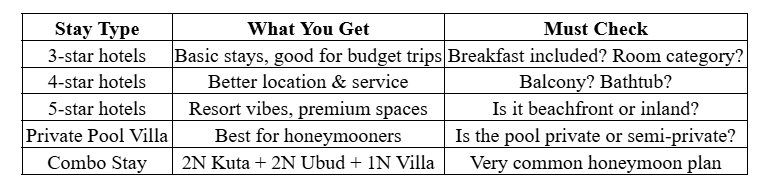
A. Hotels & Private Pool Villas

Standard inclusion in all packages:

Screenshot 2025 11 29 000002

Most couples choose 3 nights in Ubud (nature vibes) + 2 nights in Seminyak (beach & cafes) + 1-2 nights private villa.

Expert Tip:

Some companies put “villa” in the package but actually give a plunge pool, not a full private pool.
Always ask for actual photos or hotel link.

B. Meals (Breakfast)

lBreakfast is always included in any Bali hotel package.

What is NOT included:

  • Lunch
  • Dinner
  • Candle-light dinner (only in special honeymoon packages)

Food in Bali is not expensive, but couples should plan around INR 1200–2000 per day for food (for both people together) depending on their eating habits.

C. Airport Transfers (Pickup + Drop)

A genuine Bali honeymoon package always includes:

  • Pickup from Denpasar Airport
  • Drop on last day

Vehicles used: Toyota Avanza or similar.

Important:

Some budget packages use shared transfers. Avoid this — honeymoon means privacy.

D. Daily Sightseeing with Private Car

This is one of the biggest reasons Indian couples love Bali.

A private car + driver is included for the entire day.

What you get:

  • AC car
  • Driver
  • Fuel
  • 8–10 hours of service

Places covered:

  • Ubud day tour
  • Kintamani volcano
  • Tanah Lot Temple
  • Monkey Forest
  • Waterfalls like Tegenungan
  • Bali Swing
  • Rice Terrace
  • Nusa Penida day trip (by boat)

Private car means you travel at your own pace — not like a group tour where everything is rushed.

E. Sightseeing Tickets (Selective)

This is where most confusion happens.

Some tickets are included, some are not.

Common tickets that are usually included:

  • Tegenungan Waterfall
  • Bali Swing basic package
  • Tanah Lot Temple
  • Tegenungan Entrance
  • Uluwatu Temple (entry only)
  • Kintamani view
  • Rice Terrace

Tickets that are NOT included (usually):

  • Uluwatu Kecak Fire Dance show
  • Bali Swing premium package
  • Water sports at Nusa Dua
  • Snorkelling at Nusa Penida
  • Mount Batur trek
  • Atv Ride
  • Candle-light dinners
  • Spa package

Companies keep the price low by removing these premium experiences.

F. Water Sports (Depends on package)

Some honeymoon packages include:

  • Jet ski
  • Banana boat
  • Parasailing (NOT the adventure one, the basic one)

But these are usually add-ons.

G. Nusa Penida Trip (Optional / Add-On)

This is one of the most beautiful places in Bali, and most Indian honeymooners want to visit.

Nusa Penida can be:

  • Included
  • Add-on
  • or Not given in basic packages

If included, the package usually covers:

  • Return fast boat
  • Car at Nusa Penida
  • Lunch
  • Kelingking Beach viewpoint
  • Crystal Bay

H. Travel Insurance

Some good companies include this.
Budget companies skip it.

Insurance cost is small (approx INR 600–1000 per person), but extremely important.

I. Honeymoon Inclusions (Only in Premium Packages)

These may include:

  • Flower decoration in villa
  • Candle-light dinner
  • Floating breakfast
  • Flower bath
  • Spa session for couple

Most ads show these experiences, but the basic package does NOT include them.
You must check this specifically.

3. What’s NOT Included in Most Bali Honeymoon Packages (HIDDEN COSTS)

Now let’s talk about the things companies often avoid mentioning because these create extra costs later.

A. Flight Tickets from India

Most packages you see online are land packages.
Meaning: they don’t include flights.

Why flights are excluded:

  • Prices keep changing
  • Different cities have different fares
  • Couples prefer flexible dates

Approx return fare:

  • From Delhi: 28,000–45,000 per person
  • From Mumbai: 22,000–38,000
  • From Ahmedabad: 26,000–40,000
  • From Bangalore/Chennai: 20,000–36,000

B. Visa Fees

Bali visa for Indians:

  • Free for stays under 30 days
  • No documentation
  • Done on arrival

But some couples choose the Paid Visa (VoA) for faster entry.
Cost: INR 2500 approx.

C. Lunch & Dinner Expenses

As mentioned earlier, food for couples can cost around:

  • Budget eating: INR 1200/day
  • Comfortable eating: INR 2000–3000/day
  • Luxury cafés & beach clubs: depends on your choices

D. Additional Sightseeing Tickets

These include:

  • Bali Safari
  • West Nusa Penida Snorkelling
  • Gate of Heaven (Lempuyang Temple) shuttle van
  • Premium swings
  • Handara Gate
  • Waterfall hikes

These are not covered unless specifically mentioned.

E. Tips & Driver Charges

Bali drivers don’t demand tips, but it’s a courtesy:

  • 20,000–50,000 IDR per day (INR 120–300)

Not compulsory, but appreciated.

F. Personal Expenses

These include:

  • Shopping
  • Extra snacks
  • Mineral water (not free in many hotels)
  • Room service
  • Early check in

4. How to Compare Two Bali Honeymoon Packages (THE TRUTH)

I’ve seen this mistake hundreds of times:

Couples compare only the package price.
But the real comparison should be based on what’s inside.

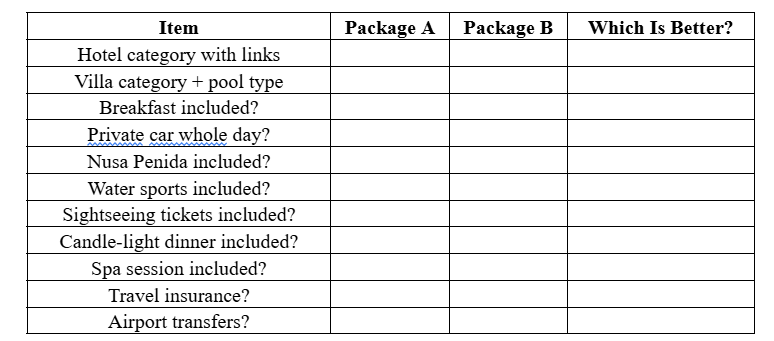
Here’s a simple comparison table you can use:

Compare Packages Using This Checklist

Screenshot 2025 11 29 002114

If Package 1 is cheap but 40% of the items are missing, then you will easily spend INR 20,000–30,000 extra in Bali.

So a higher upfront price may actually be cheaper overall.

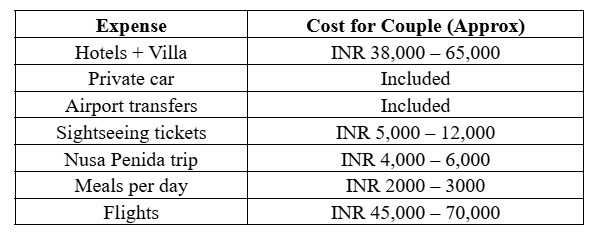
5. Honest Cost Breakdown: How Much a Bali Honeymoon Actually Costs for Indian Couples

After planning so many trips, here is the realistic cost.

A. 5-Night Honeymoon Trip (Standard)

Screenshot 2025 11 29 002417

Total: INR 90,000 – 1.4 Lakh (realistic)

This is for a comfortable, non-compromised trip.

B. 6-Night Premium Honeymoon Trip (Villa + Spa + Romantic Experiences)

Screenshot 2025 11 29 002713

Total: INR 1.4 Lakh – 2 Lakh

Most premium honeymooners fall in this range.

6. Must-Ask Questions Before Booking Any Bali Honeymoon Package

These questions will save you from 90% problems:

A. Hotel Related

  • Which hotel category?
  • Exact room category?
  • Villa pool: private or shared?

B. Car & Driver

  • Is it private or shared?
  • Full-day or half-day?

C. Experiences

  • Does it include candle-light dinner?
  • Does it include Bali Swing premium?
  • Any beach club entry?

D. Hidden Charges

  • Any sightseeing entry not included?
  • Any early check-in fee?
  • Does the driver charge extra for waiting?

E. Authenticity

  • Is the company providing hotel links?
  • Are they giving day-wise itinerary?
  • Are they mentioning inclusions in writing?

7. Final Advice: How to Choose the Right Bali Honeymoon Package

If you want an honest recommendation based on years of experience:

Choose a package that includes:

  • Good 4-star hotel
  • Minimum 1 night private pool villa
  • Daily private car
  • Nusa Penida trip
  • Breakfast
  • Airport transfers
  • Insurance

And make sure the company gives you:

  • Hotel links
  • Actual itinerary
  • Transparent exclusions
  • Clear payment terms

This is the ideal setup for a peaceful, romantic, and problem-free honeymoon.

Conclusion

Bali is one of those destinations that can be luxurious, budget-friendly, peaceful, romantic, and adventurous — all at the same time. But the only way to enjoy it properly is to understand what you’re paying for.

A transparent package helps you:

  • Avoid unexpected costs
  • Get the right villa
  • Enjoy private transfers
  • Experience Bali the way it’s meant to be

Now that you know what’s included and what’s not, you can easily compare packages and choose the right one for your honeymoon.

kashmir

10 Most Romantic Things to Do in Bali for Couples (with Hidden Spots)

For many Indian couples, Bali feels like that one dream destination which you keep seeing on Instagram and travel reels and think, “One day, we will go here.” And when the honeymoon planning starts, Bali suddenly becomes real. The idea of your first international trip together, staying in a private pool villa, watching a sunset without worrying about budgets—these thoughts are enough to melt away all the overthinking.

Bali has that warm, magical charm. The air feels slower, the colours feel deeper, and the entire island gives you these small moments that stay with you even after the trip ends—sunset walks, candlelight dinners on the beach, waterfalls hidden between cliffs, and long rides through green rice terraces.

If you want a honeymoon destination that feels romantic, peaceful, and still friendly for your budget, Bali fits perfectly.

Planning your Bali honeymoon? Get a personalized India-to-Bali package.

Why Bali is the Most Romantic Destination for Indian Couples

When you look at romantic things to do in Bali for couples, one thing becomes clear—Bali knows how to treat newlyweds. It mixes luxury, nature, privacy, and affordability in a way that very few destinations can.

Emotional Reasons Why Couples Love Bali

  • It gives you privacy—villas, beaches, sunsets, forest walks.
  • The hospitality is warm and personal.
  • Luxury doesn’t feel expensive here.
  • The overall vibe is slow, peaceful, and very couple-friendly.

Practical Reasons for Indian Travellers

  • Visa-free entry for Indian passport holders.
  • Easy flights from major cities like Mumbai, Delhi, Ahmedabad, Bengaluru.
  • Indian food available everywhere.
  • Great options for both budget and premium travellers.

Couple-Friendly Bali Features

  • Private pool villas
  • Floating breakfasts
  • Cliffside sunset points
  • Beach clubs with romantic seating
  • Tons of photoshoot locations

Download Free 6-Day Bali Honeymoon Itinerary (PDF).

1. Seminyak Sunset at Double Six Beach (Couples’ Favorite)

If you ask any couple returning from Bali which sunset they loved the most, chances are they will say Double Six Beach. It’s one of those places where the sky turns cotton-candy pink and orange, and the whole beach lights up with bean bags, lanterns, and soft live music.

You sit together on colourful bean bags, order a chilled drink or coconut, listen to acoustic music, and watch the sky change colours. It feels cinematic but comforting at the same time.

Why Couples Love This Sunset

  • Peaceful and open beachfront
  • Perfect for long romantic walks
  • Great for photos without crowds behind you
  • Soft music and cosy seating everywhere

Hidden Gem Tip

Walk towards the quieter area near La Plancha. The crowd becomes thinner, and the colours look even more dramatic.

2. Candlelight Dinner on Jimbaran Beach

If you imagine a perfect honeymoon dinner—candles, soft waves, and a table set right on the sand—Jimbaran Beach is exactly that. The restaurants here arrange rows of candle-lit tables on the beach, and as the sun sets, everything turns golden. The sound of the waves almost syncs with the soft conversations around you.

The food options are very Indian-friendly. You get seafood, vegetarian plates, grilled corn, rice bowls, and fresh juices.

Candlelight Dinner Pricing

Candlelight Dinner Pricing

This experience feels premium without being overly expensive, which is why Indian newlyweds love it.

3. Stay in a Private Pool Villa in Ubud (Ultimate Romance)

If there is one thing that makes Bali a honeymoon paradise, it’s the private pool villas, especially in Ubud. Waking up to misty mornings, hearing light rain on the roof, eating floating breakfast together—it all feels like a movie, but you’re living inside it.

Ubud villas offer privacy, forest views, and slow mornings where you don’t have to rush for sightseeing.

Hidden Spots in Ubud

For real privacy, look for villas in:

  • Tegallalang
  • Sebatu
  • Kelusa

These areas have lush forests and peaceful surroundings.

Recommended Villa Types for Couples

(General categories—no brand claims)

  • Jungle-view villas with infinity pools
  • Rice terrace–facing villas
  • Glass-wall villas with floating breakfasts

These give you the perfect mix of romance, privacy, and scenic views.

4. Bali Swing Photoshoot – Capture Your Love Story

Bali swings have become iconic for couples. You sit on a giant swing, fly over the forests, and get those dramatic photos that become your favourite honeymoon memories. Most swings offer packages that include a photographer, so you don’t have to ask strangers for photos.

Why Couples Love Bali Swing

  • Instagrammable backgrounds
  • Professional photographers available
  • Dress rental options (flowy gowns look stunning)
  • Easy to reach, mostly near Ubud

Best Time to Go

Reach before 9 AM to avoid queues and harsh sunlight.

5. Romantic Spa Experience – Balinese Couple Massage

Balinese spas are something you shouldn’t skip. The massage culture here is traditional, relaxing, and deeply rooted in Balinese healing methods. As a couple, it becomes a bonding experience where both of you can switch off from the world.

Most spas offer private couple rooms with flower baths, aroma oils, and herbal treatments.

Hidden Spa Recommendation

Choose a spa with:

  • Rice-terrace views
  • Open-air couple rooms
  • Herbal bath add-ons

Prices usually start from ₹2,500–₹4,000 per couple, depending on the area.

6. Uluwatu Sunset + Kecak Fire Show (Most Magical Evening Experience)

Uluwatu Temple sits on a tall cliff overlooking the ocean. When the sun sets here, the whole sky opens wide, and the view feels endless. Right after sunset, the famous Kecak Fire Dance begins. It’s a mix of chanting, rhythm, and storytelling—something you don’t see anywhere else.

Why It Feels Magical

  • The temple’s cliffside location
  • The dramatic sky colours
  • A traditional fire show that feels immersive
  • The breeze and sound of the waves below

Hidden Tip

Book VIP seats. You sit closer, avoid the crowd, and get a better view for photos.

7. Nusa Penida Day Trip – Explore Bali’s Most Instagrammable Island

If you want a mix of beauty and adventure, Nusa Penida is perfect. The island has dramatic cliffs, turquoise waters, and beaches that look unreal.

Top Spots to Visit

  • Kelingking Beach
  • Broken Beach
  • Angel’s Billabong
  • Crystal Bay

Why Couples Love Nusa Penida

  • Adventure + scenic beauty
  • Great for photos and videos
  • A full-day escape from crowds

Travel Time

  • 45–50 minutes by speedboat from Sanur
  • Most tours include car + guide + lunch

8. Trek to Sekumpul Waterfall – A Hidden Natural Paradise

If you want to see the real raw beauty of Bali, Sekumpul Waterfall will stay in your heart forever. It’s tall, dramatic, and surrounded by thick green forest. When the mist touches your face and the sound echoes around you, it feels like you’ve discovered your own little world.

Why It’s Special for Couples

  • Peaceful and less crowded
  • Beautiful for nature lovers
  • Romantic spot for quiet moments

Safety Tips

  • Wear sports shoes
  • The trail has steps
  • Hire a local guide (₹800–₹1,200 approx)

9. Romantic Yacht or Sunset Cruise Experience

A sunset cruise is one of the most premium feeling experiences in Bali. You board a yacht or cruise, enjoy live music, light snacks, and watch the sun set over the ocean. Some cruises also include a romantic dinner.

What’s Included

  • Soft music
  • Dinner or snacks
  • Sunset deck
  • Photographer (in some packages)

Why Couples Choose It

You get that luxury feeling without extreme costs. Booking in advance is recommended during honeymoon season.

10. Explore the Hidden Beaches of Uluwatu

Uluwatu has some of the most peaceful and photogenic beaches in Bali. Many of them require a small walk down the cliff stairs, but the views are completely worth it.

Best Hidden Beaches for Couples

  • Balangan Beach
  • Nyang Nyang Beach
  • Padang-Padang Beach

Tips

  • Wear sandals
  • Carry water
  • Go in the morning for clear water and fewer crowds

Build Your Personalized Bali Honeymoon Itinerary (Free Consultation)

If you want a honeymoon that fits your mood, style, dates, and budget, the best way is to customize your itinerary. Every couple has a different travel style—some love adventure, some prefer slow mornings, some want luxury stays, and some want the best things within a balanced budget.

We help you design everything from flights to villa selection to daily sightseeing plans.

Strong CTAs

  • Plan My Bali Honeymoon
  • Get Custom Pricing for India-to-Bali Package
  • Download Free 6 & 7-Day Bali Honeymoon Itinerary

FAQs

1. Is Bali a good honeymoon destination for Indian couples?

Yes, Bali is one of the best honeymoon destinations for Indian couples because it offers privacy, luxury villas, romantic beaches, easy food options, and affordable packages.

A 6- to 7-day trip is perfect for covering beaches, temples, Ubud, a private villa stay, and a Nusa Penida tour without rushing.

Seminyak is best for nightlife and sunsets, Nusa Dua for luxury resorts, and Ubud for nature, villas, and privacy.

Bali swings, rice terraces, and Nusa Penida viewpoints are top picks. Couples also love Uluwatu cliff spots during sunset.

A Bali honeymoon typically costs ₹75,000 to ₹1,50,000 per person depending on villa type, season, flights, and activities.

Why Indian Couples Are Choosing Bali for Their Honeymoon in 2026

Why Indian Couples Are Choosing Bali Over Maldives for Their Honeymoon — Real Costs, Best Areas, and What Nobody Tells You

So you’re newly married, the wedding madness is finally behind you, and now the question everybody’s asking is — where are you going for your honeymoon?

You open Instagram. Maldives overwater villas flood your feed. 

Then a Bali swing video pops up. 

Then a private pool villa with a floating breakfast. 

Your partner sends you a screenshot. 

You send one back. 

And now you’re both in a loop of comparison, confusion, and everyone has an opinion.

Most couples we’ve spoken to get stuck at exactly this point. 

Not because Bali isn’t good — it’s because nobody gives them a straight, honest answer about what Bali actually is for Indian honeymooners in 2026.

So here it is.

What Bali Actually Feels Like When You Land

The first thing couples notice when they step out of Ngurah Rai Airport in Denpasar is that Bali doesn’t feel like a tourist trap. 

It feels like a place that has its own rhythm. 

Lush green trees line the roads. Drivers are calm. 

The air — especially heading towards Ubud — gets noticeably cooler.

There’s no rush here. No endless queue for the “main attraction.

” In Bali, the destination itself is the experience. 

Rice terraces in Ubud at 7 AM when the mist hasn’t lifted. 

A private pool that’s yours for the entire stay. 

Clifftop sunsets at Uluwatu where you don’t need to do anything except sit there and feel something.

This is what couples come back and talk about — not a specific activity, but a feeling. 

That slow, almost meditative pace that hits you by Day 2 and makes you wonder why you ever thought you needed a louder destination.

The Real Reason Indian Couples Are Switching from Maldives to Bali

An honest comparison of what you actually get for your money.

What You WantMaldivesBali
Private pool villa₹25,000–₹80,000/night₹8,000–₹20,000/night
Things to do beyond the resortAlmost nothingUbud, Uluwatu, Canggu, Seminyak, waterfalls, temples, adventure
Indian/vegetarian foodVery limitedEasily available: Queen's Tandoor, Spice Mantra, and hundreds of veg cafés
Visa processE-visa requiredVisa on Arrival at the airport, no pre-approval
Total 7-night budget per couple₹4.5L–₹7L+₹1.5L–₹2.8L
Flights from India5–6 hrs, pricier7–10 hrs via KL/Singapore, ₹22,000–₹40,000 return

Private pool villa

Maldives
₹25,000–₹80,000/night
Bali
₹8,000–₹20,000/night

Things to do beyond the resort

Maldives
Almost nothing
Bali
Ubud, Uluwatu, Canggu, Seminyak, waterfalls, temples, adventure

Indian/vegetarian food

Maldives
Very limited
Bali
Easily available: Queen's Tandoor, Spice Mantra, and hundreds of veg cafés

Visa process

Maldives
E-visa required
Bali
Visa on Arrival at the airport, no pre-approval

Total 7-night budget per couple

Maldives
₹4.5L–₹7L+
Bali
₹1.5L–₹2.8L

Flights from India

Maldives
5–6 hrs, pricier
Bali
7–10 hrs via KL/Singapore, ₹22,000–₹40,000 return
Reality CheckMaldives is unmatched for overwater villas and turquoise lagoons, but most of the experience stays within the resort. Bali combines private pool villas with temples, waterfalls, cafés, beaches, nightlife, and adventure, giving couples far more variety for a significantly lower overall budget.

Where to Stay — The Areas That Matter for Honeymooners

One of the most common mistakes we see Indian couples make is treating Bali as one destination. 

It’s not. 

Ubud, Seminyak, Uluwatu, and Canggu are four completely different experiences. 

Most couples who do 7 nights ideally split between two areas.

Ubud — for the couples who want to feel deeply away from everything

This is the cultural and spiritual heart of Bali. 

Rice terraces, jungle sounds, morning mist, and complete privacy. 

Couples who stay in Ubud almost universally say they didn’t expect to love it as much as they did.

Where to stay in Ubud: Amora Ubud has private pool villas with jungle valley views starting around ₹12,000–₹18,000 per night. 

Viceroy Bali is the premium pick if budget allows — perched above the Valley of the Kings, with villas from ₹22,000–₹40,000 per night. 

For something intimate and affordable, Aria Villas Ubud and Asvara Villa Ubud offer private pools from ₹8,000–₹12,000 per night.

The Campuhan Ridge Walk is 15 minutes from most Ubud villas — go before 7:30 AM. 

After 9 AM, tour groups arrive and the trail gets busy. 

In the early morning, it’s just the two of you, green hills, and silence.

Seminyak — for couples who want beach + nightlife + good food

Seminyak is stylish. 

Beach clubs, rooftop bars, excellent restaurants, and beaches that are actually swimmable. 

If your partner loves the beach and you want a combination of resort life and stepping out for dinner at a proper restaurant, Seminyak makes sense.

Where to stay: W Bali Seminyak for a luxury beach experience. 

Uma Sapna in Seminyak for a private pool villa feel. 

Aksari Villa Seminyak offers a private pool close to the beach at around ₹10,000–₹14,000 per night.

Uluwatu — for dramatic sunsets and clifftop experiences

The Uluwatu temple at sunset is one of those things you see in photos and think it’s edited. 

It’s not.

The cliffs here are real, the sunset views are real, and the Rock Bar at AYANA Resort — accessed by a cable car down to the cliff edge — is one of the most genuinely spectacular places to have a drink in the world.

If you want the most “Bali postcard” experience, two nights in Uluwatu is worth it.

Canggu — for the modern couple who likes cool cafés and a relaxed surf vibe

Canggu has become one of Bali’s most popular areas for younger couples. 

Think good brunch spots, vintage shops, creative cafés, and a laid-back beach energy. 

It’s not traditional Bali, but it’s a lot of fun if that’s what you’re after.

🎁 FREE BALI HONEYMOON PLAN

Want a Ready-Made 7-Night Bali Honeymoon Plan?

Planning your honeymoon does not have to mean spending days comparing villas, routes, and budgets. Our team has planned 200+ Bali honeymoons for Indian couples and knows what works. Simply share your travel dates and budget on WhatsApp, and we'll send you a personalised 7-night Bali honeymoon itinerary with the best areas to stay, villa recommendations, and realistic costs in INR. Delivered within 24 hours, completely free, with no obligation.

🗓️

7-Night Honeymoon Plan

A complete day-by-day itinerary designed around your travel dates.

🏡

Villa Recommendations

Discover the best villa options for your honeymoon budget and travel style.

💰

Real Costs in INR

See realistic pricing for accommodation, transport, and experiences before you book.

📲

Delivered in 24 Hours

Your customised Bali honeymoon plan arrives on WhatsApp, free of charge.

The Food Question — What Indian Couples Actually Worry About

One thing couples almost never admit in public but tell us in private: “We’re worried about the food.” Especially if one partner is vegetarian or if you’re not adventurous eaters.

Bali is one of the most vegetarian-friendly international destinations you can go to. 

This isn’t marketing — it’s just how the island is.

Indian restaurants in Bali: Queen’s Tandoor is the most well-known — with multiple locations in Seminyak, Kuta, Nusa Dua, and Ubud. 

They serve butter chicken, paneer tikka, fresh naan, and dal that actually tastes like home. 

Spice Mantraa in Seminyak is a step up — more upscale, Indian fine dining with creative vegetarian options and a great setting.

Balinese food that’s naturally vegetarian: Gado-Gado (steamed vegetables with peanut sauce), Nasi Goreng (fried rice — ask for it without meat), Mie Goreng (fried noodles, easily made vegetarian), Tempeh and Tofu dishes. 

These are available at local warungs for ₹200–₹600 per meal — absurdly affordable.

Ubud in particular has dozens of dedicated vegan and vegetarian cafés. 

The Kafe in Ubud and Sage are both excellent. 

And since most villas include breakfast, the morning is already sorted.

Budget for food: ₹1,500–₹2,500 per day for two people, depending on where you eat. 

If you eat at Indian restaurants daily, budget up to ₹3,000/day.

A Sample 6-Night Bali Honeymoon Itinerary (How We Plan It)

Day 1 — Arrive, Settle, Don’t Plan Too Much Land at Ngurah Rai Airport. 

Visa on Arrival takes 20–35 minutes. 

Private airport transfer to Ubud (around 1.5 hours). 

Check into your villa. 

That’s it. 

Order floating breakfast for tomorrow morning.

Day 2 — Ubud at Your Own Pace Campuhan Ridge Walk before 7:30 AM — quiet, magical. 

Late breakfast at Locavore Jr. 

or Sari Organik café (rice field views). 

Afternoon: Tegallalang Rice Terrace (15 minutes from Ubud central). 

Evening: Ubud night market for local bites.

Day 3 — Waterfalls + Spa Morning: Tegenungan Waterfall (one of Bali’s most accessible — no trek required, just stairs). 

Afternoon: In-villa spa treatment. 

Balinese massage for two is ₹1,500–₹3,000 at most villas. 

Evening: Candlelight dinner at your villa — ask the villa manager to arrange it. 

Most villas do this for ₹2,000–₹4,000.

Day 4 — Move to Seminyak or Uluwatu Check out from Ubud after a slow morning. 

Drive to your next base.

If heading to Seminyak: check into villa, walk to the beach, watch the sunset from the shoreline. 

If Uluwatu: visit the clifftop temple for the Kecak fire dance at 6 PM (book in advance — ₹500–₹700/person).

Day 5 — Beach Day + Rock Bar Morning at the beach or pool. Afternoon at a beach club — Potato Head in Seminyak or Finns Beach Club in Canggu. Evening: Rock Bar at AYANA Uluwatu if you’re in that area. This is genuinely one of the best sunset experiences in Bali.

Day 6 — Jimbaran Candlelight Beach Dinner Jimbaran beach in the evening is famous for seafood dinners right on the sand. Tables are set on the beach. Lanterns light up the shoreline. The waves are a few feet away. Budget ₹3,000–₹6,000 per couple for the full dinner experience. Go after 6:30 PM.

Budget Breakdown: What a Bali Honeymoon Actually Costs from India

A realistic 7-night budget for Indian couples, including flights.

Budget Style7 Nights Per Couple (incl. Flights)What You Get
Budget₹90,000–₹1,30,0003-star villa or resort, local meals, shared transport, basic experiences
Mid-Range₹1,50,000–₹2,20,000Private pool villa, breakfast daily, 5–6 experiences, some Indian restaurant meals
Comfortable Luxury₹2,20,000–₹3,20,000Boutique villa with pool (Amora, Viceroy-range), candlelight dinners, spa days, private driver
Full Luxury₹3,50,000+Viceroy Bali, Capella Ubud, AYANA, full private service

Budget

Budget
₹90,000–₹1,30,000
What's Included
3-star villa or resort, local meals, shared transport, basic experiences

Mid-Range

Budget
₹1,50,000–₹2,20,000
What's Included
Private pool villa, breakfast daily, 5–6 experiences, some Indian restaurant meals

Comfortable Luxury

Budget
₹2,20,000–₹3,20,000
What's Included
Boutique villa with pool (Amora, Viceroy-range), candlelight dinners, spa days, private driver

Full Luxury

Budget
₹3,50,000+
What's Included
Viceroy Bali, Capella Ubud, AYANA, full private service
Important Costs to Remember Flights: IndiGo and AirAsia usually offer the best-value connecting flights from Delhi, Mumbai, Bengaluru, and Hyderabad. Return fares generally range from ₹18,000–₹40,000 per person when booked 6–8 weeks in advance.

Visa: Bali Visa on Arrival costs IDR 500,000 (about ₹2,700) per person and requires no pre-approval.

Tourist Levy: IDR 150,000 (about ₹800) per person, paid separately online or after arrival.
🎁 FREE BALI HONEYMOON PLANNER

Planning a Bali Honeymoon? Get a Ready-Made Plan on WhatsApp

Planning a Bali honeymoon from India can easily take 20 to 30 hours of research, from comparing villas and flight routes to choosing the right areas and deciding which experiences are genuinely worth the money. Our team has planned Bali honeymoons for hundreds of Indian couples. Simply share your travel dates, approximate budget, and what you are looking for on WhatsApp, and we will prepare a personalised honeymoon plan with recommended stays, routing, and estimated costs. Delivered within 24 hours, completely free.

🗺️

Custom Route

Get a day-by-day honeymoon itinerary designed around your travel dates and preferences.

🏡

Best Villas

Receive handpicked villa recommendations that match your budget and honeymoon style.

💸

Smart Spending

Know where it is worth spending more and where you can save without compromising the experience.

📲

Ready in 24 Hours

Your personalised Bali honeymoon plan is delivered directly to WhatsApp, free of charge.

What Nobody Tells You — The Real Tips for Indian Couples

The visa situation changed slightly in 2026. 

Indonesia still offers Visa on Arrival for Indian passport holders — no pre-approval, no embassy. 

But Bali now also charges a tourist levy of IDR 150,000 (~₹800) per person. 

You can pay it online before flying or at the airport.

Book your villa with a private pool. Not just “pool access” — a private pool. 

The difference matters enormously on a honeymoon. 

Most mid-range villas in Ubud and Seminyak with private pools are ₹8,000–₹18,000 per night. 

This is the one thing couples always say they’re glad they spent on.

Don’t try to see too much. The couples who come back most satisfied are the ones who picked 2 areas, not 5. 

Bali is best when you’re not rushing between places every day.

Grab app works beautifully. Ola isn’t available in Bali, but Grab is — and it’s reliable for short trips. 

For longer drives between areas (Ubud to Seminyak, etc.), a private driver for the day costs around ₹2,000–₹3,500 and is far more comfortable.

Best time to go: April, May, June, and September are the sweet spot — dry weather, lower crowds than July–August, and slightly better villa rates. 

July and August are peak season — still great, but prices go up 20–30%.

What Couples We’ve Sent to Bali Actually Say

“We went in March and honestly didn’t expect Bali to be this different from what we’d imagined. 

The villa in Ubud had a pool looking out at the jungle. 

We sat there on the first morning and didn’t move for two hours. 

That was the honeymoon right there.” — Priya & Rohit, Pune — March 2026

“We were comparing Maldives vs Bali for almost two months. 

The decision to go to Bali was the best thing we did. 

We got to do so many different things — the waterfall, Uluwatu sunset, Jimbaran dinner, the spa — and it still cost us less than a basic Maldives package would have.

— Deepika & Arjun, Delhi — January 2026

Bali Honeymoon FAQ

Frequently Asked Questions

Responsive Elementor-ready FAQ component with embedded CSS.

1. Is Bali safe for Indian honeymoon couples?

Yes. Bali is one of Southeast Asia's safest destinations for couples. Tourist areas like Ubud, Seminyak, Uluwatu, and Nusa Dua are well developed. Use normal precautions and licensed transport such as Grab.

2. Is Bali better than Maldives for Indian couples?

Maldives excels in privacy and overwater villas, while Bali offers more activities, culture, and value. Bali is generally the better choice for variety and budget.

3. What is the visa process for Bali in 2026?

Indian travelers can obtain a Visa on Arrival and must also pay the separate Bali Tourist Levy. Carry a passport valid for at least six months and a return ticket.

4. How much does a Bali honeymoon cost?

A comfortable 7-night honeymoon usually costs ₹1.5 lakh to ₹2.2 lakh per couple including flights. Luxury trips cost more, while budget trips are also possible.

5. Is vegetarian and Indian food available?

Yes. Bali has many Indian restaurants and vegetarian cafés, especially in Ubud and Seminyak.

6. Where should couples stay?

A split stay between Ubud and Seminyak or Uluwatu gives the best honeymoon experience.

7. What are the best romantic hotels?

Popular choices include Viceroy Bali, AYANA Resort, W Bali, Amora Ubud, and Asvara Villa.

8. When is the best time to visit?

April, May, June, and September offer the best combination of weather, crowds, and pricing.

9. What are the most romantic experiences?

Sunrise walks, floating breakfasts, Uluwatu sunsets, beach dinners, couples' spas, and Bali swings are favorites.

10. Is the Bali Swing worth it?

Yes. It is a popular photography and sightseeing experience, especially when combined with Tegallalang Rice Terrace.

11. Should we hire a private driver?

Yes. Private drivers are the most convenient way to explore Bali beyond short local trips.

12. How many days are ideal?

Six to eight nights is recommended, with seven nights being the most popular choice.

13. How long is the flight?

Flights from India generally take 8 to 11 hours with one stop. Some direct services operate from Delhi.

14. Can we honeymoon under ₹1 lakh?

It is possible during the off-season with careful planning, but ₹1.5 lakh to ₹2 lakh provides a much more comfortable experience.

15. Is Bali good for a first international honeymoon?

Yes. The easy visa process, Indian food, friendly locals, and simple logistics make Bali an excellent first international honeymoon destination.

Best Months for a Bali Honeymoon for Indian Couples - 1 - Edited

“Best Time to Visit Bali for Honeymoon from India — Month-by-Month Guide (2026)”

The best time to visit Bali for a honeymoon is May or September — and if you’re an Indian couple with some flexibility in your dates, those two months will give you the best combination of weather, price, and experience.

That said, the “best month” question is actually three different questions rolled into one. 

Weather has its own answer. Pricing has a different answer. 

And crowd levels have another. 

Most guides just say “dry season is best” and leave it there. 

That’s not wrong, but it’s not the whole picture either.

We’ve sent 500+ Indian couples to Bali across every month of the year. 

This guide gives you the honest, month-by-month breakdown — real weather, real INR prices for flights and villas, real crowd levels — so you can pick the month that actually works for your honeymoon, not just the one that sounds best on paper.

Best Time to Visit Bali for Honeymoon — Quick Answer

The best time to visit Bali for a honeymoon is May or September. 

Both months give you dry weather, fewer crowds, and prices 15–25% cheaper than peak July–August. 

If you want festivals and culture, go in June (Galungan). If you’re on a tight budget, November is the cheapest but expect afternoon rain. 

Avoid December — it’s the most expensive month with the worst weather combination.

May and September are the best months to visit Bali for a honeymoon. 

Both fall in Bali’s dry season, which runs April through October. 

May gives you settled dry weather with shoulder-season prices — flights from India typically run ₹26,000–₹36,000 per couple return, and villa rates are 15–20% lower than July–August peaks. 

September is nearly identical in weather but comes after peak season, so crowds drop further and prices ease even more.

If your wedding date falls outside these months, June and October are strong second choices. 

June brings the Galungan festival (June 17–27, 2026) — bamboo penjor poles lining every road and temple ceremonies you won’t see anywhere else. 

October has September-level weather in the first three weeks before rain starts creeping back in.

July and August have the best weather of the year but the highest costs and biggest crowds. 

November through March is wet season — workable for villa-and-spa focused honeymoons, but not ideal for beach days and outdoor photography.

May is the best overall month for a Bali honeymoon. 

The dry season is fully settled, humidity sits at a comfortable 26–29°C, crowds are well below the July–August peak, and villa prices run 15–20% cheaper than peak season — typically ₹14,000–₹18,000 per night for a private pool villa. 

If you can choose any month freely, May is the answer.

September is the top recommendation for most Indian couples visiting Bali for a honeymoon. 

The weather stays dry and clear (almost identical to July–August), but peak-season crowds have cleared and prices drop 15–25% from August levels. 

Flights from India to Bali in September typically run ₹26,000–₹38,000 per couple return — noticeably cheaper than the summer peak. 

It’s the closest thing to perfect timing that Bali offers.

When Should You Visit?

Your Priority Best Month
Perfect weather + fewer crowds May or September
Best value overall May
Romantic sunsets + beach August
Festivals + culture June
Lowest budget November
Avoid at all costs December

Perfect weather + fewer crowds

Best Month May or September

Best value overall

Best Month May

Romantic sunsets + beach

Best Month August

Festivals + culture

Best Month June

Lowest budget

Best Month November

Avoid at all costs

Best Month December
Free Bali Honeymoon Guide

Not Sure Which Month Works for Your Wedding Date and Budget?

Choosing the right month for a Bali honeymoon affects villa availability, pricing, weather, and the experiences you can enjoy. We plan Bali honeymoons for Indian couples every week and help match travel dates with the right options.

Share your travel month and budget on WhatsApp. We will tell you what to expect for your dates — villa options, realistic costs, and the one thing you should book in advance before availability changes.

Month-Wise Planning Villa Options Realistic Cost Guide Booking Priority Tips

Best Time to Visit Bali for Honeymoon (Month-by-Month Overview)

The best time to visit Bali for a honeymoon is during the dry season, which runs from April to October. Within that window, May and September stand out as the top choices — the weather is excellent, tourist numbers are manageable, and prices are significantly lower than the July–August peak.

Here’s a simple overview before we go deeper:

  • April–June: Dry season begins. April is a hidden gem — rain clears by mid-month, crowds are low. May is the best single month overall. June brings the Galungan festival.
  • July–August: Perfect weather but maximum crowds and highest costs. Budget ₹22,000–₹30,000/night for villas.
  • September–October: Post-peak sweet spot. Weather holds, prices drop, crowds thin. Best value of the dry season.
  • November–March: Wet season. Afternoon showers, lowest prices. Good for villa-and-spa honeymoons, not ideal for beach or photography.

If you’re planning from India, May and September also tend to have better flight availability and more reasonable airfare compared to July–August.

July — Best Weather, Highest Price, Most Crowded

July is Bali’s absolute peak season. European and Australian school holidays drive a surge of international tourists. 

The weather is perfect — clear blue skies every day, low humidity, ideal for every outdoor activity.

But popular places pay for that: Tegallalang Rice Terrace by 9 AM is a crowd; Uluwatu at sunset is a full-capacity experience.

Villas in July are significantly more expensive. Properties that cost ₹14,000/night in April hit ₹22,000–₹30,000 in July. 

Flight prices from India spike to ₹38,000–₹55,000 per couple return. 

Good villas — especially those with private pools in Ubud or beachfront locations in Nusa Dua — book out months in advance.

If July is your only option because of your wedding month, book everything at least 4–5 months ahead. Morning timing at all popular spots is non-negotiable: 

Campuhan Ridge Walk before 7 AM, Tegallalang before 7:30 AM, Tanah Lot an hour before sunset to secure a good position.

Good for: Couples for whom only July works and who’ve booked well in advance
Avoid if: You are price-sensitive or dislike crowds

August — Best Sunsets, Peak Crowds Continue

August shares July’s crowd levels and pricing. 

What August adds, uniquely, is Bali’s most dramatic sunset season. 

The dust particles in the dry air during August create a specific atmospheric effect that turns Bali sunsets deep orange-red — the kind of sunset that makes Uluwatu temple silhouettes look like movie shots.

Couples who specifically want those sunset photos book August deliberately. 

It’s worth it if you accept the trade-off: higher costs, crowds everywhere, and the need to be strategic about timings.

A useful tip from our experience: the Jimbaran Bay candlelit seafood dinners on the beach are best in August because the evening temperatures are the most comfortable of the year — warm but not humid.

Good for: Sunset photography, couples for whom the visual Bali experience is the priority
Avoid if: You haven’t booked villas and flights at least 3 months ahead

September — Our Top Recommendation for Most Couples

September is where we send the majority of Indian couples who have some schedule flexibility. 

By September, July–August peak crowds have thinned significantly. 

But the weather barely changes — you still get mostly clear days, comfortable temperatures, and Bali’s late-season sunsets remain stunning.

Villa prices drop 15–25% from August highs. 

Flight prices from India fall back to shoulder season rates of ₹26,000–₹38,000 per couple. The popular areas — Seminyak, Ubud, Uluwatu — feel noticeably calmer.

In our experience, couples who went to Bali in September describe having the Campuhan Ridge Walk to themselves before 8 AM, getting beach club tables without waiting, and finding restaurant service more attentive because the staff aren’t stretched across dozens of tables.

The only September caveat: some people notice a brief rain shower in the last week of September as the dry season begins transitioning. It’s short and manageable — not a reason to avoid the month.

Good for: Almost every couple type — the sweet spot of weather, price, crowds, and experience
Avoid if: Nothing significant — September is genuinely the most balanced month

October — Shoulder Season, Very Underrated

October is similar to September but slightly wetter as the transition to wet season begins. 

The first three weeks of October are still mostly dry and excellent. 

The last week can bring occasional afternoon showers. 

Prices are further down from September — this is one of the best value months for couples who want a quality experience without peak pricing.

We planned a Bali honeymoon for a Delhi couple — Ananya and Vikram — in October 2025. 

They got 6 out of 7 days of full sunshine, stayed at Alaya Resort Ubud for ₹13,500/night (the same room was ₹21,000 in August), and said the island felt like it was theirs.

Good for: Budget-conscious couples who still want dry-season weather
Avoid if: You need guaranteed outdoor sightseeing every day in the last week

November — Low Prices, Increasing Rain

November marks the start of the wet season in earnest. 

Rain is frequent and often comes in the afternoon. 

Morning hours are usually fine. Prices drop to their lowest — this is the cheapest month for flights and accommodation. 

November suits couples who prioritize budget over guaranteed weather and who are comfortable with a more villa-focused honeymoon.

Return flights from India in November can fall to ₹20,000–₹26,000 per couple — the lowest you’ll find.

Good for: Budget couples, villa-and-spa style honeymooners
Avoid if: You want beach-every-day or outdoor photography focus

December — Expensive, Rainy, and Crowded: Avoid for Honeymoon

December is the one month we genuinely advise against for honeymoons from India. 

You get the worst of both worlds: it’s wet season with frequent rain AND it’s Christmas-New Year peak season for international tourists. Prices spike to levels comparable to July–August. 

Villas are booked far in advance. Seminyak and Canggu are at maximum crowd. Uluwatu sunset is standing-room only around Christmas week.

Unless your wedding date forces December and you have no flexibility, this is the month to skip.

Good for: Couples who specifically want Bali’s party-and-nightlife energy around Christmas-New Year and have booked months in advance
Avoid if: You want a romantic, relaxed honeymoon at a fair price

What Bali Honeymoon Costs by Season: Actual INR Numbers

Season Months Return Flights (Per Couple) Private Pool Villa (Per Night) Best For
Low Season Jan–Mar, Nov ₹20,000–₹28,000 ₹8,000–₹13,000 Budget-first couples
Shoulder Season Apr–May, Sep–Oct ₹24,000–₹38,000 ₹13,000–₹20,000 Best value + weather
Peak Season Jun–Aug ₹36,000–₹55,000 ₹20,000–₹35,000 Perfect weather, higher cost
Christmas Peak Dec ₹45,000–₹65,000 ₹25,000–₹45,000 Avoid for honeymoon

Low Season

Months:
Jan–Mar, Nov

Flights:
₹20,000–₹28,000 per couple

Villa:
₹8,000–₹13,000 per night

Best For:
Budget-first couples

Shoulder Season

Months:
Apr–May, Sep–Oct

Flights:
₹24,000–₹38,000 per couple

Villa:
₹13,000–₹20,000 per night

Best For:
Best value + weather

Peak Season

Months:
Jun–Aug

Flights:
₹36,000–₹55,000 per couple

Villa:
₹20,000–₹35,000 per night

Best For:
Perfect weather, higher cost

Christmas Peak

Month:
Dec

Flights:
₹45,000–₹65,000 per couple

Villa:
₹25,000–₹45,000 per night

Best For:
Avoid for honeymoon

Free Bali Honeymoon Plan

Know Your Travel Month but Not Sure What to Book First?

Planning a Bali honeymoon depends on getting the order right — choosing the right villa, timing experiences properly, and knowing what needs to be booked early for your travel dates. We have planned Bali honeymoons across every month for Indian couples.

Share your dates and rough budget on WhatsApp. We will send you a done-for-you Bali honeymoon plan within 24 hours with villa recommendations, activity timing, and a realistic cost split.

Month-Based Planning Villa Recommendations Activity Scheduling Cost Breakdown

Quick Reference: Which Month Is Right for You?

Your Priority Best Month(s)
Perfect weather + clear skies May, June, July, August
Fewer crowds + good weather May, September, October
Budget flights + stays January, February, November
Best sunset photos August, September
Cultural experience (festivals) June 17–27 (Galungan 2026)
Value + balance of everything May, September ← our top picks
Avoid at all costs December (rain + crowds + peak price)

Perfect Weather + Clear Skies

May, June, July, August

Fewer Crowds + Good Weather

May, September, October

Budget Flights + Stays

January, February, November

Best Sunset Photos

August, September

Cultural Experience (Festivals)

June 17–27 (Galungan 2026)

Value + Balance of Everything

May, September ← our top picks

Avoid at All Costs

December (rain + crowds + peak price)

Bali Honeymoon FAQs

Bali Honeymoon FAQs for Indian Couples

Everything you actually need to know — best months, visa, costs, and what to expect on the ground.

Q1. What is the best month for a Bali honeymoon for Indian couples?
Quick AnswerMay and September are the best months — dry weather, manageable crowds, and 15–20% cheaper prices than peak July–August.

May gives you full dry season conditions with shoulder pricing (flights ₹26,000–₹36,000 per couple, villas ₹14,000–₹18,000/night). September has nearly identical weather but even fewer crowds and prices that ease further after peak season. If you can pick either, go with whichever fits your flight schedule better.

Q2. Is Bali good for a honeymoon in monsoon season?
Quick AnswerYes — if you're okay skipping beach days. Wet season (November–March) works well for villa stays, Ubud, and spa-focused honeymoons, with prices up to 40% cheaper.

Rain is mostly afternoon showers lasting 1–2 hours. Mornings are often clear. If you need beach days and sunset photos at Uluwatu, stick to April–October. If you're happy with a pool villa, Ubud walks, and spa days — wet season saves you a lot of money.

Q3. Which month is cheapest for a Bali honeymoon from India?
Quick AnswerNovember is the cheapest month — flights drop to ₹20,000–₹26,000 per couple return, roughly 40–50% less than December or July.

Villa rates also fall significantly in November. The trade-off is more frequent rain — mostly afternoon showers, but it does affect outdoor plans. If budget is the priority and you don't mind working around the weather, November gives you the best value of the year.

Q4. Is July or August worth it despite crowds and cost?
Quick AnswerYes, if your wedding date is fixed there — just book 3–4 months in advance and plan your timing carefully for popular spots.

July and August have Bali's best weather: clear skies, low humidity, and in August the most dramatic sunsets of the year. You'll pay for it — villas run ₹22,000–₹30,000/night and flights can hit ₹40,000+ per couple. Visit Tegallalang before 7:30 AM and Uluwatu 90 minutes before sunset to beat the crowds.

Q5. What happens in Bali during Nyepi? Can we travel in March?
Quick AnswerNgurah Rai Airport closes completely on Nyepi (March 19, 2026) — no flights in or out. Plan around this date if travelling in March.

Nyepi is Bali's Day of Silence — the entire island goes quiet for 24 hours. If you happen to be in Bali during it, the experience is actually unexpectedly romantic — completely still, no traffic, no noise. Just don't schedule arrival or departure on March 19.

Q6. What is Galungan and should we plan around it?
Quick AnswerGalungan (June 17–27, 2026) is Bali's biggest Hindu festival — bamboo poles lining every road, temple ceremonies, and gamelan music throughout. Worth planning around if you want cultural depth.

Every village road is decorated with tall bamboo penjor poles during this period. Temples hold dawn ceremonies open to respectful visitors. It adds a layer of atmosphere to Bali that you simply can't get at other times of year — and it doesn't disrupt tourist activities.

Q7. How far in advance should Indian couples book flights and villas?
Quick Answer6–8 weeks ahead for shoulder season (May, September, October). 3–4 months ahead for peak season (July–August). 4–6 months ahead for December.

For budget months like November–February, 3–4 weeks is usually fine for flights, but popular private pool villas still book out early. The earlier you lock in the villa, the more choice you have — especially for cliff-edge or rice terrace view properties.

Q8. Do Indian couples need a visa for Bali and how much does it cost?
Quick AnswerIndian passport holders get Visa on Arrival (VoA) at Denpasar airport. Cost in 2026: IDR 500,000 per person (approximately ₹2,800), valid 30 days.

There's also a Bali Tourism Levy of approximately ₹840 per person, payable online before travel or at arrival. No pre-approval needed — just queue at the VoA counter on arrival. Keep some USD or Indonesian Rupiah handy as payment options vary.

Q9. What is the ideal number of days for a Bali honeymoon?
Quick Answer7 nights is the sweet spot — enough time for 3 nights in Ubud and 4 nights in Seminyak or Nusa Dua without rushing.

Five nights is tight but doable if you keep the itinerary simple. Ten nights lets you add Nusa Penida or a slower pace. The classic 7-night split (Ubud for culture + temples, Seminyak or Nusa Dua for beach and sunsets) covers everything most couples want from a Bali honeymoon.

Q10. Which Bali area is best for a honeymoon, and does the month change that?
Quick AnswerMost couples do best with a split stay — 3 nights Ubud (temples, rice terraces, spa) + 4 nights Seminyak or Nusa Dua (beach, sunsets, seafood dinners). The month mainly affects the beach portion.

Ubud works well year-round — even in wet season the rice fields are vivid green and the atmosphere is beautiful. The beach areas of Seminyak, Kuta, and Nusa Dua are more weather-dependent and are best from April to October.

Q11. Are flights from India to Bali direct or do they require a stopover?
Quick AnswerYes — IndiGo flies direct from Bengaluru (6.5 hours) and Mumbai (under 7 hours). Air India flies from Delhi up to 10 times weekly.

One-stop routes via Kuala Lumpur, Singapore, or Bangkok add 2–4 hours of travel time but typically save ₹5,000–₹12,000 per couple on return fares. If saving money matters more than travel time, the one-stop options via AirAsia or Malaysia Airlines are worth checking.

Q12. Is the rain in Bali's wet season really that bad for a honeymoon?
Quick AnswerNot as bad as people expect. Wet season rain is mostly afternoon showers lasting 1–2 hours — mornings are usually clear and fine for outdoor activities.

The main impacts are on beach afternoons, sunset photography, and Nusa Penida day trips (rougher seas). Ubud is actually beautiful in wet season — rice fields are vivid green and waterfalls like Tegenungan are at their fullest. If you plan mornings outdoors and afternoons for spa/villa time, wet season works fine.

Q13. What is the most romantic experience in Bali regardless of the month?
Quick AnswerA private candlelit dinner on Jimbaran Bay beach — table on the sand, fresh seafood grilled in front of you, fishing boat lights on the water. Available year-round.

Dry season (May–October) gives you the most comfortable conditions and clearer skies. Book a specific beachfront table in advance — the front-row spots closest to the water fill up quickly, especially on weekends. It's the one experience almost every couple who visits Bali mentions as the highlight.

Why Visit China – Culture, Wonders & Authentic Travel

1: Why Visit China – A Timeless Civilization Awaits

Traveling through China is like flipping through the pages of a living history book. From the Great Wall to futuristic cities like Shanghai and Guangzhou, China invites you to discover the world’s oldest continuous civilization, rich with spiritual depth, natural wonders, and cultural treasures. It’s a vast country that stuns first-time travelers and rewards return visits.

2: The Great Wall of China – One of the World’s Greatest Feats

Walk along the ancient stones of The Great Wall of China, stretching across mountains and deserts for over 13,000 miles. Popular sections like Mutianyu and Badaling near Beijing offer unforgettable hiking and scenic views.

3: Sacred Temples & Ancient Traditions

From Shaolin Monastery, birthplace of Zen Buddhism and kung fu, to Wudang Mountains and Confucian temples in Qufu, China is deeply rooted in spiritual and philosophical teachings. Mount Putuo and Mount Wutai are sacred Buddhist destinations for pilgrimage and meditation.

4: Culinary Treasures – From Street Food to Imperial Feasts

Food is the soul of China. Savor Peking duck in Beijing, dim sum in Guangzhou, spicy Sichuan hotpot, or Yunnan mushroom cuisine. Explore night markets, dumpling houses, and teahouses for a full gastronomic journey.

5: Traditional Culture & Festivals – A Living Legacy

China’s cultural heritage thrives in its festivals, performances, and arts. Enjoy the Spring Festival (Chinese New Year), Lantern Festival, Qingming (Tomb-Sweeping Day), and the vibrant Dragon Boat Festival. Art forms like calligraphy, tai chi, and opera continue to be practiced nationwide.

6: Natural Wonders – From Zhangjiajie to the Li River

China’s landscapes are surreal. Explore the floating mountains of Zhangjiajie, cruise the Li River in Guilin, marvel at the misty Yellow Mountains (Huangshan), and hike the stunning Jiuzhaigou Valley in Sichuan. Each region is a painter’s dream brought to life.

7: Cities of the Past & Future – Beijing, Shanghai & Guangzhou

Beijing preserves imperial history in the Forbidden City and Temple of Heaven. Shanghai offers cutting-edge architecture and world-class dining. Guangzhou, China’s third-largest city, blends ancient Cantonese culture with vibrant modern life, and is a major food and shopping hub.

8: Pandas, Monkeys & Rare Wildlife

Meet giant pandas in Chengdu, snub-nosed monkeys in Yunnan, and explore remote areas home to leopards and red pandas. China is a biodiversity hotspot, with nature reserves, mountain parks, and sanctuaries for rare animals.

9: China’s Top Festivals – Lanterns, Boats & Dragons

Experience fireworks during Lunar New Year, dragon boat races in riverside towns, and lantern-lit streets during Mid-Autumn Festival. Regional festivals like Ice and Snow Festival in Harbin, Qixi Festival (Chinese Valentine’s Day), and Double Ninth (Senior’s Day) showcase China’s seasonal rhythms.

10: Offbeat & Hidden Gems – Yunnan, Guizhou, Fujian

Explore rice terraces in Longsheng, Dong and Miao minority villages in Guizhou, or the tulou (earthen homes) of Fujian. The ancient tea horse road, cave dwellings in Shaanxi, and Silk Road cities like Dunhuang and Kashgar offer deep immersion in hidden histories.

11: UNESCO Heritage Sites – A Journey Through Civilizations

China boasts 50+ UNESCO World Heritage Sites, including the Terracotta Warriors, Mogao Caves, Longmen Grottoes, classical gardens of Suzhou, and Mount Tai. These sites showcase religious art, imperial architecture, and dynastic achievements across millennia.

12: Shopping in China – From Markets to Malls

Shop for silk in Suzhou, jade and pearls in Beijing, electronics in Shenzhen, and antiques at Panjiayuan Market. Cities like Shanghai, Guangzhou, and Chengdu offer global luxury brands and vibrant local markets. Bargaining is common in local bazaars.

13: China Travel Tips – Visa, Currency, Etiquette & Essentials

🛂Visa Requirements

Indian travelers must apply for a Chinese tourist visa in advance through the Chinese Visa Application Center. Prepare hotel bookings, return flight tickets, and an invitation letter if required. Processing time: ~5-7 working days.

💵Currency & Payment

Official currency: Chinese Yuan (CNY)

Cash is used in rural areas, while cities rely heavily on Alipay or WeChat Pay. Carry a travel card or international debit card as backup.

🔌Power Plugs & Voltage

Plug types: A, C, I

Voltage: 220V / 50Hz

Universal adapters are recommended.

🧳Etiquette

  • Respect elders; give/receive items with both hands
  • Avoid political conversations
  • Avoid touching heads or pointing with feet
  • Greet with a nod or slight bow; handshakes are common
  • Use basic Mandarin phrases (e.g., Ni hao = Hello)

Packing Essentials

VPN (to access Western websites), Mandarin phrasebook or app, comfortable shoes, layered clothing, mask for pollution in some cities, basic medicine, offline maps.

Why Visit Bali

1. Beaches & Coastal Beauty

Bali’s coastlines offer something for everyone: Kuta for party vibes, Seminyak for upscale beach clubs, Nusa Dua for family-friendly resorts, and Uluwatu for dramatic sunsets and surfing. Don’t miss hidden coves like Padang Padang or the quiet black sands of Lovina.

2. Spirituality & Temples

From Tirta Empul’s holy springs to the clifftop grandeur of Uluwatu Temple, Bali’s sacred sites are deeply spiritual. Visit Besakih, the island’s mother temple, or Ulun Danu Beratan floating on a crater lake. Many travelers attend chakra healing, yoga, or water blessings in Ubud.

3. Natural Landscapes & Rice Terraces

Explore the famous Tegallalang Rice Terraces, hike Mount Batur for sunrise, and swim beneath cascading falls like Tegenungan and Sekumpul. In Bedugul and Sidemen, lush landscapes and cool breezes offer a rural escape.

4. Arts, Culture & Local Life

Bali’s soul lives in its art and ritual. Watch Barong and Legong dances, visit artisan villages like Celuk (silver) and Mas (wood carving), and browse Ubud Art Market. Sacred holidays like Galungan and Kuningan transform villages with color and devotion.

5. Adventure & Activities

Ride the surf in Canggu, white-water raft the Ayung River, trek jungle trails, or zipline across treetops. Nusa Penida offers diving with manta rays, while ATV rides and volcano climbs attract adrenaline seekers.

6. Wellness, Retreats & Spas

Bali is a global hub for healing. Attend a yoga retreat in Ubud, experience Balinese massages, or detox at Ayurvedic centers. Wellness seekers flock to Canggu and Sidemen for rejuvenation and inner peace.

7. Food & Culinary Experiences

Taste Bali’s best with dishes like nasi campur, babi guling, and satay lilit. Join a Balinese cooking class in Ubud, sip cocktails at Potato Head, or go vegan at KYND Community. Warung Ibu Oka is a local legend!

8. Islands Around Bali

Just a short boat ride away, Nusa Penida dazzles with Kelingking Beach and snorkeling. Nusa Lembongan offers laid-back surf vibes, while Gili Trawangan promises coral reefs, nightlife, and no motor vehicles.

9. Luxury, Boutique & Budget Stays

Stay in cliffside villas in Uluwatu, eco-lodges in Sidemen, or beach resorts in Seminyak. Budget travelers love Canggu hostels, while honeymooners flock to private villas with infinity pools in Ubud.

10. Festivals of Bali – Sacred, Vibrant & Timeless

Bali’s festivals blend spirituality and celebration, making them unforgettable experiences for visitors.

Major festivals to witness:

Nyepi Day (Day of Silence): Bali’s New Year – no lights, no traffic, and complete stillness for 24 hours.

Ogoh-Ogoh Parade: The night before Nyepi, watch giant demonic statues paraded and then burned to cleanse evil spirits.

Galungan & Kuningan: Celebrating the triumph of dharma over adharma – streets are adorned with tall bamboo poles called penjor.

Melasti Ceremony: A water purification ritual held days before Nyepi on Bali’s beaches.

Saraswati Day: A day to honor the goddess of knowledge, marked with prayers and offerings at schools and temples.

Bali Arts Festival (June–July): A month-long cultural celebration in Denpasar featuring dance, music, and traditional art.

Pagerwesi: A day dedicated to spiritual strengthening and ancestor worship.

These festivals are perfect for cultural travelers, photographers, and seekers of authentic local experiences.

11. Shopping in Bali

Visit Ubud Art Market, Sukawati Market, or Seminyak boutiques for fashion and décor. Find silver in Celuk, wood carvings in Mas, and hip brands at Beachwalk Mall. Bargaining is part of the fun!

12. Iconic Cafés & Restaurants in Bali

Bali is a paradise for food lovers and café hoppers. Whether you’re chasing Instagrammable smoothie bowls or fine dining by the sea, Bali has it all.

Must-visit cafés & eateries:

Potato Head Beach Club (Seminyak): Iconic beachfront club with stylish cocktails and global cuisine.

Revolver Espresso (Seminyak): Hip café with excellent coffee and rustic vibes.

KYND Community (Seminyak): A plant-based café famous for its photogenic pink décor and healthy bowls.

La Brisa (Canggu): Boho beach bar perfect for sunsets and seafood.

Warung Ibu Oka (Ubud): Local favorite for Bali’s legendary Babi Guling (roast pig).

Locavore (Ubud): Award-winning fine-dining with a hyper-local tasting menu.

The Shady Shack (Canggu): A breezy vegan-friendly spot surrounded by rice paddies.

Cafe Organic (multiple locations): Trendy vegetarian café known for organic juices and smoothie bowls.

  • Indian citizens can apply for a Vietnam e-Visa online (valid 30 days, single entry).
  • Processing time: 3–5 working days.
  • Cost: Approx. USD 25.

13. Travel Tips & Essentials

🛂Visa: 30-day Visa on Arrival for most countries

💵Currency: Indonesian Rupiah (IDR)

SIM Cards: Telkomsel or XL for tourists

Transport: Hire scooters, use Grab/GoJek, or private drivers

Best Time: April to October (dry season)

Why Visit Vietnam – Land of Timeless Beauty & Adventure

1. Imperial Cities, Halong Bay & Timeless Heritage

Wander through ancient citadels in Hue, glide past limestone karsts in Halong Bay, or walk the lantern-lit lanes of Hoi An. Vietnam is a living museum of Southeast Asian history and elegance. Whether you’re visiting the pagodas of Hanoi or the royal tombs of central Vietnam, the country offers a graceful mix of French-colonial charm and Asian mysticism.

2. Enchanting Street Culture & Local Hospitality

Vietnam’s magic lies in its street scenes — steaming pho from roadside stalls, tiny red stools filled with locals sipping iced coffee, and the chorus of scooters whizzing by. The people are warm, curious, and eager to share stories. Every street corner, café, and homestay becomes part of your adventure.

3. Food Lover’s Heaven – From Pho to Fresh Spring Rolls

Vietnamese cuisine is a sensory delight. Slurp iconic bowls of pho in Hanoi, savor banh mi baguettes in Hoi An, and try spicy bun bo Hue in central Vietnam. From wet markets to fine dining, the flavors are fresh, zesty, and deeply nourishing. Food tours are a must.

4. Buddhist Temples, Zen Retreats & Spiritual Tranquility

Find your quiet in the misty pagodas of Ninh Binh, the mountain monasteries of Sapa, or the peaceful Perfume Pagoda near Hanoi. Vietnam’s spiritual side offers reflection, silence, and beauty, making it ideal for yoga, meditation, or mindful exploration.

5. Hidden Nature Trails & Majestic Mountains

Hike the terraced rice fields of Sapa, cycle through the Mekong Delta, or explore the caves of Phong Nha-Ke Bang. From mountains to deltas, Vietnam is an adventure playground. The natural landscapes are diverse, raw, and largely untouched by mass tourism.

6. Soulful Cities – Hanoi, Hoi An & Saigon

Vietnam’s cities blend the past and future. In Hanoi, lakes and pagodas meet modern galleries. In Saigon (Ho Chi Minh City), colonial architecture merges with skyscrapers. In Hoi An, heritage lanes glow with silk lanterns. Each city offers soul, stories, and surprises.

7. Beaches & Islands – From Phu Quoc to Da Nang

Vietnam’s coastline is a tropical dream. Lounge on the white sands of Phu Quoc, surf in Da Nang, or snorkel the coral-rich waters of Nha Trang. The beaches are clean, affordable, and less crowded than Thailand — perfect for honeymoons or family holidays.

8. War History, Museums & Resilience

Vietnam’s past is powerful — from the Cu Chi tunnels near Saigon to the War Remnants Museum and the DMZ. The country wears its scars with grace. Understanding this history gives depth to your visit and honors a resilient, peaceful people.

9. Budget-Friendly Luxury for Indian & Global Travelers

From boutique stays under ₹3000/night to five-star resorts at half the price of Europe, Vietnam offers incredible value. Indian travelers enjoy visa ease, vegetarian options, and a welcoming vibe. It’s one of the best budget-luxury destinations in Southeast Asia.

10. Ideal for Soulful Solo Trips, Honeymoons & Friends

Travel solo through lantern-lit cities, honeymoon in Phu Quoc, or backpack with friends across the mountains. Vietnam’s mix of beauty, spirituality, and adventure suits all travel styles — from seekers to celebrators.

11. Festivals & Cultural Celebrations

Celebrate Tet (Lunar New Year) with dragon dances and fireworks, float lanterns during Hoi An Full Moon Festival, or enjoy ethnic festivities in the highlands. Vietnam’s festivals are colorful, sacred, and deeply rooted in tradition.

12. Sustainable Travel, Boutique Stays & Wellness

Vietnam is embracing responsible travel. Stay in eco-resorts in Ninh Binh, support local artisans in Sapa, or join organic farm tours near Da Lat. With rising interest in yoga retreats, detox cafés, and nature escapes, Vietnam is now a wellness haven too.

13. Travel Tips – Visa, Currency, Shopping, Plugs & Etiquette

🛂 Visa:

  • Indian citizens can apply for a Vietnam e-Visa online (valid 30 days, single entry).
  • Processing time: 3–5 working days.
  • Cost: Approx. USD 25.

💵 Currency:

  • Vietnamese Dong (VND).
  • INR can be exchanged easily in major cities. Carry USD for better rates.
  • Credit cards accepted at hotels and restaurants.

👜 Shopping Tips:

  • Great for silk, lanterns, handmade shoes, lacquerware, coffee, and street art.
  • Top places: Hanoi Old Quarter, Hoi An markets, Ben Thanh Market (Saigon).
  • Bargaining is expected at local markets.

🔌 Plug Types & Voltage:

  • Plug type: A, C, D (2-pin round or flat)
  • Voltage: 220V
  • Universal adapters recommended.

🧳 Packing & Etiquette Tips:

A smile and basic greetings in Vietnamese go a long way.

Lightweight clothes, shawl for temples, hiking shoes for mountains.

Dress modestly at temples, remove shoes before entering homes/pagodas.

Why Visit Nepal — What’s Actually There, What It Costs, and Why Most Indians Are Surprised by How Much They Love It

A lot of Indian travelers put Nepal on a mental “someday” list and never actually go.

And that’s a bit strange, because Nepal is one of the easiest international trips an Indian passport holder can take. 

No visa. No complicated paperwork. 

Flights under ₹10,000 return from Delhi or Mumbai. And Indian Rupees are accepted almost everywhere — so you don’t even need to figure out currency exchange before you land.

But that’s not why people come back talking about Nepal the way they do.

They come back because Nepal surprised them. 

They expected mountains and temples. 

They got that — but they also got something harder to describe. 

A sense of quiet. An older way of living that still feels very much alive. 

The kind of trip where you come back feeling like you actually went somewhere.

Here’s what’s actually in Nepal, what things cost, and how to figure out if it’s the right trip for you.

What’s Actually in Nepal — By Destination

Nepal is small in size but genuinely varied. Most people cover two or three destinations in a single trip. 

Here’s what each one gives you.

Kathmandu — Culture, Temples, and a City That Feels Lived-In

Almost every Nepal trip starts in Kathmandu, and the city deserves more time than most people give it.

The Kathmandu Valley has seven UNESCO World Heritage Sites packed into roughly 25 km. 

Not seven locations — seven individual monuments. 

The three historic cities of Kathmandu, Patan (Lalitpur), and Bhaktapur together form one of the densest concentrations of medieval architecture in Asia.

The places most worth your time:

Pashupatinath Temple is one of the most important Hindu pilgrimage sites in the world. 

It sits on the banks of the Bagmati River. Non-Hindus cannot enter the inner sanctum, but the ghats and surrounding area are open, and what you see here is unlike anything in India — cremations happening alongside prayers, sadhus in meditation, pilgrims from all over South Asia. 

It’s not a tourist attraction. 

It’s a living temple city. 

Entry fee for Indians: NPR 1,000 (roughly ₹625).

Boudhanath Stupa is a massive Buddhist stupa — one of the largest in Asia — surrounded by Tibetan monasteries, incense shops, and tiny cafés on the upper floors where you can sit and watch monks walk the circumambulation path below. 

Best early morning, before the tour groups arrive. Entry: NPR 400 (roughly ₹250).

Swayambhunath (Monkey Temple) sits on a hill above the city. 

You climb about 365 steps to reach it. 

The monkeys are genuinely bold. 

The view of Kathmandu from the top on a clear morning is good. 

Entry: NPR 200 (roughly ₹125) for SAARC nationals.

Bhaktapur is the best-preserved of the three old cities. 

It’s about 13 km from Kathmandu city center, easy to reach by taxi or bus. 

The Durbar Square here looks the way Kathmandu probably looked 400 years ago. 

It’s used as a film location regularly and for good reason — it’s that intact.

Recommended time: 2 to 3 nights in Kathmandu.

Pokhara — Lakes, Mountains, and the Best Morning Views in Asia

Pokhara is where a lot of travelers say Nepal really got them.

It’s a lakeside city — Phewa Lake is the main one — with the Annapurna range sitting directly above it. 

On clear days, the reflection of Machhapuchhre (the Fishtail Peak) in the lake is the kind of view you stop walking to look at for a while.

Sarangkot at sunrise is the one thing in Pokhara you should not skip. You leave by taxi at 4:30 AM (roughly NPR 1,500 return with waiting), reach the viewpoint in about 45 minutes, and watch the Annapurna massif light up in the early morning. 

The temperature before sunrise can be quite cold — carry a proper jacket even if you’re visiting in October. 

This is the moment most people photograph from Nepal, and it earns it.

Paragliding over Pokhara is one of Asia’s better tandem paragliding experiences. 

You launch from Sarangkot and fly over the lake with the Himalayas in the background. It costs USD 80–100 (roughly ₹6,700–₹8,400) for a 30-minute flight. It’s a splurge, but a justifiable one.

Phewa Lake boating — rent a wooden boat for NPR 600 per hour and row across to the Tal Barahi Temple on the island. 

Low cost, very peaceful.

The Lakeside area has a long stretch of cafés, restaurants, and small shops along the lake. Good for walking in the evening, much more relaxed than Thamel in Kathmandu.

Getting to Pokhara: Domestic flight from Kathmandu is 25 minutes and costs about NPR 7,000–12,000 one way (₹4,375–₹7,500). 

The tourist bus from Kathmandu takes 6 to 7 hours and costs NPR 700–1,000 (₹438–₹625). 

If you’re not trekking, the bus is fine — the road goes through good scenery.

Recommended time: 2 to 3 nights in Pokhara.

Free Nepal Itinerary

Planning a Nepal Trip From India?

Get a free Nepal itinerary built around your travel dates, group size, and the places you want to experience. Whether you want a Kathmandu cultural trip, a relaxing Pokhara escape, a Chitwan wildlife experience, or a combination of all three, we will create a plan that fits your group.

Tell us your travel dates and number of travelers. We will send you a ready day-by-day Nepal itinerary within 24 hours with hotel suggestions, sightseeing plans, realistic INR costs, and a visa and document checklist for Indian travelers.

Suggested Hotels Day-Wise Sightseeing Plan INR Cost Estimate Visa & Documents Checklist

Chitwan National Park — Tigers, Rhinos, and an Actual Jungle Safari

Chitwan is in Nepal’s southern Terai lowlands, about 5 to 6 hours by tourist bus from Kathmandu or Pokhara.

It’s a UNESCO-listed national park and one of Asia’s better wildlife destinations.

The one-horned rhino is what most people come for — Chitwan has a healthy population, and jeep safari sightings are genuinely common. 

Bengal tigers are there too but rarer. 

You can also spot gharial crocodiles, sloth bears, and hundreds of bird species.

The gateway town is Sauraha. A 2-night / 3-day package from there — including jeep safari, canoe ride, jungle walk, and Tharu cultural evening — costs roughly ₹8,000–₹15,000 per person, depending on the resort you pick. 

The national park entry fee for SAARC nationals is USD 10 per day (about ₹840), which is dramatically lower than the fee for other foreign nationals.

The Tharu cultural programme — traditional dances by the indigenous Tharu community — is worth attending if you’re staying two nights. 

It usually happens in the evening at local resorts and is often included in packages.

Recommended time: 2 nights.

Lumbini — The Birthplace of Lord Buddha

Lumbini is in Nepal’s western Terai, about 4 to 5 hours from Pokhara or reachable by direct flight (45 minutes from Kathmandu). 

It’s where Prince Siddhartha was born in 563 BCE, and it’s now a UNESCO World Heritage Site.

The Maya Devi Temple marks the exact birth spot. 

The Ashoka Pillar from 249 BCE is right next to it — placed by Emperor Ashoka during his pilgrimage here.

The sacred garden around it is quiet in a way you don’t find at most pilgrimage sites.

What makes Lumbini interesting beyond the main temple is the monastery zone — dozens of monasteries built by Buddhist communities from Thailand, Japan, Sri Lanka, China, Germany, and many other countries.

Each one is built in its own architectural style, so walking between them feels like moving between countries.

It’s genuinely unlike anything else in South Asia.

For Indian travelers with religious or spiritual interest in Buddhism, Lumbini is a significant destination. 

It’s usually added as a 1 to 2-night extension to a Pokhara leg.

What Does a Nepal Trip Actually Cost from India?

This is where Nepal becomes hard to say no to.

Indian nationals do not need a visa. Entry only requires a valid passport or voter ID — even Aadhaar works at land borders. 

And Indian Rupees are accepted in most tourist areas, restaurants, and hotels. 

The exchange rate is roughly 1 INR = 1.6 NPR, so your money goes slightly further than at home.

How Much Does a Nepal Trip from India Actually Cost?

Expense Cost Range (Per Person)
Return flights from Delhi/Mumbai ₹4,000–₹14,000
Mid-range hotel per night ₹1,500–₹4,000
Daily food (eating out, 3 meals) ₹500–₹1,200
Kathmandu sightseeing entry fees ₹1,500–₹2,500 total
Chitwan 2N/3D package ₹8,000–₹15,000
Pokhara paragliding ₹6,700–₹8,400

Realistic total trip cost for Indian travelers (7 nights, per person):

Trip Style Estimated Total
Budget (hostels, local food, buses) ₹15,000–₹25,000
Mid-range (decent hotels, some activities) ₹30,000–₹50,000
Comfortable (good hotels, all activities) ₹55,000–₹85,000

Budget Trip

Cost:
₹15,000–₹25,000 per person

Hostels, local food, buses and basic sightseeing

Mid-Range Trip

Cost:
₹30,000–₹50,000 per person

Decent hotels, comfortable transport and selected activities

Comfortable Trip

Cost:
₹55,000–₹85,000 per person

Good hotels, private experiences and all major activities

These figures include return flights from India. Nepal consistently comes out as one of the most affordable international trips for Indians — and the experience it gives for that price is genuinely difficult to match.
Free Nepal Trip Planning

Not Sure What Your Nepal Trip Should Include?

Many travelers spend hours comparing different Nepal combinations like Kathmandu + Pokhara or Kathmandu + Pokhara + Chitwan, but still struggle to decide what fits their time and budget. The right itinerary depends on your travel days, interests, and spending comfort.

Tell us your total budget and number of days. We will suggest exactly what is possible and build a Nepal itinerary that matches your trip with practical recommendations.

Destination Combination Hotel Suggestions in INR Activity Cost Guide Best Time Advice

Best Time to Visit Nepal from India

Season Months What's It Like
Autumn (Best) October – November Clear skies, best mountain views, pleasant temperatures
Spring (Good) March – May Rhododendrons blooming, good for trekking
Winter December – February Cold at altitude, but good for Chitwan safari and Kathmandu culture
Monsoon (Avoid for treks) June – August Heavy rain, challenging for mountain activities; Kathmandu still accessible

Autumn (Best)

Months:
October – November

Experience:
Clear skies, best mountain views, pleasant temperatures

Spring (Good)

Months:
March – May

Experience:
Rhododendrons blooming, good for trekking

Winter

Months:
December – February

Experience:
Cold at altitude, but good for Chitwan safari and Kathmandu culture

Monsoon (Avoid for treks)

Months:
June – August

Experience:
Heavy rain, challenging for mountain activities; Kathmandu still accessible

October and November are when most Indian travelers visit — and for good reason. The skies are the clearest they get all year, mountain views are sharp, and temperatures in Kathmandu and Pokhara are genuinely comfortable.

Who Should Visit Nepal?

Nepal works for more types of travelers than most people realize.

If you want a spiritual trip: Pashupatinath, Lumbini, Boudhanath, and dozens of monasteries across the Kathmandu Valley make Nepal one of the most meaningful destinations in Asia for Hindu and Buddhist pilgrims. 

The energy at Pashupatinath in the evening — when the Aarti happens on the banks of the Bagmati — stays with you.

If you want adventure: Pokhara is the base for paragliding, white-water rafting on the Trishuli River, bungee jumping near the Bhote Koshi gorge, and some of the world’s most famous trekking routes — Annapurna Base Camp, Everest Base Camp, Poon Hill. 

Even if you’re not a trekker, a half-day hike from Pokhara gives you serious mountain views.

If you want a peaceful trip with great scenery: Phewa Lake in Pokhara, the Lakeside area, and the quiet of Nagarkot at dawn give you exactly that. 

Nepal is not a loud or chaotic destination the way some parts of India can feel.

If you’re on a tight budget: Nepal is one of the few international destinations where ₹30,000 per person gives you 7 genuinely good days — including flights, comfortable hotels, entry fees, and most activities.

If you want a trip you haven’t done before: Most Indian travelers say Nepal felt different in a way they didn’t expect. 

Maybe because it’s familiar in language and food, but completely different in landscape and pace.

Things People Get Wrong About Nepal

“I’ll just do Kathmandu and come back.”

Kathmandu alone is fine for 2 to 3 days, but the trip really opens up when you add Pokhara. 

The contrast between the city and the lakeside is significant. 

Most people who’ve done both say they’d skip a day in Kathmandu before they’d skip Pokhara.

“It’ll feel just like India.”

There are obvious similarities — shared language in many areas, familiar food, Hindu festivals. 

But Nepal feels noticeably calmer, slower, and more intact culturally. 

The old cities of Bhaktapur and Patan look the way parts of India looked 50 years ago, but maintained. 

People comment on this often.

“I’ll need a lot of cash.”

Indian Rupees work at most hotels, restaurants, and shops in tourist areas. 

In Thamel (Kathmandu’s main tourist neighborhood) and Lakeside (Pokhara), you can run the entire trip on INR without exchanging. 

Cards and UPI are increasingly accepted in major spots too.

“Nepal is only for trekkers.”

The trekking reputation is well-earned, but most Indian travelers visit Nepal without doing any serious trekking. 

Sarangkot sunrise, Phewa Lake, Chitwan safari, and the Kathmandu Valley temples are all accessible with zero trekking fitness required.

“October will be too crowded.”

Peak season in Nepal means more tourists than February — but nothing like the overcrowding you’d find in Goa during New Year or Shimla in May. 

The sites absorb the crowds well, and you won’t feel like you’re fighting for space.

Frequently Asked Questions About Nepal Travel From India

Everything Indian travellers need to know before planning a Nepal holiday.

1
Do Indian citizens need a visa to visit Nepal?
No. Indian nationals are visa-exempt. Under the 1950 Treaty of Peace and Friendship, Indians can enter Nepal freely. You need either a valid Indian passport or a government-issued photo ID like a voter ID card. For air travel, a passport is recommended. For land border crossings, Aadhaar or a driving license is also accepted.
2
Can I use Indian Rupees in Nepal?
Yes. Indian currency is widely accepted at hotels, restaurants, taxis, and shops in tourist areas. The exchange rate is approximately 1 INR = 1.6 NPR. Some shops in border towns and tourist areas may not accept denominations above ₹200 due to old local restrictions, but in Kathmandu and Pokhara this is rarely an issue. It's still a good idea to carry some NPR for local transport and smaller purchases.
3
How many days is enough for Nepal?
For Kathmandu only: 3 to 4 days. For Kathmandu and Pokhara: 6 to 7 days. For Kathmandu, Pokhara, and Chitwan: 9 to 10 days. Most first-time visitors do either 5 to 6 days (Kathmandu + Pokhara) or 8 to 9 days if they add Chitwan. One week is the sweet spot for a first trip.
4
What is the best time to visit Nepal from India?
October and November are the best months — clear skies, the best mountain views of the year, and comfortable daytime temperatures. March and April are also excellent, especially if you want to see rhododendrons blooming in the hills. Avoid June to August for trekking, though Kathmandu is still accessible in the monsoon.
5
How much does a 7-day Nepal trip cost from India?
For a mid-range trip (decent hotels, eating out, key activities), expect roughly ₹30,000–₹50,000 per person including return flights. Budget travelers who stay in guesthouses and take buses can do it for ₹15,000–₹25,000 per person. Chitwan adds ₹8,000–₹15,000 per person to any itinerary.
6
Which airlines fly from India to Kathmandu?
IndiGo, Air India, and SpiceJet operate direct flights to Tribhuvan International Airport (KTM) in Kathmandu from Delhi, Mumbai, Kolkata, Bengaluru, Hyderabad, and Varanasi. Flight times range from about 1 hour 20 minutes (Delhi) to 2 hours 30 minutes (Mumbai). Return fares typically run ₹4,000–₹14,000 depending on how early you book and which city you fly from.
7
Is Nepal safe for Indian travelers?
Nepal consistently ranks as one of the safest countries for Indian travelers. Language is not a barrier — Nepali and Hindi are closely related, and most people in tourist areas speak enough Hindi to communicate comfortably. Kathmandu and Pokhara have good medical facilities. The main practical caution is altitude — if you're going to Everest Base Camp or other high-altitude treks, acclimatization matters.
8
What is the best way to get around Nepal?
For Kathmandu to Pokhara: tourist bus (6–7 hours, NPR 700–1,000) or domestic flight (25 minutes, NPR 7,000–12,000). For Kathmandu to Chitwan: tourist bus (5–6 hours, NPR 700–900). Within cities, taxis and ride apps (Pathao) are the most practical option. Tuk-tuks are available in Bhaktapur and some older parts of Kathmandu.
9
What's the food situation for Indian vegetarians in Nepal?
Good. Dal-bhat (lentils and rice) is the national meal of Nepal and is genuinely excellent — most local restaurants serve a thali-style version that's refillable. Roti, sabzi, and familiar Indian-style dishes are easy to find in Kathmandu and Pokhara. Pure vegetarian options are available at most hotels. The Thamel area in Kathmandu has everything from South Indian idli to pizza, so vegetarians won't struggle.
10
Is Kathmandu or Pokhara better for a first visit to Nepal?
Both are different experiences. Kathmandu is cultural, historical, and intense. Pokhara is relaxed, scenic, and more about nature. Most people who visit both say Pokhara surprised them more. If you only have 3 to 4 days, Kathmandu is the logical choice because it has more sites. If you have 6 or more days, do both — and don't skip Pokhara.
11
Can families with children visit Nepal comfortably?
Yes. Kathmandu and Pokhara are comfortable for families with children of most ages. Chitwan is a good experience for school-age children — the jeep safari is a highlight. The main consideration is Kathmandu's air quality, which can be poor in winter months (November to February). If you're traveling with young children, October or March are better months. Serious trekking is not suitable for young children, but Pokhara's lakeside area and viewpoints are very accessible.
12
How do I add Lumbini to a Nepal trip?
Lumbini is best added to the Pokhara leg of the itinerary, not Kathmandu. Yeti Airlines and Saurya Airlines fly from Kathmandu to Bhairahawa (the nearest airport) in about 40 minutes. From Bhairahawa, Lumbini is roughly 25 minutes by taxi. Alternatively, Lumbini is about 2.5 to 3 hours from Pokhara by road — manageable as a day trip or easy 1-night extension. If Buddhist heritage or pilgrimage is a priority for your trip, plan at least one night in Lumbini.
13
Should I book Nepal independently or through a travel company?
Independent travel in Nepal is easy for experienced travelers — transport, hotels, and activities are straightforward to book. However, for first-time visitors, having someone handle the logistics (hotel bookings, transport connections, sightseeing plans) usually saves time and avoids the common mistake of underestimating travel times between cities.

A well-planned Nepal package from India typically costs 10 to 15% more than DIY but removes most of the guesswork. It also helps with arranging reliable transport, choosing the right hotels, and building an itinerary that fits your travel style.
14
What are the best places to visit in Nepal for first-time Indian travelers?
For a first Nepal trip, the classic route covers Kathmandu, Pokhara, and Chitwan.

Kathmandu offers temples, heritage sites, and cultural experiences including Pashupatinath Temple, Boudhanath Stupa, and Kathmandu Durbar Square.

Pokhara offers Himalayan views, Phewa Lake, Sarangkot sunrise, waterfalls, and adventure activities.

Chitwan adds wildlife experiences with jungle safaris, where you can spot one-horned rhinoceroses, elephants, and various bird species.

A 7–9 day itinerary covering these three destinations gives a balanced introduction to Nepal.
15
What should Indian travelers pack for a Nepal trip?
Packing depends on the season and places you plan to visit.

For October–November and March–April, carry light layers, a comfortable jacket, walking shoes, sunglasses, sunscreen, and a small backpack for day trips.

For mountain areas, pack warm clothing, thermal layers, gloves, and a windproof jacket.

For city travel, comfortable walking shoes are important because many heritage sites involve uneven paths and stairs. Carry a reusable water bottle, basic medicines, power adapter, and some Nepalese Rupees for smaller expenses.