The Ali and Nino statues merge every evening at around 7pm — go at 6pm, and you wait an hour for nothing.
The Mtirala National Park shuttle from Batumi runs only on Mondays and Fridays.
Show up on a Tuesday with no transport plan, and you’re looking at an 80–100 GEL taxi each way.
The Botanical Garden has three public buses from the city centre that most guides skip entirely.
And Batumi’s beach is pebble, not sand — bare feet on those stones will end your beach day before it starts.
This roadmap gives you a practical sequence for 2–3 nights in Batumi, with entry fees, opening hours, transport facts, and the Ajarian food worth seeking out, current as of October 2026.
What To Do On Batumi Boulevard
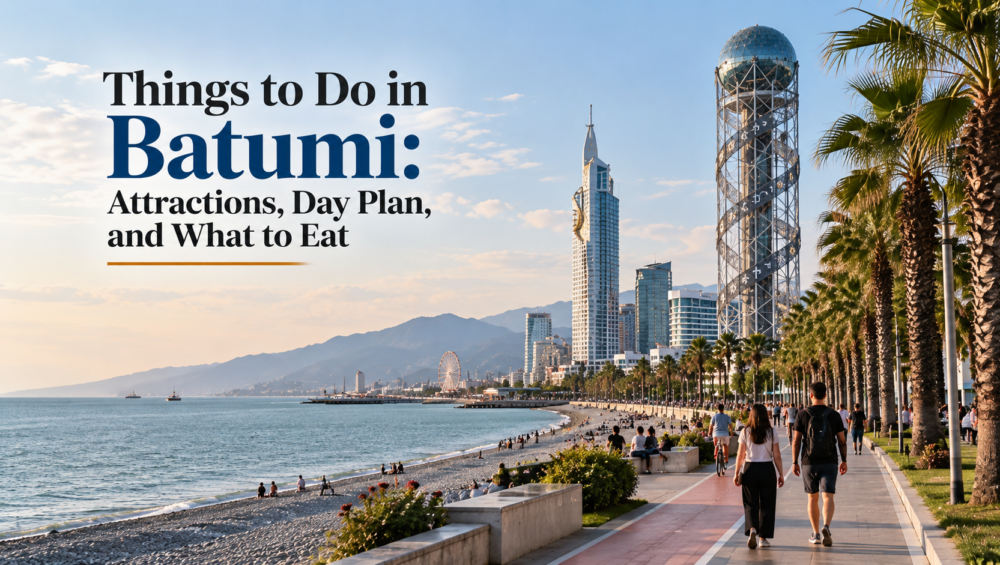
The Boulevard is the spine of Batumi — a roughly 7km seafront promenade established in 1881, with four historic alleys, a cycling path, and more than 40,000 trees and plants.
Almost everything else in this guide sits on or just off it.
You do not need a taxi or transport plan for the Boulevard itself — everything here is a short walk from the next.
The Ali And Nino Statue
Two 8-metre moving metal figures by Georgian sculptor Tamar Kvesitadze slowly approach each other, merge, and separate — the full cycle runs roughly every 10 minutes.
The movement is barely perceptible in daylight; the real effect is in the evening lighting from around 7pm.
Arrive by 6:45pm to get your position before the crowd builds.
The statue is free to view and stands along the coastline on the Boulevard.
It depicts an Azerbaijani man and a Georgian woman from Kurban Said’s 1937 novel Ali and Nino — sometimes called a Caucasian Romeo and Juliet — representing coexistence across religious and cultural lines.
The Alphabet Tower
A 130-metre structure in Miracle Park, shaped around a DNA-helix spiral and encoding the 33 letters of the Georgian alphabet.
The observation deck and restaurant occupy the top two floors, reached by lift or one of the longest pedestrian staircases in Batumi.
Entry costs 5–20 GEL depending on the floor you go to, and the tower is open from 10am to midnight daily.
That midnight closing makes it one of the few Batumi attractions suited to a late evening — worth keeping in mind if you want to combine it with the Ali and Nino statues in one evening stretch.
Europe Square And Batumi Piazza
Europe Square is centred on a statue of Medea holding the Golden Fleece — a nod to Georgia’s ancient association with the myth of Jason and the Argonauts (the same myth that gives the Argo cable car its name).
The square has restaurants, shops, hotels, and a dancing fountain.
A short walk away, Batumi Piazza is an Italian-style square built around a 106-square-metre central mosaic and a clock tower.
Both are free to enter and walkable from the Boulevard in under 10 minutes.
The Argo Cable Car
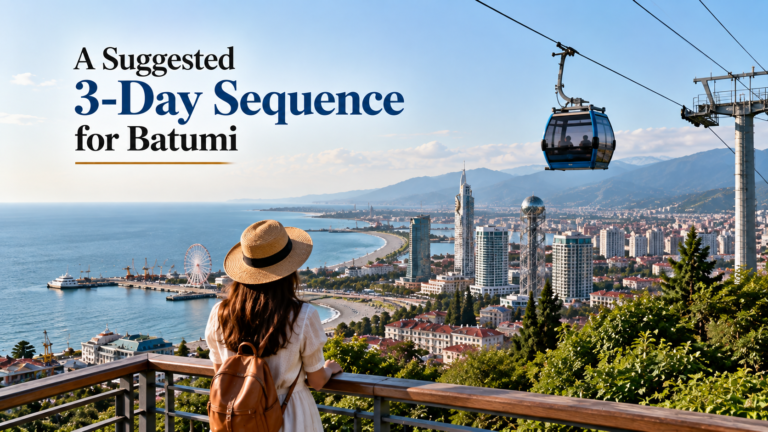
The Argo cable car runs 2.6km from the port area up roughly 250 metres to the summit of Anuria Mountain.
The ride takes about 10–15 minutes each way.
At the top, the complex has an observation deck with views over the city and the Black Sea, a Georgian restaurant, and a cultural stage with live Georgian dance and music performances.
The round-trip ticket costs approximately 30 GEL as of October 2026.
Operating hours are 11am to 10pm daily, seven days a week.
Go in the late afternoon rather than midday — the light on the sea is better, and weekday afternoons have shorter queues.
The official website for current pricing and performance schedules is argo-batumi.ge.
Batumi Botanical Garden
The Botanical Garden sits about 9km north of the city centre and covers more than 110 hectares with roughly 5,000 plant species, including Japanese sakura, Canary date palms, and over 2,000 tree species.
Entry for foreign visitors is 20 GEL.
Children under 6 enter free.
Guided tours cost 80 GEL, and an electric bus ride inside the garden is an additional 5–10 GEL.
Opening hours are 9am to 5:30pm daily, extended to 8pm in June, July, and August.
How to Get There Without a Taxi
Minibuses 15, 31, and 40 serve different entrances to the garden. The fare is 50 Tetri per person each way.
The Church of the Holy Spirit near the city centre is a common boarding point. A taxi is optional, so you can save the fare and spend it inside the garden.
Allow 2–3 hours. The garden is large, and a quick visit misses most of it.
The Beach: What To Pack And When To Go
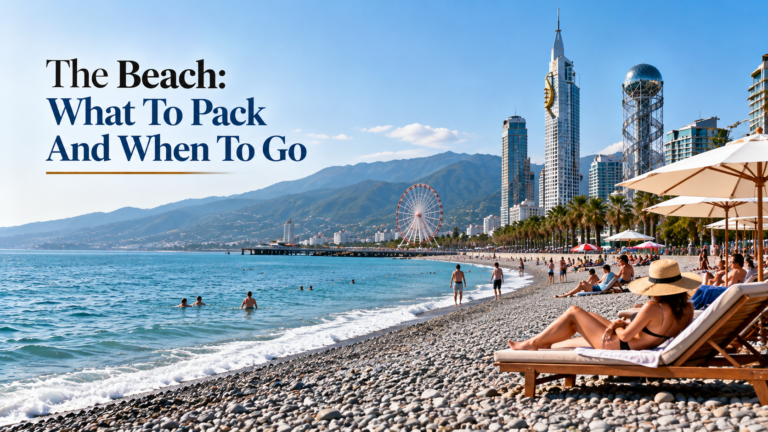
Batumi’s beach runs alongside most of the Boulevard for roughly 7km — but it is pebble, not sand.
Walking on it barefoot is genuinely uncomfortable.
Pack water shoes or thick-soled sandals before you arrive; buying them at the last minute in Batumi is possible but adds unnecessary cost and time.
The sea is comfortably swimmable from roughly July to mid-September, when the water temperature sits around 27–28°C.
By late September the water cools to around 21°C, and outside the July–mid-September window, the beach is a scenic walk rather than a swimming stop.
If your Georgia trip falls in May, June, or October, plan the beach time as a stroll along the Boulevard rather than a swim day, and redirect the afternoon to the Botanical Garden or Argo cable car instead.
See the best time to visit Georgia for how the season affects the rest of the route.
Day Trips From Batumi
Two worthwhile stops sit just outside the city for those with a free half-day or a full day.
Neither is part of the standard sightseeing on Roaming Legs’ itinerary — both are arranged by the traveller on the ground.
Gonio Fortress
Gonio Fortress is about 15km south of Batumi towards the Turkish border, roughly 20–25 minutes by road.
It was built by the Romans in the 1st century AD and is among Georgia’s oldest fortifications.
A 900-metre perimeter wall stands 5 metres high, with 18 of the original 22 towers surviving.
Local tradition holds that the Apostle Matthias is buried within the walls.
An on-site museum displays artifacts covering the site’s Roman, Byzantine, and medieval layers.
Entry is approximately 10 GEL as of October 2026.
A taxi from Batumi is the most practical option; the distance is short enough that a round-trip fare is reasonable.
Mtirala National Park
Mtirala National Park is 25km from Batumi and received UNESCO World Natural Heritage status in 2021 along with two other Adjara parks.
The shuttle fact most guides miss: A dedicated shuttle to the Chakvistavi Visitor Centre runs from Batumi on Mondays and Fridays only, costing 3 GEL per person and taking about 45 minutes.
On any other day, the only options are a taxi (80–100 GEL each way) or an organised tour.
The easier trail — Trail 1 (Tsalbnari, 7km circular) — is open May to October and includes a waterfall, a cable section, and a lake.
Trail 2 (Tsivtskaro, 16km, two-day) is open June to September, reaches 1,250 metres elevation, and the park recommends a ranger or guide.
If your Batumi days fall on a Tuesday, Wednesday, Thursday, or Saturday or Sunday, plan either a taxi budget or an organised tour — or shift Mtirala to Monday or Friday if the dates allow.
Contact for the visitor centre is +995 577 10 18 89.
What To Eat In Batumi
Ajarian food is distinct from the rest of Georgian cooking — heavier on dairy, with influences from the Black Sea coast and the mountains above.
Adjarian Khachapuri is the signature dish: a spindle-shaped cheese pie with butter and a raw egg broken on top at the table.
Tear off pieces from the sides and dip them into the butter-egg mixture.
If you prefer no egg, you can ask for it without — the egg is added to order, not baked in.
A portion costs 10–24 GEL depending on the restaurant.
Chirbuli is scrambled eggs with cauliflower and other vegetables in generous butter — one of the most straightforward vegetarian options in Ajarian cooking.
Borano is cheese and butter baked in a clay pot, served with bread.
Sinori — thin bread rolls filled with cottage cheese, sour cream, and butter — is another vegetarian-friendly option worth trying.
Ajarian Kawarma is thinly sliced, chili-seasoned meat served in a traditional clay vessel. Local baklava with honey and walnuts is a popular dessert.
Coffee brewed on hot sand is a Batumi tradition worth trying once.
Daily food and entertainment for two: 100–160 GEL, excluding accommodation.
A Suggested 3-Day Sequence for Batumi
This is the sequence that fits the 3-night Batumi allocation on Roaming Legs’ 10-day route.
Adjust it if your dates fall on a Monday or Friday — that is when the Mtirala shuttle runs, and it is worth building Trail 1 around it.
Day 1 — The Boulevard and Evening Skyline
Walk the Boulevard at your own pace in the morning.
In the afternoon, take the Argo cable car (11am–10pm; ~30 GEL return) up to Anuria Mountain.
At 6:45pm, position yourself near the Ali and Nino statues for the 7pm merge.
Walk from there to the Alphabet Tower (open until midnight; 5–20 GEL) for views after dark.
Day 2 — Botanical Garden and Old Town
Take minibus 15, 31, or 40 (50 Tetri) to the Botanical Garden; it opens at 9am.
Allow two to three hours — the electric bus inside the garden covers ground faster if your group prefers not to walk the full terrain.
Return to the city for a late lunch and spend the afternoon at Europe Square and Batumi Piazza.
Try Adjarian Khachapuri at a local restaurant near the Boulevard for dinner.
Day 3 — Day Trip
If Day 3 falls on a Monday or Friday: take the 3 GEL shuttle to Mtirala for Trail 1 (7km circular; open May–October).
Any other day: take a taxi to Gonio Fortress (15km, ~10 GEL entry) in the morning and return by early afternoon.
Mistakes That Cost Batumi Visitors Time
- Visiting the Ali and Nino statues before 6:45pm and missing the merge.
- Going to Mtirala on a non-shuttle day without a taxi budget — 80–100 GEL each way is a significant unplanned cost.
- Arriving at the Botanical Garden by taxi when buses 15, 31, and 40 cover the same route for 50 Tetri.
- Forgetting water shoes for the pebble beach.
- Trying to swim in Batumi in October — the sea drops to around 21°C and the peak season ends in mid-September.
- Booking the Alphabet Tower visit for midday when it offers better value as an evening stop open until midnight.
Frequently Asked Questions
What Is The Best Time To Visit Batumi For Swimming?
July to mid-September.
The sea reaches around 27–28°C in summer and is comfortably swimmable across that window.
By late September, the water cools to around 21°C. Scenic, but no longer a beach day by most standards.
Is Batumi Beach Sand Or Pebble?
Pebble, not sand.
The beach runs for roughly 7km alongside the Boulevard, but walking it barefoot is uncomfortable.
Pack water shoes or thick-soled sandals before you arrive.
What Time Does The Ali And Nino Statue Move?
The figures begin their cycle at approximately 7pm each evening.
They approach, merge, and separate in a cycle that repeats roughly every 10 minutes.
Arrive by 6:45pm to find a good viewing position before the crowd builds around the statue.
How Much Does The Argo Cable Car Cost?
A round-trip ticket costs approximately 30 GEL as of October 2026.
The cable car runs 11am to 10pm daily, seven days a week.
Check argo-batumi.ge before your visit as seasonal pricing can vary.
How Do I Get To The Botanical Garden Without A Taxi?
Minibuses 15, 31, and 40 each run from the city to a different entrance of the Botanical Garden.
The fare is 50 Tetri per person each way.
The Church of the Holy Spirit near the city centre is a common stop for these routes.
The garden opens at 9am daily and closes at 5:30pm (8pm in June–August).
Is Mtirala National Park Worth Visiting From Batumi?
Yes, but only plan it if your visit falls on a Monday or Friday.
The public shuttle runs only on those two days (3 GEL, 45 minutes).
On any other day, a taxi costs 80–100 GEL each way, which adds significantly to your day-trip budget.
Trail 1, a 7km circular route with a waterfall and lake, is the easier option and runs May to October.
What Food Should I Try In Batumi?
Start with Adjarian Khachapuri, a cheese pie with butter and a raw egg broken on top at the table.
Also try Borano, cheese and butter in a clay pot, Chirbuli, eggs with cauliflower, a vegetarian dish, and Sinori, cheese-filled bread rolls.
Finish with coffee brewed on hot sand. It is a Batumi-specific tradition.
Are There Vegetarian Options In Batumi?
Yes.
Chirbuli, scrambled eggs with cauliflower in butter, Sinori, cottage cheese rolls, and Adjarian Khachapuri without egg are all vegetarian-friendly.
Most restaurants along the Boulevard and in the Old Town carry these dishes.
If you prefer to avoid egg entirely in the Khachapuri, ask for it without. The egg is added to order.
How Many Days Is Enough In Batumi?
Two nights cover the Boulevard highlights, the Argo cable car, and one meal out.
Three nights give you a proper Botanical Garden morning and one day trip, such as Gonio or Mtirala.
On Roaming Legs' 10-day route, Batumi is the longest single stop at three nights, built in deliberately as downtime after the mountain and wine-country legs.
Is Batumi Already Part Of The Roaming Legs Georgia Package?
Yes, on the 10-day Full Route. It is the longest single stop, with three nights after Borjomi.
On the 5-day or 7-day route, Batumi can be added as a paid extension to a private booking.
It is not included by default on either shorter itinerary, so mention it when you enquire and our team will build it in.
See the Georgia tour packages from India page for the full route options.
What Are The Opening Hours Of The Alphabet Tower?
The Alphabet Tower is open 10am to midnight daily.
Entry costs 5–20 GEL depending on the level you visit.
It is one of the few Batumi attractions that works as a late-evening stop. Combine it with the 7pm Ali and Nino merge on the same Boulevard stretch.
Batumi Rewards Some Planning and Practically No Rush
Three nights covers the Boulevard, cable car, botanical garden, a day trip, and two proper Ajarian meals when the days are sequenced well.
Most time-wasting mistakes come down to timing: missing the statue merge, visiting Mtirala on the wrong day, or planning a swim in October.
Still deciding whether Batumi fits your Georgia route? Speak to our Georgia specialist to confirm what is already included in your itinerary.