
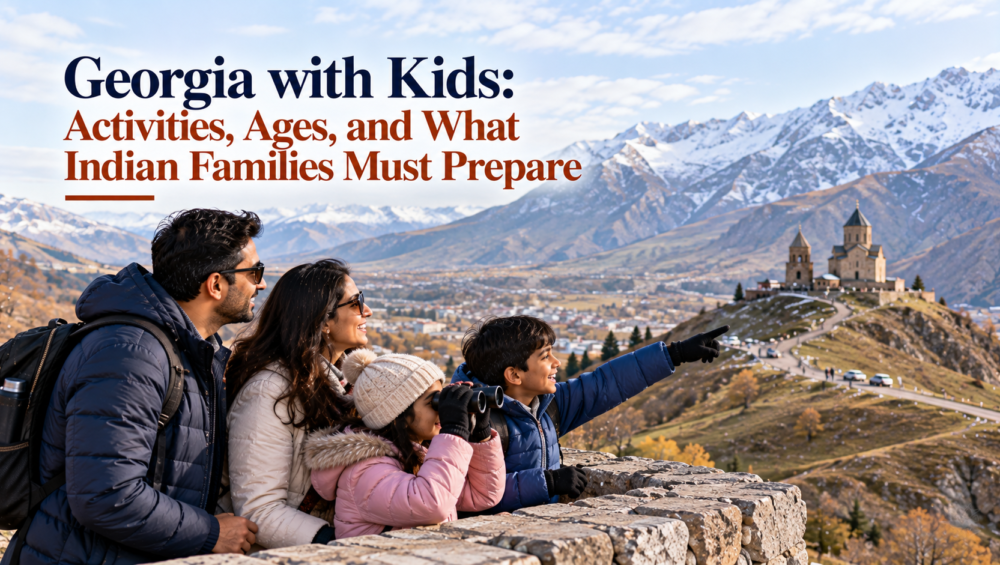
No Georgian taxi app provides a child car seat.
Prometheus Cave — the stop on almost every Kutaisi day trip — officially bans children under 6.
And a stroller that works perfectly at Bengaluru airport will become useless the moment you enter Tbilisi’s Old Town.
These are not edge cases.
They are the three logistics gaps that most family itineraries for Georgia do not flag, and that families discover — one at a time — on the trip itself.
This roadmap gives Indian families a stop-by-stop, age-honest guide to what children will actually do in Georgia, and what to prepare before you leave, current as of October 2026.
The One Fact That Changes Your Kutaisi Plan
Prometheus Cave is listed on nearly every Georgia family itinerary.
Georgia’s official Prometheus Cave portal states that entry is prohibited for children under 6.
The cave is open 10:00–18:00, closed on Mondays.
The temperature inside is 14°C throughout the year — bring a light sweater for every family member regardless of the outdoor heat.
Paths are wet and slippery; closed-toe shoes with non-slip soles are required, not optional.
Ticket prices for foreign visitors: 23 GEL for adults, 5.5 GEL for children aged 6–18.
The optional underground boat ride costs an additional 17.25 GEL per person (foreigners).
If your children are 6 or older, Prometheus Cave is one of Georgia’s most genuinely impressive experiences — six chambers, an underground river, classical music piped through the cave.
If you are travelling with a child under 6, build your Kutaisi day around Sataplia instead (see below) and save Prometheus for a future visit.
Tbilisi with Kids: What Works By Age
Most family itineraries allocate 3–4 nights in Tbilisi, and it earns that time.
The range of activities is wide, but what works depends heavily on your children’s ages.
Under 6: Cable Car, Funicular, Zoo, Rike Park
The Rike-Narikala Cable Car costs 5 GEL one-way and is free for children under 90 cm.
It rises from Rike Park on the riverbank directly to Narikala Fortress — the ride itself is the activity for young children.
The Mtatsminda Funicular costs 2 GEL one-way and is free for children under 6.
It operates from 09:00–04:00, so early morning and evening visits both work.
The funicular’s intermediate stop gives one of the best views in Tbilisi with a fraction of the crowd at the top — worth a deliberate pause.
Mtatsminda Park sits at the top: free to enter, with individual rides priced at 3–8 GEL.
Tbilisi Zoo costs 2 GEL for children aged 3–12 and 4 GEL for 12 and above; children under 3 enter free.
Visit between 10:00–12:00: the animals are most active and the crowds are thinner than the afternoon.
Rike Park is free, fully paved, and runs along the Kura riverbank — one of the few genuinely stroller-accessible open spaces in central Tbilisi.
Ages 6 To 12: Museums, Puppet Theatre, Peace Bridge
Museum of Illusions costs 23.50 GEL for visitors aged 5 and above; under-5 enter free.
Mirror rooms, gravity experiences, and interactive exhibits hold children for a solid 60–90 minutes.
The Gabriadze Puppet Theatre runs productions for children but books out quickly.
Check current showtimes and buy tickets in advance on tkt.ge — walk-in availability is not reliable.
The Peace Bridge is free, open 24 hours, and worth visiting at night when the LED structure is lit.
The bridge’s steel structure encodes chemical formulas in Morse code — a detail that gives older children something to find and decode while walking across.
The Ethnographic Open-Air Museum costs 5 GEL for children aged 6–17 and is free for under-6.
It covers a 3 km circuit through reconstructed Georgian village houses — plan for comfortable walking shoes and at least two hours.
Teenagers: Fabrika, Workshops, Chronicles Of Georgia
Fabrika is a repurposed Soviet textile factory that now holds cafés, studios, and creative workshops.
It is walkable, relaxed, and gives teenagers space to explore independently — unlike most sightseeing stops.
Clay workshops in Tbilisi typically cost 25–45 GEL per child for 1.5–2 hours, with a take-home piece included.
The Chronicles of Georgia — a monument complex of tall stone pillars on the city’s outskirts — reads differently to teenagers than to adults: the scale and visual drama land well.
Budget 15–20 GEL by taxi from the city centre, 20–25 minutes each way.
Stroller Access in Tbilisi: Where You Can And Cannot Go
Tbilisi is manageable with a stroller in several central areas, but parts of the Old City are much easier with a baby carrier. Knowing which areas work best can make your sightseeing days far more comfortable.
Stroller-Accessible Areas
- Rike Park
- The Kura embankment
- Rustaveli Avenue
- The grounds of the National Museum
Areas That Are Difficult With A Stroller
- Old City cobblestone streets
- The slopes leading to Narikala
- Most of the winding lanes in the Abanotubani (sulphur bath) district
For Children Under Approximately 15 kg
A baby carrier is more practical than a stroller for the Old City. The cobblestones, slopes and narrow lanes can make stroller travel uncomfortable and difficult.
Plan your Old City exploration as a carrier day, and your Rike Park and Rustaveli time as stroller days.
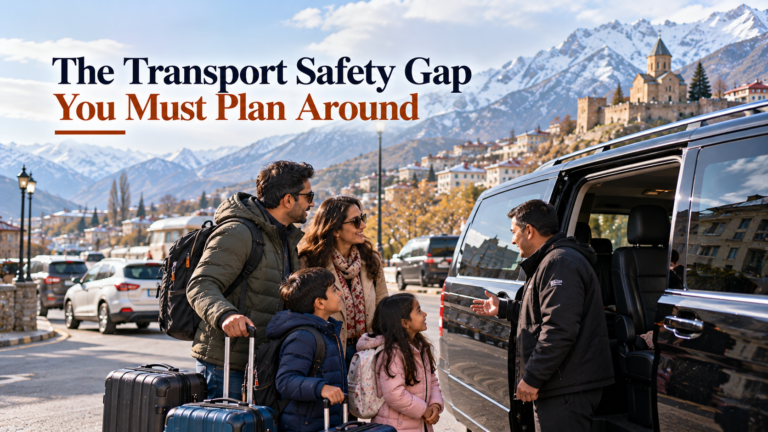
The Transport Safety Gap You Must Plan Around
No taxi company or ride-hailing app currently operating in Georgia provides child car seats.
This covers standard taxis, Bolt, and all other apps available in Tbilisi.
As of August 2026, making child seats mandatory for pre-school children in vehicles was under proposal by Georgia’s road safety strategy — but it remains a proposal and has not yet been enacted into law.
Until it is, your family has three practical options.
Option 1: Bring a lightweight travel booster seat from India.
Folding booster seats suitable for children over approximately 15 kg and 100 cm tall pack into a day bag and are available from Indian e-commerce retailers before your trip.
Option 2: Hire a private vehicle with a car seat for intercity travel.
If your operator arranges a driver for the Tbilisi–Kazbegi or Tbilisi–Borjomi leg, confirm in writing before payment whether a car seat for your child’s weight group is included.
Option 3: For the Tbilisi–Batumi overnight train, children sit in berths — the car seat question does not apply.
For families with children under 4, the transport question needs a confirmed answer before you book.
Kazbegi with Kids: The Decision Every Family Must Make
The Georgian Military Highway to Kazbegi is one of the most visually striking drives in the Caucasus, and teenagers generally find it more memorable than most museums.
Gergeti Trinity Church
The church sits 5 km from Stepantsminda town with 500 metres of elevation gain.
The hike is suitable for children aged 8 and above who are comfortable with long, uphill walking days.
For Younger Children
For children under 8, or for any family with a toddler, a pre-arranged 4x4 jeep from local operators in Stepantsminda is the alternative.
Arrange this before you arrive. There is no queue of vehicles waiting.
Confirm with your operator whether the jeep is included in your itinerary or needs to be booked and paid separately.
A split arrangement can work well: one parent hikes with older children while the other takes the jeep with younger ones. Discuss this with your operator in advance.
The drive itself, and the view of the church from the valley, are worth the Kazbegi stop regardless of whether anyone hikes.
For more detail on the child visa, insurance, and winter road risks for Kazbegi, see our guide on planning a family holiday in Georgia .
Borjomi: The Best Stop for Young Children
Borjomi is the easiest stop on a Georgia family itinerary for children under 6.
The central park is free to enter and its main walkways are paved and flat — stroller-accessible throughout.
The park has a cable car, a children’s play area, and a natural mineral spring where the Borjomi water sold across India flows directly from the source.
Children can drink from the spring in the park.
The cable car provides an easy ride with mountain views that younger children will enjoy without any hiking.
Borjomi works well as a rest day placed after the intensity of Kazbegi — one day of flat, slow exploration before the drive back toward Tbilisi or onward to Batumi.
For families with older children or teenagers, the Borjomi-Kharagauli National Park begins at the town’s edge and has marked trails ranging from 2 to 12 km — confirm current trail conditions with your operator.
Sataplia And Prometheus Cave: Plan By Your Child’s Age
Sataplia Nature Reserve near Kutaisi gives families with toddlers a cave experience without the age restriction.
The cave tour covers 309 metres and is guided in English, Georgian, and Russian.
Entry is free for children aged 0–5; children aged 6–17 pay approximately 5.5 GEL (prices as of 2021 — confirm current rates at the reserve before visiting).
The reserve is open daily 10:00–19:00.
The primary draw for children is the Cretaceous-era dinosaur footprints preserved on site with a protective roof covering them — a feature that works genuinely well for children aged 4 and above.
Sataplia is not easily reached by public transport; a taxi from Kutaisi town square is the standard approach (approximately 45 minutes).
Prometheus Cave comparison by age:
- Children under 6: Sataplia only (Prometheus entry prohibited)
- Children 6–12: Both sites are accessible; Prometheus is the more dramatic experience
- Teenagers: Prometheus is the stronger choice for impact; Sataplia is better combined with Prometheus on a two-attraction day

Food in Georgia: What Children Will And Won’t Find
Georgian cooking is mild, bread-heavy, and generally manageable for Indian children.
Khachapuri (cheese-filled bread), khinkali (dumplings), and lobiani (bean flatbread) are available everywhere and require no adjustment for children accustomed to Indian food.
Portions are large — ask for a half portion when ordering for children rather than ordering a full dish per child.
Tbilisi has Indian restaurants; Spice Garden (spicegarden.ge) and Maharajah (maharajah.ge) are named options for families who want a familiar meal on a city evening.
Outside Tbilisi, Indian restaurant options become limited to non-existent.
Plan for Georgian food on mountain days and in Borjomi; treat Tbilisi Indian restaurants as available but not as a fallback for the whole trip.
Stray dogs are present in Tbilisi and the major tourist areas.
They carry yellow ear tags from the municipality’s vaccination programme and are not aggressive — but teach children to avoid approaching them before you arrive.
Managing Summer Heat with Young Children
Tbilisi in July and August regularly reaches 33–38°C.
Full-day outdoor programmes are not workable for children under 6 in this heat.
The strategy that works: plan all outdoor activities before 12:00 and after 18:00.
Afternoons from 12:00–17:00 in summer are best spent in air-conditioned spaces — the Museum of Illusions, a mall food court, or the hotel.
Carry hats, high-SPF sunscreen, and a reusable water bottle for every family member; hydration stops are available in Tbilisi’s parks but are inconsistent outside the city.
September and October bring temperatures of 20–25°C in Tbilisi — the Kazbegi road is fully open, crowds drop, and young children can handle full outdoor days without the heat restriction.
For families with children under 6, September–October is the more manageable window.
April–May is the second-best option if your school calendar does not allow autumn travel.
Your Family’s Georgia Preparation Checklist
These are the steps specific to activities and logistics — for child visa, insurance, and Kazbegi road risks, see our family holiday planning guide.
- Check every child’s age against the Prometheus Cave cut-off (under 6 = excluded) and adjust the Kutaisi day plan.
- Decide on your child car seat approach: bring a travel booster, confirm with your operator that a private vehicle with a seat is included, or accept the train for the long intercity leg.
- Confirm whether Kazbegi’s Gergeti hike suits your children’s ages, and book the 4×4 jeep in writing if any child is under 8.
- Pack a light sweater or layer for every family member — cave temperatures are 14°C regardless of the outdoor season.
- Buy closed-toe, non-slip shoes for every family member before the cave visits.
- If visiting in July–August, restructure all outdoor activities to morning and evening slots and build afternoon indoor time into your itinerary.
- Book the Gabriadze Puppet Theatre on tkt.ge before your trip — do not rely on walk-in tickets.
- Pack any children’s medicines you rely on: paediatric pharmacies in Tbilisi (PSP, Aversi) stock European-standard medications, but specific Indian formulations may not be available.
Mistakes That Cost Families Time Or Disappointment
- Arriving at Prometheus Cave with a child under 6, expecting to enter — the ban is enforced.
- Assuming a Bolt or standard taxi will have a child car seat — none currently do.
- Bringing a stroller for Old Town Tbilisi exploration — cobblestones and slopes make it impractical; bring a carrier instead.
- Planning full outdoor days in Tbilisi during July–August with young children — the 33–38°C heat makes this unworkable without a deliberate morning/evening split.
- Not booking the Gabriadze Puppet Theatre in advance — seats are limited and the box office does not reliably have walk-in availability.
- Arriving at Stepantsminda without a jeep arranged for children who cannot hike — there is no waiting vehicle pool.
Frequently Asked Questions
Can Children Under 6 Visit Prometheus Cave?
No.
Georgia's official Prometheus Cave guide states entry is prohibited for children under 6.
The cave has unguarded drops and wet paths that make supervision of very young children impractical.
Sataplia Nature Reserve near Kutaisi has no known under-6 age ban and is the correct alternative for families with toddlers.
Are Georgian Taxis Safe for Young Children?
Taxis in Georgia do not provide child car seats.
No taxi company or app, including Bolt, currently offers vehicles with installed child seats.
As of August 2026, mandatory child seat legislation was under proposal but had not been enacted.
Families should bring a travel booster seat or confirm with their operator that a private vehicle with a car seat is included.
Is Old Town Tbilisi Accessible with a Stroller?
Not comfortably.
The Old City's cobblestone lanes and slopes are impractical for strollers.
A baby carrier is more manageable for children under approximately 15 kg.
Rike Park, Rustaveli Avenue, and the Kura embankment are fully stroller-accessible.
What Age Is the Gergeti Trinity Church Hike Suitable For?
Children aged 8 and above who are comfortable with uphill walking.
The hike is approximately 5 km each way with 500 metres of elevation gain.
Younger children need a pre-arranged 4x4 jeep from local operators in Stepantsminda. Book this before you arrive, not on the day.
Can Families Visit Sataplia with a Toddler?
Yes.
Sataplia has no known under-6 age restriction, and children aged 0–5 enter free.
The English-guided cave tour covers 309 metres and the dinosaur footprint display works well for children aged 4 and above.
Confirm current admission prices at the reserve, as the figures available from 2021 may have changed.
What Is the Best Month for a Family Trip to Georgia with Young Children?
September or October.
Temperatures in Tbilisi are 20–25°C, the Kazbegi road is fully open, and crowds are lower than summer.
For children under 6, the cooler temperatures make full outdoor days manageable in a way that July–August does not.
April–May is the second-best window if autumn travel is not possible.
Is Georgian Food Suitable for Picky Child Eaters?
Generally yes.
Khachapuri (cheese bread), khinkali (dumplings), and lobiani (bean flatbread) are mild, widely available, and do not require adjustment from typical Indian children's palates.
Ask for half portions. Georgian servings are large.
Indian restaurants in Tbilisi exist, but outside Tbilisi, Indian food options disappear.
Do I Need to Book Children's Activities in Tbilisi in Advance?
For the Gabriadze Puppet Theatre, yes. Book on tkt.ge before your trip.
For the Museum of Illusions, Mtatsminda Park, the cable car, and the funicular, advance booking is not required.
For clay workshops, confirm availability 48–72 hours ahead, particularly during summer when family demand is higher.
How Do Families Travel Between Cities in Georgia with Young Children?
By private vehicle or the Tbilisi–Batumi overnight train.
The overnight train does not require a car seat. Children sleep in berths.
For Tbilisi–Kazbegi and Tbilisi–Borjomi, the standard arrangement is a private driver.
Confirm with your operator whether a car seat is included before finalising intercity arrangements.
What Should Families Pack That They Won't Find Easily in Georgia?
A travel booster seat if you have a child between approximately 15–36 kg.
Specific Indian paediatric medicines. Tbilisi pharmacies such as PSP and Aversi chains stock European-standard medications but not Indian formulations.
Closed-toe, non-slip shoes for cave visits. Caves are approximately 14°C and paths are wet.
A light layer for each family member for cave days regardless of outdoor weather.
Georgia is a genuinely manageable family destination when the logistics are prepared in advance. The gaps are specific, not pervasive.
Get the cave age rules, the car seat question, and the Kazbegi jeep confirmed before you finalise the itinerary, and the destination itself delivers well across age groups.