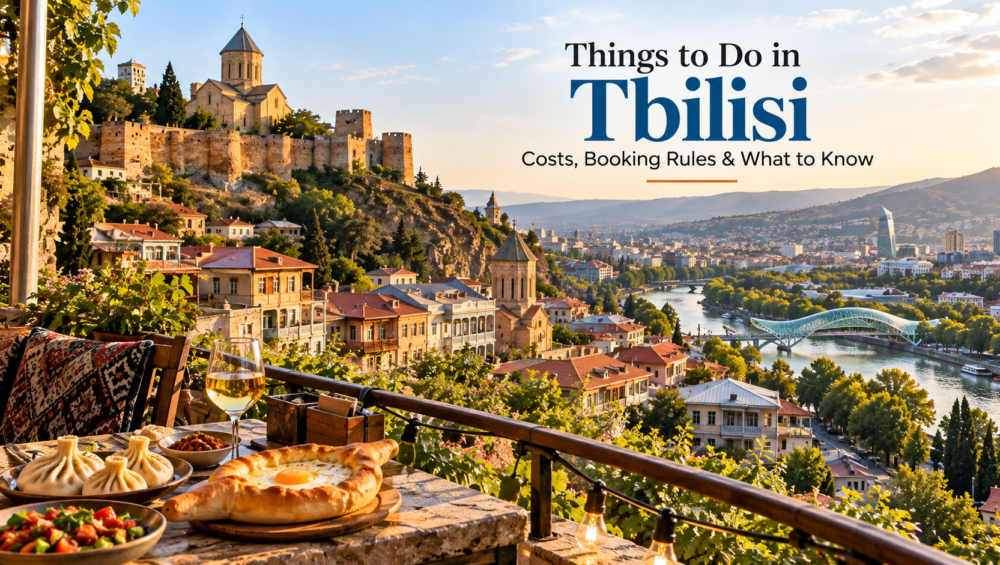
The cable car to Narikala Fortress does not accept cash or bank cards at the station.
It runs only on a Metromoney transport card — and if you arrive without one, you either walk up a steep 15-minute hill in the heat or miss the most efficient way to see Tbilisi’s most photographed viewpoint.
That is the kind of detail that separates a smooth day in Tbilisi from a frustrating one.
The National Museum’s most important exhibit — the 5,000-year-old Colchis gold collection — costs a second, separate ticket beyond the general admission most visitors buy.
The sulfur baths in Abanotubani require advance booking for private rooms, and during public holidays they must be fully prepaid.
The Dry Bridge Market is cash-only.
This roadmap covers what to actually do in Tbilisi, how much each experience costs, and what you need to sort before you arrive — current as of October 2026.
The Metromoney Card: Get It Before Anything Else
Buy a Metromoney card at any metro station or the Rike cable car station on arrival.
The card costs a refundable 2 GEL deposit and covers the metro, buses, marshrutkas, and the cable car.
Top up at metro stations, cable car stations, or Bank of Georgia terminals.
Keep the purchase receipt — you must present it with your passport to get the 2 GEL deposit refunded within one month.
One card can be shared within a group.
Narikala Fortress and the Cable Car
Narikala Fortress itself has no entry fee.
The cable car from Rike Park to the fortress costs 2.5 GEL one way (Metromoney card only) and takes about 90 seconds.
It operates roughly 11:00 AM to 11:00 PM, though hours shift slightly by season.
The cable car closes temporarily in strong wind or thunderstorms — if it’s shut when you arrive, the walk up from the Abanotubani sulfur bath district takes about 15 minutes on an uphill path.
The fortress walls and the Mother of Georgia statue above them are the best viewpoint in the city.
The Bridge of Peace across the Mtkvari River and Rike Park are both free and sit at the base of the cable car on the Old Town side.
If the Cable Car Is Closed
Walk from the sulfur bath area up the hillside path — it is steep but manageable and takes about 15 minutes.
The fortress perimeter is open and unwalled in sections, so you can walk in from multiple directions.
The Abanotubani Sulfur Baths
Public hall: around 20 GEL per hour, available at Baths No. 5, the Orbeliani Baths, and Mirzoev.
Private room: 100 to 600 GEL per hour depending on the bathhouse and room size, with extra charges for massage.
Private rooms require advance booking — walk-ins are rarely available, especially on weekends.
During Georgian public holidays, private rooms must be fully prepaid at the time of booking.
What to bring: a towel, rubber-soled slippers, and a loofah or scrub glove — items sold on-site cost more.
Leave jewelry, cameras, and phones outside the water; humidity and sulfur corrode metals and damage screens.
Soaking rule: no more than 10–12 minutes at a stretch, no more than four immersions per session.
Water temperature runs 35°C to 40°C.
The National Museum of Georgia
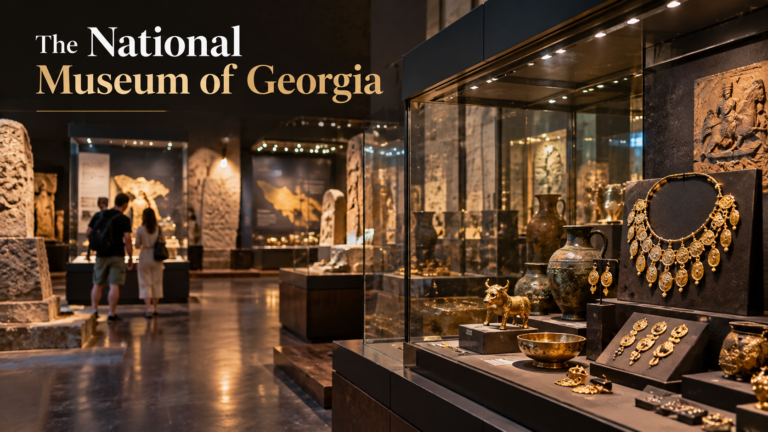
The National Museum is on Rustaveli Avenue, open Tuesday to Sunday, 10:00 AM to 6:00 PM.
General admission: 15 GEL.
The Treasury (Colchis gold collection): separate ticket, approximately 30 GEL.
The Treasury is not covered by general admission, and most visitors discover this at the entrance to the exhibit.
The Colchis collection — gold jewelry, animal figures, and ceremonial objects up to 5,000 years old — is the single most important exhibit in the building and directly connected to the myth of the Golden Fleece.
Also included in general admission: the Museum of Soviet Occupation on the top floor, with documents, photographs, and a preserved execution railcar covering 1921 to the USSR’s collapse.
Student and children’s discounts apply with valid ID.
The museum is closed on Mondays. Plan a Tuesday–Sunday morning visit to avoid arriving at a locked door.
The Mtatsminda Funicular and Hilltop Park
The funicular runs from Chonkadze Street at the base up to Mtatsminda Park, with a middle stop at the Pantheon — the resting place of Georgian writers and public figures.
Cost: 2 GEL for the Park card (purchased at the lower station ticket booth) plus 10 GEL per one-way ride to the top.
Each additional boarding costs 3 GEL, so if you ride down and back up, costs add up quickly.
Money-saving tip: ride straight to the top, walk through the park, then walk down to the middle Pantheon station rather than paying for multiple rides.
Hours: 10:30 AM to 11:15 PM daily.
After 7:00 PM, the funicular bypasses the middle Pantheon station and goes directly between the base and the top — plan any Pantheon visit before 7 PM.
The park at the top has an amusement area, restaurants, and a terrace with a wide city view, though the view from Narikala Fortress is generally considered stronger.
The Dry Bridge Market
The Dry Bridge Market is Tbilisi’s open-air antiques and Soviet memorabilia market, spread along the bridge and surrounding area near Freedom Square.
Hours: 10:00 AM to 5:00 PM daily.
Best days: weekends from 11:00 AM — weekdays, especially Mondays, are significantly slower with fewer vendors.
Payment: cash only, no cards accepted.
Bring Georgian lari in small denominations.
The surface market carries war medals, vintage cameras, vinyl records, handmade felt goods, Georgian drinking horns (kantsi), and Pirosmani replicas.
Most visitors miss the downstairs antiques section, accessed via stairs opposite 9 March Park, with porcelain, ceramics, and chandeliers.
Bargaining is acceptable, but keep it polite. Nearby Dedaena Park also has a separate book and postcard market worth a quick detour.
Tbilisi Botanical Garden
The Tbilisi Botanical Garden sits just below Narikala Fortress — a 128-hectare garden with a 22-metre waterfall.
Entry: 4 GEL for adults; 1 GEL for students and seniors; free for children under 6.
Hours: 9:00 AM to 8:00 PM in summer; 9:00 AM to 6:00 PM in winter.
The waterfall is roughly 15–20 minutes from the lower entrance along the main path and runs year-round, strongest in April–May.
Wear proper footwear — paths are uneven and the garden explicitly warns against flip-flops and heels.
The most efficient route: cable car up to Narikala (2.5 GEL), walk through the fortress, descend into the garden, exit through the lower gate — mostly downhill.

What to Eat in Tbilisi: Rules for Indian Travelers
Georgian food centres on meat, dairy, and bread — but there are genuine options for Indian travelers who eat vegetarian.
Khinkali: How to Eat It Without a Cultural Misstep
Khinkali are Georgian dumplings with hot broth sealed inside.
Pick them up by the thick doughy knot at the top, bite a small hole in the side, sip the broth, then eat the rest of the dumpling.
Do not eat the thick doughy top (called the kudi) — leaving it on the plate signals that you enjoyed the dumpling and were satisfied.
Eating it is not technically wrong, but it marks you immediately as someone who hasn’t done the homework.
Vegetarian fillings: mushroom, potato, or cheese-and-herb (soko, kartopili, and khinkali kvelit) — ask specifically, as the menu may not translate fillings into English.
Khachapuri and Lobiani
Adjaruli khachapuri is the boat-shaped bread with melted cheese, butter, and an egg — tear bread from the edges and mix it in.
Lobiani is spiced kidney bean flatbread, fully vegetarian, at roughly 2–3 GEL per piece.
Elarji is a corn porridge with Sulguni cheese — rich, filling, and vegetarian.
For Indian vegetarians: khinkali (cheese or mushroom), lobiani, and khachapuri are always available and not specialty items.
Price Anchors
A mid-range restaurant meal: 25–40 GEL per person including a drink.
Khinkali: 2–3 GEL each at a local restaurant.
Lobiani at a street bakery: 2–3 GEL per piece.
Getting Around Tbilisi Without Paying Extra
Metro: 1 GEL per journey (Metromoney card required).
Bolt or Yandex: 4–8 GEL across town — far cheaper than street taxis, which often quote 10–20 GEL for the same route.
Walking: The Old Town core — Rike Park, sulfur baths, Narikala, Bridge of Peace — is walkable in about an hour.
Use the apps rather than hailing street taxis; a Bolt from Freedom Square to the Dry Bridge Market costs around 5 GEL.
Your Tbilisi Day in Order
- 1 Buy a Metromoney card at the first metro station or the Rike cable car station.
- 2 Walk through Rike Park and across the Bridge of Peace to the Old Town side.
- 3 Take the cable car up to Narikala Fortress (2.5 GEL, Metromoney card), ideally before noon for fewer crowds.
- 4 Walk down from the fortress to Abanotubani and use your pre-booked bath slot.
- 5 Walk the Old Town toward Freedom Square for lunch. Try khinkali near Leselidze Street.
- 6 Visit the Dry Bridge Market on weekends (cash only, 11 AM–5 PM).
- 7 On a weekday morning, swap step 6 for the National Museum on Rustaveli Avenue. Buy general admission and the Treasury ticket together at the entrance.
- 8 Take the funicular to Mtatsminda before 7 PM if you want the Pantheon stop.
- 9 End the evening near Rustaveli Avenue.
Mistakes That Cost Indian Travelers Time or Money in Tbilisi
- Arriving at the cable car station with only cash or a bank card — the Metromoney card is the only accepted payment.
- Buying only the general admission at the National Museum and discovering the Treasury needs a separate ticket at the exhibit entrance.
- Attempting a walk-in at the Abanotubani sulfur baths for a private room during a weekend or holiday.
- Eating the thick doughy top of the khinkali — leaving it signals the meal was good.
- Going to the Dry Bridge Market with only a card.
- Visiting the funicular after 7 PM and expecting to stop at the Pantheon — the middle station is bypassed after that hour.
- Visiting the National Museum on a Monday — it is closed.
- Choosing a street taxi over Bolt and paying double.
Frequently Asked Questions
Is the Cable Car the Only Way Up to Narikala Fortress?
No.
You can walk up from the Abanotubani sulfur bath area in about 15 minutes on an uphill path.
The cable car is faster and offers a better view on the way up, but the walk is a reasonable backup if the car is closed due to weather.
What Is the Metromoney Card and Do I Really Need It?
It is Tbilisi's rechargeable transit card. The card has a 2 GEL deposit and works on the metro, buses, marshrutkas, and the cable car.
You cannot use cash or a bank card directly on the cable car or metro turnstiles.
Buy one at any metro or cable car station as soon as you arrive.
Keep the purchase receipt. You need it to get the 2 GEL deposit refunded.
Can I Pay by Card at the Sulfur Baths?
Bring cash for the public hall and any on-site charges.
Most private bathhouses accept card for advance bookings. Confirm when you reserve.
Do I Need to Book the Sulfur Baths in Advance?
Yes, for a private room.
Walk-ins are rarely available on weekends and nearly impossible on Georgian public holidays.
Book at least 2–3 days ahead. During major holidays, bookings must be fully prepaid at reservation time.
Is the National Museum Treasury Worth the Extra Ticket?
Yes, if you have any interest in ancient history.
The Colchis gold collection, including jewelry and ceremonial objects up to 5,000 years old, is the most significant archaeological exhibit in the South Caucasus and cannot be seen anywhere else.
The 30 GEL ticket covers the Treasury only. Buy it alongside general admission at the entrance.
What Day Is the National Museum Closed?
Monday.
Plan your visit Tuesday through Sunday between 10:00 AM and 6:00 PM.
Student and children's discounts apply with valid ID.
Is the Dry Bridge Market Open Every Day?
Yes, 10:00 AM to 5:00 PM daily.
But the best experience is on weekends from 11:00 AM, when more vendors are set up and the downstairs antiques section is fully stocked.
Bring cash. No cards are accepted anywhere at the market.
What Is the Khinkali Eating Rule?
Pick up the dumpling by the thick doughy knot, bite a small hole, sip the broth inside, then eat the rest.
Leave the thick knot, kudi, on the plate. It signals to the cook that the dumpling was good and you were satisfied.
Ask for soko (mushroom), kartopili (potato), or khinkali kvelit (cheese) if you want vegetarian fillings.
Are There Vegetarian Options in Georgian Food?
Yes. Lobiani (spiced bean flatbread), vegetarian khinkali, khachapuri, and elarji (corn and cheese porridge) are all widely available and fully vegetarian.
Ask for them by name rather than asking "do you have vegetarian options?" You will get a clearer answer.
How Much Cash Should I Carry in Tbilisi for a Day's Sightseeing?
Plan 150–200 GEL in cash.
Cable car: 2.5 GEL.
National Museum general admission plus Treasury: 45 GEL.
Botanical garden: 4 GEL.
Funicular: 12 GEL.
Public sulfur bath: 20 GEL.
Meals: approximately 60–80 GEL.
Market buffer: approximately 20–30 GEL.
The Metromoney card covers transport. Cash covers markets, baths, and meals.
Taxis via Bolt or Yandex are paid by card through the app.
Is Tbilisi Safe for Indian Tourists?
Canada's travel advisory for Georgia advises a high degree of caution in Tbilisi due to regular public demonstrations. Avoid large protest gatherings.
Do not enter Abkhazia, South Ossetia, or the 5 km boundary zone around them under any circumstances.
Petty theft is possible in crowded markets. Keep valuables in a front pocket or zipped bag.
Can I Use Indian Rupees or UPI in Tbilisi?
No. Georgia uses the Georgian lari (GEL).
Visa and Mastercard work at most ATMs and restaurants.
RuPay cards may not work at Georgian ATMs or terminals. Carry a Visa or Mastercard as a backup.
UPI is not accepted anywhere in Georgia.
One Day in Tbilisi Is Enough to Decide Whether You Want More
Every Roaming Legs Georgia itinerary, from 5-day to 10-day trips, begins and ends in Tbilisi, with airport transfers included.
Sightseeing is free and self-guided, so once the practical details are sorted, you can enjoy the day at your own pace.