Kakheti Wine Tour Guide With Costs and Tips

Kakheti Wine Tour Guide for Indian Travelers With Winery Costs and Tips

Most travelers arriving at Khareba Winery’s cellar entrance assume they can drive themselves back to Tbilisi after a tasting or two.

Georgia’s 0.03% blood alcohol limit — among the strictest in the world — makes one glass of wine enough to put many adults over the legal threshold.

Exceeding it costs you ₾200 and your licence.

That is the fact most wine-tour blogs skip.

This guide covers what you actually need to know before you plan a day in Kakheti’s wine country: which wineries are worth your time, how to arrange a tour without that risk, what orange wine is and whether you’ll enjoy it, and how many bottles you can legally carry home to India — current as of October 2026.

Lorem ipsum dolor sit amet, consectetur adipiscing elit. Ut elit tellus, luctus nec ullamcorper mattis, pulvinar dapibus leo.

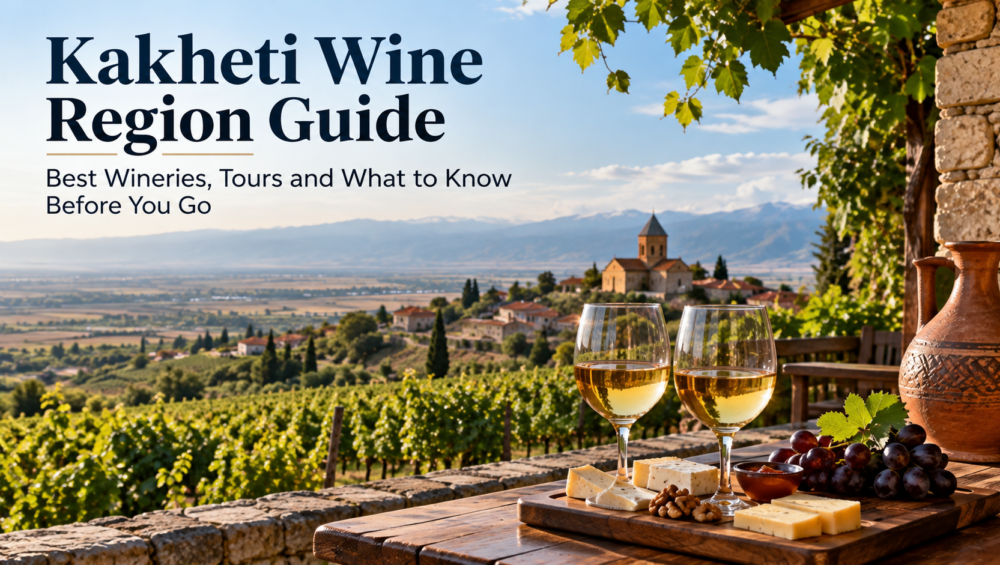
What Makes Kakheti Georgia’s Wine Country

Kakheti is not just one wine region among many.

It produces roughly 70% of Georgia’s entire annual wine harvest, in a country with more than 500 indigenous grape varieties — a figure that puts Georgia among the most genetically diverse wine regions on earth.

The tradition here runs to approximately 8,000 years.

In 2013, UNESCO added the Georgian method of fermenting and ageing wine in buried clay vessels called qvevri to its Representative List of the Intangible Cultural Heritage of Humanity.

What that means on the ground: when you visit a family cellar in Kakheti, you are tasting wine made the same way it was made in this valley thousands of years before modern bottling existed.

Saperavi: The Red That Defines Georgia

Saperavi is Georgia’s signature red grape, and it is unusual in the wine world: both its skin and its flesh are deeply coloured red.

That gives Saperavi wines their signature deep purple-black colour and full, tannic structure.

Expect flavours of dark plum, black cherry, and a distinctive earthy depth.

If you drink Malbec, Shiraz, or any full-bodied red at home, Saperavi will feel familiar — just more intense and with a longer finish.

It is the grape most likely to be in front of you at a winery tasting, and the one most worth buying to take home.

Rtveli Harvest Season What Visitors Can Actually Do

Rkatsiteli: Georgia’s Ancient White

Rkatsiteli is the white companion to Saperavi, and one of the oldest cultivated grape varieties in the world.

In its modern, stainless-steel-fermented form it produces a crisp, dry white with citrus and floral notes — lighter and easier drinking than Saperavi.

In its traditional qvevri form, with the grape skins left in contact during fermentation, it becomes something quite different: an amber wine with tannins, dried fruit notes, and a texture closer to a light red than a white.

Both styles exist in Kakheti, and most wineries will offer you at least one of each.

Orange Wine: What It Actually Is

If someone at a winery hands you a glass of deep amber wine and calls it “white wine,” that is not a mistake.

Orange wine — also called amber wine — is made from white grapes fermented with their skins left in, exactly the way red wine is made.

The skin contact pulls out tannins, colour, and complexity that a standard white wine does not have.

The result sits between a white and a light red: medium body, dried apricot and honey flavours, a slight savouriness, and a golden-amber colour.

It pairs well with grilled meats, cheese, and the kinds of rich, walnut-heavy dishes you will find at a Kakhetian supra table.

It does not taste like the white wine you may be used to.

If you try it at room temperature and find it too intense, ask for it slightly chilled — about 12–14°C brings out the fruit more clearly.

Which Wineries to Visit in Kakheti

Which Wineries to Visit in Kakheti

Kakheti has dozens of wineries, but the meaningful choice is between a large commercial estate and a small family marani (home cellar).

Large estates offer infrastructure, English-speaking guides, and consistent tasting menus.

Family cellars offer wine poured straight from the qvevri in clay bowls, food cooked that morning, and an experience that no estate can replicate — but they need advance planning.

Khareba Winery (Kvareli)

Khareba’s defining feature is its cellar: 7.7 kilometres of tunnel carved horizontally into the Caucasus mountain foothills.

The temperature inside stays at a constant 14°C year-round, which is why more than 25,000 bottles are stored there.

A tour and tasting costs approximately ₾30.

Non-drinkers in your group pay ₾10 — the only major winery in Kakheti that prices separately for this, which makes it the most practical choice for a mixed group.

The tunnel itself is worth the visit even if no one in your group drinks wine.

Kvareli is roughly 30–40 minutes northeast of Telavi.

Shumi Winery (Tsinandali Area)

Shumi was founded in 1897 and has one of the most extensive variety collections in Kakheti, with more than 400 grape varieties on site.

A tasting of five wines starts at approximately ₾25.

The winery has a museum that explains the history of Georgian winemaking across its different eras — useful context if this is your first time encountering qvevri wines.

It accepts walk-in visitors and is well-organised for groups.

Tsinandali Estate

Tsinandali is a 19th-century property near Telavi, known as the former residence of the Georgian poet and prince Alexander Chavchavadze.

Its wine collection includes bottles from 1814 — among the oldest surviving wines in the Caucasus.

The estate has an English-style garden, a small museum, and a wine tasting experience that focuses on the historic significance of the cellar as much as the wine itself.

It suits travelers who want the cultural layer alongside the tasting.

Pheasant’s Tears (Sighnaghi)

Pheasant’s Tears is a natural wine producer in Sighnaghi, run by an American winemaker since 2007.

It is one of the few wineries in Kakheti that focuses almost entirely on qvevri production using indigenous varieties, including some that are rarely seen elsewhere.

A tasting runs to 7–8 wines for approximately ₾30.

The winery also operates a restaurant in the town, which means you can combine a tasting with a proper meal rather than just a cheese board.

It is best for travelers who are already curious about natural or biodynamic wine, or who want to understand qvevri winemaking at its most deliberate.

Book in advance during April to October.

Family Marani: The Honest Alternative

A family marani is a home cellar where the owner makes wine using traditional methods, often for personal use and local sale.

Visits are informal: wine is poured from the qvevri into clay bowls, with simple seasonal food such as bread, cheese, and pickled vegetables.

Plan Ahead

These are not walk-in experiences. Contact the family winery by WhatsApp 1–3 days in advance. Your tour operator or hotel can usually make the connection.

There is usually no fixed fee, but a contribution of ₾15–30 per person is normal. Most family cellars are cash-only, so carry Georgian lari.

How to Arrange Your Wine Tour From Tbilisi

Group Day Tour From Tbilisi

A group wine tour from Tbilisi to Kakheti typically costs $50–90 per person and includes transport, an English-speaking guide, 2–3 winery visits, and lunch.

These are suitable for first-time visitors who do not want to manage logistics themselves and are comfortable with a fixed schedule.

The trade-off is that the winery selection is pre-set and the pace is the group’s pace, not yours.

Private Tour

A private tour gives you a dedicated driver and guide and lets you choose your wineries, set your own timing, and request a family marani visit.

Guide and driver costs run approximately $150–250 for the day.

For a group of four or more, the per-person cost becomes comparable to a group tour while giving full flexibility.

This is the right option if you want to include a family marani visit, plan a Rtveli harvest experience, or have specific wineries you want to reach.

Self-Drive: The BAC Problem

Many travelers plan to rent a car and drive themselves around Kakheti’s wine country.

Georgia’s legal blood alcohol limit for drivers is 0.03% — significantly below the 0.08% standard in India and most of Europe.

At 0.03%, a single standard glass of wine is enough to put the average adult over the limit.

Exceeding it results in a fine of ₾200 and licence suspension.

Canada’s travel advice for Georgia describes the enforcement approach as carrying heavy fines, detention, and driving bans.

If your group plans to self-drive, designate one person who will not drink at all and confirm that arrangement before the day begins.

Alternatively, hire a private driver for the day — this is the simpler solution and costs less than a fine.

Rtveli Harvest Season: What Visitors Can Actually Do

Rtveli is Kakheti's grape harvest, usually taking place across September and October. The exact start changes each year depending on grape ripeness.

At participating wineries and family cellars, visitors can pick grapes, tread them in traditional qvevri vessels, and join an evening supra with polyphonic Georgian singing.

Check Before You Go

Some wineries close for 2–3 days during the busiest harvest period. Call ahead to confirm they are open to visitors.

Book Early

Specialized Rtveli experiences can fill weeks ahead. Book the winery experience before booking your flights.

For the full month-by-month seasonal picture, see our best time to visit Georgia guide .

What to Eat With Your Wine

Kakheti’s food is built around the same land that produces its wine.

Most winery tastings include a basic board: local cheese, bread, and seasonal produce.

At a family marani, the food is more substantial — often a full table.

The regional dishes worth knowing:

  • Mtsvadi — meat grilled on vine-wood skewers; the smoke from the vine wood is deliberate and pairs directly with Saperavi
  • Chakapuli — a spring lamb stew made with tarragon and white wine; pairs with Rkatsiteli
  • Churchkhela — walnut strings dipped in grape juice and dried; a natural counterpart to orange wine
  • Shoti — Georgian flatbread baked on the inner wall of a clay oven; eaten with every meal

One note for travelers with nut allergies: walnuts appear in a very large proportion of Kakhetian dishes, often without being listed separately on a menu.

Check before ordering, particularly at family tables where dishes may not have written descriptions.

Your Wine Tour Planning Order

  1. Decide between a group tour, private tour, or self-drive (if self-drive, arrange a designated non-drinking driver before the day).
  2. If visiting during September or October, check with your intended winery that they are open to visitors during harvest — call at least one week before you travel.
  3. Book family marani visits 1–3 days in advance via WhatsApp; estate wineries 2–3 days ahead during April–October.
  4. Carry cash in Georgian lari — most family cellars do not accept cards.
  5. Plan 2–3 wineries maximum per day; more than that and tastings become less meaningful.
  6. If you want to bring wine home, decide in advance how many bottles you are buying across the group and stay within the 2-litre-per-person duty-free allowance.

Bringing Georgian Wine Home to India

This is the part most wine blogs do not mention. Check your customs allowance, know when excess alcohol must be declared, and pack your bottles properly.

Duty-Free Allowance

India allows 2 litres per adult traveller duty-free. Wine, spirits, and beer all count toward the same limit.

Two travellers can therefore carry up to 4 litres combined within the stated allowance.

750 ml bottle = 0.75 litres
Two bottles per person stays within 2 litres.

Above the Limit

Excess alcohol must be declared at the red channel at Indian customs.

Customs may assess the value and issue a TR-6 challan, with combined duty of approximately 150–165% of the assessed value.

Example: a ₹1,500 bottle could attract roughly ₹2,250 duty when assessed above the allowance.

Pack Wine Properly

Georgian wines are typically around 12–14% ABV, below the 24% IATA threshold mentioned for alcoholic beverages.

Pack bottles in bubble wrap or a wine sleeve, place them in the centre of your checked bag, and cushion them with clothing on all sides.

Important: Failing to declare alcohol above the permitted allowance can have serious customs consequences. Check the current Indian customs rules and your airline's baggage conditions before travelling.

Mistakes That Cost Indian Travelers On a Kakheti Wine Trip

  • Assuming that “one glass is fine” before driving — at 0.03% BAC, it is not.
  • Arriving at a family marani without calling ahead and finding the door closed.
  • Visiting during Rtveli without checking if the winery is open to visitors during active harvest.
  • Buying six or eight bottles of wine to take home and discovering the 2-litre duty-free limit at customs.
  • Carrying only a card to a family cellar — most are cash-only.
  • Trying to visit four or five wineries in one day and tasting little of what you paid for.
  • Not asking the host whether a dish contains walnuts — walnut dishes are common and not always labelled.

Frequently Asked Questions

Can I Drive Myself Around Kakheti After Wine Tastings?

No, not if you are drinking.

Georgia's BAC limit is 0.03%, which means one standard glass of wine is enough to put many adults over the legal threshold.

The fine is ₾200 plus licence suspension.

Either designate one person in the group who drinks nothing at all, or hire a private driver for the day.

Do I Need to Book Family Wineries in Advance?

Yes.

Family marani visits require contact 1–3 days ahead, typically by WhatsApp.

Large commercial estates like Khareba and Shumi accept walk-ins, but even those benefit from a call during the April–October peak season.

What Is Orange Wine and Will I Like It If I Don't Usually Drink Wine?

Orange wine is white grape wine made with the skins left in during fermentation, producing tannins, an amber colour, and dried-fruit flavours that standard white wine does not have.

It sits closer to a light red in texture than a standard white.

If you already drink red wine, orange wine will feel more familiar than a crisp white.

If you do not drink wine at all, try it slightly chilled and paired with food. The savouriness works better alongside a meal than on its own.

How Many Bottles Can I Bring Back to India?

Each adult traveller gets a 2-litre duty-free allowance for all alcohol combined.

Two standard 750 ml wine bottles equal 1.5 litres, within the limit for one person.

Three bottles, 2.25 litres, exceeds it and requires a red-channel declaration plus payment of roughly 150–165% duty on the excess.

Plan your purchases across the group accordingly before you buy.

Is Kakheti Worth Visiting If Someone in My Group Doesn't Drink?

Yes.

Khareba Winery charges ₾10, instead of ₾30, for non-drinkers, who can still tour the full 7.7 km tunnel and enjoy the cellar.

Family marani visits are as much about the food, the setting, and the conversation as the wine. Non-drinkers participate fully.

Sighnaghi's old town walk and Telavi's Batonis-tsikhe fortress are worthwhile on their own.

Which Is Better: a Group Tour or a Private Wine Tour?

Group tours, approximately $50–90 per person, work well for first-time visitors who want a structured day with transport and a guide included.

Private tours, approximately $150–250 for a guide and driver, give you full control over winery choice, pace, and the option to include a family marani visit.

For groups of four or more, the per-person cost of a private tour becomes comparable to a group tour.

When Is the Best Time to Visit for the Rtveli Harvest?

Harvest falls across September and October, with the exact start shifting each year.

Contact your intended winery directly to find out when they expect the active harvest to begin, and ask whether they accept visitors during that period.

Some wineries close to visitors for 2–3 days during peak harvest.

Specialist Rtveli packages book weeks in advance.

Do Kakheti Wineries Accept Cards?

Large commercial estates, including Khareba, Shumi, Tsinandali, and Pheasant's Tears, generally accept cards.

Family cellars are almost entirely cash-only.

Withdraw Georgian lari before leaving Telavi or Sighnaghi. ATM availability decreases sharply in rural Kakheti.

How Many Wineries Should I Visit in One Day?

Two to three is the practical maximum for a meaningful experience.

Beyond three, the tastings start to blur and the driving time between sites adds up.

A better day is two wineries and a proper lunch at one of them than a hurried five-stop circuit.

Can I Buy Wine Bottles Directly at the Winery?

Yes, at all the estates listed above.

Prices range from approximately ₾15–50 for standard bottlings and ₾200 or more for aged or single-vineyard wines.

Buy your best bottles at the last winery of the day to avoid carrying glass all afternoon.

Pack them in your hotel room that evening rather than leaving them in a hot car.

Is Saperavi Very Different From the Red Wine I Drink at Home?

Saperavi is fuller-bodied, more deeply coloured, and more tannic than most everyday Indian red wine choices.

If you drink Shiraz or Cabernet Sauvignon, Saperavi will feel familiar in structure but more intense.

If you usually drink lighter reds, ask the guide for a younger vintage. It will be fruitier and less austere.

Georgia's BAC limit applies regardless of which wine or how much you drink.

Plan Your Kakheti Wine Day Before You Leave India

The wineries that matter, especially family cellars, need advance contact. The BAC limit needs a plan, not an assumption.

The customs limit on what you carry home is fixed, not negotiable at the airport.

Get these sorted before your trip begins, and the day in Kakheti can become one of the best parts of the itinerary.

Our Georgia specialists can plan the full route, including wineries that suit your group and whether a private driver makes more sense than a group tour.
Things to Do in Batumi With Prices and Tips

Things to Do in Batumi Georgia With a 3-Day Itinerary

The Ali and Nino statues merge every evening at around 7pm — go at 6pm, and you wait an hour for nothing.

The Mtirala National Park shuttle from Batumi runs only on Mondays and Fridays.

Show up on a Tuesday with no transport plan, and you’re looking at an 80–100 GEL taxi each way.

The Botanical Garden has three public buses from the city centre that most guides skip entirely.

And Batumi’s beach is pebble, not sand — bare feet on those stones will end your beach day before it starts.

This roadmap gives you a practical sequence for 2–3 nights in Batumi, with entry fees, opening hours, transport facts, and the Ajarian food worth seeking out, current as of October 2026.

What To Do On Batumi Boulevard

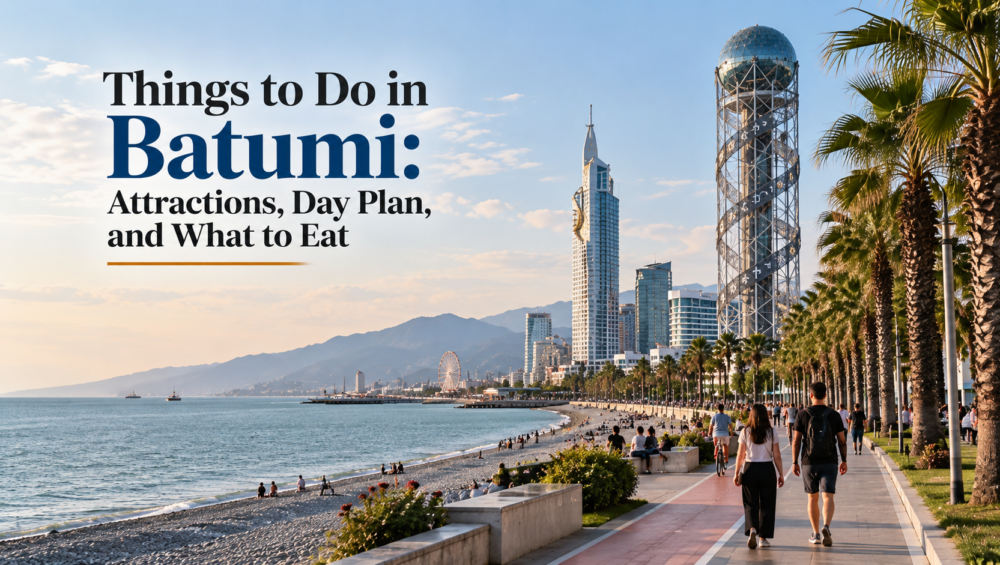
The Boulevard is the spine of Batumi — a roughly 7km seafront promenade established in 1881, with four historic alleys, a cycling path, and more than 40,000 trees and plants.

Almost everything else in this guide sits on or just off it.

You do not need a taxi or transport plan for the Boulevard itself — everything here is a short walk from the next.

The Ali And Nino Statue

Two 8-metre moving metal figures by Georgian sculptor Tamar Kvesitadze slowly approach each other, merge, and separate — the full cycle runs roughly every 10 minutes.

The movement is barely perceptible in daylight; the real effect is in the evening lighting from around 7pm.

Arrive by 6:45pm to get your position before the crowd builds.

The statue is free to view and stands along the coastline on the Boulevard.


It depicts an Azerbaijani man and a Georgian woman from Kurban Said’s 1937 novel Ali and Nino — sometimes called a Caucasian Romeo and Juliet — representing coexistence across religious and cultural lines.

The Alphabet Tower

A 130-metre structure in Miracle Park, shaped around a DNA-helix spiral and encoding the 33 letters of the Georgian alphabet.

The observation deck and restaurant occupy the top two floors, reached by lift or one of the longest pedestrian staircases in Batumi.

Entry costs 5–20 GEL depending on the floor you go to, and the tower is open from 10am to midnight daily.

That midnight closing makes it one of the few Batumi attractions suited to a late evening — worth keeping in mind if you want to combine it with the Ali and Nino statues in one evening stretch.

Europe Square And Batumi Piazza

Europe Square is centred on a statue of Medea holding the Golden Fleece — a nod to Georgia’s ancient association with the myth of Jason and the Argonauts (the same myth that gives the Argo cable car its name).

The square has restaurants, shops, hotels, and a dancing fountain.

A short walk away, Batumi Piazza is an Italian-style square built around a 106-square-metre central mosaic and a clock tower.

Both are free to enter and walkable from the Boulevard in under 10 minutes.

The Argo Cable Car

The Argo cable car runs 2.6km from the port area up roughly 250 metres to the summit of Anuria Mountain.

The ride takes about 10–15 minutes each way.

At the top, the complex has an observation deck with views over the city and the Black Sea, a Georgian restaurant, and a cultural stage with live Georgian dance and music performances.

The round-trip ticket costs approximately 30 GEL as of October 2026.

Operating hours are 11am to 10pm daily, seven days a week.

Go in the late afternoon rather than midday — the light on the sea is better, and weekday afternoons have shorter queues.

The official website for current pricing and performance schedules is argo-batumi.ge.

Batumi Botanical Garden

The Botanical Garden sits about 9km north of the city centre and covers more than 110 hectares with roughly 5,000 plant species, including Japanese sakura, Canary date palms, and over 2,000 tree species.

Entry for foreign visitors is 20 GEL.

Children under 6 enter free.

Guided tours cost 80 GEL, and an electric bus ride inside the garden is an additional 5–10 GEL.

Opening hours are 9am to 5:30pm daily, extended to 8pm in June, July, and August.

How to Get There Without a Taxi

Minibuses 15, 31, and 40 serve different entrances to the garden. The fare is 50 Tetri per person each way.

The Church of the Holy Spirit near the city centre is a common boarding point. A taxi is optional, so you can save the fare and spend it inside the garden.

Allow 2–3 hours. The garden is large, and a quick visit misses most of it.

The Beach: What To Pack And When To Go

The Beach: What To Pack And When To Go

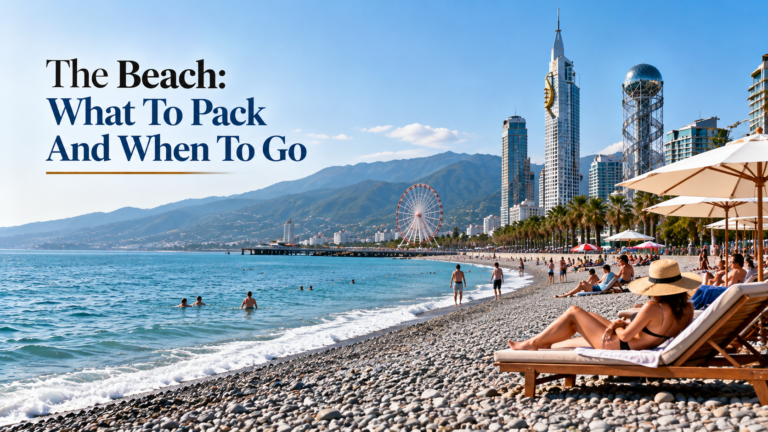
Batumi’s beach runs alongside most of the Boulevard for roughly 7km — but it is pebble, not sand.

Walking on it barefoot is genuinely uncomfortable.

Pack water shoes or thick-soled sandals before you arrive; buying them at the last minute in Batumi is possible but adds unnecessary cost and time.

The sea is comfortably swimmable from roughly July to mid-September, when the water temperature sits around 27–28°C.

By late September the water cools to around 21°C, and outside the July–mid-September window, the beach is a scenic walk rather than a swimming stop.

If your Georgia trip falls in May, June, or October, plan the beach time as a stroll along the Boulevard rather than a swim day, and redirect the afternoon to the Botanical Garden or Argo cable car instead.

See the best time to visit Georgia for how the season affects the rest of the route.

Day Trips From Batumi

Two worthwhile stops sit just outside the city for those with a free half-day or a full day.

Neither is part of the standard sightseeing on Roaming Legs’ itinerary — both are arranged by the traveller on the ground.

Gonio Fortress

Gonio Fortress is about 15km south of Batumi towards the Turkish border, roughly 20–25 minutes by road.

It was built by the Romans in the 1st century AD and is among Georgia’s oldest fortifications.

A 900-metre perimeter wall stands 5 metres high, with 18 of the original 22 towers surviving.

Local tradition holds that the Apostle Matthias is buried within the walls.

An on-site museum displays artifacts covering the site’s Roman, Byzantine, and medieval layers.

Entry is approximately 10 GEL as of October 2026.


A taxi from Batumi is the most practical option; the distance is short enough that a round-trip fare is reasonable.

Mtirala National Park

Mtirala National Park is 25km from Batumi and received UNESCO World Natural Heritage status in 2021 along with two other Adjara parks.

The shuttle fact most guides miss: A dedicated shuttle to the Chakvistavi Visitor Centre runs from Batumi on Mondays and Fridays only, costing 3 GEL per person and taking about 45 minutes.

On any other day, the only options are a taxi (80–100 GEL each way) or an organised tour.

The easier trail — Trail 1 (Tsalbnari, 7km circular) — is open May to October and includes a waterfall, a cable section, and a lake.

Trail 2 (Tsivtskaro, 16km, two-day) is open June to September, reaches 1,250 metres elevation, and the park recommends a ranger or guide.

If your Batumi days fall on a Tuesday, Wednesday, Thursday, or Saturday or Sunday, plan either a taxi budget or an organised tour — or shift Mtirala to Monday or Friday if the dates allow.

Contact for the visitor centre is +995 577 10 18 89.

What To Eat In Batumi

Ajarian food is distinct from the rest of Georgian cooking — heavier on dairy, with influences from the Black Sea coast and the mountains above.

Adjarian Khachapuri is the signature dish: a spindle-shaped cheese pie with butter and a raw egg broken on top at the table.

Tear off pieces from the sides and dip them into the butter-egg mixture.

If you prefer no egg, you can ask for it without — the egg is added to order, not baked in.

A portion costs 10–24 GEL depending on the restaurant.

Chirbuli is scrambled eggs with cauliflower and other vegetables in generous butter — one of the most straightforward vegetarian options in Ajarian cooking.

Borano is cheese and butter baked in a clay pot, served with bread.

Sinori — thin bread rolls filled with cottage cheese, sour cream, and butter — is another vegetarian-friendly option worth trying.

Ajarian Kawarma is thinly sliced, chili-seasoned meat served in a traditional clay vessel. Local baklava with honey and walnuts is a popular dessert.

Coffee brewed on hot sand is a Batumi tradition worth trying once.

Daily food and entertainment for two: 100–160 GEL, excluding accommodation.

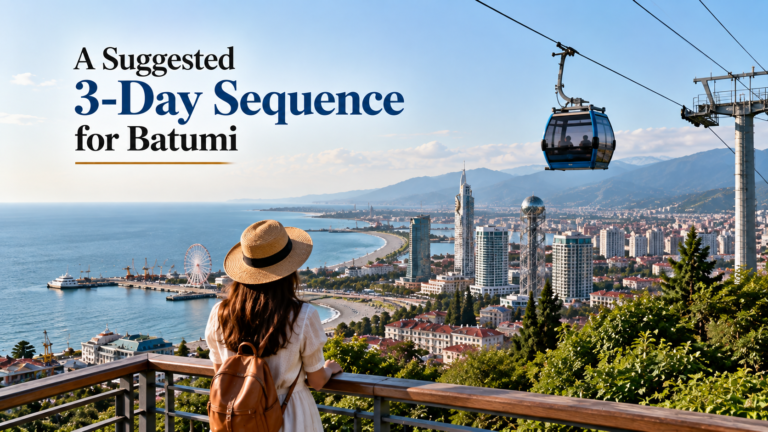
A Suggested 3-Day Sequence for Batumi

A Suggested 3-Day Sequence for Batumi

This is the sequence that fits the 3-night Batumi allocation on Roaming Legs’ 10-day route.

Adjust it if your dates fall on a Monday or Friday — that is when the Mtirala shuttle runs, and it is worth building Trail 1 around it.

Day 1 — The Boulevard and Evening Skyline

Walk the Boulevard at your own pace in the morning.

In the afternoon, take the Argo cable car (11am–10pm; ~30 GEL return) up to Anuria Mountain.

At 6:45pm, position yourself near the Ali and Nino statues for the 7pm merge.

Walk from there to the Alphabet Tower (open until midnight; 5–20 GEL) for views after dark.

Day 2 — Botanical Garden and Old Town

Take minibus 15, 31, or 40 (50 Tetri) to the Botanical Garden; it opens at 9am.

Allow two to three hours — the electric bus inside the garden covers ground faster if your group prefers not to walk the full terrain.

Return to the city for a late lunch and spend the afternoon at Europe Square and Batumi Piazza.

Try Adjarian Khachapuri at a local restaurant near the Boulevard for dinner.

Day 3 — Day Trip

If Day 3 falls on a Monday or Friday: take the 3 GEL shuttle to Mtirala for Trail 1 (7km circular; open May–October).

Any other day: take a taxi to Gonio Fortress (15km, ~10 GEL entry) in the morning and return by early afternoon.

Mistakes That Cost Batumi Visitors Time

  • Visiting the Ali and Nino statues before 6:45pm and missing the merge.
  • Going to Mtirala on a non-shuttle day without a taxi budget — 80–100 GEL each way is a significant unplanned cost.
  • Arriving at the Botanical Garden by taxi when buses 15, 31, and 40 cover the same route for 50 Tetri.
  • Forgetting water shoes for the pebble beach.
  • Trying to swim in Batumi in October — the sea drops to around 21°C and the peak season ends in mid-September.
  • Booking the Alphabet Tower visit for midday when it offers better value as an evening stop open until midnight.

Frequently Asked Questions

What Is The Best Time To Visit Batumi For Swimming?

July to mid-September.

The sea reaches around 27–28°C in summer and is comfortably swimmable across that window.

By late September, the water cools to around 21°C. Scenic, but no longer a beach day by most standards.

Is Batumi Beach Sand Or Pebble?

Pebble, not sand.

The beach runs for roughly 7km alongside the Boulevard, but walking it barefoot is uncomfortable.

Pack water shoes or thick-soled sandals before you arrive.

What Time Does The Ali And Nino Statue Move?

The figures begin their cycle at approximately 7pm each evening.

They approach, merge, and separate in a cycle that repeats roughly every 10 minutes.

Arrive by 6:45pm to find a good viewing position before the crowd builds around the statue.

How Much Does The Argo Cable Car Cost?

A round-trip ticket costs approximately 30 GEL as of October 2026.

The cable car runs 11am to 10pm daily, seven days a week.

Check argo-batumi.ge before your visit as seasonal pricing can vary.

How Do I Get To The Botanical Garden Without A Taxi?

Minibuses 15, 31, and 40 each run from the city to a different entrance of the Botanical Garden.

The fare is 50 Tetri per person each way.

The Church of the Holy Spirit near the city centre is a common stop for these routes.

The garden opens at 9am daily and closes at 5:30pm (8pm in June–August).

Is Mtirala National Park Worth Visiting From Batumi?

Yes, but only plan it if your visit falls on a Monday or Friday.

The public shuttle runs only on those two days (3 GEL, 45 minutes).

On any other day, a taxi costs 80–100 GEL each way, which adds significantly to your day-trip budget.

Trail 1, a 7km circular route with a waterfall and lake, is the easier option and runs May to October.

What Food Should I Try In Batumi?

Start with Adjarian Khachapuri, a cheese pie with butter and a raw egg broken on top at the table.

Also try Borano, cheese and butter in a clay pot, Chirbuli, eggs with cauliflower, a vegetarian dish, and Sinori, cheese-filled bread rolls.

Finish with coffee brewed on hot sand. It is a Batumi-specific tradition.

Are There Vegetarian Options In Batumi?

Yes.

Chirbuli, scrambled eggs with cauliflower in butter, Sinori, cottage cheese rolls, and Adjarian Khachapuri without egg are all vegetarian-friendly.

Most restaurants along the Boulevard and in the Old Town carry these dishes.

If you prefer to avoid egg entirely in the Khachapuri, ask for it without. The egg is added to order.

How Many Days Is Enough In Batumi?

Two nights cover the Boulevard highlights, the Argo cable car, and one meal out.

Three nights give you a proper Botanical Garden morning and one day trip, such as Gonio or Mtirala.

On Roaming Legs' 10-day route, Batumi is the longest single stop at three nights, built in deliberately as downtime after the mountain and wine-country legs.

Is Batumi Already Part Of The Roaming Legs Georgia Package?

Yes, on the 10-day Full Route. It is the longest single stop, with three nights after Borjomi.

On the 5-day or 7-day route, Batumi can be added as a paid extension to a private booking.

It is not included by default on either shorter itinerary, so mention it when you enquire and our team will build it in.

See the Georgia tour packages from India page for the full route options.

What Are The Opening Hours Of The Alphabet Tower?

The Alphabet Tower is open 10am to midnight daily.

Entry costs 5–20 GEL depending on the level you visit.

It is one of the few Batumi attractions that works as a late-evening stop. Combine it with the 7pm Ali and Nino merge on the same Boulevard stretch.

Batumi Rewards Some Planning and Practically No Rush

Three nights covers the Boulevard, cable car, botanical garden, a day trip, and two proper Ajarian meals when the days are sequenced well.

Most time-wasting mistakes come down to timing: missing the statue merge, visiting Mtirala on the wrong day, or planning a swim in October.

Still deciding whether Batumi fits your Georgia route? Speak to our Georgia specialist to confirm what is already included in your itinerary.

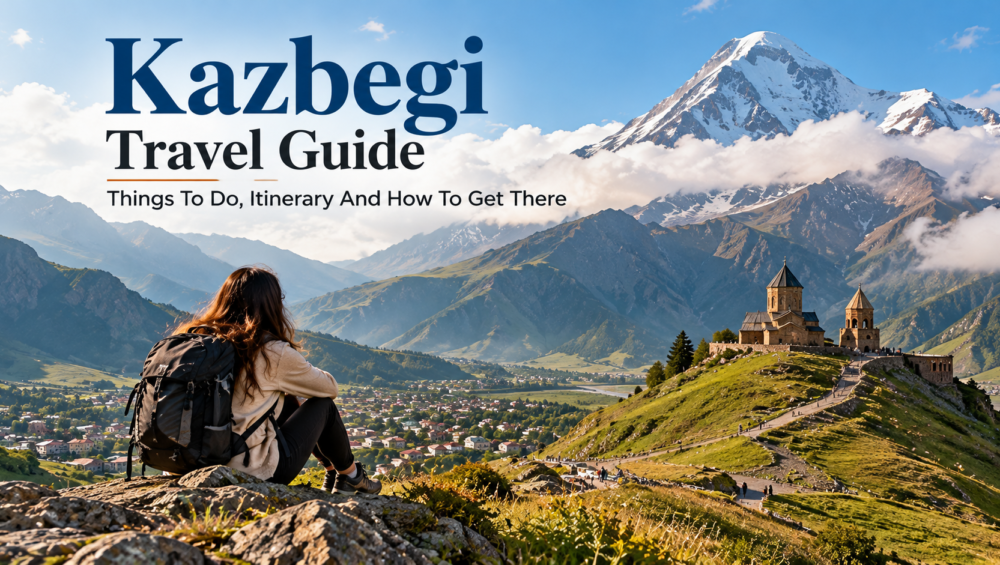
Kazbegi Travel Guide With Itinerary and Tips

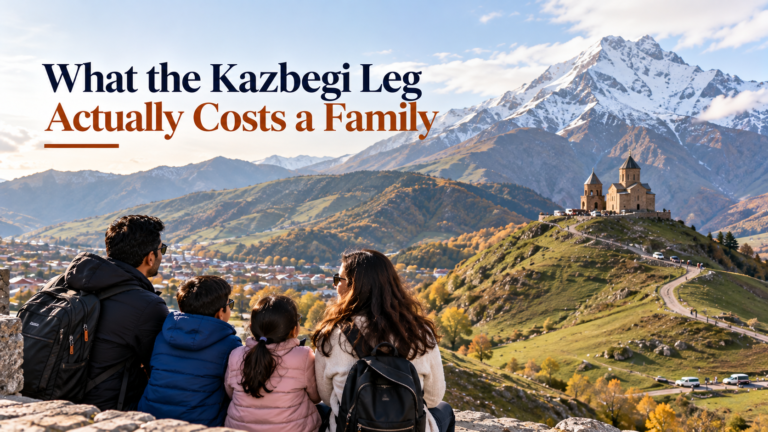
Kazbegi Georgia Travel Guide With Things to Do and a 2-Day Itinerary

On 10 February 2026, Georgia’s Roads Department closed the Gudauri–Kobi section of the Georgian Military Highway to all vehicles because of avalanche danger.

Kazbegi sits beyond that section — a closed road cuts it off completely.

Closures like this happen several times a year in winter, for hours or days at a time, and most travelers only find out after they’ve already booked non-refundable hotel nights.

There is a second fact that changes what time you leave Tbilisi: Mount Kazbek, the 5,054m peak directly behind Gergeti Trinity Church, is shrouded in cloud or mist more than 70% of the time after 2pm.

Leave by 8am and you have a much better chance of seeing it clearly.

And a third: Kazbegi is almost entirely a cash economy.

Most restaurants, guesthouses, and 4×4 taxi drivers accept only GEL — draw cash in Tbilisi before you leave.

This roadmap covers what you need to plan the Kazbegi leg of your Georgia trip correctly, current as of October 2026.

How To Get To Kazbegi From Tbilisi

Stepantsminda (the town’s official name, though everyone still calls it Kazbegi) is 157–166km north of Tbilisi on the Georgian Military Highway.

The drive takes roughly 3–4 hours at a comfortable pace, including stops.

Georgia’s official tourism site clocks the direct drive at about 2 hours 55 minutes without stops, but that doesn’t account for the mountain roads after Gudauri.

Lorem ipsum dolor sit amet, consectetur adipiscing elit. Ut elit tellus, luctus nec ullamcorper mattis, pulvinar dapibus leo.

Transport Options

Private Vehicle

The most practical choice for families and groups. You control the stops, timing, and pace. Roaming Legs uses a private vehicle for the full trip.

Shared Marshrutka

From Didube Bus Station from around 8 AM. Approximately 15–20 GEL per person and 3.5–4 hours. Pay the driver directly.

Private Taxi

Around 150–250 GEL one-way, depending on the season. GoTrip.ge lists licensed drivers.

Carry Cash: Fuel stops, roadside food, and the 4×4 taxis at Stepantsminda generally require payment in GEL.
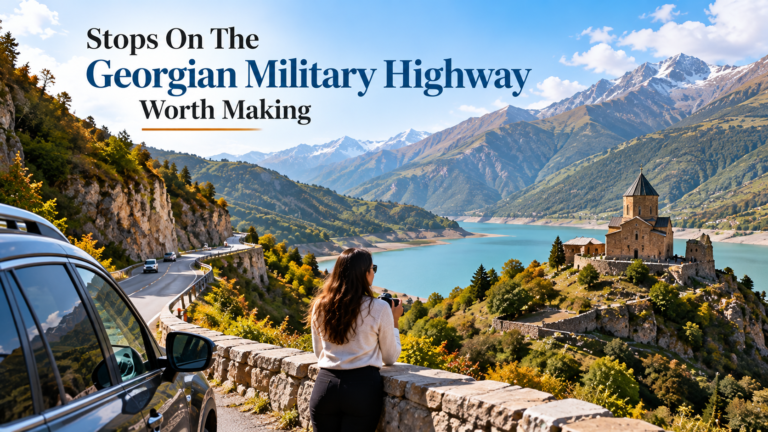
Stops On The Georgian Military Highway Worth Making

Stops On The Georgian Military Highway Worth Making

The highway from Tbilisi to Stepantsminda is one of the better drives in Georgia.

These stops sit on the route and add no meaningful detour:

  • Zhinvali Reservoir (km 70): A turquoise lake that supplies Tbilisi’s water — visible from the road and worth a brief stop for photographs.
  • Ananuri Fortress (km 72): A 13th-century fortress complex on the reservoir edge; entry is free. Allow 30–40 minutes.
  • Gudauri viewpoint / Jvari Pass (km 140, 2,379m elevation): The road crests here before descending toward Stepantsminda; the view back across the mountains is one of the best on the whole highway.
  • Friendship Monument (km 145): A Soviet-era mosaic structure above a canyon with a 900m drop; takes 10 minutes and is often missed.

Note: at Jvari Pass, temperatures average 5–10°C even in summer, while Tbilisi may be 35°C.

Bring a jacket from the car regardless of how warm it felt when you left.

The One Timing Fact That Changes Your Plan

[Verified by Georgian Military Highway road guides]: Mount Kazbek is clear roughly 70% of the time before noon.

After 2pm, that drops to around 30%.

Leave Tbilisi by 8am to reach Stepantsminda before noon and catch the mountain before the afternoon cloud builds.

If you arrive after 2pm, you may spend your first afternoon looking at mist — and the next morning is not guaranteed to be clearer.

Things To Do In Kazbegi

Gergeti Trinity Church

The church — officially Tsminda Sameba — is the reason most people come to Kazbegi.

It was built in the 14th century at roughly 2,170m above sea level, on a hillside above Stepantsminda, with Mount Kazbek directly behind it.

Historically, the church served as a vault for Georgian relics and manuscripts during invasions — the location was chosen precisely because it was hard to reach.

Two ways up:

  • Hike: 1.5–2 hours one way; a well-marked trail from the town; manageable for most adults in reasonable fitness.
  • 4×4 taxi: Around 20–30 minutes each way; drivers wait at the town square; fare is cash-only, typically 30–50 GEL return per vehicle (prices vary seasonally — confirm before you get in).

The church is an active place of worship.

Dress modestly: shoulders and knees covered; headscarves available at the entrance for women.

Arrive early morning (before 10am) for the clearest views and fewest crowds.

Truso Valley — And The Permit You Need Before You Go

Truso Valley is 22km west of Stepantsminda and one of the most visually distinct places near Kazbegi.

The valley has orange and red travertine formations, a mineral lake (Abano), the ruins of Zakagori Fortress, and Keterisi Monastery.

You need a permit to go beyond Zakagori Fortress, because the valley borders a restricted zone.

The process is free: present your passport to the military personnel at the checkpoint, state that you’re a tourist and how long you plan to stay, and the authorization takes roughly 30 minutes.

Carry your original passport — a phone photo will not be accepted at the checkpoint.

The valley is accessible by 4×4 or horseback; the road beyond the fortress is rough.

Do not climb on the travertine formations — they are fragile and the damage is visible.

Allow a half-day for Truso Valley if you plan to go beyond the fortress.

Juta And Sno Valley

Juta village sits about 45 minutes from Stepantsminda and is the base for hiking toward the Chaukhi Massif — sometimes called the “Dolomites of Georgia.”

The Juta–Chaukhi trail is a serious full-day hike; a shorter option reaches Chaukhi Lake in 1–2 hours of walking from Juta.

The road to Juta is frequently under construction and may close seasonally — confirm conditions locally before you plan the day around it.

Sno Valley is en route to Juta and is an easy add-on: it has large stone head sculptures of Georgian historical figures, created in 1984, displayed in an open field at no charge.

Allow 2 minutes for the stone heads; allow the full day if you’re trekking toward Chaukhi.

Dariali Gorge And Gveleti Waterfalls

Dariali Gorge runs north from Stepantsminda toward the Russian border, following the Terek River.

The gorge has the Archangel Michael Church Complex built into a cliff face, and the Gveleti Waterfalls a short walk from the roadside parking area.

The falls are two separate drops; the larger one is the better view.

The round trip from parking to the second waterfall is about 2km and takes 15–30 minutes on foot.

There is no entrance fee.

Signal is poor in the gorge — download offline maps before you go.

A 2-Day Kazbegi Itinerary

Two days is the right amount of time to see Gergeti Trinity Church properly and fit one other valley excursion without rushing.

One day is enough only if you’re doing the church and returning to Tbilisi the same evening — and that means you’re spending most of your time in the car.

Day 1 — The Church And The Waterfalls

Leave Tbilisi by 8am, stop at Ananuri Fortress (30–40 minutes) and the Jvari Pass viewpoint (10 minutes), and arrive in Stepantsminda before noon.

Check in, eat, then go straight to Gergeti Trinity Church — this is the window when Kazbek is most likely to be clear.

Take the 4×4 taxi up (20–30 minutes) and walk back down if you have time and energy.

Late afternoon: drive to Dariali Gorge and walk to Gveleti Waterfalls (15–30 minutes on foot from parking).

Dinner in Stepantsminda — assume cash only unless you can confirm card acceptance at the restaurant.

Day 2 — Truso Valley Or Juta

Option A: Truso Valley

Leave by 9 AM. Stop at the checkpoint with your passport for the free permit (allow 30 minutes).

Drive or hire a local 4×4 to the fortress and beyond. Return by early afternoon.

Option B: Juta Valley

Leave by 9 AM and take a taxi to Juta (about 45 minutes).

Walk to Chaukhi Lake (1–2 hours) or further. Stop at the Sno Valley stone heads on the return.

Back to Tbilisi: Either option leaves time for the 3–4 hour drive back that afternoon. Stay a third night in Kazbegi to do both valleys without rushing.
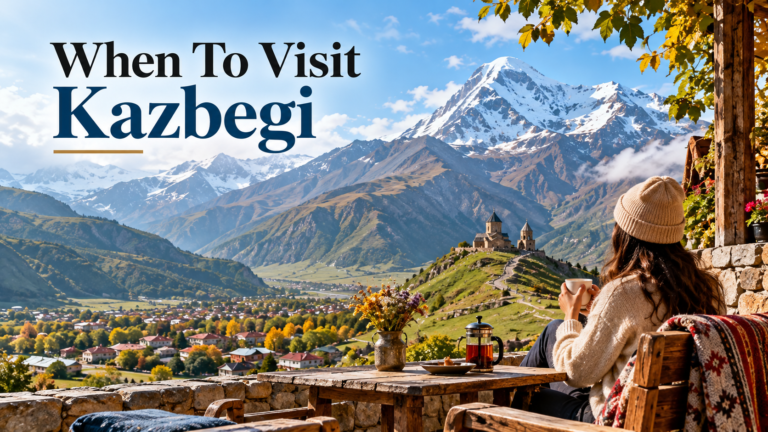
When To Visit Kazbegi

When To Visit Kazbegi

May to June and August to September are the most reliable windows.

Trails are open, weather is stable, and the mountain is visible on most clear mornings.

July and August are the warmest months and peak tourist season — the church gets crowded by mid-morning.

May and September offer similar conditions with fewer people.

Winter (November to March): The scenery is striking — snow-covered peaks and quiet roads — but road conditions are unpredictable.

The Jvari Pass closes for 3–8 hours (sometimes overnight) during snowfall; check georoad.ge before you travel in winter.

Georgia Today reported on 10 February 2026 that the Gudauri–Kobi section (km 93–107) was closed to all vehicles for avalanche danger, cutting Kazbegi off completely.

If you’re traveling between November and March, ask your operator for the contingency plan in writing before you pay.

For the full month-by-month breakdown for all of Georgia, see our [best time to visit Georgia guide →].

Cash, Cards And Connectivity In Kazbegi

Most of Kazbegi runs on GEL cash.

The 4×4 taxis to the church, most guesthouses, and smaller restaurants are cash-only.

Larger hotels may take Visa or Mastercard; RuPay and UPI do not work anywhere in Georgia.

Draw enough GEL in Tbilisi before you leave — budget conservatively for 2 days including accommodation, meals, local taxis, and the Gergeti 4×4.

ATMs in Stepantsminda are limited and can run dry on busy weekends.

Mobile data is unreliable in the valleys and gorges — download offline maps before leaving Tbilisi.

What To Pack For The Kazbegi Leg

The temperature gap between Tbilisi and the mountains catches most first-time visitors off-guard.

Tbilisi can be 30–35°C in summer; the Jvari Pass at 2,379m averages 5–10°C on the same day.

Pack a mid-layer jacket regardless of what the weather looks like when you leave the city, walking shoes with grip for the church trail and waterfall walk, sunscreen (UV is stronger at altitude), and GEL cash as described above.

Download offline maps for the Kazbegi district before you leave Tbilisi — signal drops without warning in the valleys and gorges.

Mistakes That Cost Indian Travelers Time And Money

  • Not drawing GEL cash in Tbilisi — the single most common problem; 4×4 taxis and most local restaurants only take cash.
  • Leaving Tbilisi after 10am — arriving in Stepantsminda after 2pm means a high chance of Mount Kazbek being cloud-covered for the rest of the day.
  • Skipping the Truso Valley permit step — arriving at the checkpoint without a passport means turning back; the permit is free and takes 30 minutes, but only if you have your original document.
  • Booking non-refundable hotel nights in winter without a road-closure contingency — the Gudauri–Kobi section has closed to all vehicles as recently as February 2026.
  • Relying on mobile data for navigation in the valleys — signal drops are unpredictable; offline maps are essential.
  • Underpacking for the cold — the church and pass are significantly colder than Tbilisi; a jacket left in the car is a jacket you will wish you had.

Frequently Asked Questions

How Many Days Do You Need In Kazbegi?

Two nights and two full days is the minimum to see Gergeti Trinity Church properly and visit one of the surrounding valleys without rushing.

One day is possible as a day trip from Tbilisi, but you will spend most of it driving. The round trip is 6–8 hours before you add time at the church.

If you want to hike to Juta and also visit Truso Valley, plan for a third day.

Is The Gergeti Trinity Church Hike Necessary, Or Can I Take A 4×4?

The 4×4 taxi is a fully valid option. It takes 20–30 minutes each way and gets you to the church without the 1.5–2 hour climb.

Drivers wait at Stepantsminda's town square. The fare is cash-only, typically 30–50 GEL return per vehicle.

The hike is worth it if you have the time and fitness. The descent offers different views, including the valley below.

Is The Georgian Military Highway Safe In Winter?

The road is generally maintained, but sections close without short notice.

The Jvari Pass section closes for 3–8 hours or longer during snowfall. The Gudauri–Kobi section (km 93–107) was completely closed to all vehicles on 10 February 2026 due to avalanche danger, per Georgia Today's report .

Check georoad.ge on the morning of your drive and ask your operator for a contingency plan before paying for winter accommodation in Kazbegi.

Do I Need A Permit To Visit Truso Valley?

Yes, to go beyond Zakagori Fortress.

The permit is free. Present your original passport to military personnel at the checkpoint and state that you are a tourist.

Authorization takes roughly 30 minutes, assuming the military are cooperative.

A passport photo on your phone is not accepted. Carry the original document.

What Time Should I Leave Tbilisi To See Mount Kazbek Clearly?

Leave by 8am to reach Stepantsminda before noon.

Georgian Military Highway road guides note that Kazbek is clear roughly 70% of the time before noon, compared to around 30% after 2pm.

Cloud and mist build up over the peak through the afternoon. There is no guarantee of a clear morning either, but early arrival gives you the best odds.

Can I Do Kazbegi As A Day Trip From Tbilisi?

Yes, but the round trip is 6–8 hours of driving alone.

You will have time for the church and possibly the waterfalls, but not the valleys.

An overnight stay, ideally two nights, is far better value for the distance.

Is There An ATM In Kazbegi / Stepantsminda?

There are one or two ATMs in Stepantsminda, but they can run out of cash on busy weekends and queues are long in peak season.

Draw all the GEL you need before leaving Tbilisi. TBC Bank and Bank of Georgia in central Tbilisi have reliable machines.

What Is The Difference Between Kazbegi And Stepantsminda?

They refer to the same place.

The town was originally Stepantsminda, renamed Kazbegi in 1925 under Soviet rule, and officially reverted to Stepantsminda in 2006.

The surrounding municipality is still Kazbegi and the mountain is still Mount Kazbek. Both names remain in active use on maps, signs, and in searches.

Is Kazbegi Suitable For Families With Young Children?

Yes, with planning.

Gergeti Trinity Church is accessible by 4×4 for children who cannot hike.

Dariali Gorge and Gveleti Waterfalls are easy walks suitable for most ages.

Truso Valley and Juta involve rough roads and are better for children aged 8 and above.

See our Georgia family tour packages for how the Kazbegi stop fits into a family-paced itinerary.

What Happens If The Road To Kazbegi Is Closed?

There is no alternative road route to Stepantsminda.

If the Jvari Pass or Gudauri–Kobi section closes, you wait for the closure to lift. Snow closures can last 3–8 hours, with avalanche-related closures lasting longer.

In winter, ask your operator for a contingency plan in writing before you pay for hotel nights in Kazbegi.

Do I Need Special Insurance For The Kazbegi Leg?

Since 1 January 2026, Georgia requires all tourists to carry health and accident insurance of at least GEL 30,000, valid from arrival to departure.

Medical facilities in Kazbegi are basic. Serious emergencies require evacuation to Tbilisi.

Make sure your policy explicitly covers mountain activities and medical evacuation.

Can I Trek To Mount Kazbek's Summit?

Mount Kazbek (Mkinvartsveri) at 5,054m is a multi-day technical mountaineering expedition. Crampons, ice axes, and high-altitude experience are required.

It is not a hiking trail accessible to general tourists.

Expeditions take 4–5 days from the Meteo Station base camp. Hire a licensed local guide if you are an experienced mountaineer.

Plan Your Kazbegi Visit Before You Book The Hotels

The Kazbegi leg rewards preparation more than most stops on a Georgia itinerary.

Get the timing, cash, and winter road situation sorted before you confirm anything, and the drive itself can become one of the best days of the trip.

Considering a Roaming Legs Georgia itinerary? Our Georgia specialist can walk you through the exact plan for your travel month.

Where to Stay in Georgia With Kids and Family

Where to Stay in Georgia With Family and Kids

Most Georgian hotels do not accept RuPay or UPI.

You will need a Visa or Mastercard — for the hotel deposit, for the advance booking, and for most in-hotel charges.

Connecting rooms are also not a standard configuration in Georgia.

If your family needs two adjoining rooms, you must request them in writing at the time of booking, not on arrival — many properties have only one or two such pairs, and they go first.

At Kazbegi, the one hotel with unobstructed Gergeti Trinity Church views books out 4–6 weeks ahead of peak summer and autumn dates.

A family that books flights and e-Visas without locking the Kazbegi hotel first often finds the mountain-view rooms gone.

This guide covers where to stay in Georgia with children — by city, by area, and by what to confirm before you pay — current as of October 2026.

What To Decide Before You Search For Hotels

Georgia's standard family itinerary covers three or four cities: Tbilisi, Kazbegi, and Borjomi.

Each has a different hotel landscape and different family needs.

Decide these first:
  • Which cities you are covering
  • Crib or extra bed
  • Connecting rooms
  • Vegetarian breakfast
  • Pool

A package with Roaming Legs takes care of the hotel selection: 5-star hotels throughout, private vehicle, and full-board meals.

Booking independently? The sections below explain what matters by city.

Where To Stay In Tbilisi With Family

Where To Stay In Tbilisi With Family

Tbilisi has two practical areas for Indian families on a standard Georgia itinerary.

The choice between them depends mainly on your children’s ages and how much the evening noise level matters to your family.

Old Town: Central, Walkable, But Noisier At Night

The Old Town — locally called Kala or the Altstadt — sits between the Narikala Fortress and the Metekhi Church, spanning roughly 2 km along the Mtkvari River.

It is the most practical base for sightseeing with children: the Narikala cable car, the free sulfur bath district, Rike Park, and the main pedestrian streets are all within a short walk.

The cable car from Rike Park to the Narikala fortress wall is a genuine draw for children — a 5-minute ride with views across the city, not merely a viewpoint for adults.

The trade-off is noise.

The Old Town’s main street — Shardeni — is lined with restaurants and bars that stay busy into the late evening, particularly on weekends and in peak season (June–September).

For families with children under seven who go to bed early, this is a material issue.

Ask specifically whether your room faces the street or a courtyard before you confirm.

Vake: The Quieter Family Choice

Vake is Tbilisi’s main residential and diplomatic neighbourhood, about 4 km west of the Old Town.

It is quieter, greener, and served by Vake Park — the city’s largest park, with open lawns and tree-lined paths — which borders the neighbourhood.

The trade-off is distance from the Old Town sights.

A taxi or ride from Vake to the Narikala cable car takes 10–15 minutes in normal traffic and 20–30 minutes in peak summer congestion.

For families with a private vehicle (standard on a Roaming Legs package), this adds no real inconvenience.

For families booking independently, factor the transfer cost and timing into every sightseeing day.

Hotels In Tbilisi That Work For Families

For Families Who Want A Recognised Brand

The Courtyard by Marriott Tbilisi (Rustaveli Avenue) is a reliable mid-to-upper-range option that Indian travelers find consistent with their hotel experience from other countries.

It is bookable with Marriott Bonvoy points, accepts Visa and Mastercard, and offers rooms with standard hotel configurations including cribs and extra beds on request.

Its location on Rustaveli Avenue places it within walking distance of Rustaveli Metro and the main cultural boulevard, though not directly in the Old Town.

The Sheraton Grand Tbilisi Metechi Palace sits on an elevated position above the Mtkvari River, about 10 minutes’ walk from the Old Town.

It is the closest internationally branded 5-star property to the Old Town sights and offers larger room footprints than many Old Town boutique hotels.

The Biltmore Hotel Tbilisi (operated by Millennium Hotels) is on Rustaveli Avenue, within walking distance of the National Museum.

All three chains accept international cards and offer the kind of standardised housekeeping and breakfast arrangements that reduce uncertainty for Indian families on a first trip.

None of the three has a dedicated children’s pool or kids’ club; these are not standard features in Tbilisi hotels.

For Families Who Want Space Near Old Town

Several mid-range and boutique properties in the Avlabari neighbourhood — one step above the Old Town on the hill — offer larger rooms at lower prices than the branded chains.

Properties here look across to the Narikala and the Old Town without sitting directly on the noisiest streets.

If you are booking independently, look for properties that explicitly list “courtyard-facing rooms” or “quiet side” — the difference in sleep quality for children is significant on busy summer nights.

Whatever property you choose in Tbilisi, confirm two things in writing at booking: whether a crib (travel cot) is available at no extra charge, and whether connecting rooms can be reserved for your dates.

Where To Stay In Kazbegi With Children

Where To Stay In Kazbegi With Children

Rooms Hotel Kazbegi

Rooms Hotel Kazbegi is the property most families consider in Stepantsminda. It overlooks the town and Gergeti Trinity Church and has an indoor heated pool, restaurant, and mountain-view rooms.

Its concierge can also assist with arranging the 4x4 jeep transfer from Stepantsminda for children who cannot manage the 5 km, 500-metre uphill route to Gergeti Church.

Book Early: Mountain-view rooms can sell out 4–6 weeks ahead during June–October. If Kazbegi is on your itinerary, consider securing the hotel before booking flights.

Peak-season rates were approximately US$200–280 per night in mid-2026. Verify current rates directly, as prices fluctuate.

Budget Option

Smaller guesthouses in Stepantsminda cost much less, but confirm:

  • Heating and hot water
  • English or Georgian language support
  • Availability of help during an emergency

Winter Note: The Gudauri–Kobi section of the Georgian Military Highway (km 93–107) can close during winter for avalanche control.

Travelling between November and March? Confirm the road status with your operator before finalising the hotel.

Where To Stay In Borjomi With Family

Borjomi is the easiest stop on a Georgia family itinerary.

The town is small, the central park is flat and paved, and the pace is entirely within a family’s own control.

Accommodation in Borjomi ranges from simple guesthouses to mid-range hotels clustered around the central park entrance.

The Borjomi central park is free to enter and has a cable car, a small amusement area, and Georgia’s natural mineral spring — the same Borjomi water sold across India, drinkable directly from the spring at no cost.

The park’s paved walkways are fully accessible for strollers and manageable for young children.

For families who want a hotel within easy walking distance of the park, book a property on or near the main street (Meskheti Street) rather than on the hill roads above the town, which require a steep climb.

Borjomi does not have the range of international hotel brands found in Tbilisi.

Most properties are local guesthouses or mid-range hotels; Georgian hospitality is generally warm and attentive, but do not expect a hotel concierge, a loyalty programme, or the same breakfast range as a Tbilisi 5-star.

For a family route that includes Borjomi, one night is usually sufficient.

It is best positioned as a rest day between Kazbegi (mountain intensity) and Tbilisi (city days), allowing children to recover before the flight home.

What To Confirm In Writing Before You Pay

A family hotel booking in Georgia needs more preparation than a standard adult booking.

Confirm each of the following in writing before you pay a deposit:

  • Connecting rooms: Available for your specific dates, not just “in the hotel” in general.
  • Crib or travel cot: Available for the child’s age and size, at no extra charge or with the charge confirmed.
  • Extra bed: Age and height of your child, so the hotel can advise whether a crib, cot, or rollaway is more suitable.
  • Vegetarian breakfast: Whether the included breakfast has sufficient vegetarian options — most Georgian breakfasts are heavy on eggs and dairy, which suits most Indian dietary needs, but confirm specifically if your family is strictly vegetarian.
  • Card acceptance: Whether a Visa or Mastercard is required for check-in or deposit; RuPay and UPI are not accepted at Georgian hotels.
  • Cancellation policy: The exact date by which you can cancel without penalty, in writing — not just “flexible” on the booking website.
  • 4×4 jeep transfer (Kazbegi only): Whether the hotel or your operator has arranged this in advance, or whether you need to book it separately on arrival.

Do not assume any of the above without written confirmation.

Georgian hospitality is genuine, but staff at smaller hotels may not speak fluent English. Get important requests and promises confirmed in writing rather than relying only on verbal assurances at check-in.

Your Hotel Booking Order, Step By Step

  1. Fix your itinerary cities and travel dates — your hotel choices follow from these.
  2. Confirm your Kazbegi hotel first; it has the tightest availability in peak season.
  3. Book Tbilisi next, confirming the area (Old Town vs Vake) based on your children’s ages and pace preference.
  4. Book Borjomi last; it has the widest availability and does not require the same advance window.
  5. At each booking, request connecting rooms, crib, and extra beds in writing.
  6. Confirm card acceptance; ensure you have a Visa or Mastercard ready for the deposit.
  7. Print all hotel confirmations and carry them in your cabin bag — border officers at Tbilisi airport can ask for proof of accommodation covering your full stay.
  8. Tell your Roaming Legs specialist (if travelling on a package) your children’s ages; hotel selection and room configuration are adjusted accordingly.

Mistakes That Cost Indian Families Money Or Time

  • Arriving at check-in without a Visa or Mastercard, assuming RuPay or UPI will be accepted.
  • Booking a Kazbegi hotel without confirming mountain-view room availability, then finding only town-facing rooms remain.
  • Requesting a connecting room on arrival rather than at booking, and finding none available.
  • Choosing an Old Town hotel with a street-facing room without asking which side it faces — important for families with children on early schedules.
  • Not printing hotel confirmations, then being unable to show accommodation proof at Tbilisi airport.
  • Booking Borjomi accommodation on a hill road without realising the walk to the central park is steep with a stroller or young children.
  • Assuming vegetarian breakfast is standard, without confirming the hotel’s specific offering.

Frequently Asked Questions

Do Georgian Hotels Accept RuPay Or UPI?

No, in almost all cases.

Georgian hotels use standard card terminals that accept Visa and Mastercard.

RuPay cards are not accepted, and UPI is not available at Georgian hotel payment points.

Carry a Visa or Mastercard for hotel deposits, in-hotel charges, and check-out settlement.

Can I Get A Crib Or Extra Bed For My Child At Georgian Hotels?

Yes, at most mid-range and 5-star hotels, but you must request it at booking, not on arrival.

State your child's age when you request the crib. Hotels differentiate between a travel cot for infants and a rollaway for older children.

Confirm whether there is an extra charge and get the response in writing.

Are There Connecting Rooms Available In Georgia?

Yes, at some hotels, but they are not a standard configuration.

Properties like the Sheraton Grand Tbilisi Metechi Palace and the Courtyard by Marriott Tbilisi have connecting rooms, but the number is limited.

Request them specifically, by room type and dates, at the time of booking.

Do not rely on "the hotel has connecting rooms". Confirm they are available for your dates.

Which Area Of Tbilisi Is Best For Families With Young Children?

Vake, if your children sleep early.

Old Town, if you prioritise walking distance to sights and your children handle some evening noise.

For families on a private-vehicle package, Vake's slight distance from the Old Town costs nothing in practice. A driver picks you up and drops you at every stop.

How Far In Advance Should I Book Kazbegi Hotels In Peak Season?

At least 4–6 weeks ahead for June–September and late September–October.

Mountain-view rooms at Rooms Hotel Kazbegi are the most sought-after and fill first.

If you are booking a Roaming Legs package, the hotel is arranged for you. Confirm that mountain-view rooms are specifically included.

Is Vegetarian Food Available At Georgia Hotels?

Georgian breakfasts typically include eggs, bread, local cheese, honey, and seasonal vegetables. Most options are suitable for lacto-vegetarian Indian travellers.

Confirm specifically if your family is strictly vegetarian, with no eggs, or vegan, as the standard Georgian breakfast is not vegan.

For lunch and dinner, Tbilisi has Indian restaurants, but mountain stops like Kazbegi have a limited and predominantly meat-heavy menu at local restaurants outside the hotel.

Do Hotels In Georgia Charge A Tourist Tax?

Georgia does not currently levy a national tourist tax added separately to hotel bills.

We could not confirm a formal per-night tourism levy in force as of October 2026. Verify with your specific hotel at booking, as local municipality charges can apply.

Can I Book Georgia Hotels Without A Credit Card?

Most mid-range and 5-star Georgian hotels require a card for the deposit or the guarantee at booking.

If you do not have a Visa or Mastercard, some properties may accept a cash deposit at check-in, but this is at the hotel's discretion.

Do not assume a cash guarantee will be accepted. Confirm in writing before you arrive.

Is Borjomi Worth Adding As A Hotel Stop For Families?

Yes, as a one-night rest day.

The central park is flat, paved, and free. It is the most accessible and low-effort stop on a Georgia family route.

It sits naturally between Kazbegi and a return to Tbilisi, making it a logical overnight rather than a detour.

One night is generally sufficient. Two nights can work if your children need a full recovery day after mountain travel.

What Should I Ask My Operator About Hotel Arrangements Before I Pay?

Ask for the specific hotel names and room types for each city.

Confirm that connecting rooms, if needed, are reserved, and ask for written confirmation from the hotel.

Ask whether mountain-view rooms are guaranteed at Kazbegi.

Ask whether the 4x4 jeep transfer to Gergeti Church is arranged, or whether you need to book it separately in Stepantsminda.

Ask whether full-board meals cover all three meals at every hotel stop, including Borjomi, or whether any meal is self-arranged.

Are Hotels In Kazbegi Suitable For Children Who Cannot Hike?

Yes.

Rooms Hotel Kazbegi has an indoor heated pool and an on-site restaurant, so children who cannot hike have a full day of activity available.

The 4x4 jeep transfer to Gergeti Church is the alternative to the hike. Arrange it before arrival, not on the day.

The drive from Tbilisi to Kazbegi is approximately 2.5–3 hours and is itself a significant part of the experience. The Georgian Military Highway passes through mountain scenery that children typically enjoy even from the vehicle window.

A family trip to Georgia involves three accommodation environments: a city hotel, a mountain lodge, and a small-town guesthouse or mid-range hotel.

Each needs different preparation. Confirm family-specific details such as card type, connecting rooms, crib, vegetarian food, and the jeep transfer in writing before you pay, rather than negotiating them on arrival.

7-Day Georgia Family Itinerary with Kids

7-Day Georgia Family Itinerary from India with Kids

Every child in your family needs their own Georgia travel insurance — not a family policy, not a shared certificate, but an individual policy in each child’s name, including infants.

Since 1 January 2026, Georgia’s mandatory insurance rule applies to every person crossing the border, regardless of age.

If you buy insurance at the airport on the day of travel, many policies carry a 6-hour exclusion window — your family may cross the border uninsured.

At Kazbegi, the stop every Georgia itinerary promises, a standard car cannot drive the final section to Gergeti Trinity Church.

Only a 4×4 can reach it — and there is no guaranteed vehicle waiting when you arrive.

This roadmap gives Indian parents a practical 7-day Georgia family itinerary, with the preparation steps that decide whether the trip goes smoothly, current as of October 2026.

Is 7 Days Enough for a Georgia Family Trip

Is 7 Days Enough for a Georgia Family Trip?

Yes — 7 days is enough to cover Tbilisi, a day in Mtskheta, the mountains at Kazbegi, and the wine region of Kakheti without rushing between them.

What it does not include is Borjomi or the Black Sea coast at Batumi — those require 10 days.

For families with older children who handle full days well, the 7-day route is the right call when time is the constraint.

For families with very young children or those who prefer a slower pace, the Georgia family tour packages page shows how a 10-day route adds Borjomi — a flat, paved town with a cable car and mineral springs that suits younger children particularly well.

Lorem ipsum dolor sit amet, consectetur adipiscing elit. Ut elit tellus, luctus nec ullamcorper mattis, pulvinar dapibus leo.

The 7-Day Georgia Family Route at a Glance

Day Where Primary Family Activity
1 Tbilisi (arrive) Airport transfer, Old Town evening walk
2 Tbilisi Cable car, Mtatsminda Park, zoo or botanical garden
3 Mtskheta + Kazbegi UNESCO site half-day, then drive to the mountains
4 Kazbegi Gergeti Trinity Church by 4x4 or hike
5 Kazbegi → Tbilisi (via Uplistsikhe) Cave city stop, return to base
6 Kakheti Sighnaghi hilltop town, Bodbe Monastery, vineyard landscape
7 Tbilisi (departure) Rike Park, Dry Bridge market, airport

Day-by-Day Georgia Family Itinerary

Day 1 — Arrive in Tbilisi

Your private transfer from Tbilisi International Airport takes you directly to your hotel.

If you land after midnight, your insurance start date must match the landing date — not the day you left India.

The Old Town is walkable from most central hotels and is a manageable first-evening stroll.

Keep Day 1 light — jet-adjusted children settle better with a short walk than a full programme.

Day 2 — Tbilisi Family Day

The Rike–Narikala cable car (₾5 per person) rises 50 metres above the Kura River in a 2-minute ride and is genuinely engaging for children.

Mtatsminda Funicular (₾2) — a 1905 wooden cable car at a 45-degree climb — brings you up to the hilltop park at 770 metres.

Mtatsminda Amusement Park charges ₾3–8 per ride and has attractions from carousels to rides for older children.

Tbilisi Zoo is a workable half-day for families with younger children, with ₾2–5 entry for children; active animal hours are 10:00–12:00.

Tbilisi Botanical Garden charges ₾2 for adults and is free for children under 6, and has a 20-minute waterfall walk through bamboo that children typically enjoy.

One caution: the Old City’s cobblestone streets are difficult for strollers.

Rike Park’s embankments and riverfront walkways are paved and accessible.

Plan your stroller-dependent movement around the embankment rather than the Old City lanes.

Day 3 — Tbilisi to Mtskheta, Then Kazbegi

Start early with a 20-km drive (20–25 minutes) to Mtskheta, Georgia’s ancient capital and a UNESCO World Heritage Site.

Jvari Monastery sits on a hilltop above the confluence of two rivers — the viewpoint is the most photographed sight in Mtskheta and takes 20–30 minutes.

Svetitskhoveli Cathedral is the main church where Georgian kings were crowned — allow 35–40 minutes.

Both sites have free entry.

Dress code applies to all family members: women and girls must cover heads and shoulders; men and boys need long trousers.

Shawls are provided at the entrances, but preparing children beforehand avoids friction at the gate.

After Mtskheta, the drive north on the Georgian Military Highway to Kazbegi is approximately 157 km and takes 2.5–3 hours, with an optional 30-minute stop at Ananuri Fortress, a riverside 17th-century castle with free entry.

Arrive at Stepantsminda (Kazbegi town) by late afternoon and let children acclimatise before the next morning — the town sits at 1,740 metres, which is noticeably thinner air than Tbilisi.

Day 4 — Kazbegi: Gergeti Trinity Church

This is the day that requires the most advance preparation — and the day most families get wrong.

Gergeti Trinity Church sits at 2,170 metres on a hill above town, with Mount Kazbek (5,047 metres) directly behind it on a clear morning.

A standard car cannot drive the final section of road to the church.

Only a 4×4 can manage the rough mountain terrain — this is not a guideline preference, it is a road reality.

Shared jeeps charge approximately ₾30–50 per person for a return trip; a private vehicle costs ₾100–150.

Confirm with your operator whether the jeep transfer is included in your itinerary or needs to be booked separately before you arrive.

Do not assume a vehicle is waiting at the square — availability is not guaranteed, especially in peak season.

The alternative is hiking: approximately 5 km each way with 550 metres of elevation gain, taking 1.5–2 hours up.

For children under 10, or any family with a child who does not regularly hike, the jeep is the right choice — make it confirmed before you travel.

Go early: cloud cover at this altitude is frequent after midday, and a clear view of Mount Kazbek requires a morning start.


Temperatures at Kazbegi run 10–15°C cooler than Tbilisi — carry warm layers for every family member regardless of the season.

Winter Note

The Roads Department closed the Gudauri–Kobi section (km 93–107) to all vehicles on 10 February 2026 due to avalanche danger.

Kazbegi sits beyond this section, so a closure cuts it off entirely.

Travelling between November and March? Ask your operator for a written contingency plan before you pay.

Day 5 — Kazbegi to Tbilisi via Uplistsikhe

The return drive from Kazbegi to Tbilisi takes 2.5–3 hours on the Georgian Military Highway.

An optional stop at Uplistsikhe cave city adds 1.5–2 hours to the day but is one of the most memorable stops for older children.

Uplistsikhe is 80 km from Tbilisi (approximately 1–1.5 hours from the cave site) and contains houses, temples, a theatre, and a prison carved directly into the rock.

Adult entry is ₾15; children under 6 enter free.

Two things families must know before entering:

The underground passage is slippery with limited natural light — a fall is a real risk for very young children.

The site has no shade on its upper sections — pack 1 litre of water per person, sun hats, and closed-toe shoes with grip.

If your children are small or the weather is hot, Uplistsikhe is a skip for this trip.

Arrive back in Tbilisi by early evening and use a base hotel for the final two nights to eliminate the last hotel move.

Day 6 — Kakheti: Sighnaghi and Bodde

Kakheti is approximately 112 km from Tbilisi — around 2 hours by private vehicle.

Sighnaghi is a hilltop town whose intact city walls and vine-covered lanes are walkable in 40–60 minutes.

Children enjoy the scale: the town is small enough to explore entirely on foot without fatigue.

Bodde Monastery is 2 km from Sighnaghi — an active women’s convent set in gardens.

Dress code applies here too: girls must cover heads and shoulders; boys in long trousers.

The drive through Kakheti passes vine orchards and mountain backdrops — a genuinely scenic day that suits families who need a lower-intensity day after Kazbegi.

Georgian cuisine in Kakheti is mild and manageable: khinkali (soup dumplings), fresh bread, and grilled meats appear at every local table.

Day 7 — Tbilisi Leisure and Departure

A free morning in Tbilisi for a final walk along Rike Park’s embankment or a visit to the Dry Bridge flea market.

The Dry Bridge is a good place for children to pick up a small souvenir — Soviet-era trinkets, colourful jewellery, and handmade crafts.

Allow 3 hours before your flight for the private airport transfer, and factor in check-in queues.

What Families Must Prepare Before Booking

What Families Must Prepare Before Booking

Every Child Needs Their Own Individual Insurance — Including Infants

Since 1 January 2026, Georgia’s mandatory insurance rule requires every tourist to carry individual health and accident insurance of at least GEL 30,000, covering arrival day to departure day.

This applies to every family member, including infants.

A family of four — two adults and two children — needs four separate insurance policies, each issued in the individual’s name against their passport.

One of the five most-common tourist mistakes at Georgia’s borders, as Georgia Today reported in September 2026, is “assuming children are covered under parents’ policies.”

They are not.

The policy must be presented in English or Georgian and must show seven specific details: the parties, the covered territory, the subject of insurance, start and end dates, the insured risks, coverage limits, and the premium amount and payment terms.

Do not buy insurance at the airport. Many policies carry a 6-hour exclusion after purchase — your family may cross the border before the cover begins.

Buy before your travel day.

If your Indian insurer’s certificate lacks any of the seven required details, the official e-Visa portal links two Georgian platforms — eInsurance.ge and eCover.ge — as alternatives.

Every Child Needs a Separate E-Visa

Georgia requires each traveller to have their own e-Visa application, regardless of age, even if a child is listed on a parent’s passport.

The application fee is US$20 plus a 2% processing charge — approximately ₹1,700 per child at current rates.

The fee is not refunded if the visa is denied or unused.

Each application requires a separate photo that meets the official specification: taken within 6 months, studio quality, not a phone photograph.

One family member can pay for multiple applications using one card — the card does not need to be in the child’s name.

Confirm your family’s e-Visa applications through the official portal, and keep one printed copy per person in your cabin bag.

Confirm the Kazbegi Jeep Before You Travel

A standard car cannot reach Gergeti Trinity Church. The final mountain section requires a 4x4.

Ask your operator in writing whether the jeep transfer is included in your Day 4 arrangement or needs to be booked separately at the destination.

Do not leave this unanswered until you arrive in Stepantsminda with children and no vehicle arranged.

Your Family’s Planning Order, Step by Step

  1. Fix your travel month — April–May or September–October for the best balance of weather, mountain access, and manageable temperatures for children.
  2. Check every family member’s passport: valid 3 months beyond the visa’s end date, 2 free pages, issued within the last 10 years.
  3. Get studio-quality photos for every family member within 6 months of travel — one per child for their separate e-Visa application.
  4. Buy travel insurance for every family member individually, before your travel day, each with at least GEL 30,000 cover and all seven mandatory details on the certificate.
  5. Apply for a separate e-Visa for each family member, including children, with email open and a Visa or Mastercard ready.
  6. Confirm with your operator that Day 4’s Kazbegi jeep arrangement is included or book it separately.
  7. If travelling November–March with Kazbegi on the route, request a written road-closure contingency before you pay.
  8. Pack the printed e-Visa, insurance certificate, hotel bookings, and passport photos for each family member in your cabin bag.

To understand what sits outside a package price, see the Georgia trip cost from India guide.

Mistakes That Cost Families Time or Money

  • Buying one family insurance certificate and assuming it covers all members — Georgia’s rule is one individual policy per person, including infants.
  • Purchasing insurance at the airport on travel day — the 6-hour exclusion window can leave your family uninsured at the border.
  • Missing each child’s separate e-Visa — a child refused at Tbilisi airport means the whole family turns back.
  • Assuming a 4×4 jeep will be waiting at Kazbegi without pre-arranging it — no guaranteed vehicle is on standby.
  • Booking a November–March trip with Kazbegi on the itinerary without asking for a road-closure contingency plan in writing.
  • Taking a stroller to Tbilisi’s Old City cobblestone lanes rather than the paved embankment.
  • Applying with phone photos for any family member’s e-Visa — the portal rejects them, and a rejected photo means a new application and a new fee.
  • Booking non-refundable flights before every family member’s e-Visa is approved.

Frequently Asked Questions

Is 7 Days Enough for Georgia with Kids?

Yes. 7 days covers Tbilisi, Mtskheta, Kazbegi, and Kakheti without rushing between them.

What it does not include is Borjomi or Batumi.

If you have very young children or prefer a slower pace, the 10-day route builds in more time and adds the low-effort stop at Borjomi.

Do Children Need Their Own Georgia Travel Insurance?

Yes. Every child, including infants, needs their own individual insurance policy in their name.

Since 1 January 2026, Georgia's mandatory rule applies to every person crossing the border regardless of age.

A family policy or a group certificate is not sufficient if it does not show each person's name and their individual GEL 30,000 cover.

What Happens If I Buy Insurance at the Airport?

Many policies carry a 6-hour exclusion period after purchase.

If your family crosses the border within those 6 hours, you may be uninsured during entry.

Buy insurance before your travel day, not at the airport, to avoid this gap.

Can Young Children Reach Gergeti Trinity Church Without Hiking?

Yes. By a pre-arranged 4x4 jeep from Stepantsminda town.

A standard car cannot drive the final section of road to the church.

Shared jeeps cost approximately ₾30–50 per person return; a private vehicle costs ₾100–150.

Confirm with your operator before you travel whether this is included or needs to be booked separately.

Which Days Are Most Physically Demanding for Children?

Day 4 in Kazbegi is one of the more demanding days. The base town sits at 1,740 metres and the church is at 2,170 metres, with cooler temperatures and thinner air than Tbilisi.

Day 5 at Uplistsikhe is also demanding. The underground passage is slippery with limited light, and the upper sections are fully exposed to sun.

Both days require sturdy closed-toe shoes for every family member.

Is Tbilisi Old City Stroller-Friendly?

No. The Old City's lanes are cobblestone and uneven.

Rike Park's riverfront embankments are paved and accessible, and the cable car to Narikala is stroller-accessible at the lower station.

Plan stroller-dependent movement around the embankment and major parks rather than the Old City lanes.

What Is the Best Month for a Georgia Family Trip?

September or October. Temperatures in Tbilisi reach 20–25°C, mountain roads are fully open, and crowds are lower than summer.

April–May is a good second choice if school calendars make autumn difficult, though May is Tbilisi's wettest month.

Avoid July and August with young children. Tbilisi temperatures can reach 33–38°C, and the Kazbegi and Uplistsikhe stops are significantly more draining in peak summer heat.

What Can Children Eat in Georgia?

Georgian food is mild and reliably manageable for children.

Khachapuri (cheese-filled bread), khinkali (meat or cheese soup dumplings), lobiani (bean flatbread), and grilled meats appear at most tables.

There is no significant chilli heat in Georgian cooking.

Tbilisi has Indian restaurants for families who want familiar options. Confirm current availability with your operator before banking on a specific restaurant.

Outside Tbilisi, Indian food is limited. Plan for Georgian cuisine on mountain and Kakheti days.

Should We Do the 7-Day or 10-Day Route with Kids?

The 10-day route is better for families with young children. It adds Borjomi, a flat paved spa town with a free-entry mineral park, and gives more time at each stop so travel days are less back-to-back.

The 7-day route works well for families with older children, roughly 8 and above, who handle full outdoor days confidently, and when school or work limits the trip to a week.

See the Georgia family tour packages page for both routes side by side.

Does the 2% TCS Apply to Each Child's Package Cost?

Yes. The 2% Tax Collected at Source on overseas tour packages applies to the total package value, including the cost attributed to each child.

The seller collects it at the time of payment.

It appears in your Form 26AS and can be claimed against your income tax in your annual return. Ask for it as a separate line on your invoice.

Do Children Need to Follow a Dress Code at Georgian Churches?

Yes. At all Georgian Orthodox churches and active monasteries on this route.

Girls and women must cover their heads and shoulders; boys and men must wear long trousers.

Shawls and wraps are provided at most church entrances, but preparing children before arrival avoids friction at the gate, particularly at busy sites like Svetitskhoveli Cathedral and Bodde Monastery.

Is There a Minimum Age for Uplistsikhe?

There is no official minimum age.

Children under 6 enter free.

The underground passage is slippery with limited light, and the upper sections have no shade. The site is physically demanding for small children.

Closed-toe shoes with grip are essential for all ages.

If you are travelling with children under 5, consider skipping Uplistsikhe and using Day 5 as a rest stop in Tbilisi instead.

Georgia's 7-day family route is well within reach for Indian families. The preparation is more detailed than a couple's trip, but the destination itself is genuinely suited to children who enjoy outdoor exploration.

Get the insurance and e-Visa right for every family member, confirm the Kazbegi jeep before you travel, and the logistics will not surprise you on the ground.

Best Places in Georgia for Kids by Age in 2026

Best Places to Visit in Georgia with Kids by Age

Georgia’s most photographed family moment — a child standing before Gergeti Trinity Church in Kazbegi — requires a 5 km hike with 500 metres of elevation gain.

Children under 8 cannot safely complete it on foot.

Most families find this out after they have booked non-refundable tickets.

The good news is that three other Georgia stops deliver more for young children than Kazbegi does, and Kazbegi itself is manageable if you arrange a 4×4 jeep before you arrive.

This guide maps every major Georgia destination to an honest age band, with the admission prices, physical-access realities, and scheduling details that most family travel guides skip — current as of October 2026.

For the full preparation checklist — individual e-visas, mandatory insurance, and passport photo rules for every family member — read our complete guide for families visiting Georgia before booking.

How To Use This Guide

Each destination below is rated for three age bands: under 5, ages 5–7, and ages 8 and above.

“Works well” means a child in that band has meaningful activities and can manage the terrain.

“Manageable with planning” means the stop is possible but requires advance arrangements.

“Not recommended” means the terrain, activity type, or schedule makes it genuinely poor value for that age group.

The guide covers the six stops on most India-to-Georgia family routes: Tbilisi, Kutaisi region, Borjomi, Kazbegi, Batumi, and Uplistsikhe.

Tbilisi: Where Every Age Group Has Something Real To Do

Tbilisi works for families at every age because the main activities are compact, accessible, and genuinely interesting to children.

The old town is small enough to cover without a car, and most family attractions sit within 3 km of each other.

Plan two full days here at minimum.

Narikala Cable Car And Rike Park

The cable car from Rike Park to Narikala Fortress costs GEL 2 per ride.

Children under 6 ride free.

The ride itself is the attraction for young children — a slow gondola over the old city with rooftop and river views.

Rike Park below the fortress has free playgrounds, fountains, and open lawns where children can run after a day of sightseeing.

Both the park and the cable car station are flat and pushchair-accessible.

Mtatsminda Amusement Park

Mtatsminda Park sits above Tbilisi and is reached by funicular from Rustaveli Avenue.

It has a Ferris wheel, carousel, bumper cars, and several children's rides. Children aged 3+ will find plenty to enjoy.

Family Tip: The funicular ride is part of the experience, with wooded hillside views and open city views at the top.

Tbilisi Zoo

Tbilisi Zoo charges GEL 3 per adult entry.

Children under 6 enter free.

A new Caucasian Fauna exhibition opened in 2025 featuring animals native to the Caucasus region — making it more than a standard zoo visit for school-age children with an interest in wildlife.

The zoo is not fully paved — a stroller works on main paths but not everywhere.

Allow two hours for a comfortable visit.

placeholder

Kutaisi Region: Georgia’s Best Stop For Children Who Ask Questions

The area around Kutaisi contains two attractions with genuine child-specific appeal: a cave with an underground river and a nature reserve with preserved dinosaur footprints.

Neither requires significant physical effort from children, and both are under two hours from Tbilisi by road.

Prometheus Cave: Underground River And Boat Ride

Prometheus Cave is a developed show cave near the town of Tskaltubo, approximately 15 km from Kutaisi.

The guided tour covers 1,060 metres of the cave system across six named halls, including stalactites, stalagmites, and underground pools.

Tour duration is approximately 60 minutes.

The cave maintains a constant temperature of 14°C year-round — bring a light layer for each family member, even in July.

Admission for children aged 6–17 costs GEL 5.50.

Children under 5 enter free.

Adult foreigners pay GEL 25.

At the end of the tour, an optional underground boat ride is available for GEL 17.25 per person — this is the highlight for most children and worth the extra cost.

The cave is open daily from 10:00 to 17:00.

It is not wheelchair accessible, but children who can walk the flat cave path without difficulty will manage without issue.

Sataplia Reserve: 200 Dinosaur Footprints In Limestone

Sataplia Nature Reserve, located 6 km west of Kutaisi, preserves 200 dinosaur footprints in Cretaceous limestone — the most significant dinosaur tracksite in the South Caucasus.

The footprints come from two species: a predator with 30 cm tracks and a herbivore with 48 cm tracks.

The reserve also includes a 309-metre cave with lit guided tours in English, Georgian, and Russian.

The cave temperature is 14°C — the same as Prometheus Cave — so the light-layer rule applies here too.

Admission for children aged 6–17 costs GEL 5.50.

Children under 6 enter free.

Adult foreigners pay GEL 17.25.

The reserve is open daily from 10:00 to 19:00.

There is no direct public transport from Kutaisi — take a taxi from the town square, which takes approximately 45 minutes and costs roughly GEL 20–25 each way.

A combined visit to both caves in a single day from Tbilisi is practical if you confirm opening times before departure.

Borjomi: The Easiest Stop On Any Family Route

Borjomi is the one stop on most Georgia family routes where the terrain is genuinely flat and the pace is entirely your own.

The central park is free to enter and has a cable car, a children’s play area, and Georgia’s famous mineral spring — the same Borjomi water sold across Indian supermarkets and airports.

Children can drink directly from the natural spring inside the park at no charge.

The park walkways are paved and accessible for pushchairs and young children.

Borjomi works particularly well as a rest day after Kazbegi, which involves more physical activity.

Families travelling with children under 5 will find Borjomi significantly easier than Kazbegi or the Kutaisi caves.

Kazbegi: The Mountain Stop That Needs A Plan

Kazbegi is worth visiting, but it requires decisions that most families miss.

The drive from Tbilisi on the Georgian Military Highway takes approximately 2.5 hours.

The mountain scenery and time in Stepantsminda village work for children aged 5 and above.

The hike to Gergeti Trinity Church — the photograph that defines every Georgia itinerary — is 5 km each way with 500 metres of elevation gain.

Children under 8 should not attempt it on foot.

The alternative is a pre-arranged 4×4 jeep from Stepantsminda town: local operators offer this, but you must book in advance — there is no guaranteed vehicle waiting when you arrive.

Ask your operator before travelling whether the jeep transfer is included in your itinerary or needs to be added separately.

One additional risk applies between November and March: the Gudauri–Kobi section of the Georgian Military Highway closes periodically for avalanche control, cutting off all road access to Kazbegi.

If you travel in winter, ask for a written contingency plan before you pay.

Batumi: Worth Adding For Older Children And Teens

Batumi has a flat seafront promenade that works well for younger children and a dedicated dolphinarium for older ones.

Shows run every Tuesday and Saturday at 16:00.

Tickets cost GEL 15 per person.

Children under 6 attend free.

Each show lasts 30–35 minutes.

The dolphinarium is located inside Batumi’s seaside park — combine it with an afternoon on the promenade to make a full day.

Batumi also has an aquarium and botanical garden that suit families with children aged 5 and above.

The beach itself has calm, shallow water near the shoreline, suitable for children who are comfortable in the sea.

Add Batumi to a 10-day itinerary rather than a 7-day one — it is 5–6 hours from Tbilisi by road, which makes it impractical as a day trip.

Uplistsikhe: Best For School-Age Explorers

Uplistsikhe is a rock-cut cave town dating from the 10th century BC, about 15 km east of Gori.

Best For Ages 7+

Uneven stairs, steep climbs and rock-cut paths make it unsuitable for pushchairs or children who are not confident walkers.

Cost & Time

Adults: GEL 15. Children under 6: free. Allow 1–1.5 hours for the visit.

Getting There

Taxi from Gori is the easiest option, around GEL 35–40. Public transport requires two changes and a 2 km walk.

Come Prepared

Bring water and snacks. Shade is limited during the summer months.

Family Tip: Children aged 7+ who enjoy history and outdoor exploration usually find the site genuinely engaging.

Stops That Work Better For Adults Than Children

Kakheti wine region: Georgia’s wine country centres on winery tours, tastings, and vineyard walks.

There are open spaces and some farmstays, but the primary activity — wine — has no equivalent for children.

Leave Kakheti for a couples or adult trip; it adds little for families with young children.

Gudauri: Gudauri is a ski resort at 2,000+ metres elevation.

In winter, it works for families with children aged 8 and above who ski.

Outside ski season (roughly November to April), the infrastructure is largely inactive and the area has very limited activities for families.

Do not include Gudauri in a non-ski family itinerary.

Svaneti: Svaneti’s medieval towers and glaciers are rewarding for teenagers and serious trekkers.

The drive from Tbilisi takes 7–8 hours on rough roads — impractical for young children on a standard 7 or 10-day trip.

Frequently Asked Questions

What Is The Best Place In Georgia For Families With Children Under 5?

Tbilisi and Borjomi are the two strongest stops for very young children.

Tbilisi has flat park areas, the Narikala cable car, a zoo with free entry for under-6s, and short walking distances in the old town.

Borjomi has paved paths, a pushchair-accessible park, and a free mineral spring.

Both stops avoid the physical terrain demands of Kazbegi and Uplistsikhe.

Can Toddlers Visit Kazbegi?

The drive to Kazbegi and time in Stepantsminda town is manageable for toddlers.

The hike to Gergeti Trinity Church is not. It is 5 km with 500 metres of elevation gain.

If Kazbegi is on your itinerary with a child under 5, arrange a 4x4 jeep to the church in advance and keep the rest of the day at town level.

Which Georgia Attractions Have Free Entry For Children?

Children under 5 enter Prometheus Cave free.

Children under 6 enter Sataplia Reserve, Tbilisi Zoo, and the Narikala cable car free.

Children under 6 also attend Batumi Dolphinarium shows free.

Children under 6 enter Uplistsikhe free.

Borjomi central park is free for all visitors.

Is Prometheus Cave Suitable For Children Who Are Afraid Of Enclosed Spaces?

The cave is a developed show cave with LED lighting throughout all six halls.

It is not a cramped tunnel. The main passage is wide enough for groups to walk comfortably.

Most children who are nervous about confined spaces manage without difficulty.

The underground boat section at the end is optional. Families can exit via the main route if needed.

How Long Does A Day Trip To The Kutaisi Caves Take From Tbilisi?

The drive from Tbilisi to Kutaisi takes approximately 1.5–2 hours each way.

Prometheus Cave tour: 60 minutes.

Sataplia Reserve: 1.5–2 hours including the cave and dinosaur footprints.

Travel to Sataplia from Kutaisi town: 45 minutes by taxi each way.

A combined visit to both caves in a single day from Tbilisi is possible but makes for a full day. Plan an early start.

Is Batumi Worth Adding To A Georgia Family Trip?

Yes, if you have 9–10 days.

The dolphinarium shows, beach, and promenade make it a genuinely different experience from the mountain and cave stops.

With only 7 days, the 5–6 hour drive each way from Tbilisi makes it difficult to justify. Prioritise Kazbegi and the Kutaisi caves instead.

What Age Is Uplistsikhe Suitable For?

Children aged 7 and above who are comfortable on uneven ground manage Uplistsikhe well.

The site has rock-cut staircases and steep paths with no marked trails.

Pushchairs are not practical here.

Children under 7 will find the terrain genuinely difficult rather than exciting.

Is The Borjomi Mineral Spring Safe For Children To Drink?

Yes.

The spring in Borjomi Central Park is the same natural mineral water sold in bottles under the Borjomi brand across India and internationally.

Children can drink directly from the spring at no charge.

The water has a distinct mineral taste that some children find unusual at first; it is not harmful.

Do Indian Children Need A Separate Georgia E-Visa?

Yes. Every traveller, including infants listed on a parent's passport, needs their own Georgia e-Visa application.

The fee is US$20 plus 2% per application.

Since 1 January 2026, each child also requires individual health and accident insurance covering at least GEL 30,000.

See our family preparation guide for the full document checklist.

What Is The Best Month To Visit Georgia With Children?

September and October are the best months.

Temperatures in Tbilisi reach 20–25°C, comfortable for outdoor days without the 32°C+ heat of July and August.

The Kazbegi road is fully open, crowds are lower than summer, and prices are typically lower.

April and May are a good second choice if school calendars do not allow autumn travel.

Avoid November to March if Kazbegi is on the itinerary. The Gudauri–Kobi road section closes periodically for avalanche control and can cut off access to Kazbegi without notice.

How Do I Book A Jeep To Gergeti Trinity Church For My Children?

Your tour operator should arrange this as part of the Kazbegi day.

If arranging independently, jeep transfers are offered by local operators in Stepantsminda, but supply is not guaranteed on the day, particularly in peak season.

Ask in writing before your Kazbegi day whether the transfer is confirmed. Do not assume a vehicle will be available when you arrive.

Georgia's main family stops cover a wide range of ages: cave exploration near Kutaisi, mountain scenery at Kazbegi, a coastal afternoon in Batumi, and two relaxed days in Tbilisi.

The stops that need advance planning, including Kazbegi's jeep transfer, the dolphinarium schedule, and cave temperatures, are all manageable once you know them.

Georgia Family Trip Cost from India in 2026

How Much Does a Georgia Family Trip Cost for 4?

Most Georgia cost guides give you a per-person figure.

A family of 4 is not one person.

Every child needs their own e-Visa application — that’s ₹3,300 per child, non-refundable.

Since 1 January 2026, every child also needs their own travel insurance policy of at least 30,000 GEL; a single family policy does not satisfy Georgia’s border requirement.

The 2% Tax Collected at Source (TCS) introduced in Union Budget 2026-27 applies to the full package value for every family member from April 1, 2026.

And the 4×4 jeep that gets young children up to Gergeti Trinity Church in Kazbegi is not in the package price — it must be arranged and paid separately.

This is the real cost breakdown for a Georgia family trip from India, built around a family of 4, current as of October 2026.

What A Georgia Family Trip Actually Costs: The Quick Answer

The table below shows Roaming Legs’ starting package prices, plus the verified extra costs a family of 4 realistically adds on top.

Lorem ipsum dolor sit amet, consectetur adipiscing elit. Ut elit tellus, luctus nec ullamcorper mattis, pulvinar dapibus leo.

Item 7-Day Trip 10-Day Trip
Package (per person, twin-sharing) ₹1,38,000 ₹1,89,000
Package for 2 adults ₹2,76,000 ₹3,78,000
Package for 2 children (same rate) ₹2,76,000 ₹3,78,000
Package total, family of 4 ₹5,52,000 ₹7,56,000
Flights (₹30,000–₹65,000 × 4) ₹1,20,000–₹2,60,000 ₹1,20,000–₹2,60,000
e-Visa fee × 4 (~₹3,300 each) ~₹13,200 ~₹13,200
Insurance × 4 (indicative) ~₹6,000–₹18,000 ~₹8,000–₹26,000
2% TCS on package ~₹11,040 ~₹15,120
Estimated total before personal spending ~₹7,02,000–₹8,54,000 ~₹9,12,000–₹11,12,000

Package prices are starting figures, twin-sharing. Child pricing applies the same per-person rate unless Roaming Legs quotes differently based on your children’s ages — ask when you enquire. Rupee amounts for visa and exchange-rate-dependent items are approximate at October 2026 rates.

Included Details
Hotels 5-star throughout
Transport Private vehicle for the full trip
Meals Full board
Visa Assistance with the Georgia e-visa process — no Roaming Legs service charge
Customization Private booking, fully adjustable to your family's pace

Flights are not included by default but can be added to your package.

The Extra Costs That Hit Families Harder

The Extra Costs That Hit Families Harder

Visa Fee: ₹3,300 Per Person, Per Child

Georgia has no family visa and no group application.

Each traveller — including every child, regardless of age — needs their own separate e-Visa application on the official e-Visa portal.

The fee is approximately USD 35 per application: a USD 20 consular fee plus a USD 15 DuVerify identity-verification step — roughly ₹3,300 per person at current exchange rates.

The fee is not refunded if the visa is denied or the trip is cancelled.

One family member’s card can pay for multiple applications; the card does not need to be in the traveller’s name.

For a family of 4, that is ~₹13,200 in non-refundable government fees before a single hotel night is booked.

Mandatory Travel Insurance: One Policy Per Person, Not Per Booking

Since 1 January 2026, Georgia requires every tourist to carry health and accident insurance of at least 30,000 GEL covering their full stay.

Georgia Today’s reporting (September 2026) on the first nine months of the rule confirms one of the most common family mistakes: assuming children are covered under a parent’s policy.

They are not.

Each person — including infants — needs a separate insurance policy issued in their own name against their own passport.

What your children’s policies must show:

  • The parties to the contract
  • The covered territory (must include Georgia)
  • The subject of insurance
  • The start and end dates (arrival day to departure day)
  • The insured risks
  • The coverage amount (minimum 30,000 GEL)
  • The premium amount and payment terms

Children’s policies typically cost 30–40% less than adult equivalents (Sakhva Travel, 2026).

For a family of 4 on an 8-day trip, international plans meeting the 30,000 GEL threshold start from around USD 153 for the whole family — roughly ₹14,600 at current rates.

Do not buy insurance at Tbilisi Airport.

Policies purchased there typically exclude claims during the first six hours after purchase.

That means a family arriving and buying insurance on landing is uninsured for the first hours of their trip — the exact window when an airport-to-hotel transfer or immediate health issue would be claimed.

Buy policies before you leave India, and ensure they begin on your travel date, not your departure date from Georgia.

If your Indian insurer’s certificate is missing any of the seven required details above, the official e-Visa portal links two Georgian platforms — eInsurance.ge and eCover.ge — as alternatives.

The 2% TCS on Every Family Member’s Package

The Union Budget 2026-27 replaced the previous 5%/20% TCS structure with a flat 2% on overseas tour packages, effective April 1, 2026.

This applies to the full package value — which, for a family of 4, means 2% on each person’s package cost.

On a 7-day package at ₹1,38,000 per person, 2% TCS per person is ₹2,760 — for 4 family members, that is ₹11,040 collected at the time you pay.

It is not an extra tax you lose; it appears in your Form 26AS and can be claimed against your income tax in your annual return.

Ask for TCS as a separate line on your invoice so you can claim it correctly.

Flights: Per Person, All Four of You

Flights are not included in the package price by default.

Round-trip economy fares from India to Tbilisi range from roughly ₹30,000 to ₹65,000 per person depending on your departure city, travel season, and how far in advance you book.

For a family of 4, that is ₹1,20,000 to ₹2,60,000 in flights alone — often the single largest line item outside the package itself.

Check current routes and connection options before you lock in dates: see our guide on how to reach Georgia from India.

Lorem ipsum dolor sit amet, consectetur adipiscing elit. Ut elit tellus, luctus nec ullamcorper mattis, pulvinar dapibus leo.

What the Kazbegi Leg Actually Costs a Family

What the Kazbegi Leg Actually Costs a Family

The most photographed spot in Georgia — Gergeti Trinity Church above Stepantsminda — sits 5 km and approximately 500 metres of elevation gain above the town.

Children who cannot hike that distance need a pre-arranged 4×4 jeep.

The jeep is not included in the standard package price.

Local operators in Stepantsminda charge approximately 60–70 GEL per person (roughly ₹2,200–₹2,600 per person) for the 4×4 ride to the church.

For a family of 4, that adds approximately ₹8,800–₹10,400 to the Kazbegi day.

There is no guaranteed vehicle waiting when you arrive.

Tell Roaming Legs whether your children need a jeep arrangement and confirm whether it will be booked for you or whether you need to arrange it on arrival.

Lorem ipsum dolor sit amet, consectetur adipiscing elit. Ut elit tellus, luctus nec ullamcorper mattis, pulvinar dapibus leo.

Where Families Save: Tbilisi’s Free Attractions for Children Under 6

If your family includes children under 6, Tbilisi’s main attractions have genuine cost advantages.

Attraction Adult cost Child under 6
Narikala cable car (Rike Park) 2 GEL per ride Free
Mtatsminda funicular 6 GEL Free
Tbilisi Zoo 3 GEL Free
Rike Park Free Free

Mtatsminda Park, accessible by funicular from Rustaveli Avenue, has rides and views over Tbilisi — a solid family afternoon without significant spend.

Older children pay adult rates at most sites; confirm at each venue when you visit.

A Worked Cost Example: 7-Day Family Trip for 4

This worked example is for 2 adults and 2 children on a 7-day trip, twin-sharing.

It uses Roaming Legs’ starting package price and currently-researched figures for extras.

All rupee figures are approximate at October 2026 exchange rates and will move.

Cost Item Amount
Package: 2 adults × ₹1,38,000 ₹2,76,000
Package: 2 children × ₹1,38,000 ₹2,76,000
2% TCS on ₹5,52,000 package total ₹11,040
Flights: 4 × ₹45,000 (mid estimate) ₹1,80,000
e-Visa: 4 × ₹3,300 ₹13,200
Insurance: family of 4 (7-day) ~₹14,600
Kazbegi 4×4 jeep: 4 × ₹2,400 ~₹9,600
Estimated total before personal spending ~₹10,80,440

Package price is a starting-point placeholder. Child pricing may differ from adult pricing — ask when you enquire. Flights use a mid-range estimate. Personal spending (shopping, tips, optional activities) is not included.

Your Family’s Cost Planning Order

Getting the spend sequence right prevents avoidable losses.

  1. Fix your travel month — April–May and September–October have the best weather and the Kazbegi road open. See best time to visit Georgia.
  2. Check every family member’s passport: valid 3 months beyond the visa’s end date, 2 free pages, issued within the last 10 years.
  3. Enquire with Roaming Legs for your family’s actual package quote — confirm child pricing and whether the Kazbegi 4×4 jeep is included or an add-on.
  4. Get studio-quality photos for every family member within 6 months — one photo per child for their own e-Visa application.
  5. Buy travel insurance for every family member individually before departure — each covering the full stay from arrival to departure date, with all seven required details on the certificate.
  6. Apply for a separate e-Visa for each family member including children; have email open and a Visa or Mastercard ready (RuPay is not accepted on the portal).
  7. Book non-refundable flights only after every family member’s e-Visa is approved.
  8. Confirm the Kazbegi 4×4 jeep arrangement in writing before travel.
  9. Pack a printed e-Visa, insurance certificate, hotel confirmation, and passport-copy for each family member in your cabin bag.

Mistakes That Cost Indian Families More

  • Assuming one travel insurance policy covers the whole family — Georgia’s rule is per person, and each needs a separate certificate
  • Buying insurance at Tbilisi Airport — most policies exclude claims in the first six hours after purchase
  • Forgetting that 2% TCS applies to each family member’s package cost, not just the lead booker’s
  • Not budgeting the Kazbegi 4×4 jeep separately — it is not in the standard package and is necessary for families with young children who cannot hike
  • Paying the e-Visa fee with a RuPay-only card — the portal accepts only Visa and Mastercard
  • Booking non-refundable flights before every family member’s e-Visa is approved — one rejection means a rebooking cost for the whole party
  • Missing the 1-hour email verification window on any family member’s e-Visa application — the application is cancelled and the fee is not refunded

Frequently Asked Questions

What Is the Total Cost of a Georgia Trip for a Family of 4?

A realistic total for 2 adults and 2 children on a 7-day private package, including flights, visa fees, insurance, and the Kazbegi jeep, falls roughly in the ₹10,00,000–₹11,50,000 range.

The package itself, the largest item, uses placeholder starting prices. Your actual quote from Roaming Legs will reflect your family's size, children's ages, and travel dates.

Personal spending is on top of that.

Is the Visa Fee the Same for Children?

Yes. Georgia charges the same USD 35 government e-Visa fee per application regardless of age.

Every child needs their own separate application and fee, even if listed on a parent's passport.

Do Children Need Separate Travel Insurance for Georgia?

Yes.

Georgia's mandatory insurance rule, Decree 602, in force since 1 January 2026, applies per person.

Each child needs their own policy showing at least 30,000 GEL cover, issued in their name, with all seven required details, not as a named dependent on a parent's certificate.

Can I Buy Insurance at Tbilisi Airport?

You can, but it creates a risk.

Policies purchased at the airport typically exclude claims during the first six hours after purchase, meaning your family is uninsured during the arrival transfer.

Buy insurance before you leave India, starting from your arrival date in Georgia.

Does the 2% TCS Apply to Each Child's Package?

Yes.

The 2% TCS, effective April 1, 2026, applies to the total package value collected by the seller.

For a family booking, that is 2% on the sum of all family members' package costs, including children.

Ask for TCS listed as a separate line on your invoice so you can claim it against your income tax.

What Does the 4x4 Jeep to Gergeti Church Cost?

Local operators in Stepantsminda charge approximately 60–70 GEL per person, roughly ₹2,200–₹2,600, for the 4x4 jeep to Gergeti Trinity Church.

For a family of 4 that is approximately ₹8,800–₹10,400.

The jeep must be arranged before you arrive. There is no guaranteed vehicle waiting at the base.

Ask Roaming Legs before travel whether this transfer is included in your itinerary or whether you need to arrange it separately.

Are Children Under 6 Exempt from Any Costs in Georgia?

At most Tbilisi attractions, yes. Children under 6 enter free.

The Narikala cable car, 2 GEL per adult ride, Mtatsminda funicular, 6 GEL per adult, and Tbilisi Zoo, 3 GEL per adult, all admit under-6s at no charge.

However, children under 6 still need their own e-Visa and their own separate travel insurance policy.

The cost savings are on activities, not on entry or insurance.

Does the Package Price Include Flights?

No.

Flights are an optional add-on to the Roaming Legs package.

Round-trip economy fares from India to Tbilisi currently range from approximately ₹30,000 to ₹65,000 per person depending on your city, season, and booking window.

For a family of 4 that adds ₹1,20,000 to ₹2,60,000 to the trip total.

Should We Choose 7 Days or 10 Days for a Family?

The 10-day route is better for families with young children. It includes Borjomi, a flat, walkable town ideal as a rest day, and gives more time at each stop so travel days are less back-to-back.

The 7-day route works if your children are older and handle full days outdoors well, and if available travel time is limited.

See the Georgia family tour packages page for the route comparison.

Does the Package Price Change for Families?

Package prices are per person at the rates shown.

Child pricing may differ. Some operators quote differently for children sharing a room versus requiring their own bed.

Tell Roaming Legs your children's ages when you enquire and get a confirmed per-child quote before you plan your budget around the starting-price figures.

A Georgia family trip is genuinely affordable compared to Western Europe, but the cost is not simply the package price multiplied by 4.

Four visas, four insurance policies, 2% TCS on the full family booking, and the Kazbegi jeep together add ₹50,000–₹70,000 to what the package headline suggests.

Budget for those upfront and the trip total will not surprise you.

Georgia Family Trip from India With Kids in 2026

Is Georgia a Good Family Destination for Indian Travellers?

Every child in your family needs their own Georgia e-Visa.

Not one application for the family — one per person, regardless of age, even if the child is listed on a parent’s passport.

That is ₹1,700 per child, per application, in a non-refundable fee.

Since 1 January 2026, every tourist — including children — also needs individual health and accident insurance of at least GEL 30,000 (approximately ₹9,500) covering their full stay.

One family insurance policy may not satisfy this, because Georgia’s rule asks for each person’s insurance details at the border.

And at Kazbegi, the centrepiece mountain stop, the most photographed spot — Gergeti Trinity Church — sits 5 km and 500 metres of elevation above the town.

Children who cannot hike that distance need a pre-arranged 4×4 jeep; there is no public ride waiting.

This roadmap gives Indian parents a clear verdict on Georgia as a family destination, and the preparation steps that will decide whether the trip goes smoothly, current as of October 2026.

The Short Answer: Yes, with One Honest Caveat

Georgia is a genuinely good family holiday — but it is an outdoor, walking-heavy trip, not a beach resort.

Most of what makes it worth visiting — mountain scenery, a walkable old capital, scenic drives through the Caucasus — involves being outside and on your feet.

Kids who enjoy walking, open landscapes, and exploration will have a strong trip.

Very young children, or those who tire quickly on full outdoor days, will find the mountains more demanding than Tbilisi.

That is not a reason to skip Georgia, but it is the honest framing before you plan.

Georgia Family Trip

What Makes Georgia Work for Families

Tbilisi is an easy family start, with a compact Old Town, Narikala cable car, Mtatsminda Park rides and the Tbilisi Zoo, giving kids plenty to enjoy without long walking distances.

Kazbegi: The Part That Needs a Decision Before You Arrive

The drive from Tbilisi to Kazbegi on the Georgian Military Highway is one of the most scenic drives in the Caucasus.

The problem is Gergeti Trinity Church, the photograph every Georgia itinerary promises.

The hike to the church is approximately 5 km each way and climbs 500 metres in elevation.

For children under 10, or any family travelling with a stroller or a child who does not hike, this is not accessible on foot.

The alternative is a pre-arranged 4×4 jeep, which local operators offer from Stepantsminda town.

You must arrange this in advance — do not assume a vehicle is waiting when you arrive.

Ask your operator whether the jeep access is included, or whether you need to book it separately.

Borjomi: The Genuinely Low-Effort Stop

Borjomi is the one stop on most Georgia family routes where the terrain is flat and the pace is entirely your own.

The central park is free to enter and has a cable car, a children’s play area, and Georgia’s famous free mineral spring — the same Borjomi water sold in bottles across India.

Children can drink directly from the natural spring in the park.

The park walkways are paved and accessible for strollers and young children.

Borjomi works well as a rest day after the intensity of Kazbegi.


What Families Need to Prepare That Others Miss

What Families Need to Prepare That Others Miss

Every Child Needs a Separate E-Visa

Georgia requires each traveller to have their own e-Visa.

This applies to children, regardless of age, even if they are listed on a parent’s passport.

The official e-Visa portal states this clearly, and border officers enforce it.

The application fee is US$20 plus a 2% processing charge — that is approximately ₹1,700 per child at current rates.

The fee is not refunded if the visa is denied or unused.

Each application also requires a separate photo that meets the official specification — taken within 6 months, studio quality, not a phone photograph.

One family member can pay for multiple applications using one card; the card does not need to be in the child’s name.

Family Travel Insurance

Every Child Needs Separate Insurance

Insurance is required per person, with at least GEL 30,000 cover. For a family of four, each traveller needs a policy covering Georgia and the exact arrival-to-departure dates.

Best Time to Visit Georgia with a Family

April–May and September–October are the best months for a family trip to Georgia.

Temperatures in Tbilisi reach 18–22°C in April–May and 20–25°C in September–October — warm enough for full days outdoors without the 32°C+ heat of July and August.

September and October also have fewer crowds and lower hotel prices than peak summer.

May is Tbilisi’s wettest month, so pack light rain gear if you travel in spring.

Avoid November to March for a Kazbegi-inclusive trip.

The Georgian Military Highway’s Gudauri–Kobi section (km 93–107) closes periodically for avalanche control in winter.

When this section closes, the road to Kazbegi is cut off.

On 10 February 2026, Georgia’s Roads Department closed this section to all vehicles.

If you must travel in winter with Kazbegi on the itinerary, ask your operator for a written contingency plan before you pay.


Food in Georgia What Indian Children Actually Eat

Food in Georgia: What Indian Children Actually Eat

Georgian food is mild, bread-heavy, and genuinely manageable for Indian children.

Khachapuri — the cheese-filled bread that appears on every table — is a reliable choice for children who are cautious about unfamiliar food.

Lobiani (bean-filled flatbread), fresh dairy products, and grilled meats are widely available.

Churchkhela — walnut strings dipped in grape juice and dried — is a sweet snack that most children enjoy.

There are no chilli-heavy sauces in Georgian cooking, and the cuisine is nothing like the spiced dishes Indian children may be wary of in other destinations.

For families who want Indian food, Tbilisi has Indian restaurants, including Spice Garden (spicegarden.ge) and Maharajah (maharajah.ge).

Outside Tbilisi, Indian restaurant options become limited, so plan for Georgian food on mountain days.

Georgia Family Planning

Your Family Planning Order

Choose your month, check every passport and photo, arrange separate insurance and e-Visas, then book hotels and confirm your Kazbegi plan. Share your children's ages for the right itinerary pace.

Mistakes That Cost Families Time or Money

  • Buying one family travel insurance policy and assuming it covers all members under a single certificate — Georgia’s rule is per person.
  • Missing the child’s separate e-Visa — a child refused at the border means the whole family turns around.
  • Arriving at Kazbegi without arranging a 4×4 in advance and finding young children cannot hike to Gergeti Church.
  • Booking a November–March trip with Kazbegi on the itinerary without asking for the road-closure contingency.
  • Applying with phone photos — the portal does not accept them, and a rejected photo means a new application and a new fee.
  • Booking non-refundable flights before the e-Visa for every family member is approved.
  • Forgetting that the 2% TCS applies to each family member’s package cost — budget for it before you pay.

Frequently Asked Questions

Is Georgia Safe for Families with Young Children?

Yes, for the main tourist areas.

The UK FCDO's current Georgia travel advice (updated July 2026) advises normal precautions for Tbilisi, Kazbegi, Borjomi and the main tourist routes.

It flags Abkhazia and South Ossetia as areas to avoid — stay well clear of those regions.

Petty crime in tourist areas is low and the country has a reputation for hospitality toward visitors.

What Age Is Georgia Suitable For?

There is no official minimum age.

Children who are comfortable walking for 2–4 hours on outdoor days will have a much easier trip than those who are not.

Tbilisi and Borjomi are suitable for very young children; Kazbegi is the most demanding stop and requires either a jeep arrangement or a decision to skip Gergeti Church.

Do Children Need a Separate Georgia E-Visa?

Yes.

Georgia's official e-Visa portal states that every traveller needs a separate application, regardless of age, even if listed on a parent's passport.

Apply separately for each child, pay the fee per application, and keep a printed copy for each family member.

Does My Child Need Separate Travel Insurance for Georgia?

Yes.

Georgia's mandatory insurance rule (since 1 January 2026) applies to every tourist, including children.

Each family member needs their own policy showing at least GEL 30,000 cover with all seven required details.

Can Children Reach Gergeti Trinity Church Without Hiking?

Yes, by pre-arranged 4x4 jeep from Stepantsminda town.

Local operators offer jeep rides to the church as an alternative to the 5 km, 500 m-gain hike.

You must book this before you arrive — there is no guaranteed vehicle waiting on the day.

Confirm with your operator whether the jeep transfer is included in the itinerary or needs to be added.

Is Georgian Food Suitable for Indian Children?

Generally yes.

Khachapuri (cheese bread), lobiani (bean flatbread), fresh dairy, and grilled meats are mild and widely available.

There is no significant chilli heat in Georgian cuisine.

Tbilisi has Indian restaurants for families who want familiar options on city days.

Which Month Is Best for a Family Trip to Georgia?

September or October.

These months give warm days (20–25°C in Tbilisi), the Kazbegi road fully open, lower crowds than summer, and fewer rainy days than spring.

April–May is a good second choice if September–October does not suit your school calendar.

Is the Kazbegi Road Safe for Children in Winter?

The road itself is open in winter, but the Gudauri–Kobi section closes temporarily for avalanche control, sometimes for days at a time.

When it closes, the road to Kazbegi is completely cut off.

If you travel in winter, ask your operator for a written plan that accounts for a potential closure on your Kazbegi day.

Does the 2% TCS Apply to Each Child's Package Cost?

Yes.

The 2% Tax Collected at Source on overseas tour packages applies to the total package value, including the cost attributed to children.

The seller collects it at the time of payment.

It appears in your Form 26AS and can be claimed against your income tax in your annual return — ask for it as a separate line on your invoice.

Georgia Family Tours

7 Days or 10 Days?

Choose 10 days with young children for a slower pace and Borjomi; choose 7 days with older children who handle fuller travel days. Plan four applications, insurance policies and document sets for four travellers.

Where Should Families Stay in Dubai Best Areas Explained

Best Areas to Stay in Dubai for Families: Which Location Fits Your Vacation Style?

Which Area Is Best for Families Staying in Dubai?

One of the quickest ways to make a Dubai family trip feel easy… or exhausting… has nothing to do with the hotel itself.

It comes down to where that hotel is located.

We’ve seen families book a beautiful five-star hotel and then spend hours every day in taxis because the location didn’t match their plans. We’ve also seen families stay in a simpler hotel and have an amazing trip because everything they wanted was nearby.

So if you’re asking:

“Where should families stay in Dubai?”

Here’s the short answer.

For most first-time family visitors, Downtown Dubai is usually the safest choice.

But that’s not automatically the best choice for every family.

Some families want beaches.

Some want resorts.

Some want easy walks in the evening.

Some want better value without paying luxury hotel prices.

That’s why the “best area” depends more on your vacation style than your hotel star rating.

Area Best For
Downtown Dubai First-Time Family Visitors
Dubai Marina Families Wanting Atmosphere & Walkability
Palm Jumeirah Resort-Focused Family Vacations
Jumeirah Beach Residence (JBR) Beach + Family Entertainment
Dubai Creek Harbour Quiet Family Stays
Al Barsha Better Value Hotels

The Biggest Dubai Hotel Mistake

Many families spend weeks comparing breakfast reviews, room sizes, and swimming pools.

Meanwhile, they barely think about location.

The reality?

Location often affects the trip more than the hotel.

A good hotel in the wrong area can mean:

  • Long taxi rides
  • Tired children
  • Missed afternoon breaks
  • Higher transport costs
  • More stress for parents

What We Usually Tell Families

Before choosing a hotel, ask one simple question:

“What will our children spend most of their time doing?”

That answer usually points you toward the right area immediately.

Your Family Style Recommended Area
Sightseeing Family Downtown Dubai
Beach Family JBR or Palm Jumeirah
Resort Family Palm Jumeirah
Budget-Conscious Family Al Barsha
Relaxed Family Dubai Marina

Before Choosing an Area, What Type of Family Trip Are You Planning?

This is where many hotel searches go wrong.

A family planning daily sightseeing should not stay in the same area as a family planning beach days and resort time.

Let’s make it simple.

This Is Your First International Family Vacation

You probably want things to feel easy.

You want major attractions nearby.

You don’t want to spend the trip figuring out transportation.

Best match: Downtown Dubai

Your Family Loves Beaches

If your children are happiest with sand, pools, and sea views, staying near the beach changes the entire trip.

Best match: JBR or Palm Jumeirah

Attractions Are the Main Priority

Burj Khalifa.

Dubai Mall.

Aquarium.

Fountain Show.

Museum of the Future.

If these attractions are already on your list, stay close to them.

Best match: Downtown Dubai

You Want a Slower Pace

Not every family wants a packed itinerary.

Some prefer evening walks, waterfront views, and relaxed dining.

Best match: Dubai Marina

This Is a Luxury Family Holiday

If the hotel itself is part of the experience, resort facilities become more important.

Best match: Palm Jumeirah

Why Families Get Confused

Most online recommendations focus on hotels.

Very few explain how families actually spend their days.

That’s why we usually ask:

“Will your children spend more time at attractions, beaches, pools, or exploring the city?”

The answer often solves the location question immediately.

👨‍👩‍👧 NOT SURE WHICH AREA FITS YOUR FAMILY?

Choose the Right Location for a Smooth Family Trip

A small location mistake can easily add hours of travel across your trip. We help families choose hotel areas based on children’s ages, sightseeing plans, beach preferences, and budget before any booking is made.

✓

Family-Friendly Area Selection

✓

Hotel Location Optimization

✓

Travel Time Reduction Planning

✓

Kids-Friendly Activity Mapping

✓

Sightseeing vs Stay Balance

✓

Budget-Based Area Recommendation

The right location choice can turn a tiring family trip into a smooth, well-paced experience.

Downtown Dubai: Best for First-Time Family Visitors

If this is your family’s first Dubai trip and you’re feeling unsure, Downtown is usually the safest recommendation.

Why?

Because so much of what families come to Dubai for is already here.

Why Families Choose Downtown

Major Attractions Are Nearby

You’re close to:

  • Burj Khalifa
  • Dubai Mall
  • Dubai Aquarium
  • Dubai Fountain
  • Kid-friendly attractions

Less travel usually means happier children.

And happier children usually means happier parents.

Sightseeing Feels Easy

You can cover a lot without constantly moving across the city.

That matters more than many families expect.

Strong Family Infrastructure

Restaurants.

Shopping.

Air-conditioned spaces.

Entertainment.

Everything feels convenient.

What Parents Often Love

The ability to return to the hotel during the afternoon.

Children get tired.

Parents get tired.

Downtown makes breaks easier.

Pros Cons
Central Location Higher Hotel Prices
Easy Sightseeing Limited Beach Access
Family Attractions Nearby Busy Area

Quick Insight

If this is your family’s first Dubai trip, Downtown is often the safest choice.

Dubai Marina: Best Balance of Family Fun and Relaxation

Some families don’t want sightseeing from morning to night.

They want balance.

That’s where Dubai Marina shines.

Why Families Choose Marina

Everything Feels Walkable

One thing families frequently appreciate here is the ability to walk around comfortably.

Not every outing requires a taxi.

Plenty of Family Dining

Restaurants are everywhere.

Parents have options.

Children usually find something familiar.

Great Evening Atmosphere

This is one of Marina’s biggest strengths.

After sunset, the area feels lively without becoming overwhelming.

What Families Tell Us Most Often

Children enjoy being able to walk around the promenade instead of constantly moving between attractions.

Category Rating
Walkability Excellent
Dining Excellent
Family Atmosphere Excellent
Attraction Access Very Good

Best For

Families wanting a mix of sightseeing and relaxation.

🏨 NEED HELP COMPARING DOWNTOWN AND MARINA?

Choose the Right Area for Your Family Stay

Many families get stuck between these two areas. We help compare travel times, attraction access, family convenience, and hotel value based on your exact plans—so you don’t end up in the wrong location.

✓

Downtown vs Marina Comparison

✓

Travel Time Analysis

✓

Attraction Accessibility Review

✓

Family Convenience Check

✓

Hotel Value Comparison

✓

Personalized Area Recommendation

The right area choice can save hours of travel time and completely change your travel experience.

Palm Jumeirah: Best for Resort-Focused Family Vacations

Some families visit Dubai mainly for the city.

Others visit partly for the city and partly for the hotel.

Palm Jumeirah is for the second group.

Why Families Choose Palm

The Resort Experience

Many Palm hotels are destinations on their own.

Pools.

Private beaches.

Kids clubs.

Activities.

Waterparks.

Families can easily spend entire days inside the resort.

Easy Beach Access

Beach lovers rarely complain about staying on Palm.

Strong Family Facilities

The facilities often become a major part of the vacation.

A Reality Check

Families staying on Palm usually spend more time enjoying the hotel than exploring Dubai.

That’s not a problem.

It’s simply the travel style Palm attracts.

Best For

Families wanting a resort holiday with occasional sightseeing.

Quick Insight

Choose Palm if the hotel itself is a major part of your vacation plan.

JBR: Best for Beach-Loving Families

If your children would happily spend every day near the beach, JBR deserves serious consideration.

Why Families Love It

Beach Access

The beach becomes part of daily life.

Not a special excursion.

Family Entertainment

There is usually something happening nearby.

Casual Atmosphere

Many families find JBR more relaxed than Downtown.

What Families Often Notice

The vacation feels more beach-focused and less city-focused.

Factor JBR
Beach Access Excellent
Family Dining Excellent
Walkability Very Good
Sightseeing Access Good

Best For

Families who want beach time almost every day.

🏖️ PLANNING A BEACH + DUBAI FAMILY VACATION?

Balance Beaches, Attractions & Family Comfort

The best beach area isn’t always the best family area. We’ll help you balance beaches, attractions, sightseeing, and hotel comfort based on your travel style, so your Dubai trip works for everyone in the family.

✓

Family-Friendly Area Selection

✓

Beach vs City Stay Balance

✓

Attraction Access Planning

✓

Hotel Comfort Evaluation

✓

Travel Time Optimization

✓

Personalized Itinerary Fit

A well-planned Dubai family trip is not about doing everything—it’s about choosing the right mix for your pace and comfort.

Al Barsha: Best for Families Looking for Better Value

Not every family wants to pay premium hotel prices.

And honestly, that’s perfectly reasonable.

Why Families Consider Al Barsha

Lower Hotel Costs

This is the biggest attraction.

You often get more room for less money.

Family Hotel Options

Plenty of family-friendly properties exist here.

Metro Connectivity

You can still reach major attractions fairly easily.

Honest Perspective

You sacrifice some convenience.

But many families save enough on accommodation to justify that trade-off.

Category Al Barsha
Hotel Value Excellent
Convenience Good
Attraction Access Good
Beach Access Moderate

Best For

Families prioritizing budget over prestige.

Which Area Is Best Based on Your Children’s Ages?

This is something many families overlook.

A location that works perfectly for teenagers may not work as well for toddlers.

Child Age Recommended Area
Under 5 Downtown
5–10 Downtown or Palm
10–15 Marina or Palm
Teenagers Marina
Mixed Ages Downtown

What Parents Often Discover

Children’s ages often influence area selection more than hotel ratings.

Why This Matters

The right location reduces:

  • Taxi time
  • Complaints
  • Fatigue
  • Daily planning

And increases flexibility.

🏨 NEED A HOTEL AREA RECOMMENDATION?

Choose the Right Area for Your Family Stay

We help families choose hotel locations based on children’s ages, attraction priorities, budget, and trip duration—so your stay is comfortable, well-connected, and stress-free.

✓

Family-Friendly Area Selection

✓

Hotel Location Optimization

✓

Attraction Access Planning

✓

Kids Age-Based Recommendations

✓

Budget-Based Area Fit

✓

Trip Duration Alignment

The right hotel area can save hours of daily travel and make your entire trip feel more relaxed.

Which Area Gives the Best Overall Family Experience?

After helping many families plan Dubai trips, here’s how we’d generally rank the areas.

Rank Area Best For
#1 Downtown Dubai First-Time Families
#2 Dubai Marina Balanced Family Trips
#3 Palm Jumeirah Resort Holidays
#4 JBR Beach Families
#5 Al Barsha Budget-Conscious Families
#6 Dubai Creek Harbour Quiet Family Stays

The Bottom Line

There isn’t one perfect area for every family.

The best area depends on how your family wants to spend its time.

What We Usually Tell Families

If this is your first Dubai family vacation, choose Downtown and make sightseeing easy.

If beaches and evening walks matter more, choose Marina or JBR.

If your dream holiday involves pools, resorts, relaxation, and fewer daily plans, Palm Jumeirah is often worth the extra cost.

The happiest families are usually not the ones staying in the most expensive hotel.

They’re the ones staying in the area that matches their vacation style.

🏨 FREE DUBAI FAMILY HOTEL & ITINERARY CONSULTATION

Plan a Smooth, Stress-Free Dubai Family Trip

Choosing the right area can save hours of travel, reduce costs, and make the entire trip smoother for parents and children. We’ll help you shortlist the right locations, hotels, and sightseeing plan before you book.

✓

Family-Friendly Hotel Selection

✓

Area & Location Optimization

✓

Sightseeing Route Planning

✓

Travel Time Reduction Strategy

✓

Budget-Based Recommendations

✓

Personalized Family Itinerary

A well-planned Dubai family trip isn’t about doing more—it’s about choosing the right places that fit your pace and comfort.

Frequently Asked Questions

Answers to common questions about choosing the best area to stay in Dubai with your family.

Which area is best for first-time families visiting Dubai?

Downtown Dubai is usually the strongest choice because major attractions are nearby and sightseeing feels easier.

Is Downtown or Marina better for families with children?

Downtown works better for attraction-focused trips. Marina works better for families wanting a mix of relaxation and sightseeing.

Should families stay on Palm Jumeirah?

Yes, especially if the hotel and resort experience are major priorities.

Which area offers the best balance of attractions and convenience?

Downtown Dubai generally provides the strongest overall balance.

Is JBR suitable for young children?

Yes. The beach access, family dining, and relaxed atmosphere work well for younger children.

What is the best budget-friendly area for families?

Al Barsha usually offers the best combination of hotel value and accessibility.

Which area has the shortest travel times to major attractions?

Downtown Dubai.

Is it worth paying more for a beachfront hotel?

For families planning daily beach time, yes. For attraction-focused trips, not always.

Which area works best for families with teenagers?

Dubai Marina often performs very well because of the atmosphere, walkability, and dining options.

How many hotel changes should families make during a Dubai trip?

Most families are happiest with one hotel base unless they are combining a city stay with a resort stay.

What is the biggest mistake families make when choosing where to stay?

Focusing only on the hotel and not on the location.

Can a Dubai travel expert help us choose the best area based on our children’s ages, budget, trip duration, and sightseeing plans?

Absolutely. A good recommendation often depends on how your family plans to spend each day rather than simply which hotel has the highest rating.

Dubai or Thailan Which Family Holiday Offers Better Value in 2026

Dubai or Thailand: Which Family Holiday Offers Better Value in 2026?

Before you spend hours comparing prices, hotels, and attractions, here’s something interesting.

Families rarely regret choosing Dubai.

Families rarely regret choosing Thailand either.

What they sometimes regret is choosing the destination that doesn’t match the way their family actually travels.

One family wants smooth airport transfers, easy sightseeing, and zero surprises.

Another family wants longer holidays, more beach days, and maximum experiences for every rupee spent.

Both families can have an amazing vacation.

But they probably shouldn’t choose the same destination.

That’s why the real question isn’t:

“Which destination is better?”

It’s:

“Which destination creates better value for our family?”

Dubai vs Thailand for Families

Family Priority
Better Choice
🚇 Convenience
Dubai
💰 Budget Value
Thailand
🎡 Family Attractions
Dubai
🏖️ Beaches
Thailand
✨ Luxury Family Holiday
Dubai
🗓️ Longer Vacation
Thailand
✈️ First International Family Trip
Dubai
💵 Value for Money
Thailand
😊 Hassle-Free Travel
Dubai

Quick Family Verdict

Choose Dubai if convenience, comfort, safety, luxury hotels, and family attractions are your top priorities.

Choose Thailand if you want better value, longer vacations, beautiful beaches, and more experiences for the same budget.

For many first-time international family travelers, Dubai feels easier. For families focused on value and longer holidays, Thailand often delivers more for the money.

The Honest Answer

Neither destination wins every category.

Dubai usually wins when families want:

  • Convenience
  • Comfort
  • Easy planning
  • Premium attractions

Thailand usually wins when families want:

  • Better value for money
  • Longer holidays
  • Beach experiences
  • Greater budget flexibility

Dubai Family Holiday vs Thailand Family Holiday

Factor
Dubai
Thailand
🚇 Ease
High
Medium
💰 Budget Value
Medium
High
🎡 Attractions
High
High
📋 Planning Complexity
Low
Medium

What We Usually Tell Families

Think about what matters most.

If your family values simplicity, comfort, and hassle-free travel, Dubai often comes out ahead.

If your family wants more holiday time, better value for money, beaches, and a wider range of experiences for the same budget, Thailand usually wins.

👨‍👩‍👧‍👦 FREE FAMILY VACATION CONSULTATION

Plan a Family Trip That Works for Everyone

Every family travels differently. We’ll compare your budget, children’s ages, travel style, and available vacation days to help identify the destination that fits your family best—so the trip feels enjoyable for both kids and adults.

✓

Family Travel Style Analysis

✓

Budget Suitability Check

✓

Child-Friendly Destination Match

✓

Travel Duration Planning

✓

Comfort & Convenience Review

✓

Personalized Family Itinerary

A well-planned family holiday is not about visiting more places—it’s about choosing the right pace for everyone.

Before Comparing Destinations, Let’s Talk About What “Better Value” Actually Means

This is where many families go wrong.

They compare package prices.

Then book the cheaper option.

But value isn’t just about cost.

Is It About Spending Less Money?

For some families, yes.

Is It About Giving Children More Experiences?

For others, absolutely.

Is It About Better Hotels?

Sometimes that’s the priority.

Is It About Less Stress?

Parents often place more value on this than they realize.

A Common Mistake

Many families only compare:

Package Price vs Package Price

A much smarter comparison looks like this:

Cost + Convenience + Experiences + Family Enjoyment

One Question We Often Ask Families

“What would make this holiday feel successful when you look back at it a year later?”

The answer usually reveals which destination is the better fit.

Family Priority Checklist

Ask yourself:

  • Do we prefer convenience or adventure?
  • Are beaches important?
  • Do our children enjoy attractions or nature?
  • Is budget flexibility important?
  • Is this our first international family holiday?

The answers usually make the decision much easier.

Which Destination Is Easier for Families?

If convenience is your biggest priority, Dubai has a strong advantage.

Why Dubai Feels So Easy

From the moment you land, things tend to work smoothly.

Transportation is straightforward.

Tourist infrastructure is excellent.

Most attractions are family-focused.

Everything feels predictable.

For parents traveling with young children, that predictability matters.

Why Thailand Requires Slightly More Effort

Thailand isn’t difficult.

But it often involves more decisions.

You may need to choose between:

  • Phuket
  • Krabi
  • Bangkok
  • Pattaya
  • Koh Samui

Then come transfers.

Then island connections.

Then internal travel plans.

None of this is complicated.

It simply requires more planning.

What Parents Often Tell Us

Dubai feels easy from arrival day until departure day.

That simplicity removes a lot of travel stress.

Why First-Time Family Travelers Often Pick Dubai

Because uncertainty is lower.

And for many families, especially with younger children, that’s valuable.

Convenience Scorecard

Factor
Dubai
Thailand
✈️ Airport Transfers
Excellent
Good
🚇 Transportation
Excellent
Good
👨‍👩‍👧 Family Facilities
Excellent
Very Good
📋 Ease of Planning
Excellent
Good

What This Means

Dubai’s biggest advantage is convenience.

Everything is designed to make travel easy, from airport arrivals and transportation to hotels, attractions, and family facilities.

Thailand offers excellent value and experiences, but usually requires a little more planning and movement between destinations.

Which Destination Gives Better Value for Money?

This is where Thailand becomes very difficult to beat.

Hotels

Thailand generally offers more hotel options across different budgets.

Families often get larger rooms or longer stays for the same spend.

Food

Food costs are usually lower in Thailand.

That becomes noticeable very quickly for families.

Activities

Dubai attractions are excellent.

But they can add up.

Theme parks, water parks, observation decks, and premium experiences often come with premium pricing.

Thailand attractions are generally more affordable.

Overall Holiday Budget

For the same total budget, many families can stay longer in Thailand.

And more vacation days often feel like better value.

Reality Check

Thailand frequently delivers more holiday for the same amount of money.

What We Commonly See

Families who want flexibility within their budget often lean toward Thailand.

Comparison Table

Expense Category
Dubai
Thailand
🏨 Hotels
Higher
Lower
🍽️ Food
Higher
Lower
🎡 Attractions
Higher
Moderate
🚕 Local Transport
Higher
Lower

Budget Reality Check

Thailand usually stretches a family travel budget much further. You can often stay longer, enjoy more activities, and upgrade accommodation while spending a similar amount. Dubai typically delivers greater convenience and comfort, but at a noticeably higher overall cost.

Sample Family Budget Ranges

Family Style
Dubai
Thailand
💰 Budget Family
Higher Spend
Lower Spend
🏖️ Mid-Range Family
Moderate to High
Moderate
✨ Premium Family
High
Moderate to High

What This Usually Means

Thailand generally offers better value across all family budget levels. Dubai delivers greater convenience, premium infrastructure, and a smoother travel experience, while Thailand often provides more vacation time, larger hotels, and more activities for the same overall budget.

👨‍👩‍👧‍👦 FREE FAMILY BUDGET PLANNING CONSULTATION

Understand Real Family Travel Costs Before You Book

We’ll compare realistic family costs for both destinations based on your travel dates, family size, and preferred hotel category so you can plan a trip that fits your budget without surprises.

✓

Destination Cost Comparison

✓

Hotel Category Pricing Review

✓

Family Size Cost Breakdown

✓

Seasonal Price Impact Check

✓

Travel Dates Optimization

✓

Personalized Budget Plan

A clear budget plan helps families choose confidently and avoid overspending during peak travel periods.

Which Destination Keeps Kids More Entertained?

This depends heavily on your children’s interests.

Why Dubai Is Built for Family Entertainment

Dubai almost feels designed for family tourism.

You’ll find:

  • Theme parks
  • Water parks
  • Interactive museums
  • Aquariums
  • Indoor attractions
  • Entertainment zones

Parents rarely struggle to fill the itinerary.

Why Thailand Feels Different

Thailand offers:

  • Beaches
  • Wildlife experiences
  • Boat trips
  • Island adventures
  • Outdoor activities

Entertainment comes from experiences rather than attractions.

What Parents Often Notice

Dubai delivers structured entertainment.

Thailand delivers natural experiences.

Both work well.

Just in different ways.

Age-Based Recommendation

Child Age
Better Choice
🧒 3–8 Years
Dubai
👦 8–15 Years
Tie
🧑 Teenagers
Depends on Interests

What We Usually See

For younger children, Dubai often has a slight advantage because many attractions are purpose-built for families, with shorter travel times, modern facilities, and a highly convenient environment.

Which Destination Is Better for Parents?

Let’s be honest.

A family holiday shouldn’t only be fun for the kids.

Parents deserve a holiday too.

Why Parents Love Dubai

Convenience.

Comfort.

Luxury.

Everything feels easy.

Why Parents Love Thailand

A slower pace.

More beach time.

Better value.

Longer vacations.

Something Families Frequently Discover

The best family holidays happen when parents enjoy themselves too.

Happy parents often create happier vacations.

Parent Satisfaction Matrix

Priority
Dubai
Thailand
✨ Luxury
Excellent
Good
🏖️ Relaxation
Good
Excellent
🚇 Convenience
Excellent
Good
💰 Budget Value
Moderate
Excellent

What Parents Usually Tell Us

Dubai tends to win on convenience, comfort, and premium family experiences. Thailand usually wins on relaxation, holiday value, and getting more experiences for the same budget. The right choice depends on whether your family prioritizes ease or value.

👨‍👩‍👧‍👦 FREE FAMILY HOLIDAY CONSULTATION

Dubai or Thailand — What Will Your Family Enjoy More?

Not sure whether your family would enjoy Dubai’s attractions or Thailand’s beaches more? We’ll help build a vacation around your family’s interests, travel style, and comfort level so everyone has a great experience.

✓

Family Interest Matching

✓

Destination Comparison

✓

Kids-Friendly Activity Planning

✓

Comfort & Pace Evaluation

✓

Budget Suitability Review

✓

Personalized Vacation Plan

The best family holiday isn’t about the destination alone—it’s about how well it matches everyone’s expectations.

Which Destination Is Better for a First International Family Trip?

This is one area where Dubai often has a clear advantage.

Why Dubai Usually Wins

Everything feels predictable.

Infrastructure is excellent.

Transportation is easy.

Tourist services are straightforward.

For families traveling abroad together for the first time, that can be very reassuring.

When Thailand Might Be Better

Families who already travel comfortably.

Families who enjoy a little more flexibility.

Families who want longer holidays.

What First-Time International Travelers Often Appreciate

A destination where logistics don’t become part of the stress.

What We Usually Recommend

For a family’s first overseas holiday, Dubai often provides the smoothest experience.

First-Time Family Traveler Framework

Choose Dubai if:

  • This is your first international trip
  • Young children are traveling
  • Convenience matters most

Choose Thailand if:

  • You have previous international travel experience
  • Budget value matters more
  • You want a longer vacation

Which Destination Creates Better Family Memories?

This is where things become personal.

Dubai Memories

Families often remember:

  • Iconic attractions
  • Famous landmarks
  • Theme parks
  • Luxury experiences

Thailand Memories

Families often remember:

  • Beach days
  • Island adventures
  • Family downtime
  • Relaxed moments together

An Interesting Observation

Some families remember excitement.

Some remember relaxation.

Neither is wrong.

What Families Tell Us Years Later

The destination that created the strongest memories usually matched their personality.

Memory Comparison Chart

Memory Type
Dubai
Thailand
🎡 Attractions
Strong
Moderate
🏖️ Beach Memories
Moderate
Strong
🌴 Relaxation
Moderate
Strong
✨ Luxury Experiences
Strong
Moderate

What Families Remember Most

Dubai tends to create stronger memories around attractions, luxury experiences, and iconic landmarks. Thailand often creates stronger memories through beaches, relaxation, island experiences, and slower-paced family time together.

👨‍👩‍👧‍👦 FREE FAMILY DESTINATION CONSULTATION

Choose the Destination That Creates the Right Memories

Every family remembers vacations differently. We’ll help identify which destination is more likely to create the type of memories your family values most—based on your travel style, kids’ ages, budget, and comfort preferences.

✓

Memory-Based Destination Matching

✓

Family Travel Style Analysis

✓

Budget & Value Comparison

✓

Kids-Friendly Experience Review

✓

Comfort & Convenience Check

✓

Personalized Holiday Recommendation

The right destination is not just about places—it’s about the memories your family will talk about for years.

Our Verdict: Which Vacation Gives Better Value?

Here’s the simplest answer.

Choose Dubai If…

  • This is your first international family trip
  • Convenience matters most
  • You want premium attractions
  • You prefer shorter vacations
  • Young children are traveling

Choose Thailand If…

  • Value for money matters most
  • You want more vacation days
  • Beaches are important
  • You enjoy a slower pace
  • You want maximum experiences within your budget

Final Recommendation Table

Family Situation
Better Choice
✈️ First International Trip
Dubai
💰 Budget-Conscious Family
Thailand
👶 Family With Young Kids
Dubai
🏖️ Beach-Loving Family
Thailand
✨ Luxury Family Holiday
Dubai
🗓️ Longer Vacation
Thailand
💵 Best Overall Value
Thailand
😊 Most Hassle-Free Experience
Dubai

Our Final Take

Choose Dubai if your priority is convenience, luxury, safety, short travel times, and a smooth family experience.

Choose Thailand if your priority is value for money, beaches, longer holidays, and getting more experiences within the same budget.

Neither destination is universally better. The best choice depends on what your family wants most from the trip.

The Bottom Line

Dubai delivers exceptional convenience.

Thailand delivers exceptional value.

Neither destination is the wrong choice.

The better destination depends on whether your family values simplicity or maximum experiences for the budget.

What We Usually Tell Families

If you’re taking your children abroad for the first time and want the easiest possible experience, Dubai is very hard to beat.

If you’ve traveled internationally before and want longer holidays, more beach time, and stronger value for money, Thailand usually comes out ahead.

👨‍👩‍👧‍👦 FREE FAMILY VACATION PLANNING CONSULTATION

Dubai or Thailand — What Fits Your Family Best?

Still deciding between Dubai and Thailand? We’ll compare both destinations based on your family’s budget, children’s ages, travel preferences, and available vacation days so you can book with confidence and avoid the wrong choice.

✓

Family Budget Comparison

✓

Age-Based Suitability Check

✓

Destination Experience Match

✓

Travel Preference Analysis

✓

Vacation Days Optimization

✓

Personalized Recommendation

The best family trips are not chosen randomly—they’re matched to what your family actually enjoys together.

Frequently Asked Questions

Answers to common questions families ask when comparing Dubai and Thailand for their next holiday.

We have two children under 10. Is Dubai or Thailand easier?

Dubai is usually easier due to shorter logistics, family infrastructure, and organized attractions.

Which destination gives better value for a family of four?

Thailand generally offers stronger value for money.

Is Dubai worth the extra cost compared to Thailand?

For families prioritizing convenience and premium attractions, many feel it is.

Which destination has better attractions for children?

Dubai usually wins for purpose-built family attractions.

We only have 5–6 vacation days. Which destination works better?

Dubai often fits shorter trips very well.

Which destination is more relaxing for parents?

Thailand generally offers a more relaxed holiday pace.

Is Thailand still a better value destination in 2026?

For most families, yes.

What type of family enjoys Dubai more than Thailand?

Families seeking convenience, luxury, and structured entertainment.

Which destination creates better memories for children?

That depends on the child. Attraction-focused children often love Dubai. Beach-loving children often prefer Thailand.

If this is our first international holiday together, which destination should we choose?

Dubai is often the safest and simplest starting point.

How much more expensive is Dubai compared to Thailand for families?

Costs vary by season and travel style, but Dubai is generally more expensive across accommodation, food, and attractions.

Can a travel expert help us compare Dubai and Thailand based on our family’s budget, children’s ages, and travel goals?

Absolutely. In fact, that’s usually the fastest way to identify which destination will create the best overall family experience.