
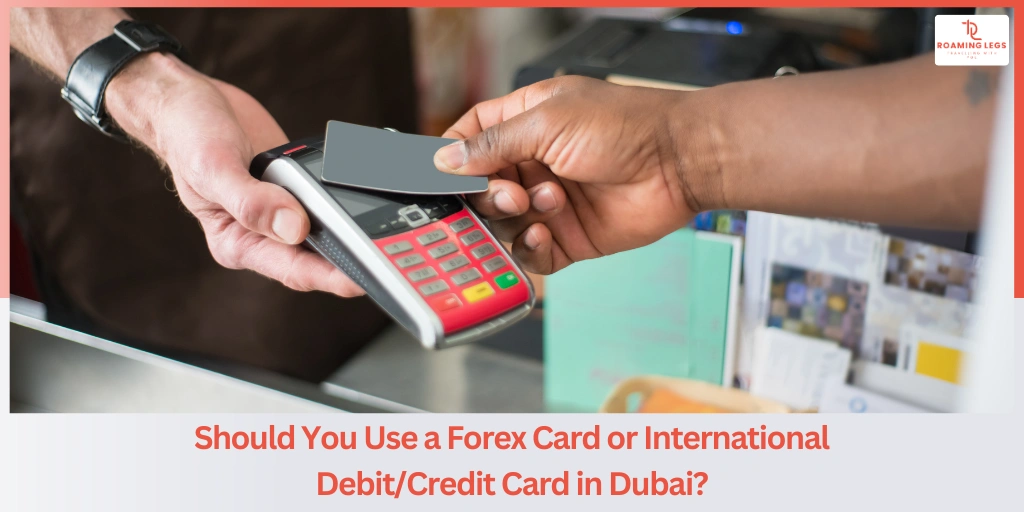
Forex Card or International Card for Dubai? Here’s What Indians Actually Use (And What It’ll Really Cost You)
So you’re going to Dubai — and now someone told you to “get a forex card.”
And you’re wondering if your regular HDFC or SBI card won’t work.
Or maybe it’s the other way around — you have a forex card loaded up, and now you’re wondering if you even need to carry a credit card too.
Here’s the honest answer: both work in Dubai.
But the one you reach for first will decide how much money you’re quietly losing to bank fees without realizing it.
Let’s sort this out simply, with real numbers.
What’s the Actual Difference Between the Two?
Think of it this way.
Your international debit or credit card is just your regular bank card with international access switched on.
When you swipe it in Dubai, your bank converts your spend from AED (UAE Dirhams) to INR at that moment’s exchange rate — and adds its own fees on top. You get the bill later.
A forex card works differently.
You load money onto it before you leave India.
The exchange rate gets locked the moment you load it.
So if the AED rate is good today and you load ₹50,000 worth of AED — that’s what you’ve locked in.
Even if the rate moves against you tomorrow, you’re fine.
Both let you swipe at shops, hotels, malls, and restaurants in Dubai.
Both let you withdraw cash from ATMs.
The difference is how much it costs you — and that gap is bigger than most people expect.
The Real Cost Difference — Let’s Talk Numbers
This is the part most blogs skip, so let’s be clear about it.
When you use a standard Indian credit card abroad, your bank typically adds:
- 3% to 3.5% foreign transaction markup on every swipe
- 18% GST on that markup
- Sometimes an additional currency conversion fee
So on a ₹1,00,000 Dubai trip spend, you’re quietly paying ₹3,500–4,000 extra — just in bank fees.
That’s two nice dinners in Dubai, gone.
With a forex card loaded in AED, you typically pay zero markup on transactions.
The fee is paid only once — at the time of loading — and it’s usually 0.5% to 1% above the RBI reference rate, which is much lower.
The math is simple: for a 5-day Dubai trip spending ₹1–1.5 lakh, a forex card saves you ₹3,000–5,000 over a standard credit card.
There’s one exception though — and it matters.
Some premium credit cards like Axis Magnus, HDFC Infinia, or RBL World Safari have zero or near-zero forex markup.
If you already have one of these, your credit card is actually competitive with a forex card on cost.
But if you’re on a regular HDFC Regalia, ICICI Platinum, or SBI Simply Click — a forex card will be cheaper every time.
Which Forex Cards Actually Work Well for Dubai?
Not all forex cards are the same.
Here are four that Indian travelers actually use for Dubai:
Niyo Global (DCB Bank)
Zero forex markup.
No issuance fee.
Works in 130+ countries.
The big advantage is that your rupees sit in a savings account and you spend from it — so you don’t have to “load” AED in advance.
It just converts at near-interbank rates when you swipe.
ATM withdrawal fee is ₹425 per transaction.
Great for people who don’t want to pre-estimate their spending.
BookMyForex Wow Card
Zero markup on loaded currencies.
Rate gets locked when you load.
Doorstep delivery in India — they’ll courier the card to your house before you travel.
Good for people who want to know exactly what rate they’re getting before they land.
The downside: if you load too much, getting your money back takes a few extra days.
HDFC Multicurrency Forex Card
This one supports up to 22 currencies including AED.
Issuance fee around ₹500 + GST. Zero markup when you spend in the currency loaded.
A 3.5% cross-currency fee applies if you use a currency you haven’t loaded.
Good for multi-destination trips.
If you’re going only to Dubai, load AED directly.
Axis Bank Multi-Currency Forex Card
Issuance fee around ₹300 + GST (waived for Axis Priority or Burgundy holders).
No reward structure, but solid for straightforward Dubai spending.
Works well with Axis Bank accounts.
Not Sure How Much AED You Need for Your Dubai Trip?
Planning your Dubai budget can be confusing. We help Indian travelers estimate daily spending for accommodation, food, shopping, and activities so you know how much AED to carry without loading too much or running short.
Share your travel dates and travel style on WhatsApp. We will send a Dubai trip budget breakdown designed around your plans.

Where to Use Which Card in Dubai — The Practical Guide
Dubai is extremely card-friendly.
You can pay by card at almost everything — The Dubai Mall, Mall of the Emirates, Burj Khalifa entry, Dubai Frame, desert safari bookings, restaurants on JBR Walk, supermarkets, Careem rides, Dubai Metro.
Cards work everywhere.
Here’s a simple way to think about it:
Use your forex card for:
- Daily meals and café visits
- Shopping at malls and souks
- Supermarket runs (Carrefour, Lulu)
- Paying for smaller tourist attractions
- Dubai Metro tickets from the app
Use your international credit card for:
- Hotel check-in (hotels put a security hold/deposit, and credit cards handle this better than prepaid cards)
- Car rental deposits
- Large one-time purchases where your credit card has purchase protection
- Emergency backup if your forex card gets blocked or lost
Carry AED 300–500 in cash for:
- Taxis that don’t accept cards (Gold and Silver metered cabs are fine, but some older cabs outside malls may prefer cash)
- Tips at restaurants and for hotel staff
- Traditional souk shopping where cash gets you better bargaining power
- Small local eateries near Deira or Old Dubai
The Trap That Catches First-Time Dubai Travelers
This happens at shops, restaurants, and even hotel counters in Dubai — and it’ll cost you money if you’re not ready for it.
When you swipe your card, the payment machine sometimes asks: “Pay in INR or AED?”
Always choose AED. Always.
If you choose INR, the merchant’s bank does the conversion for you — at a rate that’s 3%–5% worse than anything you’d get from your own bank or forex card.
It feels convenient (“oh good, I can see the amount in rupees”) but it’s quietly expensive.
This is called Dynamic Currency Conversion (DCC), and it’s one of the most common ways tourists lose money in Dubai without realizing it.
Your forex card or credit card will handle the AED-to-INR conversion at a much better rate.
Just say no to the “pay in INR” option every time a machine offers it.
A Quick Note on TCS — This Applies to Forex Card Loads
If you’re loading more than ₹7 lakh onto a forex card in a financial year (April to March), the bank will collect 20% TCS (Tax Collected at Source) on the amount above that limit.
This is an RBI rule under the Liberalised Remittance Scheme (LRS).
For a standard 5–7 day Dubai holiday, most families spend ₹1.5–3 lakh on cards.
You won’t come anywhere near the ₹7 lakh limit.
But if you’re going on a long trip or loading cards for multiple family members — worth knowing.
The TCS amount is claimable in your ITR, so it’s not a permanent loss, just a cash flow thing.
Get Your Free Dubai Travel Preparation Checklist
Going to Dubai soon? Get a practical checklist covering card activation, when to load money, how much AED cash to carry, and what to do if your card stops working abroad.
The Strategy That Most Experienced Dubai Travelers Actually Use
If you talk to someone who’s done Dubai two or three times, this is almost always what they say:
One forex card (Niyo or BookMyForex) for daily spending.
One international credit card in the bag for hotel check-in and emergencies.
AED 400–500 in cash for taxis and tips.
That’s it. Three things. Simple.
The reason for the forex card is obvious — lower fees.
The reason for keeping a credit card is also simple — hotels in Dubai, especially 4-star and 5-star ones, will ask for a card at check-in and block ₹10,000–25,000 as a security deposit.
Prepaid forex cards handle this, but credit cards do it more smoothly and don’t impact your spending balance on the forex card.
If you’re staying at something like Address Downtown, JW Marriott, or Atlantis Palm, they’ll almost certainly ask for a credit card at check-in.
The cash is for everything that doesn’t take cards — small purchases in the Deira Gold Souk, tips for the concierge, and that late-night shawarma from the Al Ustad Special Kabab place in Karama where the card machine is permanently “not working.”
Frequently Asked Questions About Forex Cards for Dubai
Everything Indian travelers need to know about using money, cards, and payments in Dubai.
Is a forex card better than my regular debit card for Dubai?
Yes, almost always. Regular Indian debit cards used abroad usually add a 3%–3.5% foreign transaction markup on every payment, plus GST on that markup.
A forex card with zero markup can reduce these extra charges significantly during a Dubai trip.
Can I use my Indian credit card in Dubai?
Yes. Visa and Mastercard credit cards with international transactions enabled work widely across Dubai.
Activate international usage through your banking app before travel. Keep in mind that many Indian credit cards charge a foreign currency markup fee.
Which forex card is best for a Dubai trip from India?
Niyo Global and BookMyForex are popular choices because of their low markup structure.
HDFC Multicurrency Forex Card and Axis Bank Forex Card are also reliable options, especially if you already use these banks.
Do forex cards work at Dubai ATMs?
Yes. Most forex cards work at ATMs throughout Dubai.
ATM withdrawals may include a fixed withdrawal fee, so withdrawing larger amounts fewer times can help reduce charges.
Should I carry cash AED for Dubai?
Yes, carrying a small amount of AED is practical.
AED 300–500 is usually enough for taxis, tips, small purchases, and situations where card payments are unavailable.
What is Dynamic Currency Conversion and should I avoid it?
Dynamic Currency Conversion (DCC) happens when a payment terminal offers to charge you in INR instead of AED.
Always choose AED. Paying in INR usually uses a poorer exchange rate and can increase your final cost.
Can I use UPI or Google Pay in Dubai?
UPI acceptance in Dubai is growing but is not available everywhere.
For restaurants, hotels, shopping malls, and attractions, keep a forex card or international card as your primary payment method.
Do I need to tell my bank before using my card in Dubai?
Yes. Enable international transactions through your banking app before leaving India.
This simple step prevents your card from being blocked when you try making payments abroad.
Is it safe to use a forex card in Dubai?
Yes. Forex cards offer chip-and-PIN protection and can usually be blocked instantly through the provider's app if lost.
They are safer than carrying large amounts of cash during international travel.
What happens if I have AED leftover after my Dubai trip?
For traditional prepaid forex cards, you can request an unload after returning to India. The returned amount depends on the current exchange rate.
Try to load a realistic amount to avoid unnecessary conversion losses.
Can a forex card be used for hotel check-in deposits in Dubai?
Yes, but credit cards are usually more convenient for hotel security deposits.
Hotels often place temporary holds for incidentals, and a credit card avoids reducing your available travel balance during the stay.
How much AED should I load for a 5-day Dubai trip?
For a mid-range Dubai trip, a family of 2–3 may spend around AED 2,000–4,000 on daily expenses, shopping, food, and attractions.
The exact amount depends on hotel category, shopping plans, and activities.
Does TCS apply when I load a forex card for Dubai?
TCS applies only when your total foreign remittances cross the applicable annual threshold.
Most standard Dubai holiday expenses remain below this limit, but frequent international travelers should track their yearly forex spending.
