
Going to Dubai is exciting.
But the moment you start thinking about money — how much to carry, where to exchange, whether to get a forex card — things get confusing fast.
Here’s the thing: most Indian travelers lose ₹2,000–₹6,000 on currency exchange alone.
Not because rates are bad everywhere, but because they exchange at the wrong place at the wrong time.
This guide is based on real conversations we’ve had with hundreds of Indian travelers who’ve been to Dubai.
Here’s exactly what we tell every one of them.
What Currency Do You Need in Dubai?
Simple answer — UAE Dirham (AED).
That’s it.
Hotels, cabs, restaurants, Dubai Mall, Gold Souk, desert safari — everything is paid in AED.
No other currency works for day-to-day spending.
As of July 2026, 1 AED = approximately ₹26. So when something costs AED 100, that’s roughly ₹2,600. Keep this number in your head — it makes budgeting in Dubai so much easier on the go.
Will Dubai Accept Your Indian Rupees?
No. Shops and restaurants don’t accept INR.
And here’s something even more important: most exchange houses in Dubai don’t convert INR to AED anymore.
After India’s demonetization and a few counterfeit currency incidents, several reputed exchange counters in Dubai simply stopped accepting Indian cash.
So don’t land in Dubai with a wallet full of rupees hoping to convert them there.
It won’t work the way you expect.
Convert your rupees to AED in India before you fly.
Should You Exchange Money in India or Dubai?
This is honestly the most common question we get.
The real answer is: do both — just don’t rely on either airport.
Here’s the practical split that works for most travelers:
- Exchange AED 500–1,000 in India before flying (for your cab, first meal, and hotel check-in)
- Exchange the remaining amount at Bur Dubai after you settle in
Why Bur Dubai? The Al Fahidi neighbourhood near the Al Fahidi Metro station has dozens of competing exchange houses, and they consistently offer 2–3% better rates than most locations in Dubai — and often better than what you’d get in India too.
Best Places to Exchange INR to AED in India
Skip the airport. Instead, use these:
BookMyForex (a MakeMyTrip subsidiary) — Book AED at live interbank rates online, then pick it up or get home delivery.
Transparent pricing, no hidden charges. Worth it if you’re exchanging ₹50,000 or more.
Thomas Cook India — Branches in most major cities. You can also load a Thomas Cook Forex Card here with AED at a locked rate, which is useful if you want to avoid exchange rate fluctuations closer to your trip.
Orient Exchange — Competitive rates, good for travelers in Mumbai and Delhi.
Worth checking alongside BookMyForex.
Local RBI-authorized money changers — Some offer rates that beat even the big names.
Just make sure they’re licensed and give you a proper receipt.
One tip before you go anywhere: Check the INR to AED rate on Google first. That’s the “real” mid-market rate.
Any provider will charge slightly above it — that’s normal.
But if someone’s charging 5–8% above the Google rate, that’s too much. Walk out.
Not Sure How Much AED to Carry? We'll Calculate It for You.
Every Dubai trip is different. Share your travel dates, number of travellers, and travel style on WhatsApp, and we'll prepare a personalised forex plan with recommended AED to carry, estimated daily expenses, shopping budget, and practical money-saving tips. Delivered within 24 hours.
AED Budget
Know how much cash you'll realistically need.
Daily Spending
Meals, transport, shopping, and sightseeing mapped out.
Save on Forex
Get practical tips to avoid unnecessary expenses.
24-Hour Plan
Your personalised Dubai money plan sent on WhatsApp.
Dubai Airport Exchange — Is It Worth It?
Only for AED 200–300. Nothing more.
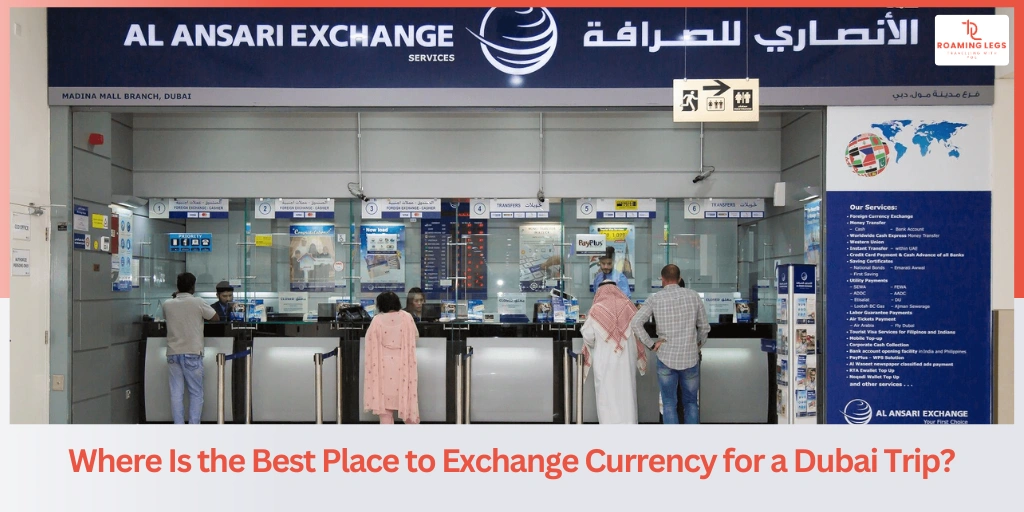
Dubai International Airport has Al Ansari Exchange counters that are open 24/7 — genuinely helpful if you land at 2 AM and need cab fare.
But their rates are typically 10–15% worse than what you’d get in the city.
On ₹1,00,000 worth of AED, that’s ₹10,000–₹15,000 extra just for the convenience of exchanging at the airport.
That’s a real number.
So if you’ve landed without any AED: exchange just enough for a taxi and a meal — around AED 200–300.
Then sort the rest at Bur Dubai the next day.
Best Places to Exchange Money in Dubai
Once you’re in the city, you have real options:
Bur Dubai — Al Fahidi Area (Best overall) This is where savvy Indian travelers go.
The lanes around Al Fahidi Metro have dozens of competing exchange houses.
Al Fardan Exchange and Al Sharaf Exchange both have branches here.
Rates here are consistently 1–3% better than Dubai Mall or Marina. On ₹1,00,000, that difference is ₹1,000–₹3,000.
Al Ansari Exchange (Best for convenience) 200+ branches across Dubai — inside Dubai Mall, Ibn Battuta Mall, Dragon Mart, and more.
Rates aren’t the sharpest, but finding a branch is never a problem.
Good for smaller top-ups during your trip.
Al Fardan Exchange (Best rates in the city) Slightly better INR-to-AED rates than Al Ansari.
Branches in Deira, Bur Dubai, and Dubai Mall. Check their rate board online before you visit — you can walk in knowing exactly what to expect.
Lulu Exchange (Good if you’re near a Lulu Hypermarket) Decent rates, quick service.
Convenient if your hotel is near a Lulu.
One habit worth building: always check the rate board at two or three counters before exchanging.
Even in the same mall, rates vary between shops.
Forex Card vs Cash — What Should You Carry?
Dubai is a very cashless city. Uber, Careem, metro, malls, restaurants — almost everything takes cards. So you don’t need to carry a ton of physical AED.
The ratio that works best for most Indian travelers: 70% forex card, 30% AED cash.
Why carry a forex card?
When you load AED onto a forex card in India, that exchange rate gets locked in.
Even if AED becomes more expensive later, you’ve already secured your rate. On top of that:
- No conversion charges when you pay at stores
- Much safer than carrying cash
- Can be blocked instantly if lost
- Works at most ATMs in Dubai
Which forex card works well for Dubai?
- Niyo Global Card (SBM Bank) — Zero forex markup, works smoothly at Dubai ATMs and merchants
- IDFC First WOW Credit Card — Zero forex markup, no annual fee, good for shopping-heavy trips
- Thomas Cook Forex Card — Load AED at a locked rate before you fly; accepted at most Dubai ATMs
On a trip where you’re spending ₹1,00,000 total, using a zero-markup card instead of your regular Indian debit card can save ₹3,000–5,000 in fees.
If you’re using a regular SBI, HDFC, or ICICI debit card, expect 3–5% charges on every international transaction. It adds up fast.
Forex Card, Cash, or Both? Get a Personalised Dubai Money Plan
The best way to carry money depends on your trip budget, travel dates, and spending habits. Share your details on WhatsApp and we'll recommend exactly how much to keep on a forex card, how much AED cash to carry, and where each payment method works best, helping you minimise conversion charges and unnecessary fees.
Forex Card Split
Know how much to load before you travel.
AED Cash Plan
Carry the right amount for everyday expenses.
Lower Forex Costs
Reduce markups and avoid unnecessary charges.
WhatsApp Recommendation
Receive your personalised payment strategy within 24 hours.
How Much AED Should You Actually Carry?
Here’s a quick reference based on what Indian travelers actually spend in Dubai (not including hotels and flights):
| Traveler Type | Daily Spend | 5-Night Trip Total | In Rupees |
|---|---|---|---|
| Budget (street food, metro, group tours) | AED 100–200 | AED 500–1,000 | ₹13,000–₹26,000 |
| Mid-range (restaurants, taxis, shopping) | AED 300–500 | AED 1,500–2,500 | ₹39,000–₹65,000 |
| Premium (fine dining, desert safari, yacht) | AED 700–1,200 | AED 3,500–6,000 | ₹91,000–₹1,56,000 |
AED 100–200
5-Night Trip TotalAED 500–1,000
Approx. in Rupees₹13,000–₹26,000
AED 300–500
5-Night Trip TotalAED 1,500–2,500
Approx. in Rupees₹39,000–₹65,000
AED 700–1,200
5-Night Trip TotalAED 3,500–6,000
Approx. in Rupees₹91,000–₹1,56,000
Common Currency Mistakes — Stop These Before They Happen
Exchanging everything at the airport — Rates are 10–15% worse. Only exchange AED 200–300 there.
Carrying INR to Dubai hoping to convert — Most exchange houses won’t accept it. Convert in India.
Using a regular Indian debit card for all transactions — 3–5% per swipe adds up to thousands on a long trip.
Saying yes to INR on payment machines — Always pay in AED. Never choose your home currency at a POS terminal.
Not carrying any cash at all — Dubai is digital but not 100% digital. Always keep AED 300–500 on you.
Converting leftover AED back at the Dubai airport — Buy-back rates at airports are terrible. Either spend it, or convert it at a proper exchange house in India after you return.
Frequently Asked Questions About Dubai Currency Exchange
Everything Indian travelers need to know about exchanging INR, using cards, and managing AED in Dubai.
Should I exchange INR to AED in India or in Dubai?
Do both, but use the right approach. Exchange around AED 500–1,000 in India for airport transfers and arrival expenses.
For the remaining amount, Dubai exchange houses generally offer better rates than airports and hotel counters.
Where is the cheapest place to exchange currency in Dubai?
Bur Dubai, especially the Al Fahidi area, is known for competitive exchange rates.
Avoid exchanging large amounts at Dubai Mall and Marina Walk counters, where rates are often less favorable.
Do Dubai exchange houses accept Indian Rupees?
Most Dubai exchange houses do not commonly accept Indian Rupee cash.
It is better to convert INR into AED before flying or use an international card after arrival.
How much AED is enough for a 5-day Dubai trip?
A mid-range traveler can start with AED 1,500–2,500 excluding hotel costs.
Budget travelers may manage with AED 500–1,000, but keeping an emergency buffer is always useful.
What is the current INR to AED exchange rate?
As of July 2026, approximately 1 AED = ₹26.
Check live rates on Google or trusted forex providers before exchanging money because rates change daily.
Is a forex card actually worth it for Dubai?
Yes, especially if you plan to spend ₹50,000 or more during your trip.
Zero-markup forex cards can reduce foreign transaction charges compared with regular debit cards.
Which Indian forex card has zero markup for Dubai?
Niyo Global, IDFC First WOW Credit Card, and IndusInd Nexxt Card are popular options for travelers looking to reduce forex charges.
Traditional prepaid forex cards are also available if you prefer loading AED before travel.
Is it safe to use ATMs in Dubai?
Yes. Dubai ATMs are safe and widely available at malls, hotels, and metro stations.
Check your Indian bank's withdrawal and conversion fees before using your card abroad.
Can I use UPI or Google Pay in Dubai?
Standard UPI linked to Indian bank accounts is not accepted everywhere in Dubai.
Google Pay and Apple Pay work when connected to supported international cards.
What should I do with leftover AED when I return to India?
Convert leftover AED through an authorized forex dealer in India.
Avoid airport exchange counters because their buy-back rates are usually less competitive.
Do I need to declare currency at Dubai or Indian customs?
Most tourists do not carry amounts that require declaration.
For large amounts of foreign currency, check current customs and RBI rules before travel.
Is the 70% card and 30% cash rule practical for Dubai?
Yes. Dubai is highly digital, and cards work almost everywhere.
Cash is mainly useful for tips, small vendors, souks, and occasional payment issues. Keeping AED 300–500 available is practical.
Can I use my regular SBI or HDFC debit card in Dubai?
Yes, but international debit card transactions can become expensive due to forex conversion charges and withdrawal fees.
A zero-forex card or forex card can reduce these extra costs during your trip.
What if I run out of AED while I am in Dubai?
You can exchange money at authorized exchange houses or withdraw AED from international ATMs using your card.
Forex cards can also usually be topped up online if additional funds are needed.
