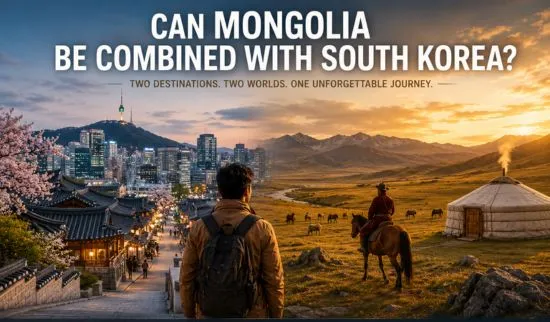
At First Glance, Mongolia and South Korea Look Like an Odd Travel Combination
One gives you endless grasslands, nomadic culture, and nights in a ger camp.
The other gives you neon-lit streets, Korean BBQ, shopping districts, and some of Asia’s most modern cities.
They couldn’t be more different.
And that’s exactly why they work so well together.
In fact, many travelers spend weeks trying to decide between Mongolia and South Korea without realizing there’s another option:
Visit both.
The real question isn’t whether Mongolia and South Korea can be combined.
They absolutely can.
The better question is whether you have enough time to enjoy both properly.
Because done well, this can become one of the most balanced trips in Asia.
Done poorly, it can feel rushed and leave both destinations shortchanged.
When Does Combining Mongolia With Another Destination Make Sense?
The Bigger Question
The real decision isn’t how many days you have.
It’s whether adding another destination improves your trip or simply adds more flights, transfers, and logistics.
Many travelers discover that Mongolia rewards depth more than variety. Spending extra time exploring fewer regions often creates better memories than trying to fit multiple countries into the same itinerary.
If you’re visiting Mongolia primarily for its landscapes, culture, and experiences, giving yourself more time in Mongolia is usually the better choice.
Here’s Something Most Indian Travelers Don’t Consider
When people think about combining Mongolia with another country, they usually look at:
- China
- Japan
- Sometimes Russia
South Korea often gets overlooked.
That’s surprising because South Korea usually creates a smoother and more balanced itinerary than many alternatives.
Mongolia vs South Korea: Which Experience Are You Looking For?
- Vast open landscapes
- Nomadic culture and traditions
- Nature-focused travel
- Remote and authentic experiences
- Slow-paced exploration
- Adventure and wilderness
- Minimal crowds outside major events
- Modern cities and technology
- Contemporary culture and entertainment
- Food, shopping, and nightlife
- Efficient transportation
- Fast-paced sightseeing
- Convenient travel infrastructure
- Urban experiences mixed with nature
The Real Difference
South Korea is often about energy, convenience, culture, food, and city life.
Mongolia is often about space, silence, nature, and experiences that feel disconnected from modern life.
Neither destination is objectively better. They simply appeal to different travel personalities.
If you’re excited by cities, food, shopping, and modern culture, South Korea is usually the stronger choice. If you’re looking for open landscapes, nomadic culture, adventure, and a feeling of freedom, Mongolia is difficult to match.
Why This Combination Feels So Good
After spending days in remote landscapes, many travelers enjoy returning to:
- Great food
- Cafes
- Shopping
- Comfortable hotels
- Vibrant city life
The contrast creates a feeling that you’re taking two completely different holidays in one trip.
And very few Asia itineraries deliver that as effectively as Mongolia and South Korea.
💡 Mongolia and South Korea offer completely different experiences. Mongolia rewards slow travel, open landscapes, and cultural immersion, while South Korea excels at food, cities, convenience, and modern culture. We’ll help you determine whether combining both creates a richer trip or simply creates a rushed itinerary.
So Why Are More Travelers Putting These Two Countries Together?
Because the combination solves a common travel problem.
Many travelers want variety.
But they don’t want constant airport hopping.
Mongolia and South Korea create variety naturally.
The Flight Connections Usually Work Well
Travel between the two countries is relatively straightforward compared to some multi-country combinations.
That alone makes planning easier.
Every Day Feels Different
This is where the combination becomes interesting.
One day you’re riding through open landscapes.
A few days later you’re exploring Seoul.
One day you’re watching a sunset beside a ger camp.
The next you’re sitting in a trendy café in Gangnam.
The shift feels dramatic.
There’s Very Little Overlap
This matters more than most people realize.
Many multi-country trips start feeling repetitive.
Mongolia and South Korea don’t.
Mongolia vs South Korea: Which Is Better For You?
Quick Summary: Choose Mongolia for nature, adventure, photography, and unique cultural experiences. Choose South Korea for food, cities, shopping, nightlife, and convenience.
What Travelers Often Tell Us Afterwards
The contrast becomes one of their favorite parts of the trip.
Instead of feeling repetitive, every stage feels fresh.
Who Usually Loves This Combination?
Not every traveler.
But certain types of travelers absolutely love it.
Couples Looking for Variety
This may be the strongest audience for this itinerary.
You get:
- Adventure
- Culture
- Food
- Nature
- City life
All in one holiday.
First-Time Northeast Asia Travelers
If you’ve never explored this part of Asia, Mongolia and South Korea provide a fascinating introduction.
Travelers Who Love Nature and Food Equally
This combination almost feels designed for them.
Mongolia delivers the landscapes.
South Korea delivers the food.
Travelers Who Enjoy Experiences and Sightseeing
Some travelers only want nature.
Others only want cities.
Most people enjoy a mix.
That’s where this route shines.
Who Usually Enjoys a Mongolia + South Korea Trip Most?
The Real Advantage of Combining Both
Most multi-country trips combine similar destinations.
Mongolia and South Korea are almost opposites.
One is built around nature, open space, and slow exploration. The other is known for food, cities, technology, and convenience.
That’s why travelers who have enough time often find the combination surprisingly rewarding. You experience two very different sides of Asia in a single journey.
Something We Notice Quite Often
Couples frequently rate this combination higher than Mongolia plus another nature destination.
The reason is simple.
Variety.
The trip never starts feeling repetitive.
💡 Mongolia and South Korea complement each other surprisingly well. One offers open landscapes, nomadic culture, and adventure. The other offers food, cities, convenience, and modern culture. We’ll help you determine whether combining both creates a richer travel experience or whether one destination deserves your full attention.
When Does It Make More Sense to Focus Only on Mongolia?
This is where many travelers get caught.
Because adding another country always sounds exciting.
But sometimes it’s the wrong move.
You Have Less Than 10 Days
This is probably the easiest decision.
Stay focused on Mongolia.
Mongolia Is Your Dream Destination
Maybe you’ve wanted to visit for years.
Maybe the landscapes are the main reason for the trip.
Don’t dilute the experience.
You Prefer Slow Travel
If you enjoy spending more time in fewer places, Mongolia alone often feels more rewarding.
You Want Deeper Cultural Experiences
Culture takes time.
Rushing between countries often reduces that depth.
Depth vs Variety: The Real Trade-Off
The key trade-off: The more destinations you add, the less deeply you experience each one.
For most travelers with around 10 days available, focusing on a single country often creates a better trip than splitting time between Mongolia and South Korea.
Once you have 12–14 days or more, the combination becomes much more rewarding because you can experience both destinations without constantly feeling rushed.
In many cases, depth creates better memories than variety.
A Common Regret
Many travelers underestimate how much time Mongolia deserves.
Then they return wishing they had allocated a few extra days there.
What We’d Usually Recommend
If you only have 8 to 10 days available, Mongolia alone often creates the stronger trip.
💡 The biggest mistake travelers make is assuming more destinations automatically create a better trip. In reality, the best itinerary is often the one that gives you enough time to fully enjoy each destination instead of constantly moving between airports, hotels, and transfers.
Which Parts of South Korea Work Best After Mongolia?
Let’s keep this simple.
Most first-time visitors don’t need four Korean cities.
Seoul
For many travelers, Seoul is enough.
You get:
- Food
- Shopping
- Culture
- Palaces
- Modern Korea
Without constant movement.
Busan
A good choice if you want:
- Coastal scenery
- Seafood
- Slower pace
- Ocean views
Jeju Island
Popular with couples.
Especially those wanting:
- Nature
- Relaxation
- Romantic scenery
Which South Korea Destination Pairs Best With Mongolia?
The Best Pairing Depends on What Mongolia Doesn’t Give You
Mongolia already provides open landscapes, nature, adventure, and cultural immersion.
Many travelers use South Korea to add experiences Mongolia doesn’t focus on, such as world-class food, modern cities, shopping, nightlife, beaches, and convenience.
Rather than choosing the most famous destination, it’s usually better to choose the South Korea destination that complements the experiences you’re already getting in Mongolia.
What First-Time Visitors Usually Enjoy Most
A few days in Seoul after Mongolia.
The contrast is remarkable.
One week you’re surrounded by open wilderness.
The next you’re exploring one of Asia’s most dynamic cities.
What We’d Usually Recommend
For a first Mongolia and South Korea combination, Seoul is often enough.
Keep things simple.
How Should You Divide Your Time?
This is where planning becomes
Recommended Mongolia + South Korea Trip Splits
The general rule: Mongolia usually benefits from slightly more time than travelers initially expect because distances are larger and travel is slower.
For most travelers, 12–14 days is the point where combining Mongolia and South Korea starts to feel comfortable rather than rushed.
If you only have around 7–10 days available, focusing on one destination often creates a better overall trip.
The Balance We Usually Prefer
Slightly more time in Mongolia.
Why?
Because Mongolia takes more effort.
The experiences unfold more slowly.
And reducing Mongolia too much often weakens the trip.
One Important Planning Principle
Mongolia should remain the main experience.
Not a stopover on the way to South Korea.
Sample 14-Day Journey
Days 1–8
Mongolia
- Ulaanbaatar
- Central Mongolia
- Ger stays
- Nomadic culture
- National parks
Days 9–14
South Korea
- Seoul
- Food experiences
- Day trips
- Shopping
- Cultural sites
That balance works very well for most travelers.
💡 Most itinerary problems don’t come from choosing the wrong destination. They come from trying to fit too many places into too few days. We’ll help you determine whether adding South Korea improves your trip or whether giving more time to Mongolia creates a better overall experience.
The Logistics Are Easy. The Bigger Challenge Is Something Else.
Most travelers worry about flights.
That’s usually not the problem.
The Real Challenge
Resisting the urge to do too much.
One More Korean City…
This is where itineraries often become overloaded.
One More Mongolia Region…
Same problem.
Common Mongolia + South Korea Planning Mistakes
Reality Check
The logistics of combining Mongolia and South Korea are actually quite manageable.
The bigger challenge is resisting the temptation to overpack the itinerary simply because both countries offer so many interesting experiences.
The best itineraries usually leave room for flexibility, downtime, and unexpected moments rather than trying to maximize every hour.
If We Were Designing This Trip Ourselves
This is probably what we’d do.
Mongolia: 7–8 Days
Focus on:
- Ulaanbaatar
- Central Mongolia
- Ger camps
- Nomadic culture
- Open landscapes
South Korea: 5–6 Days
Focus on:
- Seoul
- Food
- Culture
- Shopping
- Day trips
Why This Structure Works
Neither country feels rushed.
Neither country dominates the itinerary.
You experience two completely different sides of Asia.
Sample Mongolia + South Korea Framework
Why This Combination Works
Mongolia and South Korea complement each other because they deliver very different travel experiences.
Mongolia focuses on nature, space, adventure, and cultural immersion. South Korea adds food, modern cities, nightlife, shopping, and efficient travel infrastructure.
Together, they create variety without chaos and contrast without feeling repetitive.
💡 The best Mongolia–South Korea itinerary isn’t necessarily the one with the most destinations. It’s the one that matches how you like to travel. We’ll help you decide where to spend more time, what to skip, and how to create a trip that feels memorable rather than exhausting.
So, Should You Combine Mongolia and South Korea?
For many travelers, yes.
For some travelers, no.
The answer depends almost entirely on trip length.
If You Have 7–10 Days
Choose one destination.
If You Have 12–14 Days
The combination starts making sense.
If You Have 15+ Days
It becomes an excellent option.
If You’re Traveling as a Couple
Strongly consider it.
Final Recommendation
The Bottom Line
Mongolia and South Korea complement each other remarkably well because they deliver very different experiences.
Mongolia offers nature, adventure, open landscapes, and cultural immersion. South Korea adds food, cities, convenience, shopping, and contemporary culture.
The combination works best when you have enough time to enjoy both countries properly rather than treating them as quick stopovers.
If you have 12 days or more available, combining Mongolia and South Korea is often one of the most rewarding multi-country trips in Asia.
The Key Takeaway
Mongolia and South Korea work so well together because they don’t compete with each other.
They complement each other.
One gives you space.
The other gives you energy.
One slows you down.
The other speeds things up.
One shows you traditional Asia.
The other shows you modern Asia.
And that’s exactly why the combination feels so balanced.
What We Usually Tell Indian Travelers
If you have at least two weeks available and enjoy both cultural experiences and nature, Mongolia and South Korea create one of Asia’s most rewarding travel combinations.
If your time is limited, give Mongolia the attention it deserves and save South Korea for another adventure.
💡 The biggest itinerary mistake isn’t choosing the wrong destination. It’s trying to squeeze too much into too little time. We’ll help determine whether Mongolia alone, South Korea alone, or a combination of both gives you the best overall travel experience.
Frequently Asked Questions
Answers to common questions about combining Mongolia and South Korea in a single trip.
We have 12 days available. Is Mongolia and South Korea a realistic combination?
Yes. Twelve days is usually the point where this combination starts becoming practical.
Should we visit South Korea before or after Mongolia?
Most travelers prefer South Korea after Mongolia because it provides a comfortable transition back into city life.
How many days should couples spend in each country?
A 7-day Mongolia and 5-day South Korea split works very well.
Is Seoul enough or should we add Busan?
For most first-time visitors, Seoul is enough.
Which destination should get more days?
Usually Mongolia.
Will Mongolia feel too remote after visiting South Korea?
No. The contrast often becomes one of the highlights of the trip.
Is this combination better than Mongolia and China?
For many leisure travelers, yes, because the experiences feel more complementary and logistics are often simpler.
We love food and nature equally. Is this the right combination for us?
Absolutely. That’s one of the strongest reasons to combine these countries.
What are the biggest mistakes travelers make when combining Mongolia and South Korea?
Too many Korean cities, too little time in Mongolia, and trying to see everything.
Can we include the Gobi Desert and Seoul in the same trip?
Yes, especially if you have at least 14 days.
Is 14 days enough for a comfortable Mongolia and South Korea itinerary?
Yes. Fourteen days is one of the best trip lengths for this combination.
Can a travel expert help us design a Mongolia and South Korea itinerary that matches our travel style and available leave?
Definitely. Multi-country trips benefit greatly from personalized planning because travel style matters as much as trip length.