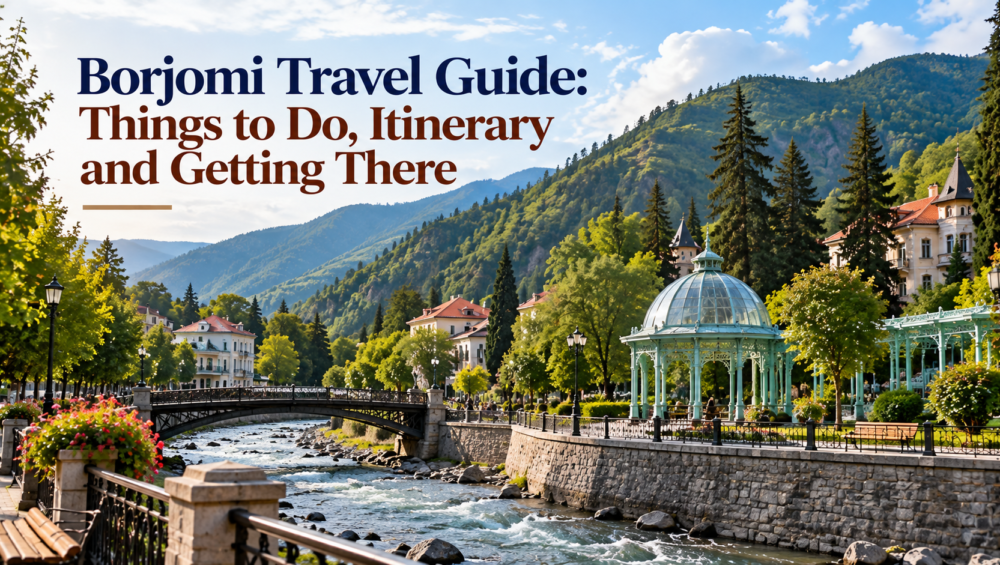
Most Borjomi travel blogs still tell you to take the historic train to Bakuriani.
That train has not run since March 2021, and as of early 2026, there is no confirmed sign of it resuming.
Several of the same blogs describe Likani Palace as a place you can freely walk through.
That palace is the Georgian President’s official summer residence today, and it is not open for casual visits.
Borjomi is Georgia’s most famous spa town — built around naturally carbonated mineral springs that have drawn visitors since the 1840s — and it is genuinely worth a stop.
But arriving with accurate information about what is actually open matters before you plan your day around an attraction that no longer works the way older content describes.
This guide covers the real picture, current as of October 2026.
What Borjomi Is (And Why Indian Travelers End Up Here)
Borjomi sits at 794 metres in a gorge in Georgia’s Samtskhe-Javakheti region, roughly 160 kilometres — about 2.5 to 3 hours — south of Tbilisi by road.
It is Georgia’s best-known spa town, built around naturally carbonated mineral springs that have been in continuous use since the 19th century.
Borjomi mineral water is exported to around 32 countries today, making it one of Georgia’s most recognised products internationally alongside its wine.
On a Georgia trip from India, Borjomi typically appears in the 10-day itinerary.
It is not included in 5-day or 7-day routes, which concentrate on Tbilisi, the Greater Caucasus mountains, and Kakheti wine country.
On the 10-day route, Borjomi sits between the mountains and the coast: a one-night pause after the high-altitude driving of Kazbegi and Gudauri, before the long road west to Batumi.
How to Reach Borjomi from Tbilisi
By Marshrutka (Minibus)
The cheapest independent option is a marshrutka from Tbilisi’s Didube bus terminal.
Journey time is roughly 2.5 to 3 hours, with fares around 10–12 GEL per person.
Departures depend on seats filling, so early morning is usually more reliable.
By Train
Georgian Railway operates a Tbilisi–Borjomi-Likani service taking approximately 3.5 to 4.5 hours, with fares around 6–8 GEL.
Services run once or twice daily. Check Georgian Railway for current schedules.
By Private Car or Taxi
Roaming Legs package options use a private vehicle with a driver for each journey leg.
The drive from Tbilisi or Kazbegi to Borjomi takes approximately 2.5 to 3 hours.
Independent travellers can arrange a shared or private taxi from Tbilisi for roughly 80–120 GEL, depending on the vehicle.
Things to Do in Borjomi
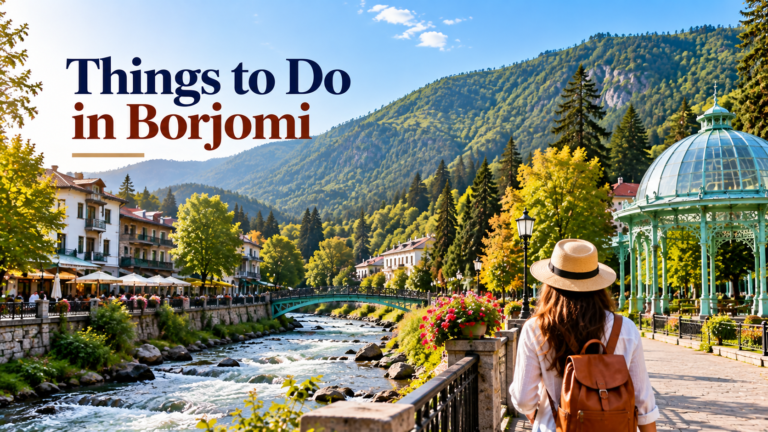
Borjomi Central Park and the Mineral Springs
The core of any Borjomi visit is the landscaped Central Park, built directly around the mineral springs.
Park entry costs around 5 GEL.
The main free-flowing spring — the Ekaterine Spring — draws water from a borehole nearly 200 metres deep.
The water is naturally carbonated due to the volcanic geology of the gorge, not artificially treated.
Most visitors spend one to two hours walking the park grounds and tasting the water at the spring.
The Cable Car to the Plateau
A cable car, originally built in 1962 and refurbished in 2005, runs from inside the park up to a small plateau above the gorge.
The ride takes about 2 minutes and costs roughly 15 GEL one way.
The plateau has a Ferris wheel and a few cafés, with views down over the town.
Operating hours are roughly 10am to 8pm in season — confirm locally on the day.
The Tsar’s Sulfur Baths
About 3 kilometres into the forest from the Central Park entrance, a set of open-air thermal pools known as the Tsar’s Sulfur Baths maintains a temperature of around 30–32°C year-round.
Entry costs around 10 GEL.
Reaching the baths requires a roughly one-hour walk each way on an unpaved forest path — plan for a full 2 hours minimum for the round trip.
Wear proper walking shoes; the path can be muddy after rain.
Firuza Heritage House
Built in 1892 for Persian diplomat Mirza Riza Khan in an ornate Qajar style, the Firuza Heritage House is one of the most architecturally distinctive buildings in Borjomi.
The building is now a hotel, but the courtyard café is open to non-guests.
It is a 10-minute walk from the Central Park entrance.
Borjomi Museum of Local Lore
Founded in 1938 and housed in a building dating to 1890, the Borjomi Museum of Local Lore holds more than 40,000 objects covering the town’s Romanov-era and mineral-water history.
Entry fees are small — typically under 5 GEL — and the museum takes under an hour for most visitors.
Likani Palace: What You Can and Cannot See
Likani Palace — sometimes called the Romanov Palace — was built in the 1890s for Grand Duke Nicholas Mikhailovich on an estate his father had received in 1871.
It later became a Soviet retreat and was used by Communist Party leaders including Stalin.
Today, it is the Georgian President’s official summer residence.
A small museum opened on the grounds in 2016, but access is by scheduled arrangement, not an open walk-in visit.
The building and grounds are visible from the road; older travel guides describing it as freely explorable are no longer accurate.
Borjomi–Kharagauli National Park
Borjomi–Kharagauli National Park was established in 1995 as Georgia’s first national park. It covers more than 104,000 hectares and has 12 marked trails.
Footprint Trail: 13 km from Likani Guard Station, taking around 6–8 hours.
St. Andrew’s Trail: 54 km over 4 days, suited to experienced hikers.
Free safety permits are required for longer routes. Get one from the visitor centre at 23 Meskheti Street, Borjomi, before setting out.
For a one-night stop, a short walk near the park entrance is the practical choice. Multi-day hikes require proper preparation, equipment, and the free permit.
A Note on the Bakuriani Train
The Kukushka — a narrow-gauge railway that once ran between Borjomi and the ski town of Bakuriani — appears in nearly every Borjomi travel guide still published online.
It has not operated since March 2021, when service was suspended during the COVID-19 pandemic.
As of early 2026, there is no confirmed date for its return.
Bakuriani is still reachable by taxi or marshrutka in roughly 40 minutes — if the town interests you, go by road.
How Many Days Do You Need in Borjomi
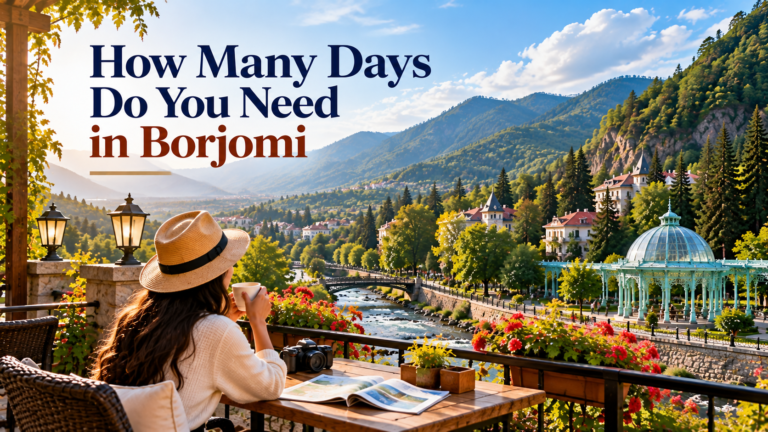
One night is enough for the core visit: an evening walk through Central Park, the mineral springs, the cable car, and a morning spent at the museum or on a short forest walk.
Travellers who want to visit the sulfur baths and explore Central Park on the same day need a full day, since the baths require a dedicated 2-hour round-trip.
If you want to hike a proper trail in Borjomi–Kharagauli National Park, add a second day.
On Roaming Legs’ 10-day itinerary, Borjomi receives one night — enough to cover the park, springs, and cable car without overloading a route that already spans Tbilisi, Kazbegi, Gudauri, Kakheti, and Batumi.
A One-Night Borjomi Itinerary
Afternoon (arrival):
- Walk to Borjomi Central Park (roughly 10–15 minutes from central accommodation).
- Taste the mineral water at the Ekaterine Spring.
- Take the cable car up to the plateau for views over the gorge.
Evening:
- Stop at the Firuza Heritage House courtyard café.
- Dinner near the park entrance — aim to eat by 9pm, as restaurants close earlier here than in Tbilisi.
Morning (before onward departure):
- Museum of Local Lore if history interests you (opens around 10am — confirm locally).
- Or: an early walk toward the sulfur baths if you have 2 hours before your departure.
Note: the sulfur baths and the museum cannot both be comfortably done on the same morning before a mid-morning departure.
How Borjomi Fits a Georgia Trip from India
Borjomi appears on the 10-day Georgia route only.
It comes after Kazbegi and the mountain section, with the drive back through Tbilisi and a possible stop at Uplistsikhe, before continuing west to Batumi the next morning.
The 5-day and 7-day itineraries skip Borjomi to keep the route focused on Tbilisi, the Greater Caucasus, and Kakheti.
If Borjomi matters to your trip, see the 10-day Georgia itinerary .
Your Borjomi Planning Order
- Confirm your itinerary includes Borjomi — it is only on the 10-day route.
- If travelling independently, check Georgian Railway’s schedule and book transport in advance.
- Book accommodation within 15 minutes’ walk of the Central Park entrance.
- If you plan to hike beyond a short walk in the national park, visit the park visitor centre at 23 Meskheti Street first for your free permit.
- Pack walking shoes — the sulfur baths path is unpaved.
- Plan dinner before 9pm; restaurant options are limited after that hour.
- Skip the Bakuriani train; build Bakuriani into your plan as a 40-minute road transfer if it interests you.
Mistakes That Cost Borjomi Visitors Time and Money
- Planning your day around the Kukushka train — it has not run since 2021 and has no confirmed return date.
- Treating Likani Palace as a free, walk-in attraction — it functions as a Presidential residence.
- Booking accommodation outside the central area — the main attractions are walkable from the park, and a remote hotel adds unnecessary taxi costs.
- Underestimating the sulfur baths walk — it is 3km each way on unpaved forest path, not a short stroll from the park.
- Starting a longer national park trail without collecting the free permit from the visitor centre first.
- Arriving in Borjomi without dinner plans — limited options after 9pm.
Frequently Asked Questions
Is Borjomi Worth Visiting on a Georgia Trip?
Yes, if your itinerary is 10 days or longer.
Borjomi adds a genuine change of pace between the mountain driving of Kazbegi and Gudauri and the coast at Batumi.
The mineral springs, national park, and spa-town architecture are unlike anything else on the standard Georgia circuit.
How Far Is Borjomi from Tbilisi?
Roughly 160 kilometres by road, taking 2.5 to 3 hours under normal traffic conditions.
Sources quote figures from 118km to 165km because they measure different route variants. The 2.5–3 hour drive time is the consistent figure.
Can I Do Borjomi as a Day Trip from Tbilisi?
Yes, but it requires an early start.
Leave Tbilisi by 8–9am to have at least 5–6 hours at your destination before the return drive.
Is the Borjomi–Bakuriani Train Running?
No.
The Kukushka narrow-gauge railway has been suspended since March 2021.
As of early 2026, there is no confirmed restart date.
Bakuriani is reachable by taxi or marshrutka in approximately 40 minutes.
Can I Visit Likani Palace?
Not as a casual walk-in.
Likani Palace is the official summer residence of the Georgian President.
A museum on the grounds opened in 2016, but access is by scheduled arrangement and is subject to official use at the time of your visit.
Do I Need a Permit to Hike in Borjomi–Kharagauli National Park?
Free safety permits are required for longer trails.
Collect the permit from the park visitor centre at 23 Meskheti Street, Borjomi, before heading to the trailhead.
Short walks from the park entrances near the town centre do not require a permit.
What Is the Best Time to Visit Borjomi?
June to October is the best window for comfortable walking conditions and full access to park trails.
Summer, July–August, averages around 29°C during the day.
Spring and autumn are cooler and quieter, with good conditions for hiking.
Winter is possible, but some services operate on reduced hours and trails can be icy.
Is Borjomi on Every Georgia Itinerary?
No. It is included in the 10-day “Full Route” only.
The 5-day and 7-day itineraries do not include it.
Can I Drink the Mineral Water Directly from the Spring?
Yes.
The Ekaterine Spring in Central Park flows freely and visitors drink directly from it or fill bottles to take away.
The water is naturally carbonated due to the volcanic geology of the Borjomi Gorge.
Is Borjomi Suitable for Families?
Yes. Central Park is flat, the cable car is a short ride children enjoy, and the mineral-water spring is a novelty.
The sulfur baths walk, 3km each way on unpaved forest path, is less suitable for young children and requires planning separately.
Plan the Georgia Trip That Includes Borjomi
Borjomi is not the centrepiece of a Georgia trip. It is one of the most distinctive stops within one.
The 10-day route is built around it and rewards travellers who arrive knowing what is actually open, rather than relying on outdated information.
Roaming Legs’ Georgia specialist can walk you through the 10-day route, confirm inclusions at each stop, and help you decide whether Borjomi justifies the extra days over a shorter itinerary.