
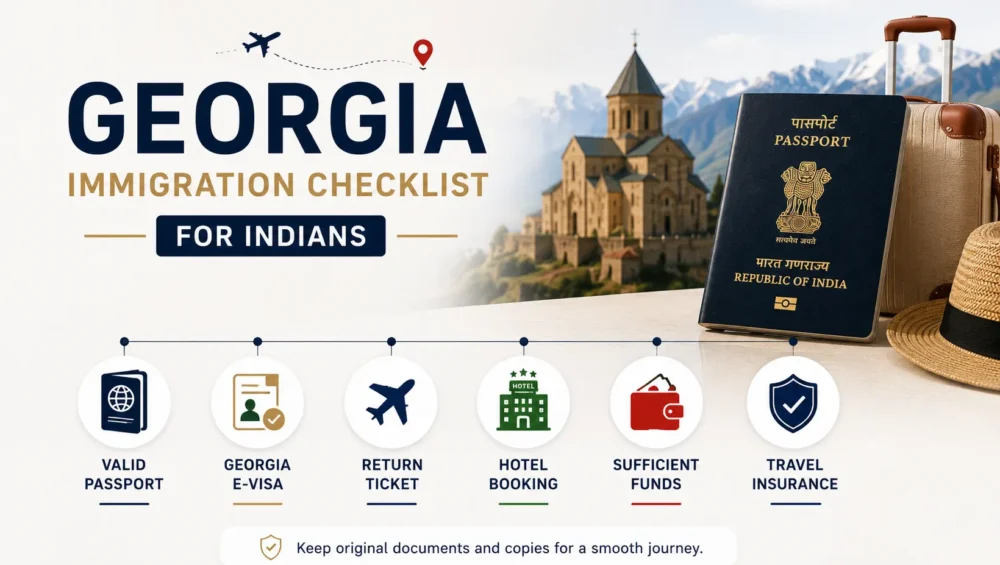
What Documents Should Indians Carry for Georgia Immigration

Georgia Immigration Checklist for Indians: What Documents Should You Carry at Arrival?

What Documents Should Indians Carry for Georgia Immigration?

Imagine this situation.

You’ve received your Georgia visa.

Your hotel is booked.

Your flights are confirmed.

You’re excited, reach immigration in Georgia, and suddenly an officer asks:

“Can you show your hotel bookings?”

Then:

“Do you have proof of funds?”

And maybe:

“What’s your plan during your stay?”

This is where some travelers become nervous.

Not because they’ve done anything wrong.

Simply because they weren’t expecting additional questions after getting their visa.

Here’s what most Indian travelers don’t realize:

A visa allows you to travel to Georgia. Immigration officers may still ask for supporting documents when you arrive.

The good news?

Most immigration conversations are straightforward when your paperwork is organized and easy to show.

Let’s go through exactly what should be inside your Georgia immigration folder before you leave India.

The Essential Georgia Immigration Folder

✓ Passport

✓ Georgia Visa / e-Visa (if applicable)

✓ Return Flight Ticket

✓ Hotel Confirmations

✓ Travel Insurance

✓ Bank Statements

✓ Day-Wise Itinerary

✓ Employment Proof

✓ Emergency Contacts

✓ Additional Supporting Documents

The Biggest Mistake Travelers Make

A surprisingly common thought is:

“My visa has already been approved. Why would anyone ask for more documents?”

Because immigration officers are checking something slightly different.

They want to understand:

  • Why you’re visiting
  • Where you’re staying
  • How you’ll pay for your trip
  • When you’ll leave

The travelers who move through immigration most smoothly are often the ones carrying more documents than they actually need.

Think of it this way.

It’s far better to have a document nobody asks for than need a document you don’t have.

Georgia Immigration Readiness Checklist

Essential Documents (Green Zone)

  • Passport
  • Visa / e-Visa
  • Return Ticket
  • Hotel Bookings
  • Travel Insurance

Recommended Documents (Yellow Zone)

  • Bank Statements
  • Employment Proof
  • Itinerary
  • Credit Cards
  • Emergency Contacts

Documents You Shouldn’t Leave Behind (Red Zone If Missing)

  • Passport
  • Visa
  • Accommodation Proof
  • Return Flight

Passport: The First Thing Immigration Will Look At

Before anything else, immigration officers will check your passport.

Seems obvious, right?

Yet passport-related issues create more travel problems than many people realize.

What You Should Carry

  • Original passport
  • At least six months validity preferred
  • Passport in good condition
  • Previous passports (optional but helpful)

A Common Problem Travelers Overlook

A damaged passport can create unnecessary questions.

Things like:

  • Torn pages
  • Water damage
  • Loose covers
  • Missing pages

can slow down the process.

What We Usually Recommend

Keep:

  • Original passport
  • Photocopy
  • Scanned digital copy

stored separately.

If anything unexpected happens during your trip, you’ll be grateful you did.

Passport Verification Checklist

✓ Passport valid

✓ Personal details clearly visible

✓ No major physical damage

✓ Digital copy saved

✓ Photocopy packed

🇬🇪 NOT SURE IF YOUR DOCUMENTS ARE COMPLETE?

Check Your Travel Documents Before You Fly

We’ll review your travel profile and identify any missing documents before departure so you can avoid last-minute issues and travel with confidence.

✓

Document Completeness Review

✓

Itinerary Verification

✓

Travel Profile Audit

✓

Missing Document Detection

✓

Risk Reduction Guidance

✓

Personalized Readiness Report

A quick pre-check can prevent delays, confusion, and unnecessary stress at immigration.

Visa, e-Visa, or Supporting Eligibility Document

One of the most common questions travelers ask is:

“Can I just show my e-Visa on my phone?”

Technically, digital copies are useful.

Practically, printed copies make life easier.

What To Carry

  • Printed visa or e-Visa approval
  • Digital backup copy
  • Supporting visa or residence permit if traveling through alternative eligibility rules

A Common Traveler Mistake

Many people rely entirely on screenshots.

Then:

  • Phone battery dies
  • Internet isn’t available
  • Documents become difficult to access

That’s unnecessary stress.

What We Usually Recommend

Carry:

  • Printed copy
  • PDF on your phone
  • PDF in email
  • Backup cloud storage copy

Multiple backups take almost no effort and can save a lot of anxiety.

Travel Document Folder

Your visa folder should contain:

✓ Visa

✓ Passport copy

✓ Insurance

✓ Flight details

✓ Hotel confirmations

Return Flight Ticket: One of the Most Important Documents

If immigration officers ask only one supporting question, this is often it.

“When are you leaving Georgia?”

A return ticket answers that immediately.

Why It Matters

A return flight demonstrates that you have a clear plan to leave the country after your holiday.

It supports your overall travel story.

What Immigration Wants To See

A simple and believable journey.

Something like:

India → Georgia → India

without confusion.

What We Usually Recommend

Carry:

  • Flight booking confirmation
  • Airline ticket receipt
  • E-ticket copy

Don’t rely solely on airline apps.

Travel Timeline

India → Georgia Arrival

Georgia Holiday

Georgia Departure

India Return

The simpler your travel plan looks, the easier immigration conversations usually become.

Hotel Confirmations: Don’t Arrive Without Them

Many travelers have hotel bookings.

Far fewer can show them quickly.

And that’s where problems begin.

What To Carry

  • Hotel confirmation vouchers
  • Booking confirmations
  • Hotel contact information
  • Hotel address

Why Immigration May Ask

They simply want to know where you’ll stay.

That’s all.

A Common Issue

A traveler knows they booked the hotel.

But then spends five minutes scrolling through emails trying to find proof.

Not ideal.

What We Usually Recommend

Keep:

  • Printed copies
  • PDFs on your phone
  • Offline versions

ready to show immediately.

Accommodation Checklist

✓ Hotel name

✓ Hotel address

✓ Booking dates

✓ Contact number

✓ Confirmation number

Small Tip That Helps

If you’re visiting multiple cities such as Tbilisi, Gudauri, and Kazbegi, carry accommodation proof for every location.

It makes your travel plan much easier to explain.

🇬🇪 WANT A GEORGIA IMMIGRATION READINESS CHECK?

Know Your Travel Status Before You Depart

We’ll review your bookings, itinerary, and supporting documents before departure so you know exactly how prepared you are for immigration and can fix gaps in advance.

✓

Booking Verification

✓

Itinerary Review

✓

Document Assessment

✓

Immigration Readiness Score

✓

Risk Gap Analysis

✓

Personalized Fix Recommendations

A quick readiness check can help you travel with confidence and reduce uncertainty at immigration.

Bank Statements and Proof of Funds

This is probably the document that surprises travelers most.

“Can immigration really ask for bank statements?”

Yes.

They can.

What To Carry

  • Last 3–6 months bank statements
  • Credit cards
  • Financial documents if self-employed
  • Investment statements (optional)

Why It Matters

Immigration officers want confidence that you can comfortably support yourself during your stay.

It’s not about showing enormous amounts of money.

It’s about showing realistic financial capability.

Reality Check

Having money isn’t enough.

You may need to demonstrate it.

Document
Bank Statement
Credit Card
Salary Proof
Investments
Importance
Critical
Helpful
Helpful
Optional
What We Usually Recommend

Carry recent statements in PDF format and printed copies.
Better to have them and never use them.

Travel Insurance: The Document Many Travelers Forget

Ask travelers what they packed.

Most will mention:

  • Passport
  • Visa
  • Flights

Very few immediately mention insurance.

What To Carry

  • Insurance certificate
  • Policy document
  • Emergency assistance details

Common Mistake

Buying insurance because it’s required and never downloading the policy.

Then nobody knows where the document is when needed.

What We Usually Recommend

Keep:

  • Printed copy
  • PDF copy
  • Emergency contact numbers

accessible throughout the trip.

Insurance Checklist

✓ Policy downloaded

✓ Coverage dates correct

✓ Emergency number available

✓ Digital backup saved

🇬🇪 NEED HELP PREPARING FOR GEORGIA IMMIGRATION?

Reduce Airport Stress Before You Travel

A quick document review can prevent unnecessary airport stress. We’ll check your itinerary, bookings, and supporting documents so you can travel with clarity and confidence.

✓

Document Review Check

✓

Booking Validation

✓

Itinerary Assessment

✓

Immigration Readiness Review

✓

Risk Gap Identification

✓

Personalized Travel Guidance

Small preparation steps before departure can make a big difference at immigration checkpoints.

The Document Nobody Talks About: Your Itinerary

You may never be asked for it.

But if questions arise, it becomes incredibly useful.

Why It Helps

Imagine an officer asks:

“What are your plans in Georgia?”

Instead of trying to remember everything, you can simply show your itinerary.

Sample 5-Day Georgia Plan

Day 1 – Tbilisi

Day 2 – Kazbegi

Day 3 – Gudauri

Day 4 – Kakheti

Day 5 – Departure

Why This Works

All your documents start telling the same story.

Hotels match your itinerary.

Flights match your itinerary.

Travel dates match your itinerary.

Consistency creates confidence.

Employment and Business Documents

Another common immigration question is:

“What do you do for work?”

Most travelers answer verbally.

But supporting documents can help.

Salaried Travelers

Carry:

  • Company ID
  • Employment letter
  • Approved leave letter

Business Owners

Carry:

  • Business registration
  • GST registration
  • Business proof

A Common Situation

An officer asks about your occupation.

You answer confidently.

Then you can support that answer immediately if needed.

Employment Checklist

✓ Occupation proof

✓ Employer details

✓ Leave approval

✓ Business documents (if applicable)

🇬🇪 FIRST INTERNATIONAL TRIP TO GEORGIA?

Check Your Documents Before You Depart

We’ll help you identify any document gaps before departure so you can travel with confidence and avoid last-minute surprises at immigration.

✓

Document Gap Check

✓

Travel Profile Review

✓

Itinerary Validation

✓

Booking Verification

✓

Risk Assessment

✓

Personalized Readiness Guidance

A quick pre-departure check can make your first international trip smoother and stress-free.

Documents Families, Couples, and Honeymoon Travelers Should Carry

Different travelers sometimes need slightly different paperwork.

Couples

Useful documents include:

  • Shared hotel bookings
  • Shared itinerary
  • Marriage certificate copy (optional)

Families

Carry:

  • Child passports
  • Child documents
  • Family hotel bookings
  • Return tickets for everyone

Why This Helps

When everyone’s paperwork tells the same story, immigration checks become much smoother.

What We Usually Recommend

Keep all family documents inside one organized folder rather than spreading them across multiple bags.

Our Recommended Georgia Immigration Folder

Essential Documents

✓ Passport

✓ Visa / e-Visa

✓ Return Flight

✓ Hotel Bookings

✓ Travel Insurance

✓ Bank Statements

Strong Supporting Documents

✓ Employment Proof

✓ Day-Wise Itinerary

✓ Credit Cards

✓ Emergency Contacts

✓ Previous Travel History

The Bottom Line

Most immigration issues don’t happen because travelers lack a visa.

They happen because travelers assume the visa is the only thing that matters.

When arriving in Georgia, be ready to answer three simple questions:

Why are you visiting?

Tourism.

Where are you staying?

Hotel confirmations.

How are you paying for the trip?

Bank statements and financial proof.

When your documents clearly answer those three questions, immigration conversations usually become straightforward and stress-free.

The goal isn’t carrying a thick stack of papers.

The goal is carrying the right papers and finding them instantly when needed.

🇬🇪 GEORGIA VISA & IMMIGRATION CONSULTATION

Are Your Documents Ready for a Smooth Entry?

Not sure whether your documents are sufficient for a smooth arrival? We’ll review your travel profile, bookings, finances, and supporting documents before you fly so you can avoid last-minute uncertainty at immigration.

✓

Travel Profile Review

✓

Booking Verification

✓

Financial Readiness Check

✓

Document Completeness Audit

✓

Immigration Risk Assessment

✓

Personalized Readiness Report

A quick pre-travel review can significantly reduce uncertainty and help you enter Georgia with confidence.

Frequently Asked Questions

Answers to common questions about Georgia travel documents, immigration checks, and entry preparation.

Can Georgia immigration ask for bank statements even if I have a valid visa?

Yes. Immigration officers can ask for proof of funds even after visa approval.

Should I print my hotel bookings or is a phone copy enough?

Printed copies are strongly recommended, even if digital versions are available.

How much bank balance should I show for a 5-day Georgia trip?

There is no universal amount, but your financial documents should comfortably support your planned expenses.

Is travel insurance mandatory for entry into Georgia?

Travel and health insurance is strongly recommended and may be required depending on your travel circumstances.

Should honeymoon couples carry a marriage certificate?

Not mandatory, but carrying a copy can occasionally be useful.

What questions are most commonly asked at Georgia immigration?

Purpose of visit, accommodation details, trip duration, return plans, and financial capability.

Can I enter Georgia with only an e-Visa and passport?

You should also carry supporting documents such as hotel bookings, return flights, and financial proof.

Should I carry employment proof if I’m salaried?

Yes. It helps support your travel profile if questions arise.

What documents should self-employed travelers carry?

Business registration, GST documents, company information, and financial records.

Is a day-wise itinerary really necessary?

Not mandatory, but it can be extremely useful if immigration officers ask about your travel plans.

What is the single most important document after the passport?

Usually your visa and return flight ticket.

Can a Georgia travel expert review my documents before departure and identify any potential immigration concerns?

Yes. A professional review can help identify missing documents and reduce the chances of unnecessary immigration delays.
Trssddw

Which Indian City Is Best to Fly From for a Bali Couple Trip?

One of the most common questions couples ask while planning Bali is:

"We can fly from Delhi, Mumbai, Bangalore, Chennai, Ahmedabad, Hyderabad, or Kolkata. Which city should we choose?"

The truth is that there is no single winner for everyone.

The best departure city depends on where you live, your budget, available leave, total travel time, and how comfortable you want the journey to be.

Many travelers focus only on airfare. Experienced Bali planners look at the complete travel experience, including layovers, airport transfers, baggage handling, transit quality, and arrival timing in Bali.

Quick Comparison: Best Indian Cities for Bali Flights

Most Flight Options
Delhi
Best for West India
Mumbai
Best for South India
Bangalore
Best Overall Balance
Mumbai / Bangalore
Cheapest Fares Often
Delhi
Shortest Travel Time
Bangalore

Flight Convenience Score by Departure City

Mumbai
9.5
Excellent Connectivity & Convenience
Bangalore
9.5
Outstanding Balance of Cost & Time
Delhi
9
Maximum Flight Availability
Chennai
8
Good Regional Option
Hyderabad
8
Reliable Connectivity
Kolkata
7.5
Useful Gateway for East India

Key Insight: The city with the cheapest airfare is not always the city that gives you the best Bali travel experience. Total travel effort matters just as much as ticket price.

⚠ Most Travelers Miss This

What Many Couples Don't Realize

The cheapest Bali flight is not always the cheapest Bali trip.

Suppose you save ₹10,000 by flying from another city. It sounds like a great deal initially.

But once you calculate the complete journey, the numbers often look very different.

✈️
Domestic Flights

Additional tickets can quickly reduce your expected savings.

🚕
Airport Transfers

Travel between airports, hotels, and terminals adds extra cost.

🧳
Baggage Charges

Separate tickets often create additional baggage expenses.

🏨
Hotel Stays

Some flight schedules force travelers to stay overnight before departure.

⏰
Long Transit Time

Extra hours spent traveling can impact your holiday experience.

📅
Extra Leave From Work

Longer travel routes sometimes require additional vacation days.

What We Usually Look At While Planning Bali Trips

When planning Bali trips for Indian couples, we evaluate the complete travel effort rather than focusing on airfare alone.

A flight that costs ₹5,000 more but saves six hours of travel can often create a significantly better holiday experience.

"After all, Bali should begin with excitement and anticipation, not exhaustion from a complicated journey."

The most valuable flight is usually the one that balances:

  • Reasonable airfare
  • Comfortable transit duration
  • Reliable connections
  • Good departure timings
  • Minimal travel stress
FREE BALI FLIGHT PLANNING CONSULTATION
Not Sure Whether Mumbai, Delhi, Bangalore, or Another City Makes More Sense?

Before booking flights, compare all realistic options side-by-side and identify the route that offers the best balance of cost, travel time, comfort, and convenience.

✅ Compare multiple departure city options
✅ Identify hidden travel costs before booking
✅ Review transit airports and connection quality
✅ Find the most comfortable route for your trip

What We Usually Look At While Planning Bali Trips

When planning Bali trips for Indian couples, we evaluate the complete travel effort rather than focusing only on airfare.

A flight that costs ₹5,000 more but saves six hours of travel can often deliver a significantly better overall experience.

💰
Total Cost
⏱️
Travel Time
🧳
Transit Quality
📍
Airport Convenience
😌
Travel Comfort
❌ What Most Travelers Compare
  • Cheapest airfare
  • Lowest advertised price
  • One flight option
  • Savings on paper
✅ What Experienced Bali Planners Compare
  • Total journey duration
  • Transit airport quality
  • Baggage and transfer costs
  • Arrival timing in Bali
  • Travel fatigue level
After all, Bali is supposed to start with excitement, not exhaustion.
FREE BALI FLIGHT PLANNING CONSULTATION
Not Sure Whether Mumbai, Delhi, Bangalore, or Another City Makes More Sense for Your Trip?

Before booking, compare all realistic departure options and identify the route that offers the best balance of cost, comfort, travel time, and convenience.

✅ Compare multiple departure cities side-by-side
✅ Identify hidden costs before booking
✅ Review transit airports and connection quality
✅ Find the most comfortable Bali route
ADD YOUR ELEMENTOR BUTTON HERE

Should You Fly From Your Home City or Position Yourself to Another Airport?

Another question couples frequently ask:

"Should we first travel to Delhi or Mumbai and then take our Bali flight?"

Sometimes yes. Sometimes absolutely not. The answer depends on how much money you save and what you sacrifice to get that saving.

✅ When It Makes Sense
  • Airfare savings exceed ₹15,000+
  • Flight timings are significantly better
  • Total travel time becomes shorter
  • You get a much better airline experience
  • You are already visiting that city before departure
❌ When It Usually Doesn't
  • Separate domestic tickets are required
  • An overnight hotel stay becomes necessary
  • Baggage costs increase significantly
  • Connection risks become higher
  • Savings are relatively small

Simple Decision Framework

Under ₹5,000
Rarely Worth It
₹5,000–₹15,000
Depends
₹15,000+
Often Worth It

What We Usually Recommend

Most honeymoon couples prioritize comfort over squeezing every possible rupee out of flight costs. When the savings are small, convenience usually wins.

Real Example: Ahmedabad to Bali

Ahmedabad → Bali
₹48,000
→
Mumbai → Bali
₹38,000
→
Looks Like Savings
₹10,000

Now add the Ahmedabad-to-Mumbai flight, airport transfers, baggage charges, and a possible hotel stay. The actual savings can become much smaller.

For some couples, Mumbai still makes sense. For others, the reduced convenience outweighs the savings.

Mumbai vs Delhi for Bali Flights: Which Is Better for Couples?

Mumbai
Connectivity Excellent
Flight Duration Very Good
Transit Options Excellent
Convenience Excellent
Delhi
Connectivity Excellent
Flight Duration Good
Transit Options Excellent
Convenience Very Good

Common Misconception

Many travelers assume Delhi always offers the cheapest Bali fares. That isn't always true. Depending on season, airline promotions, and travel dates, Mumbai or even Bangalore can offer equally attractive pricing.

Mumbai vs Delhi for Bali Flights: Which Is Better for Couples?

Mumbai
Connectivity Excellent
Flight Duration Very Good
Transit Options Excellent
Convenience Excellent
Delhi
Connectivity Excellent
Flight Duration Good
Transit Options Excellent
Convenience Very Good

Common Misconception

Many travelers assume Delhi always offers the cheapest Bali fares. That isn't always true. Depending on season, airline promotions, and travel dates, Mumbai or even Bangalore can offer equally attractive pricing.

Best Departure City Based on Where You Live in India

Instead of asking, "Which city is best for Bali?", a better question is:

"Which city is best for me?"

West India
Pune → Mumbai
Ahmedabad → Mumbai
Surat → Mumbai
North India
Delhi → Delhi
Jaipur → Delhi
Chandigarh → Delhi
Lucknow → Delhi
South India
Bangalore → Bangalore
Chennai → Chennai / Bangalore
Kochi → Bangalore
Coimbatore → Bangalore
East India
Kolkata → Kolkata
Bhubaneswar → Kolkata
Guwahati → Kolkata

Our Recommendation: The closest major international gateway often delivers a better overall travel experience than chasing small airfare savings elsewhere.

Which Indian Cities Usually Get the Cheapest Bali Airfares?

The cheapest departure city changes throughout the year, but some cities consistently remain competitive.

Delhi
High
Mumbai
High
Bangalore
Medium+
Chennai
Medium
Hyderabad
Medium
📈 Peak Season
  • June – August
  • October
  • December
  • New Year Period
💰 Better Value Months
  • February
  • March
  • April
  • September
🎉 Sale Opportunities
  • Independence Day Sales
  • Festival Sales
  • New Year Promotions
  • Airline Anniversary Sales

Price Insight: Flexibility with travel dates often creates bigger savings than changing departure cities. A shift of just 3–5 days can sometimes save more money than repositioning to another airport.

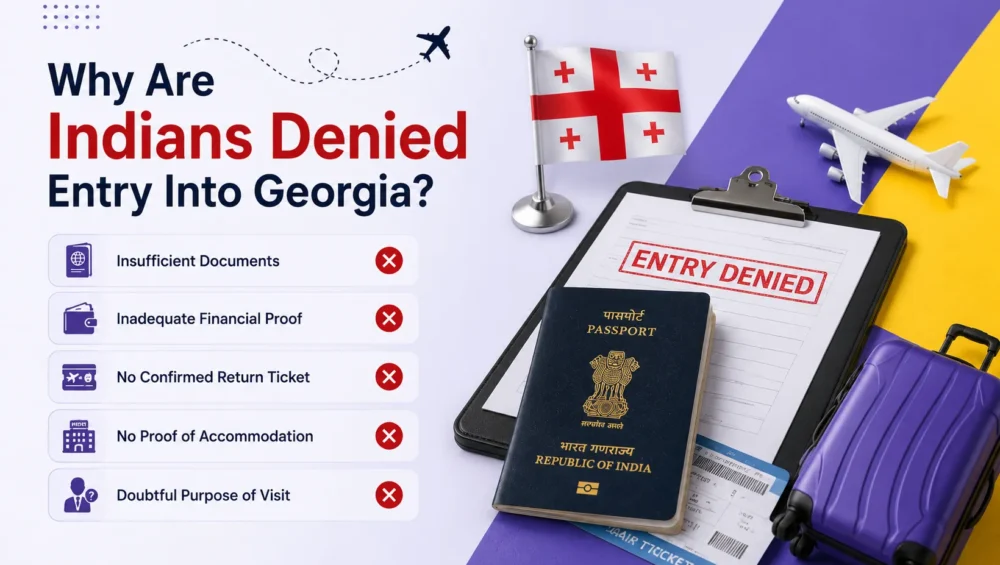
Why Are Indians Denied Entry Into Georgia

Why Are Some Indians Being Denied Entry Into Georgia Despite Having a Visa?

A question that has made many travelers nervous over the last few years is this:

“If my visa is approved, can Georgia still refuse me entry?”

The short answer is yes.

But before you panic, it’s important to understand what’s actually happening.

Most Indian travelers who enter Georgia every year have no problems at all. The cases you hear about online usually involve travelers whose documents, finances, itinerary, or travel purpose raised concerns during immigration checks.

In other words, people are usually not refused entry simply because they are Indian. They are refused because immigration officers are not fully convinced about the trip itself.

Trying to Understand the Risk? Here’s the Short Answer

Many travelers think visa approval and entry approval are the same thing.

They’re not.

A visa gives you permission to travel to Georgia. The final decision happens when you land and meet the immigration officer.

Question
Can Georgia deny entry after visa approval?
Does this happen to every Indian traveler?
Is nationality alone the reason?
Can preparation reduce the risk?
Should travelers take immigration seriously?
Honest Answer
Yes
No
Usually no
Absolutely
Yes

What Many Travelers Misunderstand

One of the biggest misconceptions is:

“I got the visa, so my job is done.”

Unfortunately, immigration officers are evaluating more than the visa sticker or approval letter. They want to understand whether your trip looks genuine, realistic, and financially supported.

How the Process Actually Works

Visa Approval → Arrival in Georgia → Immigration Questions → Entry Decision

That final step is what many travelers overlook.

What Are Georgia Immigration Officers Actually Looking For?

When travelers imagine immigration checks, they often think officers are searching for missing paperwork.

In reality, they’re trying to answer one simple question:

“Does this person genuinely look like a tourist who plans to visit Georgia and return home after the trip?”

Everything else supports that decision.

Is This a Genuine Tourist?

Your hotel bookings, return flight, travel plans, and answers should all point to the same story.

If you’re visiting for tourism, your documents should clearly show a tourism-focused trip.

Can This Traveler Afford the Trip?

Immigration officers want confidence that visitors can comfortably pay for:

  • Hotels
  • Meals
  • Local transportation
  • Sightseeing
  • Unexpected expenses

Does the Itinerary Make Sense?

A realistic travel plan is often more convincing than an ambitious one.

For example, saying you’ll visit five cities in four days can create unnecessary questions.

Do the Documents Match the Story?

If your hotel booking says one thing and your answers suggest something different, that inconsistency can create concerns.

Think of It Like This

Immigration officers aren’t reviewing individual documents in isolation.

They’re checking whether all the pieces fit together logically.

One of the Most Common Problems: Weak Travel Documentation

Surprisingly, many travelers spend weeks obtaining a visa and then arrive with incomplete supporting documents.

Documents That Frequently Create Problems

  • Missing hotel confirmations
  • No return flight booking
  • No travel insurance
  • Vague travel plans
  • Incomplete itinerary

What Experienced Travelers Usually Carry

✓ Hotel booking confirmations

✓ Return flight tickets

✓ Travel insurance

✓ Day-by-day itinerary

✓ Emergency contact details

✓ Copies of important travel documents

Document
Return Ticket
Hotel Booking
Travel Insurance
Itinerary
Emergency Contacts
Importance
Critical
Critical
Important
Important
Helpful
The stronger your paperwork, the easier it becomes for immigration officers to understand your trip.

Can Your Answers at Immigration Affect Entry?

Yes.

Many travelers are surprised by this.

They assume documents are everything.

But officers also pay attention to whether you can confidently explain your own travel plans.

Questions You May Be Asked

  • Why are you visiting Georgia?
  • How many days will you stay?
  • Which cities will you visit?
  • Where are you staying?
  • What do you do for work?
  • Who is paying for the trip?

None of these are difficult questions.

The issue arises when travelers hesitate, contradict their documents, or appear unsure.

Here’s What Immigration Wants

Not perfect answers.

Not rehearsed answers.

Just clear and consistent answers.

A Common Example

Imagine carrying a detailed itinerary but being unable to explain:

  • Which city you’re visiting first
  • How long you’re staying
  • Which hotel you’ve booked

That creates confusion.

A simple travel plan explained confidently often works better than a complicated itinerary you barely understand.

Another Major Reason: Weak Proof of Funds

Money matters at immigration.

Not because officers expect luxury travelers.

Because they want reassurance that visitors can support themselves during the trip.

Why Financial Proof Matters

Officers may want confidence that you can pay for:

  • Accommodation
  • Meals
  • Transportation
  • Activities
  • Unexpected situations

A Mistake Many Travelers Make

Some travelers genuinely have enough money but carry no evidence.

If asked, they struggle to demonstrate their financial capacity.

Useful Financial Documents

  • Recent bank statements
  • International credit cards
  • Salary slips
  • Proof of business ownership
  • Income documents

Financial Readiness Checklist

✓ Recent bank statement

✓ Active debit/credit cards

✓ Proof of income

✓ Emergency funds

Being financially prepared and being able to prove it are two different things.

You need both.

Does Travel History Matter?

This topic creates a lot of anxiety among first-time travelers.

The truth is more balanced.

Can First-Time International Travelers Enter Georgia?

Absolutely.

Thousands do every year.

Then Why Does Travel History Matter?

Previous international trips can sometimes help demonstrate a pattern of lawful travel.

For immigration officers, that may provide additional confidence.

Traveler Profile
Strong Travel History
Couple With Previous Trips
Family Travelers
First-Time Traveler
Typical Scrutiny
Lower
Lower
Lower
Moderate
This doesn’t mean first-time travelers are likely to be denied. It simply means they may be asked more questions.

Employment and Income Questions Sometimes Matter Too

Another area where travelers occasionally struggle is explaining their work situation.

What Officers May Want to Understand

  • Your occupation
  • Your source of income
  • Why you’ll return home after the trip

Important Clarification

Being:

  • Self-employed
  • Freelance
  • Business owner
  • Remote worker

is not a problem.

The problem starts when travelers cannot clearly explain their work circumstances.

Documents That Help

✓ Employment letter

✓ Leave approval

✓ Business registration

✓ GST documents

✓ Company ID card

✓ Income proof

The goal isn’t to impress immigration officers.

The goal is to make your situation easy to understand.

Sometimes the Concern Is About Overall Credibility

This is the hardest part for travelers to understand.

Immigration decisions are not always based on one missing document.

They’re often based on the overall picture.

Situations That May Raise Questions

  • Unrealistic budgets
  • Conflicting travel plans
  • Missing reservations
  • Contradictory answers
  • Weak documentation

Think Like an Immigration Officer

Imagine hearing:

  • “I don’t know where I’m staying.”
  • “My friend booked everything.”
  • “I haven’t planned the trip yet.”

Even if those answers are honest, they may create uncertainty.

The Travel Credibility Formula

Documents + Itinerary + Answers = Credibility

The strongest travelers make all three tell the same story.

Why Are Couples and Families Usually Less Affected?

This doesn’t mean couples and families are automatically approved.

However, they often face fewer complications.

Why?

Because their travel purpose is usually easier to verify.

A honeymoon itinerary is generally straightforward.

A family vacation often includes:

  • Hotel bookings
  • Return tickets
  • Planned sightseeing

All of these help establish credibility.

Traveler Type
Family
Honeymoon Couple
Group Tour
First-Time Solo Traveler
Typical Risk
Lower
Lower
Lower
Moderate
These are broad observations, not guarantees. Preparation remains the most important factor.

So What Can Indian Travelers Do Before Departure?

The good news is that many common problems can be avoided.

Carry Printed Documents

Phone batteries die.

Internet connections fail.

Printed copies are still useful.

Keep Confirmed Hotel Bookings

Make sure reservations are active and accessible.

Carry Travel Insurance

Apart from protection, it also strengthens your travel profile.

Have Proof of Funds Available

You may never be asked.

But if you are, you’ll be prepared.

Understand Your Own Itinerary

You don’t need to memorize every detail.

You should simply know:

  • Where you’re staying
  • Which cities you’re visiting
  • How long you’re staying

Keep Travel Plans Realistic

Simple, believable itineraries usually work better than overly ambitious schedules.

Georgia Entry Readiness Checklist

✓ Valid visa

✓ Hotel confirmations

✓ Return ticket

✓ Travel insurance

✓ Bank statements

✓ Itinerary

✓ Employment proof

✓ Emergency contacts

If you can confidently tick these boxes, you’re already ahead of many travelers.

Our Verdict: Why Are Indians Being Denied Entry Into Georgia?

After looking at hundreds of traveler experiences, one thing becomes clear.

Most entry refusals are not about nationality alone.

They’re usually connected to one or more of the following:

  • Weak documentation
  • Financial concerns
  • Inconsistent answers
  • Unclear travel purpose
  • Overall credibility issues
Factor
Complete Documents
Clear Itinerary
Proof of Funds
Strong Travel History
Weak Documentation
Inconsistent Answers
Impact on Entry
Positive
Positive
Positive
Positive
Negative
Negative
The Bottom Line: Most Indian travelers who enter Georgia smoothly have one thing in common — strong preparation and consistent documentation.

They arrive prepared.

A visa approval is important, but it’s only part of the journey.

Confirmed hotels, return flights, travel insurance, proof of funds, employment documents, and a clear understanding of your own itinerary often make a bigger difference when standing in front of an immigration officer.

No preparation can guarantee entry.

But strong preparation can significantly improve your chances of having a smooth and stress-free arrival experience.

Frequently Asked Questions

Common questions about Georgia immigration, entry requirements, and travel preparation for Indian travelers.

Can I be denied entry even if my Georgia visa is approved?

Yes. Visa approval allows travel to Georgia, but immigration officers make the final entry decision after arrival.

How much bank balance should I show for a Georgia trip?

There is no universal number. The amount should realistically support your trip duration, accommodation, transportation, food, and activities.

What questions are commonly asked at Georgia immigration?

Typical questions include your travel purpose, hotel details, trip duration, occupation, return plans, and financial arrangements.

Are honeymoon couples facing entry issues?

Most honeymoon couples with proper documentation experience smooth entry, although immigration officers can still ask questions if required.

Is Georgia risky for first-time international travelers?

Not necessarily. Many first-time travelers enter successfully. They should simply prepare their documents more carefully and understand their itinerary.

Does having a US, UK, or Schengen visa help?

It may strengthen your travel profile in some situations, but it does not guarantee entry.

Are families with children getting denied entry?

Families generally face fewer concerns when documentation, finances, and travel plans are clear and consistent.

Should I carry printed hotel and flight confirmations?

Yes. Printed copies remain useful and can help if officers request supporting documents.

Does entering through Armenia increase scrutiny?

Scrutiny depends on the overall travel profile and itinerary rather than a single border crossing point.

What is the most common reason travelers get refused?

Weak documentation and an inability to clearly explain the purpose and details of the trip are among the most common issues.

Is Georgia still worth visiting despite these concerns?

Yes. Thousands of Indian travelers visit Georgia successfully every year. Proper preparation significantly reduces potential problems.

Can a travel expert review our itinerary and documents before we travel?

Yes. A professional review can help identify weak areas in your itinerary, documentation, financial preparation, and overall travel profile before departure.

Are Indians Still Getting Denied Entry Into Georgia

Are Indians Still Being Denied Entry Into Georgia in 2026? Here’s What Travelers Should Know

A few years ago, this article would have been much shorter.

Someone would ask, “Can Indians travel to Georgia?” and the answer would simply be yes.

Today, the conversation is different.

If you’ve been researching Georgia recently, you’ve probably come across stories about Indian travelers being questioned, detained, or denied entry at immigration. 

Some of these stories are genuine. Some are missing important details. 

And many have created the impression that Georgia is no longer welcoming Indian tourists.

The reality sits somewhere in the middle.

Yes, some Indian travelers are still being denied entry into Georgia. But no, Georgia has not stopped welcoming Indian tourists. 

In fact, Indian arrivals continued growing throughout 2025 despite the concerns being discussed online. The question isn’t whether Indians can enter Georgia. 

The real question is whether you’re arriving with the kind of documentation and travel plans immigration officers expect to see.

Are Indians Still Being Denied Entry Into Georgia in 2026? Here’s What Travelers Should Know

Let’s address the concern directly.

Yes, some Indian travelers are still being denied entry into Georgia, even when they hold valid visas or qualify under Georgia’s entry rules.

At the same time, thousands of Indian tourists continue entering Georgia successfully every year.

That’s why blanket statements like “Georgia has banned Indians” or “Nobody can enter Georgia anymore” are simply incorrect.

Claim
Indians are banned from Georgia
Nobody can enter Georgia
Some travelers face stricter checks
Entry denials still happen
Most genuine tourists enter successfully
Reality
False
False
True
True
True

What Most Travelers Get Wrong

The biggest mistake is assuming that one viral story represents everyone’s experience.

Someone shares a deportation experience on Instagram or Reddit, and suddenly hundreds of people believe Georgia has become impossible to visit.

What those posts rarely show are the thousands of travelers who landed, cleared immigration in a few minutes, enjoyed their trip, and never posted about it.

What We Usually Tell Travelers

Georgia’s challenge isn’t accessibility.

It’s predictability.

Compared to destinations like Thailand, Bali, Dubai, or Singapore, Georgia immigration often appears more willing to question travelers and request supporting documents.

That extra scrutiny is what creates concern.

Why Are So Many Georgia Travelers Talking About Immigration Right Now?

The topic became much bigger during 2025 because several incidents involving Indian travelers received significant attention online.

Viral Traveler Stories

Videos and posts started appearing in travel communities describing situations where travelers claimed they were questioned extensively or denied entry despite holding visas and supporting documents.

Naturally, these stories spread quickly.

Social Media Makes Every Incident Feel Bigger

Here’s something worth remembering.

Nobody usually uploads a reel titled:

“Entered Georgia smoothly. Immigration took three minutes. Had a great holiday.”

People share unusual experiences.

Negative experiences spread faster.

As a result, a handful of incidents can create the impression that an entire destination has become problematic.

The Part Most Travelers Miss

Despite the headlines, Indian visitor arrivals to Georgia continued growing.

If Georgia were truly refusing most Indian travelers, those numbers would be moving in the opposite direction.

That doesn’t mean concerns should be ignored.

It simply means the reality is more balanced than social media often suggests.

🇬🇪 WORRIED ABOUT GEORGIA IMMIGRATION?

Not Sure If Your Documents Are Strong Enough?

Not sure whether your documents, itinerary, or travel history are strong enough? Get a clear pre-check of your travel profile so you understand any gaps before you apply or travel.

✓

Document Strength Review

✓

Itinerary Validation Check

✓

Travel History Assessment

✓

Risk Flag Identification

✓

Improvement Recommendations

✓

Personalized Readiness Report

A strong application starts with knowing where you stand—before you book flights or submit documents.

Can You Be Denied Entry Even If You Have a Valid Visa?

This surprises many first-time international travelers.

The answer is yes.

A visa allows you to travel to Georgia.

It does not guarantee admission.

Immigration officers make the final decision when you arrive.

Why Does This Happen?

Think about it from an immigration officer’s perspective.

Their job isn’t simply checking whether you have a visa.

Their job is deciding whether your stated travel purpose appears genuine.

They may look at:

  • Your hotel bookings
  • Your return flight
  • Your travel history
  • Your financial documents
  • Your answers during questioning

A traveler with a visa but weak documentation can sometimes attract more scrutiny than a traveler with stronger supporting evidence.

This Isn’t Just a Georgia Rule

Many countries operate the same way.

The difference is that Georgia has developed a reputation for using this authority more actively than many leisure destinations.

Which Travelers Usually Get More Questions at Immigration?

There is no official list.

But patterns appear repeatedly in traveler reports.

First-Time International Travelers

Having no travel history doesn’t mean you’ll be denied.

It simply means immigration officers may ask more questions.

Travelers With Weak Documentation

This is one of the most common issues.

Examples include:

  • Unclear hotel reservations
  • Missing travel insurance
  • No return ticket
  • Incomplete itinerary

Travelers Who Can’t Explain Their Trip

Questions are often simple.

For example:

  • Why are you visiting Georgia?
  • How long are you staying?
  • Which cities are you visiting?
  • What do you do for work?
  • Where will you stay?

The issue isn’t getting questioned.

The issue is giving unclear or inconsistent answers.

Travelers With Limited Proof of Funds

Officers may want evidence that you can support yourself during the trip.

That doesn’t necessarily mean carrying huge amounts of money.

It means being able to demonstrate financial preparedness.

Travelers Who Usually Have the Smoothest Experience

✓ Confirmed hotel bookings

✓ Return flights

✓ Travel insurance

✓ Clear itinerary

✓ Adequate funds

✓ Consistent answers

Traveler Type
Families with complete documents
Couples with confirmed plans
Experienced international travelers
First-time international travelers
Travelers with weak documentation
Risk Level
Low
Low
Low
Moderate
Higher
🇬🇪 NOT SURE IF YOUR DOCUMENTS ARE STRONG ENOUGH?

Get Clarity Before You Book Your Flights

Before booking flights, get clarity on what immigration officers may expect. We’ll review your travel profile, documents, and itinerary so you know exactly where you stand before you travel.

✓

Document Readiness Check

✓

Itinerary Strength Review

✓

Travel Profile Assessment

✓

Immigration Expectation Overview

✓

Risk Gap Identification

✓

Personalized Readiness Guidance

A quick pre-check can help you avoid last-minute surprises at immigration and travel with more confidence.

Does a Strong Travel History Make Things Easier?

Many Indian travelers ask whether holding a valid US, UK, Schengen, Japan, Australia, or UAE visa helps.

The short answer is usually yes.

A strong travel history can help demonstrate genuine tourism intent.

Georgia also provides easier entry pathways for certain travelers holding valid visas or residence permits from specific countries under current regulations.

But Here’s the Important Part

A strong travel history is helpful.

It is not a guarantee.

Even travelers with impressive passport stamps should still arrive with proper documentation.

Why Travel History Matters

From an immigration perspective, previous international travel can provide reassurance that you’re traveling for tourism and returning home as expected.

Think of it as a positive signal rather than a guaranteed approval.

Flying Into Tbilisi or Entering Through Armenia: Which Is Easier?

This question comes up frequently.

Especially among travelers planning a Georgia-Armenia itinerary.

Why The Question Exists

Several well-known complaints from Indian travelers involved land border crossings between Armenia and Georgia.

Because of that, many first-time visitors now prefer direct flights into Tbilisi.

What We Usually Recommend

For a first Georgia trip, direct arrival by air generally creates fewer uncertainties.

Factor
Simplicity
Documentation Review
First-Time Visitor Suitability
Direct Flight
Higher
Standard
Excellent
Land Border
Lower
Often More Detailed
Moderate
This doesn’t mean land crossings are problematic. It simply means first-time travelers often prefer the more straightforward option.
🇬🇪🇦🇲 PLANNING GEORGIA + ARMENIA TOGETHER?

Does Your Combined Route Actually Make Sense?

Let’s review whether your route makes sense before you finalize it. We’ll help you check travel flow, timing, and experience balance so your Georgia and Armenia trip feels smooth instead of rushed.

✓

Cross-Country Route Review

✓

Travel Time Optimization

✓

Itinerary Flow Check

✓

Experience Balance Analysis

✓

Logistics Feasibility Review

✓

Personalized Route Suggestion

A well-structured multi-country itinerary ensures you enjoy both destinations without wasting time in transit or rushed planning.

What Should You Have Ready Before You Reach The Immigration Counter?

Many travelers spend weeks getting a visa.

Then spend almost no time preparing for immigration.

That’s backwards.

Your Georgia Immigration Folder Should Include

✓ Passport

✓ Valid visa or eligibility proof

✓ Return flight ticket

✓ Hotel confirmations

✓ Travel insurance

✓ Recent bank statements

✓ Day-wise itinerary

✓ Employment proof (if applicable)

✓ Leave approval letter (optional but useful)

One Simple Tip

Carry both printed and digital copies.

Phones run out of battery.

Internet connections fail.

Printed documents often make questioning much smoother.

The Most Common Preparation Mistake

Focusing entirely on the visa.

And not preparing for the questions that come after landing.

After Hearing All This, Should You Still Visit Georgia?

For most travelers, yes.

Georgia remains popular for good reasons.

  • Beautiful mountain landscapes
  • Scenic road trips
  • Historic towns
  • Wine regions
  • Affordable pricing
  • Relatively easy connectivity from India

The concerns are real.

But so are the reasons people continue visiting.

Benefits
Beautiful landscapes
Affordable travel
Unique culture
Growing tourism infrastructure
Challenges
Stricter immigration
Extra documentation
Possible questioning
Entry never guaranteed

What Smart Travelers Do Differently

They don’t panic.

They prepare.

They treat Georgia immigration more seriously than they might for destinations like Bali, Thailand, or Dubai.

That small shift often makes a big difference.

🇬🇪 FIRST INTERNATIONAL TRIP TO GEORGIA?

Is Your Travel Plan Immigration-Ready?

Find out whether your travel plans are immigration-ready. We’ll review your itinerary, documents, and travel profile so you can travel with confidence on your first international trip to Georgia.

✓

First-Time Traveller Check

✓

Document Readiness Review

✓

Itinerary Validation

✓

Travel Profile Assessment

✓

Risk Gap Analysis

✓

Personalized Travel Guidance

A strong first international trip starts with clarity—before booking flights or finalizing plans.

Our Verdict: Should Indians Still Visit Georgia?

If You Have Complete Documentation

Yes.

If You Have Genuine Tourism Intentions

Yes.

If You’re Prepared For Immigration Questions

Yes.

If You’re Hoping To Travel With Minimal Documentation

Think carefully.

Question
Are Indians still being denied entry?
Are most Indians entering successfully?
Is Georgia safe for tourists?
Should travelers carry strong documentation?
Is Georgia still worth visiting?
Answer
Yes, some are
Yes
Yes
Absolutely
For many travelers, yes

The Bottom Line

Two things can be true at the same time.

Some Indian travelers are still being denied entry into Georgia.

And thousands of Indian travelers are still entering Georgia successfully every year.

The concern is real.

The panic is often exaggerated.

What we usually tell Indian travelers is simple: treat Georgia immigration seriously. Arrive with complete documentation, confirmed bookings, proof of funds, travel insurance, and a clear understanding of your itinerary. Most genuine tourists who prepare properly continue to enjoy successful trips to Georgia, which is why visitor numbers from India continue growing despite the headlines.

Frequently Asked Questions

Answers to common questions about Georgia immigration, entry requirements, and first-time travel concerns.

My wife and I are planning a Georgia honeymoon. Are couples generally entering without issues?

Couples with confirmed hotel bookings, return tickets, and complete documentation generally face fewer problems than travelers with unclear plans.

If Georgia is my first international trip, should I be concerned?

Not necessarily. First-time travelers may receive additional questions, but strong documentation and clear travel plans can help significantly.

Does holding a valid Schengen visa improve my chances of entry?

A strong travel history can help demonstrate genuine tourism intent, but it does not guarantee admission.

Are airport arrivals smoother than land border crossings?

Many first-time travelers prefer flying directly into Tbilisi because it often feels more straightforward than cross-border entry.

How much bank balance should I show for a Georgia trip?

There is no universal amount. The key is being able to demonstrate that you can comfortably support yourself throughout the trip.

Should I carry printed hotel confirmations?

Yes. Printed confirmations can be extremely useful if immigration officers request supporting documents.

Is travel insurance mandatory for Georgia?

Requirements can change, but carrying valid travel insurance is strongly recommended.

Why do some travelers get denied despite having visas?

Because immigration officers evaluate more than just the visa. Documentation, travel purpose, financial readiness, and interview responses may all influence the decision.

Are families with children facing similar issues?

Families traveling together with complete documentation generally report smoother experiences.

What questions are commonly asked at Georgia immigration?

Questions often focus on trip purpose, accommodation, duration of stay, occupation, finances, and return travel plans.

Should I combine Georgia with Armenia if it’s my first visit?

You can, but many first-time travelers prefer entering Georgia directly by air before attempting land border crossings.

Can a Georgia travel expert review our itinerary and documents before we book flights?

Yes. A professional review can help identify documentation gaps, strengthen your itinerary, and reduce avoidable immigration concerns.

Why Visit China – Culture, Wonders & Authentic Travel

1: Why Visit China – A Timeless Civilization Awaits

Traveling through China is like flipping through the pages of a living history book. From the Great Wall to futuristic cities like Shanghai and Guangzhou, China invites you to discover the world’s oldest continuous civilization, rich with spiritual depth, natural wonders, and cultural treasures. It’s a vast country that stuns first-time travelers and rewards return visits.

2: The Great Wall of China – One of the World’s Greatest Feats

Walk along the ancient stones of The Great Wall of China, stretching across mountains and deserts for over 13,000 miles. Popular sections like Mutianyu and Badaling near Beijing offer unforgettable hiking and scenic views.

3: Sacred Temples & Ancient Traditions

From Shaolin Monastery, birthplace of Zen Buddhism and kung fu, to Wudang Mountains and Confucian temples in Qufu, China is deeply rooted in spiritual and philosophical teachings. Mount Putuo and Mount Wutai are sacred Buddhist destinations for pilgrimage and meditation.

4: Culinary Treasures – From Street Food to Imperial Feasts

Food is the soul of China. Savor Peking duck in Beijing, dim sum in Guangzhou, spicy Sichuan hotpot, or Yunnan mushroom cuisine. Explore night markets, dumpling houses, and teahouses for a full gastronomic journey.

5: Traditional Culture & Festivals – A Living Legacy

China’s cultural heritage thrives in its festivals, performances, and arts. Enjoy the Spring Festival (Chinese New Year), Lantern Festival, Qingming (Tomb-Sweeping Day), and the vibrant Dragon Boat Festival. Art forms like calligraphy, tai chi, and opera continue to be practiced nationwide.

6: Natural Wonders – From Zhangjiajie to the Li River

China’s landscapes are surreal. Explore the floating mountains of Zhangjiajie, cruise the Li River in Guilin, marvel at the misty Yellow Mountains (Huangshan), and hike the stunning Jiuzhaigou Valley in Sichuan. Each region is a painter’s dream brought to life.

7: Cities of the Past & Future – Beijing, Shanghai & Guangzhou

Beijing preserves imperial history in the Forbidden City and Temple of Heaven. Shanghai offers cutting-edge architecture and world-class dining. Guangzhou, China’s third-largest city, blends ancient Cantonese culture with vibrant modern life, and is a major food and shopping hub.

8: Pandas, Monkeys & Rare Wildlife

Meet giant pandas in Chengdu, snub-nosed monkeys in Yunnan, and explore remote areas home to leopards and red pandas. China is a biodiversity hotspot, with nature reserves, mountain parks, and sanctuaries for rare animals.

9: China’s Top Festivals – Lanterns, Boats & Dragons

Experience fireworks during Lunar New Year, dragon boat races in riverside towns, and lantern-lit streets during Mid-Autumn Festival. Regional festivals like Ice and Snow Festival in Harbin, Qixi Festival (Chinese Valentine’s Day), and Double Ninth (Senior’s Day) showcase China’s seasonal rhythms.

10: Offbeat & Hidden Gems – Yunnan, Guizhou, Fujian

Explore rice terraces in Longsheng, Dong and Miao minority villages in Guizhou, or the tulou (earthen homes) of Fujian. The ancient tea horse road, cave dwellings in Shaanxi, and Silk Road cities like Dunhuang and Kashgar offer deep immersion in hidden histories.

11: UNESCO Heritage Sites – A Journey Through Civilizations

China boasts 50+ UNESCO World Heritage Sites, including the Terracotta Warriors, Mogao Caves, Longmen Grottoes, classical gardens of Suzhou, and Mount Tai. These sites showcase religious art, imperial architecture, and dynastic achievements across millennia.

12: Shopping in China – From Markets to Malls

Shop for silk in Suzhou, jade and pearls in Beijing, electronics in Shenzhen, and antiques at Panjiayuan Market. Cities like Shanghai, Guangzhou, and Chengdu offer global luxury brands and vibrant local markets. Bargaining is common in local bazaars.

13: China Travel Tips – Visa, Currency, Etiquette & Essentials

🛂Visa Requirements

Indian travelers must apply for a Chinese tourist visa in advance through the Chinese Visa Application Center. Prepare hotel bookings, return flight tickets, and an invitation letter if required. Processing time: ~5-7 working days.

💵Currency & Payment

Official currency: Chinese Yuan (CNY)

Cash is used in rural areas, while cities rely heavily on Alipay or WeChat Pay. Carry a travel card or international debit card as backup.

🔌Power Plugs & Voltage

Plug types: A, C, I

Voltage: 220V / 50Hz

Universal adapters are recommended.

🧳Etiquette

  • Respect elders; give/receive items with both hands
  • Avoid political conversations
  • Avoid touching heads or pointing with feet
  • Greet with a nod or slight bow; handshakes are common
  • Use basic Mandarin phrases (e.g., Ni hao = Hello)

Packing Essentials

VPN (to access Western websites), Mandarin phrasebook or app, comfortable shoes, layered clothing, mask for pollution in some cities, basic medicine, offline maps.

Why Visit Bali

1. Beaches & Coastal Beauty

Bali’s coastlines offer something for everyone: Kuta for party vibes, Seminyak for upscale beach clubs, Nusa Dua for family-friendly resorts, and Uluwatu for dramatic sunsets and surfing. Don’t miss hidden coves like Padang Padang or the quiet black sands of Lovina.

2. Spirituality & Temples

From Tirta Empul’s holy springs to the clifftop grandeur of Uluwatu Temple, Bali’s sacred sites are deeply spiritual. Visit Besakih, the island’s mother temple, or Ulun Danu Beratan floating on a crater lake. Many travelers attend chakra healing, yoga, or water blessings in Ubud.

3. Natural Landscapes & Rice Terraces

Explore the famous Tegallalang Rice Terraces, hike Mount Batur for sunrise, and swim beneath cascading falls like Tegenungan and Sekumpul. In Bedugul and Sidemen, lush landscapes and cool breezes offer a rural escape.

4. Arts, Culture & Local Life

Bali’s soul lives in its art and ritual. Watch Barong and Legong dances, visit artisan villages like Celuk (silver) and Mas (wood carving), and browse Ubud Art Market. Sacred holidays like Galungan and Kuningan transform villages with color and devotion.

5. Adventure & Activities

Ride the surf in Canggu, white-water raft the Ayung River, trek jungle trails, or zipline across treetops. Nusa Penida offers diving with manta rays, while ATV rides and volcano climbs attract adrenaline seekers.

6. Wellness, Retreats & Spas

Bali is a global hub for healing. Attend a yoga retreat in Ubud, experience Balinese massages, or detox at Ayurvedic centers. Wellness seekers flock to Canggu and Sidemen for rejuvenation and inner peace.

7. Food & Culinary Experiences

Taste Bali’s best with dishes like nasi campur, babi guling, and satay lilit. Join a Balinese cooking class in Ubud, sip cocktails at Potato Head, or go vegan at KYND Community. Warung Ibu Oka is a local legend!

8. Islands Around Bali

Just a short boat ride away, Nusa Penida dazzles with Kelingking Beach and snorkeling. Nusa Lembongan offers laid-back surf vibes, while Gili Trawangan promises coral reefs, nightlife, and no motor vehicles.

9. Luxury, Boutique & Budget Stays

Stay in cliffside villas in Uluwatu, eco-lodges in Sidemen, or beach resorts in Seminyak. Budget travelers love Canggu hostels, while honeymooners flock to private villas with infinity pools in Ubud.

10. Festivals of Bali – Sacred, Vibrant & Timeless

Bali’s festivals blend spirituality and celebration, making them unforgettable experiences for visitors.

Major festivals to witness:

Nyepi Day (Day of Silence): Bali’s New Year – no lights, no traffic, and complete stillness for 24 hours.

Ogoh-Ogoh Parade: The night before Nyepi, watch giant demonic statues paraded and then burned to cleanse evil spirits.

Galungan & Kuningan: Celebrating the triumph of dharma over adharma – streets are adorned with tall bamboo poles called penjor.

Melasti Ceremony: A water purification ritual held days before Nyepi on Bali’s beaches.

Saraswati Day: A day to honor the goddess of knowledge, marked with prayers and offerings at schools and temples.

Bali Arts Festival (June–July): A month-long cultural celebration in Denpasar featuring dance, music, and traditional art.

Pagerwesi: A day dedicated to spiritual strengthening and ancestor worship.

These festivals are perfect for cultural travelers, photographers, and seekers of authentic local experiences.

11. Shopping in Bali

Visit Ubud Art Market, Sukawati Market, or Seminyak boutiques for fashion and décor. Find silver in Celuk, wood carvings in Mas, and hip brands at Beachwalk Mall. Bargaining is part of the fun!

12. Iconic Cafés & Restaurants in Bali

Bali is a paradise for food lovers and café hoppers. Whether you’re chasing Instagrammable smoothie bowls or fine dining by the sea, Bali has it all.

Must-visit cafés & eateries:

Potato Head Beach Club (Seminyak): Iconic beachfront club with stylish cocktails and global cuisine.

Revolver Espresso (Seminyak): Hip café with excellent coffee and rustic vibes.

KYND Community (Seminyak): A plant-based café famous for its photogenic pink décor and healthy bowls.

La Brisa (Canggu): Boho beach bar perfect for sunsets and seafood.

Warung Ibu Oka (Ubud): Local favorite for Bali’s legendary Babi Guling (roast pig).

Locavore (Ubud): Award-winning fine-dining with a hyper-local tasting menu.

The Shady Shack (Canggu): A breezy vegan-friendly spot surrounded by rice paddies.

Cafe Organic (multiple locations): Trendy vegetarian café known for organic juices and smoothie bowls.

  • Indian citizens can apply for a Vietnam e-Visa online (valid 30 days, single entry).
  • Processing time: 3–5 working days.
  • Cost: Approx. USD 25.

13. Travel Tips & Essentials

🛂Visa: 30-day Visa on Arrival for most countries

💵Currency: Indonesian Rupiah (IDR)

SIM Cards: Telkomsel or XL for tourists

Transport: Hire scooters, use Grab/GoJek, or private drivers

Best Time: April to October (dry season)

Why Visit Vietnam – Land of Timeless Beauty & Adventure

1. Imperial Cities, Halong Bay & Timeless Heritage

Wander through ancient citadels in Hue, glide past limestone karsts in Halong Bay, or walk the lantern-lit lanes of Hoi An. Vietnam is a living museum of Southeast Asian history and elegance. Whether you’re visiting the pagodas of Hanoi or the royal tombs of central Vietnam, the country offers a graceful mix of French-colonial charm and Asian mysticism.

2. Enchanting Street Culture & Local Hospitality

Vietnam’s magic lies in its street scenes — steaming pho from roadside stalls, tiny red stools filled with locals sipping iced coffee, and the chorus of scooters whizzing by. The people are warm, curious, and eager to share stories. Every street corner, café, and homestay becomes part of your adventure.

3. Food Lover’s Heaven – From Pho to Fresh Spring Rolls

Vietnamese cuisine is a sensory delight. Slurp iconic bowls of pho in Hanoi, savor banh mi baguettes in Hoi An, and try spicy bun bo Hue in central Vietnam. From wet markets to fine dining, the flavors are fresh, zesty, and deeply nourishing. Food tours are a must.

4. Buddhist Temples, Zen Retreats & Spiritual Tranquility

Find your quiet in the misty pagodas of Ninh Binh, the mountain monasteries of Sapa, or the peaceful Perfume Pagoda near Hanoi. Vietnam’s spiritual side offers reflection, silence, and beauty, making it ideal for yoga, meditation, or mindful exploration.

5. Hidden Nature Trails & Majestic Mountains

Hike the terraced rice fields of Sapa, cycle through the Mekong Delta, or explore the caves of Phong Nha-Ke Bang. From mountains to deltas, Vietnam is an adventure playground. The natural landscapes are diverse, raw, and largely untouched by mass tourism.

6. Soulful Cities – Hanoi, Hoi An & Saigon

Vietnam’s cities blend the past and future. In Hanoi, lakes and pagodas meet modern galleries. In Saigon (Ho Chi Minh City), colonial architecture merges with skyscrapers. In Hoi An, heritage lanes glow with silk lanterns. Each city offers soul, stories, and surprises.

7. Beaches & Islands – From Phu Quoc to Da Nang

Vietnam’s coastline is a tropical dream. Lounge on the white sands of Phu Quoc, surf in Da Nang, or snorkel the coral-rich waters of Nha Trang. The beaches are clean, affordable, and less crowded than Thailand — perfect for honeymoons or family holidays.

8. War History, Museums & Resilience

Vietnam’s past is powerful — from the Cu Chi tunnels near Saigon to the War Remnants Museum and the DMZ. The country wears its scars with grace. Understanding this history gives depth to your visit and honors a resilient, peaceful people.

9. Budget-Friendly Luxury for Indian & Global Travelers

From boutique stays under ₹3000/night to five-star resorts at half the price of Europe, Vietnam offers incredible value. Indian travelers enjoy visa ease, vegetarian options, and a welcoming vibe. It’s one of the best budget-luxury destinations in Southeast Asia.

10. Ideal for Soulful Solo Trips, Honeymoons & Friends

Travel solo through lantern-lit cities, honeymoon in Phu Quoc, or backpack with friends across the mountains. Vietnam’s mix of beauty, spirituality, and adventure suits all travel styles — from seekers to celebrators.

11. Festivals & Cultural Celebrations

Celebrate Tet (Lunar New Year) with dragon dances and fireworks, float lanterns during Hoi An Full Moon Festival, or enjoy ethnic festivities in the highlands. Vietnam’s festivals are colorful, sacred, and deeply rooted in tradition.

12. Sustainable Travel, Boutique Stays & Wellness

Vietnam is embracing responsible travel. Stay in eco-resorts in Ninh Binh, support local artisans in Sapa, or join organic farm tours near Da Lat. With rising interest in yoga retreats, detox cafés, and nature escapes, Vietnam is now a wellness haven too.

13. Travel Tips – Visa, Currency, Shopping, Plugs & Etiquette

🛂 Visa:

  • Indian citizens can apply for a Vietnam e-Visa online (valid 30 days, single entry).
  • Processing time: 3–5 working days.
  • Cost: Approx. USD 25.

💵 Currency:

  • Vietnamese Dong (VND).
  • INR can be exchanged easily in major cities. Carry USD for better rates.
  • Credit cards accepted at hotels and restaurants.

👜 Shopping Tips:

  • Great for silk, lanterns, handmade shoes, lacquerware, coffee, and street art.
  • Top places: Hanoi Old Quarter, Hoi An markets, Ben Thanh Market (Saigon).
  • Bargaining is expected at local markets.

🔌 Plug Types & Voltage:

  • Plug type: A, C, D (2-pin round or flat)
  • Voltage: 220V
  • Universal adapters recommended.

🧳 Packing & Etiquette Tips:

A smile and basic greetings in Vietnamese go a long way.

Lightweight clothes, shawl for temples, hiking shoes for mountains.

Dress modestly at temples, remove shoes before entering homes/pagodas.

Why Visit Nepal — What’s Actually There, What It Costs, and Why Most Indians Are Surprised by How Much They Love It

A lot of Indian travelers put Nepal on a mental “someday” list and never actually go.

And that’s a bit strange, because Nepal is one of the easiest international trips an Indian passport holder can take. 

No visa. No complicated paperwork. 

Flights under ₹10,000 return from Delhi or Mumbai. And Indian Rupees are accepted almost everywhere — so you don’t even need to figure out currency exchange before you land.

But that’s not why people come back talking about Nepal the way they do.

They come back because Nepal surprised them. 

They expected mountains and temples. 

They got that — but they also got something harder to describe. 

A sense of quiet. An older way of living that still feels very much alive. 

The kind of trip where you come back feeling like you actually went somewhere.

Here’s what’s actually in Nepal, what things cost, and how to figure out if it’s the right trip for you.

What’s Actually in Nepal — By Destination

Nepal is small in size but genuinely varied. Most people cover two or three destinations in a single trip. 

Here’s what each one gives you.

Kathmandu — Culture, Temples, and a City That Feels Lived-In

Almost every Nepal trip starts in Kathmandu, and the city deserves more time than most people give it.

The Kathmandu Valley has seven UNESCO World Heritage Sites packed into roughly 25 km. 

Not seven locations — seven individual monuments. 

The three historic cities of Kathmandu, Patan (Lalitpur), and Bhaktapur together form one of the densest concentrations of medieval architecture in Asia.

The places most worth your time:

Pashupatinath Temple is one of the most important Hindu pilgrimage sites in the world. 

It sits on the banks of the Bagmati River. Non-Hindus cannot enter the inner sanctum, but the ghats and surrounding area are open, and what you see here is unlike anything in India — cremations happening alongside prayers, sadhus in meditation, pilgrims from all over South Asia. 

It’s not a tourist attraction. 

It’s a living temple city. 

Entry fee for Indians: NPR 1,000 (roughly ₹625).

Boudhanath Stupa is a massive Buddhist stupa — one of the largest in Asia — surrounded by Tibetan monasteries, incense shops, and tiny cafés on the upper floors where you can sit and watch monks walk the circumambulation path below. 

Best early morning, before the tour groups arrive. Entry: NPR 400 (roughly ₹250).

Swayambhunath (Monkey Temple) sits on a hill above the city. 

You climb about 365 steps to reach it. 

The monkeys are genuinely bold. 

The view of Kathmandu from the top on a clear morning is good. 

Entry: NPR 200 (roughly ₹125) for SAARC nationals.

Bhaktapur is the best-preserved of the three old cities. 

It’s about 13 km from Kathmandu city center, easy to reach by taxi or bus. 

The Durbar Square here looks the way Kathmandu probably looked 400 years ago. 

It’s used as a film location regularly and for good reason — it’s that intact.

Recommended time: 2 to 3 nights in Kathmandu.

Pokhara — Lakes, Mountains, and the Best Morning Views in Asia

Pokhara is where a lot of travelers say Nepal really got them.

It’s a lakeside city — Phewa Lake is the main one — with the Annapurna range sitting directly above it. 

On clear days, the reflection of Machhapuchhre (the Fishtail Peak) in the lake is the kind of view you stop walking to look at for a while.

Sarangkot at sunrise is the one thing in Pokhara you should not skip. You leave by taxi at 4:30 AM (roughly NPR 1,500 return with waiting), reach the viewpoint in about 45 minutes, and watch the Annapurna massif light up in the early morning. 

The temperature before sunrise can be quite cold — carry a proper jacket even if you’re visiting in October. 

This is the moment most people photograph from Nepal, and it earns it.

Paragliding over Pokhara is one of Asia’s better tandem paragliding experiences. 

You launch from Sarangkot and fly over the lake with the Himalayas in the background. It costs USD 80–100 (roughly ₹6,700–₹8,400) for a 30-minute flight. It’s a splurge, but a justifiable one.

Phewa Lake boating — rent a wooden boat for NPR 600 per hour and row across to the Tal Barahi Temple on the island. 

Low cost, very peaceful.

The Lakeside area has a long stretch of cafés, restaurants, and small shops along the lake. Good for walking in the evening, much more relaxed than Thamel in Kathmandu.

Getting to Pokhara: Domestic flight from Kathmandu is 25 minutes and costs about NPR 7,000–12,000 one way (₹4,375–₹7,500). 

The tourist bus from Kathmandu takes 6 to 7 hours and costs NPR 700–1,000 (₹438–₹625). 

If you’re not trekking, the bus is fine — the road goes through good scenery.

Recommended time: 2 to 3 nights in Pokhara.

Free Nepal Itinerary

Planning a Nepal Trip From India?

Get a free Nepal itinerary built around your travel dates, group size, and the places you want to experience. Whether you want a Kathmandu cultural trip, a relaxing Pokhara escape, a Chitwan wildlife experience, or a combination of all three, we will create a plan that fits your group.

Tell us your travel dates and number of travelers. We will send you a ready day-by-day Nepal itinerary within 24 hours with hotel suggestions, sightseeing plans, realistic INR costs, and a visa and document checklist for Indian travelers.

Suggested Hotels Day-Wise Sightseeing Plan INR Cost Estimate Visa & Documents Checklist

Chitwan National Park — Tigers, Rhinos, and an Actual Jungle Safari

Chitwan is in Nepal’s southern Terai lowlands, about 5 to 6 hours by tourist bus from Kathmandu or Pokhara.

It’s a UNESCO-listed national park and one of Asia’s better wildlife destinations.

The one-horned rhino is what most people come for — Chitwan has a healthy population, and jeep safari sightings are genuinely common. 

Bengal tigers are there too but rarer. 

You can also spot gharial crocodiles, sloth bears, and hundreds of bird species.

The gateway town is Sauraha. A 2-night / 3-day package from there — including jeep safari, canoe ride, jungle walk, and Tharu cultural evening — costs roughly ₹8,000–₹15,000 per person, depending on the resort you pick. 

The national park entry fee for SAARC nationals is USD 10 per day (about ₹840), which is dramatically lower than the fee for other foreign nationals.

The Tharu cultural programme — traditional dances by the indigenous Tharu community — is worth attending if you’re staying two nights. 

It usually happens in the evening at local resorts and is often included in packages.

Recommended time: 2 nights.

Lumbini — The Birthplace of Lord Buddha

Lumbini is in Nepal’s western Terai, about 4 to 5 hours from Pokhara or reachable by direct flight (45 minutes from Kathmandu). 

It’s where Prince Siddhartha was born in 563 BCE, and it’s now a UNESCO World Heritage Site.

The Maya Devi Temple marks the exact birth spot. 

The Ashoka Pillar from 249 BCE is right next to it — placed by Emperor Ashoka during his pilgrimage here.

The sacred garden around it is quiet in a way you don’t find at most pilgrimage sites.

What makes Lumbini interesting beyond the main temple is the monastery zone — dozens of monasteries built by Buddhist communities from Thailand, Japan, Sri Lanka, China, Germany, and many other countries.

Each one is built in its own architectural style, so walking between them feels like moving between countries.

It’s genuinely unlike anything else in South Asia.

For Indian travelers with religious or spiritual interest in Buddhism, Lumbini is a significant destination. 

It’s usually added as a 1 to 2-night extension to a Pokhara leg.

What Does a Nepal Trip Actually Cost from India?

This is where Nepal becomes hard to say no to.

Indian nationals do not need a visa. Entry only requires a valid passport or voter ID — even Aadhaar works at land borders. 

And Indian Rupees are accepted in most tourist areas, restaurants, and hotels. 

The exchange rate is roughly 1 INR = 1.6 NPR, so your money goes slightly further than at home.

How Much Does a Nepal Trip from India Actually Cost?

Expense Cost Range (Per Person)
Return flights from Delhi/Mumbai ₹4,000–₹14,000
Mid-range hotel per night ₹1,500–₹4,000
Daily food (eating out, 3 meals) ₹500–₹1,200
Kathmandu sightseeing entry fees ₹1,500–₹2,500 total
Chitwan 2N/3D package ₹8,000–₹15,000
Pokhara paragliding ₹6,700–₹8,400

Realistic total trip cost for Indian travelers (7 nights, per person):

Trip Style Estimated Total
Budget (hostels, local food, buses) ₹15,000–₹25,000
Mid-range (decent hotels, some activities) ₹30,000–₹50,000
Comfortable (good hotels, all activities) ₹55,000–₹85,000

Budget Trip

Cost:
₹15,000–₹25,000 per person

Hostels, local food, buses and basic sightseeing

Mid-Range Trip

Cost:
₹30,000–₹50,000 per person

Decent hotels, comfortable transport and selected activities

Comfortable Trip

Cost:
₹55,000–₹85,000 per person

Good hotels, private experiences and all major activities

These figures include return flights from India. Nepal consistently comes out as one of the most affordable international trips for Indians — and the experience it gives for that price is genuinely difficult to match.
Free Nepal Trip Planning

Not Sure What Your Nepal Trip Should Include?

Many travelers spend hours comparing different Nepal combinations like Kathmandu + Pokhara or Kathmandu + Pokhara + Chitwan, but still struggle to decide what fits their time and budget. The right itinerary depends on your travel days, interests, and spending comfort.

Tell us your total budget and number of days. We will suggest exactly what is possible and build a Nepal itinerary that matches your trip with practical recommendations.

Destination Combination Hotel Suggestions in INR Activity Cost Guide Best Time Advice

Best Time to Visit Nepal from India

Season Months What's It Like
Autumn (Best) October – November Clear skies, best mountain views, pleasant temperatures
Spring (Good) March – May Rhododendrons blooming, good for trekking
Winter December – February Cold at altitude, but good for Chitwan safari and Kathmandu culture
Monsoon (Avoid for treks) June – August Heavy rain, challenging for mountain activities; Kathmandu still accessible

Autumn (Best)

Months:
October – November

Experience:
Clear skies, best mountain views, pleasant temperatures

Spring (Good)

Months:
March – May

Experience:
Rhododendrons blooming, good for trekking

Winter

Months:
December – February

Experience:
Cold at altitude, but good for Chitwan safari and Kathmandu culture

Monsoon (Avoid for treks)

Months:
June – August

Experience:
Heavy rain, challenging for mountain activities; Kathmandu still accessible

October and November are when most Indian travelers visit — and for good reason. The skies are the clearest they get all year, mountain views are sharp, and temperatures in Kathmandu and Pokhara are genuinely comfortable.

Who Should Visit Nepal?

Nepal works for more types of travelers than most people realize.

If you want a spiritual trip: Pashupatinath, Lumbini, Boudhanath, and dozens of monasteries across the Kathmandu Valley make Nepal one of the most meaningful destinations in Asia for Hindu and Buddhist pilgrims. 

The energy at Pashupatinath in the evening — when the Aarti happens on the banks of the Bagmati — stays with you.

If you want adventure: Pokhara is the base for paragliding, white-water rafting on the Trishuli River, bungee jumping near the Bhote Koshi gorge, and some of the world’s most famous trekking routes — Annapurna Base Camp, Everest Base Camp, Poon Hill. 

Even if you’re not a trekker, a half-day hike from Pokhara gives you serious mountain views.

If you want a peaceful trip with great scenery: Phewa Lake in Pokhara, the Lakeside area, and the quiet of Nagarkot at dawn give you exactly that. 

Nepal is not a loud or chaotic destination the way some parts of India can feel.

If you’re on a tight budget: Nepal is one of the few international destinations where ₹30,000 per person gives you 7 genuinely good days — including flights, comfortable hotels, entry fees, and most activities.

If you want a trip you haven’t done before: Most Indian travelers say Nepal felt different in a way they didn’t expect. 

Maybe because it’s familiar in language and food, but completely different in landscape and pace.

Things People Get Wrong About Nepal

“I’ll just do Kathmandu and come back.”

Kathmandu alone is fine for 2 to 3 days, but the trip really opens up when you add Pokhara. 

The contrast between the city and the lakeside is significant. 

Most people who’ve done both say they’d skip a day in Kathmandu before they’d skip Pokhara.

“It’ll feel just like India.”

There are obvious similarities — shared language in many areas, familiar food, Hindu festivals. 

But Nepal feels noticeably calmer, slower, and more intact culturally. 

The old cities of Bhaktapur and Patan look the way parts of India looked 50 years ago, but maintained. 

People comment on this often.

“I’ll need a lot of cash.”

Indian Rupees work at most hotels, restaurants, and shops in tourist areas. 

In Thamel (Kathmandu’s main tourist neighborhood) and Lakeside (Pokhara), you can run the entire trip on INR without exchanging. 

Cards and UPI are increasingly accepted in major spots too.

“Nepal is only for trekkers.”

The trekking reputation is well-earned, but most Indian travelers visit Nepal without doing any serious trekking. 

Sarangkot sunrise, Phewa Lake, Chitwan safari, and the Kathmandu Valley temples are all accessible with zero trekking fitness required.

“October will be too crowded.”

Peak season in Nepal means more tourists than February — but nothing like the overcrowding you’d find in Goa during New Year or Shimla in May. 

The sites absorb the crowds well, and you won’t feel like you’re fighting for space.

Frequently Asked Questions About Nepal Travel From India

Everything Indian travellers need to know before planning a Nepal holiday.

1
Do Indian citizens need a visa to visit Nepal?
No. Indian nationals are visa-exempt. Under the 1950 Treaty of Peace and Friendship, Indians can enter Nepal freely. You need either a valid Indian passport or a government-issued photo ID like a voter ID card. For air travel, a passport is recommended. For land border crossings, Aadhaar or a driving license is also accepted.
2
Can I use Indian Rupees in Nepal?
Yes. Indian currency is widely accepted at hotels, restaurants, taxis, and shops in tourist areas. The exchange rate is approximately 1 INR = 1.6 NPR. Some shops in border towns and tourist areas may not accept denominations above ₹200 due to old local restrictions, but in Kathmandu and Pokhara this is rarely an issue. It's still a good idea to carry some NPR for local transport and smaller purchases.
3
How many days is enough for Nepal?
For Kathmandu only: 3 to 4 days. For Kathmandu and Pokhara: 6 to 7 days. For Kathmandu, Pokhara, and Chitwan: 9 to 10 days. Most first-time visitors do either 5 to 6 days (Kathmandu + Pokhara) or 8 to 9 days if they add Chitwan. One week is the sweet spot for a first trip.
4
What is the best time to visit Nepal from India?
October and November are the best months — clear skies, the best mountain views of the year, and comfortable daytime temperatures. March and April are also excellent, especially if you want to see rhododendrons blooming in the hills. Avoid June to August for trekking, though Kathmandu is still accessible in the monsoon.
5
How much does a 7-day Nepal trip cost from India?
For a mid-range trip (decent hotels, eating out, key activities), expect roughly ₹30,000–₹50,000 per person including return flights. Budget travelers who stay in guesthouses and take buses can do it for ₹15,000–₹25,000 per person. Chitwan adds ₹8,000–₹15,000 per person to any itinerary.
6
Which airlines fly from India to Kathmandu?
IndiGo, Air India, and SpiceJet operate direct flights to Tribhuvan International Airport (KTM) in Kathmandu from Delhi, Mumbai, Kolkata, Bengaluru, Hyderabad, and Varanasi. Flight times range from about 1 hour 20 minutes (Delhi) to 2 hours 30 minutes (Mumbai). Return fares typically run ₹4,000–₹14,000 depending on how early you book and which city you fly from.
7
Is Nepal safe for Indian travelers?
Nepal consistently ranks as one of the safest countries for Indian travelers. Language is not a barrier — Nepali and Hindi are closely related, and most people in tourist areas speak enough Hindi to communicate comfortably. Kathmandu and Pokhara have good medical facilities. The main practical caution is altitude — if you're going to Everest Base Camp or other high-altitude treks, acclimatization matters.
8
What is the best way to get around Nepal?
For Kathmandu to Pokhara: tourist bus (6–7 hours, NPR 700–1,000) or domestic flight (25 minutes, NPR 7,000–12,000). For Kathmandu to Chitwan: tourist bus (5–6 hours, NPR 700–900). Within cities, taxis and ride apps (Pathao) are the most practical option. Tuk-tuks are available in Bhaktapur and some older parts of Kathmandu.
9
What's the food situation for Indian vegetarians in Nepal?
Good. Dal-bhat (lentils and rice) is the national meal of Nepal and is genuinely excellent — most local restaurants serve a thali-style version that's refillable. Roti, sabzi, and familiar Indian-style dishes are easy to find in Kathmandu and Pokhara. Pure vegetarian options are available at most hotels. The Thamel area in Kathmandu has everything from South Indian idli to pizza, so vegetarians won't struggle.
10
Is Kathmandu or Pokhara better for a first visit to Nepal?
Both are different experiences. Kathmandu is cultural, historical, and intense. Pokhara is relaxed, scenic, and more about nature. Most people who visit both say Pokhara surprised them more. If you only have 3 to 4 days, Kathmandu is the logical choice because it has more sites. If you have 6 or more days, do both — and don't skip Pokhara.
11
Can families with children visit Nepal comfortably?
Yes. Kathmandu and Pokhara are comfortable for families with children of most ages. Chitwan is a good experience for school-age children — the jeep safari is a highlight. The main consideration is Kathmandu's air quality, which can be poor in winter months (November to February). If you're traveling with young children, October or March are better months. Serious trekking is not suitable for young children, but Pokhara's lakeside area and viewpoints are very accessible.
12
How do I add Lumbini to a Nepal trip?
Lumbini is best added to the Pokhara leg of the itinerary, not Kathmandu. Yeti Airlines and Saurya Airlines fly from Kathmandu to Bhairahawa (the nearest airport) in about 40 minutes. From Bhairahawa, Lumbini is roughly 25 minutes by taxi. Alternatively, Lumbini is about 2.5 to 3 hours from Pokhara by road — manageable as a day trip or easy 1-night extension. If Buddhist heritage or pilgrimage is a priority for your trip, plan at least one night in Lumbini.
13
Should I book Nepal independently or through a travel company?
Independent travel in Nepal is easy for experienced travelers — transport, hotels, and activities are straightforward to book. However, for first-time visitors, having someone handle the logistics (hotel bookings, transport connections, sightseeing plans) usually saves time and avoids the common mistake of underestimating travel times between cities.

A well-planned Nepal package from India typically costs 10 to 15% more than DIY but removes most of the guesswork. It also helps with arranging reliable transport, choosing the right hotels, and building an itinerary that fits your travel style.
14
What are the best places to visit in Nepal for first-time Indian travelers?
For a first Nepal trip, the classic route covers Kathmandu, Pokhara, and Chitwan.

Kathmandu offers temples, heritage sites, and cultural experiences including Pashupatinath Temple, Boudhanath Stupa, and Kathmandu Durbar Square.

Pokhara offers Himalayan views, Phewa Lake, Sarangkot sunrise, waterfalls, and adventure activities.

Chitwan adds wildlife experiences with jungle safaris, where you can spot one-horned rhinoceroses, elephants, and various bird species.

A 7–9 day itinerary covering these three destinations gives a balanced introduction to Nepal.
15
What should Indian travelers pack for a Nepal trip?
Packing depends on the season and places you plan to visit.

For October–November and March–April, carry light layers, a comfortable jacket, walking shoes, sunglasses, sunscreen, and a small backpack for day trips.

For mountain areas, pack warm clothing, thermal layers, gloves, and a windproof jacket.

For city travel, comfortable walking shoes are important because many heritage sites involve uneven paths and stairs. Carry a reusable water bottle, basic medicines, power adapter, and some Nepalese Rupees for smaller expenses.

Why Sri Lanka Should Be Your Next Trip From India — Ramayana Trail, Sigiriya, Wildlife & Everything You Need to Know

You know what’s funny? Most Indian travelers spend months deciding between Bali, Thailand, and Vietnam — and completely overlook Sri Lanka. 

A country that is just 90 minutes from Chennai. 

A place where you can stand at the exact spot where Sita was held captive in Ashoka Vatika. 

And then, the very next morning, watch a leopard cross the road in front of your safari jeep.

Sri Lanka is not a budget fallback. 

It is genuinely one of the most diverse trips you can take from India — part Ramayana pilgrimage, part wildlife safari, part beach holiday, part hill station getaway. 

And you can fit all of that into 7–8 days.

The people who finally visit always say the same thing: “Why did we wait so long?”

The Ramayana Connection — This Is the Part That Hits Different for Indian Visitors

For most Indian families, Sri Lanka is not just a foreign country. 

It is a chapter from the Ramayana they have been hearing about since childhood. 

The thing that surprises people when they actually get here — the places are all real, and you can stand inside them.

The Ramayana trail covers over 50 sites across the island. Here are the ones that actually matter:

Seetha Amman Temple, Nuwara Eliya — This is Ashoka Vatika. 

The place where Ravana kept Sita captive. 

There is a stream running beside the temple, and the footprints pressed into the rocks are said to be Sita’s own. 

If you grew up reciting the Sunderkand, being here feels different from any temple back home. 

Many visitors get emotional — that is not an exaggeration.

Munneswaram Temple (near Chilaw) — Lord Rama stopped here after defeating Ravana to pray and seek forgiveness. The Shiva lingam inside is believed to have been consecrated by Rama himself. 

It is an active temple, full of devotees, and nothing like the tourist-heavy sites you see elsewhere on the trail.

Divurumpola — This is where Sita’s Agni Pariksha (trial by fire) took place, according to the epic. What makes this interesting: even today, the local community uses this temple as a court of conscience. People come here to take oaths, and those oaths are considered binding. The belief is alive and functioning, not just historical.

Ravana Falls and Ravana Cave, Ella — Ravana is said to have hidden Sita in these caves before moving her to Ashoka Vatika. 

The waterfall is worth seeing on its own, but knowing what the cave supposedly held makes the whole stop feel like more than sightseeing.

Gayathri Peedam and Koneshwaram Temple, Trincomalee — Most Ramayana tour packages skip these entirely. 

Koneshwaram is one of the Pancha Ishwarams (five sacred Shiva temples of Sri Lanka) and is directly connected to Rama’s story. 

The clifftop setting above the ocean is unlike anything else on the island.

Sigiriya Rock — This One Place Can Justify an Entire Trip

Even if mythology means nothing to you, Sigiriya is worth the flight on its own.

A 5th-century rock fortress built by King Kashyapa, rising 200 meters straight out of the jungle. 

The climb is around 1,200 steps, and yes, it is tiring. 

But when you reach the top and look out across nothing but forest in every direction — no buildings, no roads, no noise — it is genuinely one of those views that stays with you.

What you actually need to know before you go:

  • Entry fee for Indians: SAARC citizens pay USD 20 (around ₹1,700), which is exactly half the standard foreigner rate of USD 35. Show your Indian passport at the ticket counter — some people miss this and pay the full rate.
  • Best time to arrive: Before 8:00 AM. After 10 AM, it gets hot and the tour buses arrive. The morning light is also better for photos.
  • Time needed: Budget 3–4 hours total — the climb, the ancient frescoes section (closed at 5:45 PM), and the water gardens at the base.
  • Pidurangala Rock: This is 15 minutes from Sigiriya and most people skip it. Do not. It gives you the best view of Sigiriya itself — the iconic photo everyone has seen. Entry is only LKR 1,000 (about ₹270). Go here first, then head to Sigiriya.

Buddhist Heritage — Older Than Most Countries in the World

Sri Lanka’s Buddhist civilization is over 2,300 years old. 

These three stops are not optional if you care about history.

Temple of the Sacred Tooth Relic, Kandy — One of the most important Buddhist shrines in all of Asia. 

The evening Pooja ceremony at 6:30 PM — with drums, flowers, and hundreds of devotees — is something you should see at least once. Non-Buddhists are welcome.

Dambulla Cave Temples — Five cave temples carved into a rock face, with over 150 Buddha statues and ceiling paintings that are 2,000 years old. 

Entry for SAARC citizens: USD 10 (around ₹850). Quiet, impressive, and very different from anything in India.

Anuradhapura — Sri Lanka’s first ancient capital, home to the Sri Maha Bodhi — a sacred fig tree that is a direct sapling from the tree under which Buddha attained enlightenment. 

It is over 2,200 years old and is considered the oldest documented living tree in recorded human history.

Free Sri Lanka Itinerary

Not Sure How to Structure Your Sri Lanka Days?

Sri Lanka offers a mix of culture, wildlife, beaches, and heritage experiences, but fitting everything into the right order can be challenging. We have helped families, couples, and solo travelers plan trips covering the Ramayana circuit, Cultural Triangle, wildlife parks, and coastal stays.

Tell us your trip duration and we will send you a ready-made day-by-day Sri Lanka itinerary on WhatsApp, planned specifically for Indian travelers.

Ramayana Circuit Cultural Triangle Wildlife & Beaches Day-Wise Itinerary

Wildlife — Leopards, 300 Elephants in One Place, and Baby Rhinos

Here is what most people do not realize about Sri Lanka: you can see a leopard and a wild elephant herd in the same 7-day trip. 

Not in a wildlife park, not in a zoo — in actual jungle, in actual wild habitat.

Yala National Park has the highest density of leopards anywhere in the world. 

That claim is accurate. 

The terrain is open enough that sightings happen regularly, unlike denser forests where you can go days without spotting anything. 

Safaris run early morning (5:30 AM–9 AM) and late afternoon (3 PM–6 PM). 

A shared safari jeep costs ₹3,000–₹4,500 per person; a private jeep runs ₹8,000–₹12,000 and gives you more flexibility to wait at sightings.

Minneriya National Park is the one most Indian visitors miss — and they regret it. 

Every year between July and October, 200–300 wild elephants gather in one open plain around the Minneriya reservoir in what is called “The Gathering.” It is one of Asia’s largest seasonal wildlife events. 

And since it sits just 30 km from Sigiriya, you can cover both in a single base.

Pinnawala Elephant Orphanage is more accessible and perfect for families with children. 

Rescued baby elephants, feeding sessions, and the famous river bathing at 10 AM and 2 PM. 

Entry: LKR 3,000 (around ₹810). Get there before 9:30 AM to avoid the tour bus crowd.

Nuwara Eliya and the Kandy-Ella Train — The Part Nobody Expects

Sri Lanka’s hill country surprises most visitors. 

You come expecting tropical. 

You get cool, misty hills, tea estates rolling to the horizon, and waterfalls that appear every few kilometers.

Nuwara Eliya sits at 1,868 meters. 

Carry a light jacket even in summer — the temperature drops to 12–15°C at night. 

Heritance Tea Factory and Araliya Green Hills Hotel are two of the better-known properties here, with rooms from ₹6,000–₹12,000 per night.

The Kandy to Ella train is regularly listed as one of the most scenic train rides in the world. 

The journey takes 6–7 hours through tea country, over stone viaducts, past waterfalls, and through mountain tunnels. 

Second class reserved seats cost around ₹450–₹800 per person. 

The observation car seats sell out weeks in advance — book online through the Sri Lanka Railways website or via a local agent.

Stop at Ella to see the Nine Arch Bridge, do the Little Adam’s Peak hike (2 hours, easy terrain, great views), and eat at Chill Villa restaurant on the main road. 

Good rice and curry for under ₹400 per person.

Beaches — South Coast, East Coast, and What's in Season When

Sri Lanka has beaches on multiple coasts, and they do not all work in the same season. This is the detail that trips up a lot of Indian travelers.

Beach Best Season What It's For
Bentota / Hikkaduwa Dec–Apr Families, water sports, calm water
Mirissa Dec–Apr Whale watching, relaxed beach vibe
Unawatuna Dec–Apr Snorkeling, beach cafés
Arugam Bay May–Oct World-class surfing
Nilaveli, Trincomalee May–Sept Crystal water, Pigeon Island coral reef

Bentota / Hikkaduwa

Best Season:
Dec–Apr

Best For:
Families, water sports, calm water

Mirissa

Best Season:
Dec–Apr

Best For:
Whale watching, relaxed beach vibe

Unawatuna

Best Season:
Dec–Apr

Best For:
Snorkeling, beach cafés

Arugam Bay

Best Season:
May–Oct

Best For:
World-class surfing

Nilaveli, Trincomalee

Best Season:
May–Sept

Best For:
Crystal water, Pigeon Island coral reef

Mirissa is the one most people underestimate. Whale watching here (December to April) involves going out at 6 AM on a small boat and watching blue whales — 25–30 meters long — surface close enough that you can hear them breathe. A well-known whale called Raja has been spotted in these waters for years. Most boats charge ₹2,500–₹3,500 per person. Book through a registered operator — avoid the guys who approach you on the beach directly.
Free Sri Lanka Budget Guide

Worried About Budgeting Your Sri Lanka Trip?

A Sri Lanka trip budget depends on your hotel category, travel season, transport choices, and travel style. A 7-day trip from India can vary widely, which makes planning your actual spend before booking important.

We have created a free Sri Lanka budget breakdown for Indian travelers with real hotel examples, airline cost estimates, and daily spending guidance. Get a clearer picture of what your trip may realistically cost.

Hotel Cost Guide Flight Price Estimates Daily Spending Plan Indian Traveler Budget Tips

What Does a Sri Lanka Trip from India Actually Cost?

Trip Style Budget Per Person (7 days) What's Included
Budget ₹45,000–₹60,000 Guesthouses, trains, local meals
Mid-Range ₹65,000–₹85,000 3-star hotels, private cab, mix of meals
Comfortable ₹90,000–₹1,20,000 4-star hotels, private tours, restaurants

Budget Trip

Cost:
₹45,000–₹60,000 per person

Includes:
Guesthouses, trains, local meals

Mid-Range Trip

Cost:
₹65,000–₹85,000 per person

Includes:
3-star hotels, private cab, mix of meals

Comfortable Trip

Cost:
₹90,000–₹1,20,000 per person

Includes:
4-star hotels, private tours, restaurants

Flights: IndiGo, SriLankan Airlines, and Air India fly direct from Chennai, Mumbai, Delhi, Bengaluru, Kochi and Hyderabad to Colombo (Bandaranaike Airport). From Chennai: ₹8,000–₹18,000 return. From Delhi or Mumbai: ₹18,000–₹35,000 return. Book 6–8 weeks in advance and look for mid-week departures for the best rates.

ETA Visa: Apply online at eta.gov.lk before travel. Fee: USD 20 (around ₹1,700). Valid 30 days, double entry. Processing is usually done within 24–48 hours.

A Few Things That Will Save You Real Hassle

  • Currency: Sri Lankan Rupee (LKR). Around 3.5 LKR per INR. ATMs work in all major towns — carry some cash for temples, small shops, and tuk-tuk drivers.
  • SIM Card: Pick up a Dialog or Mobitel SIM at Bandaranaike Airport arrivals. Around ₹200–₹300 for 5–7GB data. Much faster than roaming on your Indian number.
  • Getting around: PickMe is the local app for cabs and tuk-tuks — works like Uber in Colombo, Kandy, and Galle. Outside of cities, pre-arrange private cabs through your hotel or a local driver.
  • Temple dress code: Shoulders and knees covered at every Buddhist and Hindu site. Keep a scarf in your bag — you will need it multiple times per day.
  • Food: Sri Lankan food is spicy and coconut-heavy. Vegetarians can find options, but be specific when ordering. Kottu roti, egg hoppers, pol sambol, and fish ambul thiyal are worth trying at least once.
  • Best time to visit: December to March is ideal for the south coast, west coast, and cultural triangle. East coast beaches (Trincomalee, Arugam Bay) are better from May to September.
Free Sri Lanka Trip Plan

🗺️ Ready to Start Planning Your Sri Lanka Trip?

Many travelers try to cover too many places in too few days and end up spending most of their holiday on the road. A well-planned route helps you enjoy Sri Lanka's culture, wildlife, beaches, and scenic landscapes without rushing.

We build custom Sri Lanka itineraries for Indian families, couples, and first-time solo travelers. Share your travel dates and what matters most to you, and we will put together a practical trip plan that fits your journey.

Custom Sri Lanka Route Family & Couple Plans Day-Wise Itinerary Experience-Based Planning

Frequently Asked Questions About Sri Lanka for Indian Travelers

Everything Indian travelers need to know before planning a Sri Lanka holiday.

1
Do Indian citizens need a visa to visit Sri Lanka?
Yes. Indian citizens need an ETA (Electronic Travel Authorization). Apply online at eta.gov.lk before your trip. It costs USD 20 (around ₹1,700), is valid for 30 days, and allows double entry. Processing is quick — usually within 24 hours. Do not wait until the day of travel.
2
How many days are enough for Sri Lanka?
Seven to eight days gives you a solid trip covering the cultural triangle (Sigiriya, Kandy, Dambulla), one or two Ramayana sites, a hill country stop (Ella or Nuwara Eliya), and a beach destination (Mirissa or Bentota). Ten to twelve days lets you add Yala wildlife or Trincomalee's east coast beaches.
3
Is Sri Lanka safe for Indian tourists?
Yes. Sri Lanka is generally safe and Indians are familiar faces — the cultural overlap, the food, and the language situation (English is widely spoken) make it comfortable to travel. Standard precautions apply: watch your belongings in crowded areas, use registered taxis in cities, and book whale watching only through authorized operators.
4
What is the entry fee for Sigiriya for Indian tourists?
As a SAARC country citizen, you pay USD 20 (around ₹1,700) instead of the full foreigner rate of USD 35. Show your Indian passport at the ticket counter. The site is open from 7:00 AM to 5:30 PM daily. Arrive before 8 AM to beat the crowd and the heat.
5
How many Ramayana sites can I cover in a 7-day Sri Lanka trip?
A standard Ramayana trail covers 8–10 major sites. In 7 days, you can comfortably visit Munneswaram and Manavari temples (near Chilaw), Seetha Amman Temple and Sita's garden in Nuwara Eliya, Divurumpola, and Ravana Falls and Cave in Ella. Adding Koneshwaram in Trincomalee works if you are extending to 10 days.
6
Which is better for Indians — Sri Lanka or Bali?
Different trips entirely. Sri Lanka has the Ramayana connection, UNESCO heritage sites, leopard safaris, hill country, and beaches — all in one destination. Bali is better for luxury resorts, rice terrace scenery, and yoga retreats. For families and first-time international travelers from India, Sri Lanka gives more variety and cultural familiarity for a similar budget.
7
What is the best time to visit Sri Lanka from India?
December to March is the most popular window — the west and south coasts are dry, Sigiriya is at its most pleasant, and whale watching season is open at Mirissa. July to October is actually when the Elephant Gathering at Minneriya happens and the east coast beaches are at their best. Avoid the heavy monsoon months (June and October) if you are planning outdoor-heavy days.
8
Can I see both leopards and wild elephants in Sri Lanka?
Yes, and this is honestly one of Sri Lanka's strongest selling points. Yala National Park (south) for leopards, and Minneriya National Park (north-central) for the elephant gathering. Both can be covered in the same 7-day trip with a bit of planning. Minneriya is right next to Sigiriya, which makes it easy to combine.
9
How much does the Kandy to Ella train ticket cost?
Second class reserved seats cost around LKR 530–800 (roughly ₹150–₹230). The observation car seats — which have the open-window view — are more expensive through private agents but still under ₹1,000 per person. Book as early as possible; these fill up weeks in advance, especially during December to March.
10
What are the best beaches in Sri Lanka for Indian families?
Bentota and Hikkaduwa on the south-west coast are ideal for families — calm water, beach activities, and good resort options. Unawatuna near Galle is also family-friendly with shallow waters. For something more remote, Nilaveli near Trincomalee on the east coast has very clean, uncrowded water and easy access to Pigeon Island for snorkeling.
11
Is the Ramayana trail worth doing or just a tourist gimmick?
It depends on what you are looking for. For Indian Hindu families, visiting Seetha Amman Temple or standing at Divurumpola is a genuine emotional experience — not just sightseeing. For those with no connection to the epic, the sites themselves are often beautiful temples and caves in scenic locations that are interesting on their own. Most people find it more meaningful than they expected.
12
Can I go whale watching in Sri Lanka?
Yes. Mirissa on the south coast is the most popular spot for whale watching, with the season running December to April. Blue whales and spinner dolphins are the main sightings. An early morning boat trip costs around ₹2,500–₹3,500 per person. Trincomalee on the east coast offers whale watching from May to September, which is useful if you are visiting during the off-season for the south coast.

Why Sri Lanka Is One of the Smartest Trips You Can Take from India Right Now — And What’s Actually Worth Your Time There

A lot of Indian travelers we talk to have Sri Lanka on their list — but it keeps getting pushed to “next year.” 

And honestly, most of them don’t have a clear reason why they haven’t gone yet.

Here’s the reality: Sri Lanka is three hours from most Indian cities. 

It has the Ramayana Trail running through its hills and coasts, one of the most scenic train rides in Asia, leopards in Yala, elephants in Minneriya, whale watching in Mirissa, and a colonial fort in Galle that TripAdvisor ranked as one of the top five honeymoon destinations in the world in 2025. 

And because of Sri Lanka’s recovery from its 2022 economic crisis, the prices are still surprisingly low compared to what you get.

In 2025 alone, over 531,000 Indian tourists visited Sri Lanka — making India the single largest source of international visitors for the island, accounting for nearly 23% of all arrivals (Sri Lanka Tourism Development Authority, 2025). 

Most of them were families, couples, and pilgrims on the Ramayana Trail.

This guide tells you exactly what Sri Lanka is good for, what it actually costs from India, and how to plan it without guesswork.

Sri Lanka at a Glance — Quick Facts for Indian Travelers

What You Want to Know The Answer
Visa required? Online ETA — apply at eta.gov.lk, takes 10–15 minutes, approved within 24–72 hours
ETA fee? Free as of 2026 for Indian nationals (verify on eta.gov.lk before booking)
Flight time from Chennai/Kochi ~1 hour 45 minutes
Flight time from Mumbai ~3 hours 15 minutes
Flight time from Delhi ~3 hours 35 minutes
Main airlines IndiGo, Air India, SriLankan Airlines
Return flight cost ₹8,000–₹18,000 from South India; ₹15,000–₹28,000 from Delhi/Mumbai
Currency Sri Lankan Rupee (LKR). 1 INR ≈ LKR 3.8 (as of 2026)
Typical trip budget ₹40,000–₹85,000 per person for 7 nights, including flights
Best months to visit West/south coast: December–March. East coast: May–September
Best suited for Families, couples, pilgrims, wildlife lovers, first-time international travelers

Visa required?

Online ETA — apply at eta.gov.lk, takes 10–15 minutes, approved within 24–72 hours

ETA fee?

Free as of 2026 for Indian nationals (verify on eta.gov.lk before booking)

Flight Time

From Chennai/Kochi: ~1 hour 45 minutes
From Mumbai: ~3 hours 15 minutes
From Delhi: ~3 hours 35 minutes

Main Airlines

IndiGo, Air India, SriLankan Airlines

Return Flight Cost

₹8,000–₹18,000 from South India
₹15,000–₹28,000 from Delhi/Mumbai

Currency

Sri Lankan Rupee (LKR). 1 INR ≈ LKR 3.8 (as of 2026)

Typical Trip Budget

₹40,000–₹85,000 per person for 7 nights, including flights

Best Months to Visit

West/south coast: December–March
East coast: May–September

Best Suited For

Families, couples, pilgrims, wildlife lovers, first-time international travelers

Why Does Sri Lanka Make Sense for Indian Travelers Specifically?

There are three things that make Sri Lanka genuinely different from most other international destinations at this price range.

The cultural connection is real. Sri Lanka isn’t just “close to India” — it’s deeply intertwined with Indian mythology, history, and religion in a way that very few countries are. 

The Ramayana Trail runs through the island’s hills and coast. 

The Temple of the Tooth in Kandy holds one of Buddhism’s most sacred relics. 

Tamil culture in Jaffna and the north feels familiar to South Indian travelers. You’re not arriving as a stranger.

The variety is hard to match. You can start your trip at Sigiriya Rock Fortress (a 5th-century palace built on top of a 200-metre rock), take the scenic train through tea estates to Ella, spot a leopard in Yala National Park, and end your trip watching blue whales off Mirissa — all within an island smaller than the state of Tamil Nadu.

The prices are currently underpriced for what you get. Sri Lanka’s tourism took a hit in 2022 during the country’s economic crisis. 

The country has fully recovered — but hotel prices, local transport, and food costs haven’t climbed back to pre-crisis levels. 

In 2026, you’re getting a destination at a discount that won’t last.

What Sri Lanka Is Actually Good For — By Experience Type

The Ramayana Trail — For Pilgrims and Spiritual Travelers

The Ramayana Trail is the single biggest reason Indian travelers give for visiting Sri Lanka. 

And unlike most “spiritual tourism” where you’re visiting a plaque and a gift shop, these sites are genuinely compelling.

Seetha Amman Temple (Nuwara Eliya) is the most visited stop on the trail. 

This is where Sita is believed to have been held in captivity — there’s a stream nearby with depressions in the rocks said to be Sita’s footprints. 

The temple is surrounded by tea estates and has a peaceful, unhurried energy that most big Indian temples don’t have.

Hakgala Botanical Garden (Ashok Vatika) is where Ravana kept Sita captive and where Hanuman first found her. 

Today it’s one of Sri Lanka’s five main botanical gardens — you can walk through it with the Ramayana connection in mind, and the setting in the Nuwara Eliya hills is genuinely beautiful.

Ravana Falls near Ella is an 82-foot waterfall associated with Ravana’s aerial chariot. 

It’s a 5-minute stop from the road and worth it purely for the views — the mythology is a bonus.

Divurumpola is the site where, according to legend, Sita performed her Agni Pariksha (fire test). 

There’s a temple here now, and it draws serious pilgrims. About 40 minutes from Ella.

Manavari Temple (near Chilaw) is where Lord Rama is believed to have performed his first Shiva puja after the war. 

One of the quieter stops on the trail, but meaningful for devotees.

One thing most Ramayana trail guides miss: the trail runs through some of Sri Lanka’s most scenic areas — Nuwara Eliya’s hills, Ella’s valleys, the central highlands. 

So you’re not just doing a pilgrimage — you’re doing it through some of the most beautiful countryside on the island.

The Kandy-to-Ella Train — The One Everyone Talks About

If there’s one thing people mention when they come back from Sri Lanka, it’s this train journey. 

The route from Kandy to Ella (about 6–7 hours) passes through tea estates, waterfalls, mountain tunnels, and small villages with platforms that trains barely fit through. 

You’re going through misty green hills at 6,000 feet at some points.

The most famous section is between Nanu Oya (near Nuwara Eliya) and Ella — particularly the Nine Arch Bridge near Ella, which appears in almost every Sri Lanka photo you’ve ever seen.

Book your train ticket at least 4–5 days in advance on the Sri Lanka Railways website or through your travel agent. 

Second-class observation car seats (around ₹400–₹700 per person) are what most travelers go for — windows that open, actual views.

Don’t book the first-class reserved coaches thinking they’re better — the windows stay closed and you lose the experience.

Wildlife — Yala, Minneriya, and Udawalawe

Sri Lanka has the highest density of leopards in the world, and most of them are in Yala National Park in the south. 

A half-day jeep safari in Yala’s Block 1 costs around ₹3,500–₹5,500 per person (including park entry and jeep sharing). 

No guarantee of a leopard sighting — but the sighting rate at Yala is among the highest in the world. 

Sloth bears, crocodiles, and elephants are far more common.

For elephants specifically, Minneriya National Park is where the action is. The “Gathering” — a seasonal event between July and October where over 200 wild elephants congregate around the Minneriya reservoir — is one of the largest collections of wild Asian elephants on earth. 

If you’re visiting between July and October, don’t miss this.

Udawalawe is the easiest park for elephant spotting — the landscape is open, there are over 600 resident elephants, and sighting rates are extremely high. 

Good option if you have kids and want a reliable wildlife experience without relying on a leopard sighting.

Beaches and Whale Watching — Where and When

Here’s the thing about Sri Lanka’s beaches that most itineraries get wrong: which coast is good depends entirely on when you’re going.

West and south coast (Bentota, Hikkaduwa, Mirissa, Unawatuna): Best December to March. This is what most Indian travelers experience on their first trip — calm water, warm sun, classic beach holiday.

East coast (Trincomalee, Pasikudah, Arugam Bay): Best May to September. 

Trincomalee has some of the clearest water on the island. 

Arugam Bay is Sri Lanka’s main surf spot — well-known internationally but still relatively low-key.

Whale watching in Mirissa runs from December to April and is genuinely one of the most reliable places in the world to spot blue whales — the largest animal on earth. 

A morning boat tour costs around ₹3,000–₹4,500 per person. 

Go out early (boats leave by 6:30 AM), pick a reputable operator like Mirissa Water Sports or Raja & the Whales, and expect to be out for 3–4 hours.

Free Sri Lanka Itinerary

Not Sure Which Route Makes Sense for Your Trip?

Sri Lanka offers many ways to travel — the Ramayana Trail, tea-covered hill country, wildlife experiences, and relaxing beaches. Trying to fit everything into one trip can easily lead to long travel days and a rushed holiday.

The best route depends on your travel dates, group type, and what you want to experience. Tell us your travel dates and priorities on WhatsApp, and we will create a free day-by-day Sri Lanka itinerary built around what matters to you.

Route Planning Ramayana Trail Options Wildlife & Beach Planning Custom Day-Wise Itinerary

How Much Does a Sri Lanka Trip from India Actually Cost?

Here's a realistic per-person breakdown, including return flights from India:

Travel Style Total per Person (7 nights) What You Get
Budget ₹35,000–₹50,000 Budget guesthouses (₹800–₹1,800/night), local dal rice meals (₹130–₹200), trains and buses between cities
Mid-Range ₹55,000–₹85,000 3-star hotels (₹2,500–₹9,000/night), restaurant meals, private or shared tourist transport between cities, 1–2 major activities
Comfortable ₹85,000–₹1,20,000 Boutique properties (Mawella Reach in Kandy, EKHO Ella, Beach and Bliss Marissa), private driver for most legs, whale watching + safari
Luxury ₹1,30,000+ Properties like Heritance Kandalama (around ₹18,000–₹25,000/night), Ceylon Tea Trails in Hatton, Amanwella in Tangalle — full-service, private tours

Budget

Cost:
₹35,000–₹50,000 per person

Includes:
Guesthouses, local meals, trains and buses between cities

Mid-Range

Cost:
₹55,000–₹85,000 per person

Includes:
3-star hotels, restaurant meals, tourist transport, major activities

Comfortable

Cost:
₹85,000–₹1,20,000 per person

Includes:
Boutique hotels, private driver, whale watching and safari

Luxury

Cost:
₹1,30,000+

Includes:
Luxury heritage hotels, premium stays, private tours

The realistic mid-range picture: Hotels, food, local transport, and activities for a mid-range 7-night trip typically come to ₹35,000–₹50,000 per person. Flights are the variable. From Chennai or Kochi, you can find IndiGo or SriLankan Airlines returns for ₹8,000–₹15,000. From Delhi or Mumbai, budget ₹15,000–₹25,000 return.

Money tip: The LKR-INR exchange rate is roughly 3.8 LKR per rupee, but it changes. Use ATMs in Colombo for the best rate. UPI is not widely accepted in Sri Lanka yet, so carry some cash.

When Is the Best Time to Visit Sri Lanka from India?

Sri Lanka’s weather runs on two monsoon systems, and this affects which part of the island you can visit.

December to March — Best for west and south coast trips (Colombo, Bentota, Mirissa, Galle, Yala). Clear skies, good beach weather, perfect for whale watching. This is also peak season — book hotels 6–8 weeks ahead.

May to September — East coast (Trincomalee, Arugam Bay, Pasikudah) is at its best. Also a good time for hill country (Kandy, Ella, Nuwara Eliya) since the central highlands stay relatively dry. Indian travelers can escape India’s monsoon and find sunshine in Sri Lanka’s east.

October to November — Shoulder season. Prices are lower, crowds are thinner. Some rain on both coasts, but it’s manageable. Often the best time for budget travelers.

The hill country — Kandy, Ella, Nuwara Eliya — can technically be visited year-round. It rains on and off in the hills regardless of season, but it doesn’t usually spoil the experience.

A 7-Night Sri Lanka Itinerary That Works for Indian Travelers

This covers the most popular circuit — Colombo, Kandy, hill country, and the south coast — which fits most Indian travel styles and timeframes.

Day 1 — Arrive Colombo Land at Bandaranaike International Airport (CMB). Check in to a hotel in Colombo — Cinnamon Grand or Movenpick for mid-range, or a Thamel-style guesthouse in Colpetty for budget. Evening walk along Galle Face Green (Colombo’s oceanfront promenade). Try kottu roti at a local restaurant.

Day 2 — Colombo City + Depart for Kandy Morning: Gangaramaya Temple, National Museum, Dutch Hospital shopping precinct. Afternoon: 3-hour drive to Kandy. Evening: Temple of the Tooth — go before 7 PM to catch the evening puja with drumming and chanting.

Day 3 — Kandy Morning: Royal Botanical Gardens at Peradeniya (one of the best in Asia — entry around ₹400 for SAARC nationals). Afternoon: Kandy Lake walk and local market. Optional: Cultural dance show in the evening.

Day 4 — Kandy to Nuwara Eliya (Ramayana Trail) Drive through Ramboda (Hanuman’s Leap) to Nuwara Eliya. Stop at Seetha Amman Temple and Hakgala Botanical Garden (Ashok Vatika). Afternoon tea at a colonial-era bungalow. Nuwara Eliya has a cool, misty “hill station” feel — it genuinely reminds people of Ooty, but more intact.

Day 5 — Train to Ella Take the morning train from Nanu Oya (nearest station to Nuwara Eliya) to Ella — 3 hours of tea estate views, mountain tunnels, and open-window scenery. In Ella: visit Ravana Falls (5 minutes from the road), walk to Nine Arch Bridge before sunset (15-minute walk from Ella town). Divurumpola temple is about 40 minutes from Ella.

Day 6 — Ella to Mirissa (or Yala) Morning: Little Adam’s Peak hike from Ella — 2 hours, easy trail, 360-degree views from the top. Afternoon: Drive 3–4 hours to Mirissa (south coast). Check in, walk to the beach.

Day 7 — Mirissa Whale Watching Pre-book a 6:30 AM whale watching boat tour (₹3,000–₹4,500). Blue whales, spinner dolphins, and if you’re lucky, sperm whales. Afternoon: beach time. Optional stop at Galle Fort (45 minutes from Mirissa) for a walk through the Dutch-Portuguese colonial fort before heading back to Colombo for your flight.

Free Sri Lanka Trip Plan

Want This Itinerary Built for Your Dates, Group, and Budget?

Every Sri Lanka trip needs a different approach. Some travelers prefer a relaxed beach holiday, while others want a complete circuit covering the Ramayana Trail, wildlife, and tea hills. We have planned Sri Lanka trips for hundreds of Indian families and couples across different travel styles.

We know which train connections work best, which hotels are worth the extra spend, and the common mistakes first-time travelers make. Share your travel dates, group details, and budget, and we will prepare a practical Sri Lanka itinerary built around your trip.

Custom Route Planning Hotel Recommendations Train Connection Guidance Budget-Based Itinerary

Before You Go — Practical Things Every Indian Traveler Should Know

Visa (ETA): Apply online at eta.gov.lk — the official government website. As of 2026, the ETA is free for Indian nationals. 

Takes 10–15 minutes to fill out. Approval comes by email within 24–72 hours. Print it and carry it. Avoid third-party websites that charge inflated fees — go directly to eta.gov.lk.

Flights: IndiGo, Air India, and SriLankan Airlines all fly to Colombo (Bandaranaike International Airport, code: CMB). From Chennai, the journey is about 1 hour 45 minutes. 

From Delhi, about 3 hours 35 minutes with Air India (6 daily flights). Book 6–8 weeks ahead for the best fares.

Currency: 1 INR ≈ LKR 3.8 (as of 2026). Indian rupees are NOT accepted in Sri Lanka (unlike Nepal).

Exchange at the airport or use ATMs — Standard Chartered and Sampath Bank ATMs are the most reliable.

Carry enough LKR for small restaurants, tuk-tuks, and temple offerings.

Getting Around: Within Colombo, PickMe (Sri Lanka’s Uber equivalent) is affordable and reliable. 

Between cities, tourist buses and trains are the budget option. 

Private drivers for full-day sightseeing cost around ₹3,500–₹5,000 per day — worth it if you’re covering multiple sites in one day.

Train Booking: For the Kandy-Ella leg, book on the Sri Lanka Railways website (seatreservation.railway.gov.lk) at least 4–5 days ahead. 

Second-class observation car seats (₹400–₹700) are the best value. 

First class is often sold out and not significantly better.

Safety: Sri Lanka is safe for Indian travelers. 

The country recovered well from the 2022 economic crisis. Language is easy — Sinhala and Tamil are the main languages, but English is widely spoken in tourist areas. 

South Indian travelers often find Tamil helpful in the north and some parts of Colombo.

What Indian Travelers Who Went Are Saying

“We went for our honeymoon — 8 nights covering Kandy, Nuwara Eliya, Ella, and Mirissa. 

The Kandy-Ella train was the highlight of the entire trip. 

We had our window seats booked, the tea estates just kept going, and I’m not exaggerating when I say it was the most beautiful 6 hours I’ve spent on a train. 

Mirissa’s beach was a bonus. 

Total spend was around ₹62,000 each including flights from Bengaluru.” — Karan & Divya Menon, Bengaluru | Traveled December 2024

“We went as a family of four — two adults and two kids (10 and 13). 

We added the Ramayana Trail and our kids, who knew the story, were genuinely excited at Seetha Amman Temple and Ravana Falls. 

The wildlife safari in Udawalawe was the other standout — we saw over 40 elephants in two hours. 

Sri Lanka is genuinely underrated for Indian families.” — Suresh Nair, Chennai | Traveled March 2025

FAQs: Sri Lanka Travel from India

Everything Indian travelers need to know before planning a Sri Lanka holiday.

1
Do Indians need a visa for Sri Lanka in 2026?
Indian nationals need an Electronic Travel Authorization (ETA) to enter Sri Lanka — not a traditional visa. You apply online at eta.gov.lk, fill out a short form, and receive email approval within 24–72 hours. As of 2026, the ETA is free for Indian nationals. No embassy visit, no physical stamp, no agent required. Apply directly through the official website — some third-party sites charge fees unnecessarily. Print the approval and carry it at the airport.
2
How long does it take to fly from India to Sri Lanka?
Depends on your departure city. From Chennai or Kochi, it's about 1 hour 45 minutes. From Bengaluru or Hyderabad, around 2 hours. From Mumbai, about 3 hours 15 minutes. From Delhi, about 3 hours 35 minutes. IndiGo, Air India, and SriLankan Airlines all operate this route with multiple daily departures. It's one of the shorter international flights available to Indian travelers.
3
How much does a Sri Lanka trip cost from India per person?
A budget trip with guesthouses, local food, trains, and buses runs about ₹35,000–₹50,000 per person for 7 nights including flights. A mid-range trip with 3-star hotels, tourist transport, and a couple of activities costs ₹55,000–₹85,000. A comfortable trip with boutique hotels like EKHO Ella or Mahaweli Reach Hotel and private transfers comes to ₹85,000–₹1,20,000. Flights are the biggest variable — from South India they can be as low as ₹8,000 return; from Delhi or Mumbai, budget ₹15,000–₹25,000 return.
4
What are the best places to visit in Sri Lanka for first-time Indian travelers?
The most popular first-trip circuit is Colombo (1 night) → Kandy (2 nights) → Nuwara Eliya/Ella including Ramayana sites (2 nights) → south coast beach like Mirissa or Galle (2 nights). This covers culture, temples, the Ramayana Trail, the scenic train, and beach — in 7 nights. If you want wildlife, add a night near Yala or go to Udawalawe for elephants. Sigiriya Rock Fortress is worth a half-day if you're in the Cultural Triangle (Dambulla–Polonnaruwa area).
5
What is the Ramayana Trail in Sri Lanka and is it worth visiting?
The Ramayana Trail is a series of sites across Sri Lanka connected to the Ramayana epic — where Sita was held captive, where Hanuman searched for her, and where key events in the story are said to have happened. The main stops are Seetha Amman Temple and Hakgala Botanical Garden (Ashok Vatika) in Nuwara Eliya, Ravana Falls and Divurumpola near Ella, and Manavari Temple near Chilaw. For Indian pilgrims and devotees, this is the primary reason to visit Sri Lanka. The sites are spread across beautiful parts of the island, so the trail combines spiritual significance with genuinely scenic travel.
6
What is the best time of year to visit Sri Lanka from India?
It depends on which part of Sri Lanka you're visiting. The west and south coasts (Colombo, Galle, Mirissa, Bentota) are best December to March — clear skies, calm seas. The east coast (Trincomalee, Arugam Bay, Pasikudah) is best May to September. The hill country (Kandy, Ella, Nuwara Eliya) can be visited year-round with some rain any time. Indian travelers escaping India's monsoon (June–August) often find the east coast and hill country a good option during that period.
7
Is the Kandy-to-Ella train really worth it?
Yes — this is one of those experiences that earns its reputation. The 6–7 hour train journey from Kandy through Nuwara Eliya to Ella passes through some of the most scenic parts of Sri Lanka: tea estates, waterfalls, mountain tunnels, and small villages with platforms barely wide enough for a person to stand on. Book second-class observation car seats (₹400–₹700 per person) at least 4–5 days ahead on the Sri Lanka Railways website. Avoid glass-windowed first-class coaches — you want the open windows.
8
Is Sri Lanka safe for Indian tourists in 2026?
Yes. Sri Lanka has fully recovered from the 2022 economic crisis — power is stable, fuel is available, inflation has come down, and tourist infrastructure is solid. Sri Lankan people are genuinely welcoming to Indian travelers, and the Tamil-speaking north and east feel particularly familiar to South Indian visitors. The main things to watch are petty theft in busy areas and tuk-tuk drivers overcharging tourists — both handled easily with standard travel awareness. Solo female travelers generally report feeling safe.
9
Can I use Indian rupees in Sri Lanka?
No — unlike Nepal, Sri Lanka does not accept Indian rupees. The local currency is the Sri Lankan Rupee (LKR). The current exchange rate is approximately 1 INR = 3.8 LKR. Exchange at the airport or use ATMs (Standard Chartered and Sampath Bank have reliable networks). UPI is not widely accepted in Sri Lanka yet, so carry enough LKR cash for smaller purchases, tuk-tuks, and temple entry fees.
10
How many days is enough for a Sri Lanka trip?
5 nights is the minimum for a first trip if you're focusing on Colombo + Kandy + Ella. 7 nights is the sweet spot for most Indian travelers — you can comfortably add beaches (Mirissa or Galle) and the Ramayana Trail stops without feeling rushed. 9–10 nights lets you go deeper into wildlife (Yala, Minneriya), the east coast (Trincomalee), or the Cultural Triangle (Sigiriya, Dambulla, Anuradhapura). For a Ramayana Trail-focused pilgrimage trip, 6–7 nights is usually enough.
11
What's whale watching like in Sri Lanka, and is it worth doing?
Mirissa is one of the most reliable places in the world to spot blue whales — the largest animals on Earth. The peak season runs from December to April off the south coast. Boat tours depart by 6:30 AM and last 3–4 hours. Cost is around ₹3,000–₹4,500 per person. You'll almost certainly see spinner dolphins and very likely a blue whale or two. Reputable operators include Mirissa Water Sports and Raja & the Whales — book a day or two in advance during peak season. If you're visiting between May and October, Trincomalee on the east coast is the alternative whale watching destination.
12
Is Sri Lanka good for a honeymoon from India?
Yes — it's actually one of the best honeymoon destinations from India at a mid-range budget. Galle Fort was ranked one of TripAdvisor's top five honeymoon destinations in 2025. For couples, the typical honeymoon circuit combines Colombo (1 night), Kandy (2 nights), Ella (2 nights), and the south coast — Mirissa or Galle (3 nights). Private beach resorts like Anantara Peace Haven Tangalle and Jetwing Lighthouse in Galle are the premium picks. For mid-range couples, Mirissa's beachside guesthouses offer good value — budget ₹4,000–₹8,000 per night.
13
What should I eat in Sri Lanka that I won't find in India?
A few things worth going out of your way for. Kottu roti — chopped flatbread stir-fried with vegetables, egg, and spices on a hot griddle — is the street food you'll hear before you see it. Lamprais — a Dutch-Burgher dish of rice, curries, and sambal wrapped in banana leaf and baked — is something genuinely unique to Sri Lanka. String hoppers with coconut milk and dhal for breakfast. And in the hill country, the Ceylon tea is different at source — a proper cup of Ceylon orange pekoe at a tea factory in Nuwara Eliya is worth it.
14
What is Sigiriya and should it be on my itinerary?
Sigiriya is a 5th-century rock fortress built on top of a 200-metre-high granite column by King Kasyapa. It's one of Sri Lanka's eight UNESCO World Heritage Sites and one of the most dramatic archaeological sites in Asia. Climbing it takes about 1–1.5 hours each way. Entry for tourists is around USD 30 (₹2,500). It's in Sri Lanka's Cultural Triangle (along with Dambulla Cave Temples and Polonnaruwa), which is about 3 hours from Kandy. Worth adding a night in the area if your itinerary is 8+ nights. For a 7-night trip, it's tight to fit in without rushing elsewhere.
15
What documents do I need to carry for a Sri Lanka trip?
Your Indian passport (valid for at least 6 months beyond your travel dates), your ETA approval email (printed copy recommended), return flight tickets or onward travel proof, and accommodation details for your first night — immigration may ask. Unlike Nepal, Voter ID is not accepted for entry to Sri Lanka. Your passport is the required document. Travel insurance covering medical emergencies is strongly recommended — especially if you're planning a Yala wildlife safari or any trekking.