Every travel blog will tell you Dubai, Bali, and Vietnam are “generally safe for tourists.”
That sentence is technically true and practically useless.
What Indian families, couples, and first-time international travelers actually want to know is this: what are the specific risks in each place, what do I actually need to watch out for, and which destination suits my travel style and group type from a safety standpoint?
That’s what this guide covers — not star ratings, not emoji safety scales, but real, specific information about what can go wrong in each destination and how to make sure it doesn’t happen to you.
The One-Line Honest Answer Before You Read Further
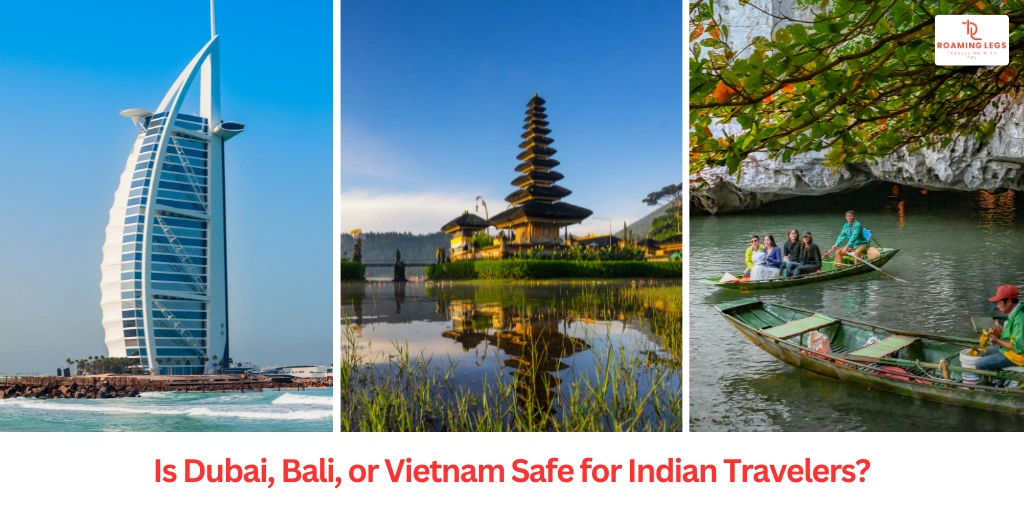
Dubai is the safest of the three — strict laws, low crime, heavy surveillance, and excellent emergency infrastructure.
The main risks are not crime-related; they are legal.
Breaking a Dubai law you didn’t know existed is the danger Indian tourists don’t think about until it’s too late.
Bali is safe from violent crime but has three genuinely serious risks that catch tourists every single year: scooter accidents, ocean rip currents, and Indonesia’s brutal drug laws.
None of these are dramatic or rare — scooter accidents alone send dozens of tourists to BIMC Hospital in Kuta every week.
Vietnam is safe and very welcoming, but it has a specific set of scams that target tourists in 2026 — including fake e-visa websites, motorbike phone snatching, and taxi overcharging — that have gotten more sophisticated.
Traffic in Hanoi and Ho Chi Minh City also genuinely shocks most first-time visitors.
All three are worth visiting.
None are worth visiting without knowing what to actually watch out for.
Dubai — The Safest Destination, With One Major Catch
Dubai ranks among the top 5 safest major cities in the world by most international safety indices.
The crime index for the UAE in 2026 sits at 14.0 — one of the lowest recorded figures globally, well below London, Mumbai, or Bangkok.
Less than 0.3% of Dubai’s 14 million+ annual visitors report any crime-related incident.
Violent crime against tourists is exceptionally rare.
Petty theft exists but is uncommon.
The metro, taxis, and malls are monitored and well-lit.
Women — including solo Indian women — consistently report feeling safe walking around Dubai at night in tourist and commercial areas.
So what is the actual risk for Indian travelers in Dubai?
The laws. Dubai’s legal code is strict in ways that Indian tourists frequently underestimate, and ignorance is not accepted as a defence in UAE courts.
Here is what catches people out:
Alcohol rules are specific, not strict. You can drink freely in Dubai — in licensed venues.
Hotel bars, restaurants attached to hotels, licensed clubs.
That covers almost everywhere Indian tourists drink.
What you absolutely cannot do: drink in public, on the beach unless it is a licensed hotel beach, in parks, or on the street.
Buying alcohol from licensed liquor stores like MMI or African+Eastern for your hotel room is fine — they register your passport as a temporary tourist permit.
Stumbling out of a bar and drinking on the pavement outside is an arrest.
Public displays of affection. Kissing in public has led to arrests and deportation of foreign tourists. Holding hands is generally tolerated in tourist areas but is not technically legal.
For Indian couples, the practical rule is: what you do inside your hotel room is your business; what you do in lobbies, malls, and on the street is visible to police.
Dress code is real. Malls and public spaces require covered shoulders and knees.
Bikinis belong on hotel private beaches and pool areas, not on public beaches or while walking to a restaurant.
Women wearing revealing clothing in a public souk have been stopped by police.
What you say online about the UAE. Posting a social media complaint about UAE government, traffic, or laws while in Dubai can technically be a criminal offence.
This has resulted in arrests of foreign nationals.
Keep opinions about Dubai and the UAE government off your social media while you are there.
Medications from India. Some prescription medications that are legal in India — including certain codeine-containing painkillers, some anxiety medications, and sleep aids — are classified as controlled substances in the UAE.
Carry medications in original pharmacy packaging with a doctor’s prescription and check the UAE MOHAP approved medicines list if you take anything regularly.
Road safety. This is the one area where Dubai’s infrastructure does not protect you.
UAE road fatalities are significantly higher per capita than Europe or the US.
Speeding is common, lane discipline is poor on highways, and pedestrians account for over 25% of road fatalities.
Cross roads at designated crossings only and do not assume speeding cars will stop.
Dubai emergency numbers: Police: 999 | Ambulance: 998 | Indian Embassy Abu Dhabi: +971 2 449 2700 | Indian Consulate Dubai: +971 4 397 1333
Planning a Dubai Family Trip? Get Your Complete Pre-Departure Brief
Not sure what you need before flying to Dubai? Share your travel dates and group type on WhatsApp, and we'll send you a personalised Dubai pre-departure brief covering your visa rules, what not to carry, UAE laws every traveller must know, and a complete safety and documents checklist. It is completely free and takes just two minutes to request.
Visa & Documents
Know exactly which documents and visa requirements your family needs before departure.
What Not to Carry
Avoid fines and airport delays by knowing what items are restricted or banned in the UAE.
UAE Laws to Know
Stay on the right side of UAE law with a simple guide to rules that surprise most tourists.
Delivered on WhatsApp
Your customised Dubai brief is sent within 24 hours, completely free.
Bali — Genuinely Lovely, Genuinely Risky in Specific Ways
Millions of Indians visit Bali every year.
The overwhelming majority have a wonderful, incident-free trip.
Violent crime against tourists in Bali is rare — Bali has a dedicated Tourist Police (Polisi Pariwisata) force, tourist areas like Seminyak, Ubud, Nusa Dua, and Canggu are well-patrolled, and the Balinese community has enormous economic incentive to keep visitors safe and happy.
But Bali has three specific risk areas that send real tourists to real hospitals or real courts every year, and every Indian traveler needs to understand them before arriving.
Risk 1: Scooter Accidents — The Biggest Danger in Bali by a Large Margin
Scooter accidents are the number one cause of tourist injury and death in Bali.
Not crime.
Not terrorism. Traffic.
Bali’s roads — especially in South Bali (Kuta, Seminyak, Canggu) — are narrow, busy, and chaotic. Surfaces get slippery when it rains, which happens daily in certain seasons.
Indonesian traffic rules are loose on the ground.
Many tourists rent scooters believing that riding a two-wheeler in India means they can handle Bali traffic — and many end up at BIMC Hospital in Kuta, which handles dozens of tourist scooter cases every week.
The practical rule: if you have genuine motorcycle experience and a valid International Driving Permit, riding in Bali’s quieter areas (Ubud, Amed, Uluwatu) is manageable.
In Kuta, Seminyak, and Canggu, the traffic density makes it genuinely dangerous even for experienced riders.
For longer journeys, hire a driver for the day — it costs around ₹2,000–₹3,000 for 8 hours and removes all transport stress.
Use Grab or Gojek for short trips in town.
The convenience of a scooter is not worth the risk if you are traveling with family or are not an experienced rider.
Also: Indonesian insurance laws are strict.
If you have an accident without a valid motorcycle license, your travel insurance very likely will not cover your medical bills.
This is not a theoretical risk — it is a common claim rejection.
Risk 2: Ocean Rip Currents — Deadliest at Kuta and Seminyak Beaches
Bali’s southern beaches — Kuta, Legian, Seminyak, Canggu — have some of the most powerful rip currents in Southeast Asia.
Several tourists drown every year.
The waves look manageable from the shore, but rip currents can pull even strong swimmers out faster than they can respond.
The rule is simple: only swim at beaches with active lifeguards and coloured flag systems.
Nusa Dua and Sanur are calmer, protected beaches far better suited for families and non-swimmers.
If you see red flags, stay out of the water — no exceptions. If you get caught in a rip, swim parallel to the shore, not directly against the current.
Risk 3: Indonesia’s Drug Laws — Non-Negotiable
Indonesia has some of the strictest drug laws in the world.
Possession of even small amounts of recreational drugs can result in years in prison.
There is no leniency for tourists, no “first offence” consideration, and no intervention that reliably resolves the situation.
This is not a theoretical warning — there are Indian and other South Asian nationals currently serving sentences in Indonesian prisons for drug offences.
Common Scams in Bali
Unofficial money changers — Bali has a notorious unofficial money changer circuit, particularly in Kuta, where tourist get short-changed through sleight of hand.
Always use the Digibank/Kasikorn ATMs or authorised money changers like Bali Maspintjingan that show rates clearly and give a receipt.
Taxi mafia at the airport and tourist spots — Ngurah Rai Airport has official metered taxis.
Do not accept offers from men approaching you in arrivals.
Use the official taxi counter or book Grab/Gojek from outside the building.
Motorbike damage scams — You rent a scooter, return it, and the owner claims you caused a scratch that was there before you rented it.
Always photograph the bike thoroughly before you ride, including any existing damage, and share the photos with the rental shop in writing.
Bali emergency numbers: Police: 110 | Ambulance: 118 | Indian Embassy Jakarta: +62 21 5793 1100
Vietnam — Safe, Specific Scams, Shocking Traffic
Vietnam is rated Level 1 — Exercise Normal Precautions by the US State Department, the same advisory level as most of Western Europe.
Berkshire Hathaway Travel Protection ranked Vietnam among the top 10 safest international destinations for tourists in 2026.
Violent crime against tourists is genuinely uncommon — Vietnam’s homicide rate is around 1.5 per 100,000 people, significantly lower than many cities Indian travelers visit domestically.
The risks are real but specific.
Know what they are and Vietnam is a very comfortable destination.
The Traffic in Hanoi and Ho Chi Minh City
Nothing prepares first-time Vietnam visitors for the traffic in Hanoi’s Old Quarter or Saigon’s District 1.
Motorbikes flow like water — seemingly in every direction at once.
There are no gaps that feel obvious.
Pedestrians cross not by waiting for a gap but by walking steadily and letting traffic flow around them.
The key: walk slowly, keep a consistent pace, make eye contact with drivers, and never stop suddenly in the middle of the road.
Do not run.
Traffic flows around predictable pedestrians.
Use Grab for all transportation within cities — it is cheap, reliable, and removes the taxi overcharging risk entirely.
Recommended taxi operator if you prefer metered taxis: Mai Linh (green taxis) — legitimate and widely trusted.
Vietnam’s Specific Tourist Scams in 2026
Fake e-visa websites — This is the biggest scam for Indian travelers in 2026.
Scammers have built near-perfect replicas of Vietnam’s official e-visa portal (evisa.gov.vn) that appear in search results.
They collect your application fee and personal data.
Only ever apply at evisa.gov.vn — type the URL directly, never click a sponsored search result.
Drive-by phone snatching — Ho Chi Minh City’s District 1 and Hanoi’s Old Quarter are hotspots for motorbike riders who snatch phones from people walking with them in hand or in open bags.
Keep your phone in a zipped inner pocket or a cross-body bag worn in front of your body.
Never look at your phone while standing at the roadside.
Shoe-shining scam — In Hanoi’s Old Quarter and HCMC’s District 1, someone may point to a mark on your shoe, grab your foot, and start cleaning before you can object — then demand ₹1,500–₹3,000 for a “service” you didn’t agree to.
Simply walk away if someone approaches.
Fake tour operators near tourist sites — At Hoan Kiem Lake in Hanoi and the Saigon Notre-Dame area, street sellers offer Halong Bay cruises, Sapa trips, and city tours at significantly below-market prices. Many of these tours are either cancelled on departure day without refund, or end up being a completely different product from what was described.
Always book through your hotel or a verified operator, not through street touts.
The bamboo hat photo trick — Someone places a traditional non la hat on your head for a photo, then demands payment.
Similarly, someone hands you a traditional fruit basket yoke for a photograph and then demands ₹1,000–₹2,000.
You are within your rights to firmly say no and walk away.
Currency confusion — Vietnamese Dong comes in denominations of 500,000, 200,000, 100,000, 50,000 and smaller.
The 500,000 note (around ₹175) looks similar to the 20,000 note to a first-day visitor.
Some vendors exploit this confusion.
Always count your change carefully and keep small denominations separate.
Vietnam emergency numbers: Ambulance: 115 | Police: 113 | Indian Embassy Hanoi: +84 24 3823 4804 | Indian Consulate HCMC: +84 28 3822 5050
Dubai, Bali, or Vietnam — Which One Is Right for You?
Can't decide between three amazing destinations? Tell us who you're travelling with — family, couple, or a group — and we'll give you an honest recommendation and a sample itinerary for the destination that fits your travel style best. No generic advice. Just a real suggestion based on how you actually travel.
Dubai
- World-class shopping & dining
- Iconic skyline & desert safaris
- Great for families & luxury trips
- Easy visa process for Indians
Bali
- Beaches, temples & rice terraces
- Budget-friendly & laid-back vibe
- Perfect for couples & groups
- Rich culture & wellness retreats
Vietnam
- Street food, history & landscapes
- Very affordable for long trips
- Ideal for first-time Asia travellers
- North to south variety in one trip
Family
Travelling with kids? We'll match you with the safest, most family-friendly option.
Couple
Looking for romance or adventure? We'll pick the destination that sets the mood.
Group
Friends trip? We'll find the spot that keeps everyone happy without breaking the budget.
Side-by-Side Safety Comparison
| Factor | Dubai | Bali | Vietnam |
|---|---|---|---|
| Violent crime risk | Extremely low | Very low | Very low |
| Petty theft / scams | Low | Moderate (specific areas) | Moderate (specific scams) |
| Traffic danger | Medium (highways) | High (scooters) | High (city roads) |
| Legal risk (laws) | High (strict laws) | High (drug laws) | Low |
| Ocean / water risk | Low | High (rip currents) | Low–Medium |
| Solo female safety | Excellent | Good (take precautions) | Good |
| Family friendliness | Excellent | Good | Good |
| First international trip | Very easy | Moderate | Moderate |
| Recommended transport | Metro, Uber, official taxi | Grab, Gojek, hired driver | Grab, Mai Linh taxis |
Violent crime risk
Petty theft / scams
Traffic danger
Legal risk (laws)
Ocean / water risk
Solo female safety
Family friendliness
First international trip
Recommended transport
What Real Indian Travelers Say About Safety in Each Destination
“We took our parents to Dubai in December 2024.
My mother was nervous about being conservative enough with what she wore.
Honestly, as long as you dress reasonably — covered shoulders, no shorts in malls — there’s zero problem.
The metro is cleaner than most Indian metros and everyone is very professional.
We felt completely safe the whole time.
“ — Mehta Family, Surat, December 2024
“First time in Bali, we rented scooters on day one because everyone said it was easy.
My husband fell on day two — nothing serious, just a graze, but we both agree now that we should have used Grab.
The traffic in Seminyak is genuinely chaotic and we weren’t prepared for it.
The rest of the trip was amazing.
“ — Priya and Rahul K., Bengaluru, March 2025
“Vietnam felt very safe overall.
The thing that tripped us up was crossing roads in Hanoi — first two days were stressful.
After that, once we understood how it works, it was fine.
Grab was our best friend for getting anywhere.
Never had a problem.
“ — Iyer Family, Chennai, November 2024
Safety FAQs — Dubai, Bali & Vietnam for Indian Travelers
Responsive, Elementor-ready FAQ component with embedded CSS and no JavaScript.
1. Which is the safest destination for Indian families?
Dubai offers the strongest safety infrastructure, while Bali and Vietnam are also family-friendly with sensible precautions.
2. Is Dubai safe for Indian women traveling solo?
Yes. Dubai is widely regarded as one of the safest cities for solo female travelers when normal travel precautions are followed.
3. What do Indian tourists get arrested for in Dubai?
Common issues include public intoxication, controlled medicines, offensive behavior, and violating local laws.
4. Is Bali safe for couples and honeymooners?
Yes. Use reputable transport, swim only at safe beaches, and avoid illegal drugs or risky scooter use.
5. Is Vietnam safe for first-time travelers?
Yes. Tourist infrastructure is strong, though visitors should be cautious with traffic and common tourist scams.
6. Which destination has the most tourist scams?
Vietnam and Bali have more common tourist scams than Dubai, but awareness greatly reduces risk.
7. Is it safe to use ATMs?
Use bank-operated ATMs in Bali and Vietnam, shield your PIN, and avoid isolated machines.
8. Do I need travel insurance?
Yes. Comprehensive travel insurance is strongly recommended for Dubai, Bali, and Vietnam.
9. Which transport apps work?
Uber and Careem are popular in Dubai, Grab works across Bali and Vietnam, and Gojek is also common in Bali.
10. How should I handle a medical emergency?
Call the local emergency number, go to a reputable hospital, and contact your travel insurer immediately.
11. Which destination is best for a first international trip?
Dubai is generally the easiest first international destination, while Bali and Vietnam are excellent once you have a little travel experience.