Best Currency Exchange for Your Dubai Trip — Where to Get More AED for Every Rupee

Best Currency Exchange Options for Dubai Trip

Going to Dubai is exciting. 

But the moment you start thinking about money — how much to carry, where to exchange, whether to get a forex card — things get confusing fast.

Here’s the thing: most Indian travelers lose ₹2,000–₹6,000 on currency exchange alone. 

Not because rates are bad everywhere, but because they exchange at the wrong place at the wrong time.

This guide is based on real conversations we’ve had with hundreds of Indian travelers who’ve been to Dubai. 

Here’s exactly what we tell every one of them.

What Currency Do You Need in Dubai?

Simple answer — UAE Dirham (AED).

That’s it. 

Hotels, cabs, restaurants, Dubai Mall, Gold Souk, desert safari — everything is paid in AED. 

No other currency works for day-to-day spending.

As of July 2026, 1 AED = approximately ₹26. So when something costs AED 100, that’s roughly ₹2,600. Keep this number in your head — it makes budgeting in Dubai so much easier on the go.

Will Dubai Accept Your Indian Rupees?

No. Shops and restaurants don’t accept INR.

And here’s something even more important: most exchange houses in Dubai don’t convert INR to AED anymore.

After India’s demonetization and a few counterfeit currency incidents, several reputed exchange counters in Dubai simply stopped accepting Indian cash.

So don’t land in Dubai with a wallet full of rupees hoping to convert them there. 

It won’t work the way you expect.

Convert your rupees to AED in India before you fly.

Should You Exchange Money in India or Dubai?

This is honestly the most common question we get.

The real answer is: do both — just don’t rely on either airport.

Here’s the practical split that works for most travelers:

  • Exchange AED 500–1,000 in India before flying (for your cab, first meal, and hotel check-in)
  • Exchange the remaining amount at Bur Dubai after you settle in

Why Bur Dubai? The Al Fahidi neighbourhood near the Al Fahidi Metro station has dozens of competing exchange houses, and they consistently offer 2–3% better rates than most locations in Dubai — and often better than what you’d get in India too. 

More on this below.

Best Places to Exchange INR to AED in India

Skip the airport. Instead, use these:

BookMyForex (a MakeMyTrip subsidiary) — Book AED at live interbank rates online, then pick it up or get home delivery. 

Transparent pricing, no hidden charges. Worth it if you’re exchanging ₹50,000 or more.

Thomas Cook India — Branches in most major cities. You can also load a Thomas Cook Forex Card here with AED at a locked rate, which is useful if you want to avoid exchange rate fluctuations closer to your trip.

Orient Exchange — Competitive rates, good for travelers in Mumbai and Delhi. 

Worth checking alongside BookMyForex.

Local RBI-authorized money changers — Some offer rates that beat even the big names. 

Just make sure they’re licensed and give you a proper receipt.

One tip before you go anywhere: Check the INR to AED rate on Google first. That’s the “real” mid-market rate. 

Any provider will charge slightly above it — that’s normal. 

But if someone’s charging 5–8% above the Google rate, that’s too much. Walk out.

Best Currency Exchange Options for Dubai Travelers​
💱 FREE DUBAI FOREX PLANNER

Not Sure How Much AED to Carry? We'll Calculate It for You.

Every Dubai trip is different. Share your travel dates, number of travellers, and travel style on WhatsApp, and we'll prepare a personalised forex plan with recommended AED to carry, estimated daily expenses, shopping budget, and practical money-saving tips. Delivered within 24 hours.

💰

AED Budget

Know how much cash you'll realistically need.

📅

Daily Spending

Meals, transport, shopping, and sightseeing mapped out.

💡

Save on Forex

Get practical tips to avoid unnecessary expenses.

📲

24-Hour Plan

Your personalised Dubai money plan sent on WhatsApp.

Dubai Airport Exchange — Is It Worth It?

Only for AED 200–300. Nothing more.

Dubai International Airport has Al Ansari Exchange counters that are open 24/7 — genuinely helpful if you land at 2 AM and need cab fare. 

But their rates are typically 10–15% worse than what you’d get in the city.

On ₹1,00,000 worth of AED, that’s ₹10,000–₹15,000 extra just for the convenience of exchanging at the airport. 

That’s a real number.

So if you’ve landed without any AED: exchange just enough for a taxi and a meal — around AED 200–300. 

Then sort the rest at Bur Dubai the next day.

Best Places to Exchange Money in Dubai

Once you’re in the city, you have real options:

Bur Dubai — Al Fahidi Area (Best overall) This is where savvy Indian travelers go. 

The lanes around Al Fahidi Metro have dozens of competing exchange houses. 

Al Fardan Exchange and Al Sharaf Exchange both have branches here. 

Rates here are consistently 1–3% better than Dubai Mall or Marina. On ₹1,00,000, that difference is ₹1,000–₹3,000.

Al Ansari Exchange (Best for convenience) 200+ branches across Dubai — inside Dubai Mall, Ibn Battuta Mall, Dragon Mart, and more. 

Rates aren’t the sharpest, but finding a branch is never a problem. 

Good for smaller top-ups during your trip.

Al Fardan Exchange (Best rates in the city) Slightly better INR-to-AED rates than Al Ansari. 

Branches in Deira, Bur Dubai, and Dubai Mall. Check their rate board online before you visit — you can walk in knowing exactly what to expect.

Lulu Exchange (Good if you’re near a Lulu Hypermarket) Decent rates, quick service. 

Convenient if your hotel is near a Lulu.

One habit worth building: always check the rate board at two or three counters before exchanging. 

Even in the same mall, rates vary between shops.

Forex Card vs Cash — What Should You Carry?

Dubai is a very cashless city. Uber, Careem, metro, malls, restaurants — almost everything takes cards. So you don’t need to carry a ton of physical AED.

The ratio that works best for most Indian travelers: 70% forex card, 30% AED cash.

Why carry a forex card?

When you load AED onto a forex card in India, that exchange rate gets locked in

Even if AED becomes more expensive later, you’ve already secured your rate. On top of that:

  • No conversion charges when you pay at stores
  • Much safer than carrying cash
  • Can be blocked instantly if lost
  • Works at most ATMs in Dubai

Which forex card works well for Dubai?

  • Niyo Global Card (SBM Bank) — Zero forex markup, works smoothly at Dubai ATMs and merchants
  • IDFC First WOW Credit Card — Zero forex markup, no annual fee, good for shopping-heavy trips
  • Thomas Cook Forex Card — Load AED at a locked rate before you fly; accepted at most Dubai ATMs

On a trip where you’re spending ₹1,00,000 total, using a zero-markup card instead of your regular Indian debit card can save ₹3,000–5,000 in fees.

If you’re using a regular SBI, HDFC, or ICICI debit card, expect 3–5% charges on every international transaction. It adds up fast.

💳 FREE DUBAI PAYMENT PLANNER

Forex Card, Cash, or Both? Get a Personalised Dubai Money Plan

The best way to carry money depends on your trip budget, travel dates, and spending habits. Share your details on WhatsApp and we'll recommend exactly how much to keep on a forex card, how much AED cash to carry, and where each payment method works best, helping you minimise conversion charges and unnecessary fees.

💳

Forex Card Split

Know how much to load before you travel.

💵

AED Cash Plan

Carry the right amount for everyday expenses.

📉

Lower Forex Costs

Reduce markups and avoid unnecessary charges.

📲

WhatsApp Recommendation

Receive your personalised payment strategy within 24 hours.

Final Tips for Getting the Best Currency Exchange Rates​

How Much AED Should You Actually Carry?

Here’s a quick reference based on what Indian travelers actually spend in Dubai (not including hotels and flights):

Traveler Type Daily Spend 5-Night Trip Total In Rupees
Budget (street food, metro, group tours) AED 100–200 AED 500–1,000 ₹13,000–₹26,000
Mid-range (restaurants, taxis, shopping) AED 300–500 AED 1,500–2,500 ₹39,000–₹65,000
Premium (fine dining, desert safari, yacht) AED 700–1,200 AED 3,500–6,000 ₹91,000–₹1,56,000
Budget Traveler
Daily Spend

AED 100–200

5-Night Trip Total

AED 500–1,000

Approx. in Rupees

₹13,000–₹26,000

Mid-Range Traveler
Daily Spend

AED 300–500

5-Night Trip Total

AED 1,500–2,500

Approx. in Rupees

₹39,000–₹65,000

Premium Traveler
Daily Spend

AED 700–1,200

5-Night Trip Total

AED 3,500–6,000

Approx. in Rupees

₹91,000–₹1,56,000

Standard advice: Carry at least AED 500 in cash at all times, even if you’re planning to use a card for most things. Tipping, parking, smaller market vendors, and emergencies still need cash.

Common Currency Mistakes — Stop These Before They Happen

Exchanging everything at the airport — Rates are 10–15% worse. Only exchange AED 200–300 there.

Carrying INR to Dubai hoping to convert — Most exchange houses won’t accept it. Convert in India.

Using a regular Indian debit card for all transactions — 3–5% per swipe adds up to thousands on a long trip.

Saying yes to INR on payment machines — Always pay in AED. Never choose your home currency at a POS terminal.

Not carrying any cash at all — Dubai is digital but not 100% digital. Always keep AED 300–500 on you.

Converting leftover AED back at the Dubai airport — Buy-back rates at airports are terrible. Either spend it, or convert it at a proper exchange house in India after you return.

Frequently Asked Questions About Dubai Currency Exchange

Everything Indian travelers need to know about exchanging INR, using cards, and managing AED in Dubai.

Should I exchange INR to AED in India or in Dubai?

Do both, but use the right approach. Exchange around AED 500–1,000 in India for airport transfers and arrival expenses.

For the remaining amount, Dubai exchange houses generally offer better rates than airports and hotel counters.

Where is the cheapest place to exchange currency in Dubai?

Bur Dubai, especially the Al Fahidi area, is known for competitive exchange rates.

Avoid exchanging large amounts at Dubai Mall and Marina Walk counters, where rates are often less favorable.

Do Dubai exchange houses accept Indian Rupees?

Most Dubai exchange houses do not commonly accept Indian Rupee cash.

It is better to convert INR into AED before flying or use an international card after arrival.

How much AED is enough for a 5-day Dubai trip?

A mid-range traveler can start with AED 1,500–2,500 excluding hotel costs.

Budget travelers may manage with AED 500–1,000, but keeping an emergency buffer is always useful.

What is the current INR to AED exchange rate?

As of July 2026, approximately 1 AED = ₹26.

Check live rates on Google or trusted forex providers before exchanging money because rates change daily.

Is a forex card actually worth it for Dubai?

Yes, especially if you plan to spend ₹50,000 or more during your trip.

Zero-markup forex cards can reduce foreign transaction charges compared with regular debit cards.

Which Indian forex card has zero markup for Dubai?

Niyo Global, IDFC First WOW Credit Card, and IndusInd Nexxt Card are popular options for travelers looking to reduce forex charges.

Traditional prepaid forex cards are also available if you prefer loading AED before travel.

Is it safe to use ATMs in Dubai?

Yes. Dubai ATMs are safe and widely available at malls, hotels, and metro stations.

Check your Indian bank's withdrawal and conversion fees before using your card abroad.

Can I use UPI or Google Pay in Dubai?

Standard UPI linked to Indian bank accounts is not accepted everywhere in Dubai.

Google Pay and Apple Pay work when connected to supported international cards.

What should I do with leftover AED when I return to India?

Convert leftover AED through an authorized forex dealer in India.

Avoid airport exchange counters because their buy-back rates are usually less competitive.

Do I need to declare currency at Dubai or Indian customs?

Most tourists do not carry amounts that require declaration.

For large amounts of foreign currency, check current customs and RBI rules before travel.

Is the 70% card and 30% cash rule practical for Dubai?

Yes. Dubai is highly digital, and cards work almost everywhere.

Cash is mainly useful for tips, small vendors, souks, and occasional payment issues. Keeping AED 300–500 available is practical.

Can I use my regular SBI or HDFC debit card in Dubai?

Yes, but international debit card transactions can become expensive due to forex conversion charges and withdrawal fees.

A zero-forex card or forex card can reduce these extra costs during your trip.

What if I run out of AED while I am in Dubai?

You can exchange money at authorized exchange houses or withdraw AED from international ATMs using your card.

Forex cards can also usually be topped up online if additional funds are needed.
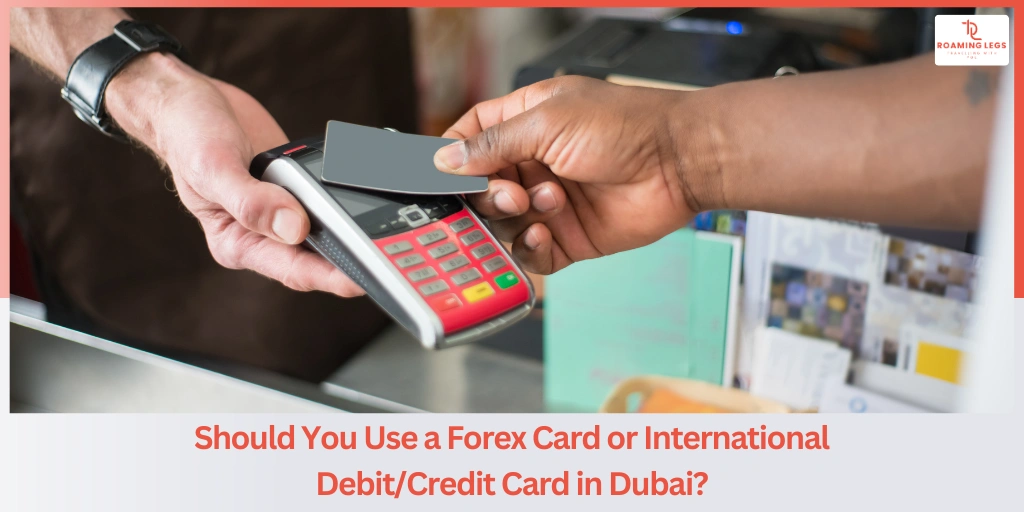
Forex Card or International Card for Dubai? Here’s What Indians Actually Use (And What It’ll Really Cost You)

International Cards vs Forex Cards for Dubai Travel

Forex Card or International Card for Dubai? Here’s What Indians Actually Use (And What It’ll Really Cost You)

So you’re going to Dubai — and now someone told you to “get a forex card.” 

And you’re wondering if your regular HDFC or SBI card won’t work. 

Or maybe it’s the other way around — you have a forex card loaded up, and now you’re wondering if you even need to carry a credit card too.

Here’s the honest answer: both work in Dubai. 

But the one you reach for first will decide how much money you’re quietly losing to bank fees without realizing it.

Let’s sort this out simply, with real numbers.

What’s the Actual Difference Between the Two?

Think of it this way.

Your international debit or credit card is just your regular bank card with international access switched on. 

When you swipe it in Dubai, your bank converts your spend from AED (UAE Dirhams) to INR at that moment’s exchange rate — and adds its own fees on top. You get the bill later.

A forex card works differently. 

You load money onto it before you leave India. 

The exchange rate gets locked the moment you load it. 

So if the AED rate is good today and you load ₹50,000 worth of AED — that’s what you’ve locked in. 

Even if the rate moves against you tomorrow, you’re fine.

Both let you swipe at shops, hotels, malls, and restaurants in Dubai. 

Both let you withdraw cash from ATMs. 

The difference is how much it costs you — and that gap is bigger than most people expect.

The Real Cost Difference — Let’s Talk Numbers

This is the part most blogs skip, so let’s be clear about it.

When you use a standard Indian credit card abroad, your bank typically adds:

  • 3% to 3.5% foreign transaction markup on every swipe
  • 18% GST on that markup
  • Sometimes an additional currency conversion fee

So on a ₹1,00,000 Dubai trip spend, you’re quietly paying ₹3,500–4,000 extra — just in bank fees. 

That’s two nice dinners in Dubai, gone.

With a forex card loaded in AED, you typically pay zero markup on transactions. 

The fee is paid only once — at the time of loading — and it’s usually 0.5% to 1% above the RBI reference rate, which is much lower.

The math is simple: for a 5-day Dubai trip spending ₹1–1.5 lakh, a forex card saves you ₹3,000–5,000 over a standard credit card.

There’s one exception though — and it matters. 

Some premium credit cards like Axis Magnus, HDFC Infinia, or RBL World Safari have zero or near-zero forex markup. 

If you already have one of these, your credit card is actually competitive with a forex card on cost. 

But if you’re on a regular HDFC Regalia, ICICI Platinum, or SBI Simply Click — a forex card will be cheaper every time.

Which Forex Cards Actually Work Well for Dubai?

Not all forex cards are the same. 

Here are four that Indian travelers actually use for Dubai:

Niyo Global (DCB Bank)

Zero forex markup. 

No issuance fee. 

Works in 130+ countries. 

The big advantage is that your rupees sit in a savings account and you spend from it — so you don’t have to “load” AED in advance. 

It just converts at near-interbank rates when you swipe. 

ATM withdrawal fee is ₹425 per transaction. 

Great for people who don’t want to pre-estimate their spending.

BookMyForex Wow Card

Zero markup on loaded currencies. 

Rate gets locked when you load. 

Doorstep delivery in India — they’ll courier the card to your house before you travel. 

Good for people who want to know exactly what rate they’re getting before they land. 

The downside: if you load too much, getting your money back takes a few extra days.

HDFC Multicurrency Forex Card

This one supports up to 22 currencies including AED. 

Issuance fee around ₹500 + GST. Zero markup when you spend in the currency loaded. 

A 3.5% cross-currency fee applies if you use a currency you haven’t loaded. 

Good for multi-destination trips. 

If you’re going only to Dubai, load AED directly.

Axis Bank Multi-Currency Forex Card

Issuance fee around ₹300 + GST (waived for Axis Priority or Burgundy holders). 

No reward structure, but solid for straightforward Dubai spending. 

Works well with Axis Bank accounts.

Free Dubai Budget Guide

Not Sure How Much AED You Need for Your Dubai Trip?

Planning your Dubai budget can be confusing. We help Indian travelers estimate daily spending for accommodation, food, shopping, and activities so you know how much AED to carry without loading too much or running short.

Share your travel dates and travel style on WhatsApp. We will send a Dubai trip budget breakdown designed around your plans.

Daily Budget Planning AED Estimate Food & Activity Costs Shopping Budget
Get your Dubai budget breakdown on WhatsApp →
International Cards vs Forex Cards: Key Differences​

Where to Use Which Card in Dubai — The Practical Guide

Dubai is extremely card-friendly. 

You can pay by card at almost everything — The Dubai Mall, Mall of the Emirates, Burj Khalifa entry, Dubai Frame, desert safari bookings, restaurants on JBR Walk, supermarkets, Careem rides, Dubai Metro. 

Cards work everywhere.

Here’s a simple way to think about it:

Use your forex card for:

  • Daily meals and café visits
  • Shopping at malls and souks
  • Supermarket runs (Carrefour, Lulu)
  • Paying for smaller tourist attractions
  • Dubai Metro tickets from the app

Use your international credit card for:

  • Hotel check-in (hotels put a security hold/deposit, and credit cards handle this better than prepaid cards)
  • Car rental deposits
  • Large one-time purchases where your credit card has purchase protection
  • Emergency backup if your forex card gets blocked or lost

Carry AED 300–500 in cash for:

  • Taxis that don’t accept cards (Gold and Silver metered cabs are fine, but some older cabs outside malls may prefer cash)
  • Tips at restaurants and for hotel staff
  • Traditional souk shopping where cash gets you better bargaining power
  • Small local eateries near Deira or Old Dubai

The Trap That Catches First-Time Dubai Travelers

This happens at shops, restaurants, and even hotel counters in Dubai — and it’ll cost you money if you’re not ready for it.

When you swipe your card, the payment machine sometimes asks: “Pay in INR or AED?”

Always choose AED. Always.

If you choose INR, the merchant’s bank does the conversion for you — at a rate that’s 3%–5% worse than anything you’d get from your own bank or forex card. 

It feels convenient (“oh good, I can see the amount in rupees”) but it’s quietly expensive. 

This is called Dynamic Currency Conversion (DCC), and it’s one of the most common ways tourists lose money in Dubai without realizing it.

Your forex card or credit card will handle the AED-to-INR conversion at a much better rate. 

Just say no to the “pay in INR” option every time a machine offers it.

A Quick Note on TCS — This Applies to Forex Card Loads

If you’re loading more than ₹7 lakh onto a forex card in a financial year (April to March), the bank will collect 20% TCS (Tax Collected at Source) on the amount above that limit. 

This is an RBI rule under the Liberalised Remittance Scheme (LRS).

For a standard 5–7 day Dubai holiday, most families spend ₹1.5–3 lakh on cards. 

You won’t come anywhere near the ₹7 lakh limit. 

But if you’re going on a long trip or loading cards for multiple family members — worth knowing. 

The TCS amount is claimable in your ITR, so it’s not a permanent loss, just a cash flow thing.

Free Dubai Checklist

Get Your Free Dubai Travel Preparation Checklist

Going to Dubai soon? Get a practical checklist covering card activation, when to load money, how much AED cash to carry, and what to do if your card stops working abroad.

Card Setup Tips AED Cash Planning Payment Guide Emergency Preparation
Download your free Dubai travel checklist →
Which Option Is Better for Dubai Travel?​

The Strategy That Most Experienced Dubai Travelers Actually Use

If you talk to someone who’s done Dubai two or three times, this is almost always what they say:

One forex card (Niyo or BookMyForex) for daily spending. 

One international credit card in the bag for hotel check-in and emergencies. 

AED 400–500 in cash for taxis and tips.

That’s it. Three things. Simple.

The reason for the forex card is obvious — lower fees. 

The reason for keeping a credit card is also simple — hotels in Dubai, especially 4-star and 5-star ones, will ask for a card at check-in and block ₹10,000–25,000 as a security deposit. 

Prepaid forex cards handle this, but credit cards do it more smoothly and don’t impact your spending balance on the forex card. 

If you’re staying at something like Address Downtown, JW Marriott, or Atlantis Palm, they’ll almost certainly ask for a credit card at check-in.

The cash is for everything that doesn’t take cards — small purchases in the Deira Gold Souk, tips for the concierge, and that late-night shawarma from the Al Ustad Special Kabab place in Karama where the card machine is permanently “not working.”

Frequently Asked Questions About Forex Cards for Dubai

Everything Indian travelers need to know about using money, cards, and payments in Dubai.

Is a forex card better than my regular debit card for Dubai?

Yes, almost always. Regular Indian debit cards used abroad usually add a 3%–3.5% foreign transaction markup on every payment, plus GST on that markup.

A forex card with zero markup can reduce these extra charges significantly during a Dubai trip.

Can I use my Indian credit card in Dubai?

Yes. Visa and Mastercard credit cards with international transactions enabled work widely across Dubai.

Activate international usage through your banking app before travel. Keep in mind that many Indian credit cards charge a foreign currency markup fee.

Which forex card is best for a Dubai trip from India?

Niyo Global and BookMyForex are popular choices because of their low markup structure.

HDFC Multicurrency Forex Card and Axis Bank Forex Card are also reliable options, especially if you already use these banks.

Do forex cards work at Dubai ATMs?

Yes. Most forex cards work at ATMs throughout Dubai.

ATM withdrawals may include a fixed withdrawal fee, so withdrawing larger amounts fewer times can help reduce charges.

Should I carry cash AED for Dubai?

Yes, carrying a small amount of AED is practical.

AED 300–500 is usually enough for taxis, tips, small purchases, and situations where card payments are unavailable.

What is Dynamic Currency Conversion and should I avoid it?

Dynamic Currency Conversion (DCC) happens when a payment terminal offers to charge you in INR instead of AED.

Always choose AED. Paying in INR usually uses a poorer exchange rate and can increase your final cost.

Can I use UPI or Google Pay in Dubai?

UPI acceptance in Dubai is growing but is not available everywhere.

For restaurants, hotels, shopping malls, and attractions, keep a forex card or international card as your primary payment method.

Do I need to tell my bank before using my card in Dubai?

Yes. Enable international transactions through your banking app before leaving India.

This simple step prevents your card from being blocked when you try making payments abroad.

Is it safe to use a forex card in Dubai?

Yes. Forex cards offer chip-and-PIN protection and can usually be blocked instantly through the provider's app if lost.

They are safer than carrying large amounts of cash during international travel.

What happens if I have AED leftover after my Dubai trip?

For traditional prepaid forex cards, you can request an unload after returning to India. The returned amount depends on the current exchange rate.

Try to load a realistic amount to avoid unnecessary conversion losses.

Can a forex card be used for hotel check-in deposits in Dubai?

Yes, but credit cards are usually more convenient for hotel security deposits.

Hotels often place temporary holds for incidentals, and a credit card avoids reducing your available travel balance during the stay.

How much AED should I load for a 5-day Dubai trip?

For a mid-range Dubai trip, a family of 2–3 may spend around AED 2,000–4,000 on daily expenses, shopping, food, and attractions.

The exact amount depends on hotel category, shopping plans, and activities.

Does TCS apply when I load a forex card for Dubai?

TCS applies only when your total foreign remittances cross the applicable annual threshold.

Most standard Dubai holiday expenses remain below this limit, but frequent international travelers should track their yearly forex spending.

Cash or Card in Dubai in 2026 — How Much Cash to Carry, When Cards Work, and What Actually Saves You Money

Should You Carry Cash or Card in Dubai?

Should You Carry Cash or Card in Dubai?

Card. 

For almost everything.

Honestly, Dubai is one of the easiest cities in the world to travel without cash. 

Your Visa or Mastercard works at hotels, malls, restaurants, the metro, most taxis, and even tiny cafés. 

You just tap and go. The only thing you really need cash for is small stuff — a chai at a corner shop, tipping the bellboy, or bargaining in the old souks.

So here’s the short answer most people want: use a card (ideally a forex card) for 80–90% of your spending, and keep around AED 300–500 in cash for the small things. That’s it.

But there’s more to it than that, and this is the part most guides skip. 

Which card you use decides how much money you quietly lose to fees. 

Dubai is also going properly cashless in 2026, which changes a few things for tourists this year. 

And there’s one screen at every card machine that can cost you 3–5% extra if you press the wrong button.

This guide covers all of it — how much cash to actually carry, where cards work and where they don’t, the fees nobody warns you about, and the smartest way to pay so you keep more of your holiday budget for actual holiday things.

Cash or Card in Dubai — At a Glance

What You’re Paying For Best Way to Pay
Hotels, malls, restaurants, attractions Card (forex card or credit card)
Metro and buses Nol card (tap)
Taxis Card usually works, but keep cash as backup
Souks (Gold Souk, Spice Souk) Cash — you’ll bargain better
Tips (hotel staff, drivers) Small cash notes
Street snacks, small kiosks Cash
Big shopping and duty-free Card
Hotels, malls, restaurants, attractions
Best Way to Pay

Card (forex card or credit card)

Metro and buses
Best Way to Pay

Nol card (tap)

Taxis
Best Way to Pay

Card usually works, but keep cash as backup.

Souks (Gold Souk, Spice Souk)
Best Way to Pay

Cash — you’ll bargain better.

Tips (Hotel Staff, Drivers)
Best Way to Pay

Small cash notes.

Street Snacks, Small Kiosks
Best Way to Pay

Cash.

Big Shopping and Duty-Free
Best Way to Pay

Card.

Rule of thumb: Carry only the cash you’ll use in a day. Withdraw or exchange more only when you run low.

Is Cash or Card Actually Better in Dubai?

Card wins for most people, but the real answer is “both, used smartly.”

Dubai is aiming to make around 90% of all payments cashless by the end of 2026, so card and tap payments are accepted almost everywhere now.

Cards are safer too — if you lose a card you block it in seconds, but lost cash is just gone.

The thing is, cards aren’t free to use abroad. A normal Indian debit or credit card usually charges a foreign transaction fee of around 2–3.5% on every swipe. 

On a ₹1.5 lakh Dubai trip, that’s ₹3,000–₹5,000 gone just in silent fees. 

A zero-markup forex card skips most of that, which is why it’s the smart traveller’s choice. More on that below.

Cash still has its place. In the old souks, cash gives you a real edge when you bargain — a shopkeeper drops the price faster for cash than for card. 

And for AED 5 tips or a quick snack, digging out a card feels silly.

Payment Method Best Used For Watch Out For
Forex card (zero markup) Almost everything — shopping, dining, ATMs Small ATM withdrawal fee
Credit card Hotels, big purchases, backup 2–3.5% foreign transaction fee
Indian debit card Emergency backup, ATM withdrawals Fees + your daily limit
Cash (AED) Souks, tips, taxis, small shops Carry only what you need
Forex Card (Zero Markup)
Best Used For

Almost everything — shopping, dining, ATMs.

Watch Out For

Small ATM withdrawal fee.

Credit Card
Best Used For

Hotels, big purchases, backup.

Watch Out For

2–3.5% foreign transaction fee.

Indian Debit Card
Best Used For

Emergency backup, ATM withdrawals.

Watch Out For

Fees + your daily limit.

Cash (AED)
Best Used For

Souks, tips, taxis, small shops.

Watch Out For

Carry only what you need.

Where Cards Work in Dubai (Almost Everywhere)

Cards work in nearly every place a tourist actually goes. You’ll rarely be stuck.

Tap or swipe works smoothly at:

  • Big malls — Dubai Mall, Mall of the Emirates, Ibn Battuta
  • Hotels and resorts
  • Restaurants and cafés (even most small ones)
  • Attractions — Burj Khalifa, aquariums, desert safari operators
  • Uber and Careem (linked to your card in the app)
  • Airport and duty-free shops
  • Supermarkets like Carrefour and Lulu

Visa and Mastercard are accepted basically everywhere. 

American Express works in a lot of places but not all, so don’t make it your only card. 

Apple Pay, Google Pay, and Samsung Wallet are widely accepted too — just tap your phone.

One tip from experience: even when a card reader is right there, some small taxi drivers will say “cash only” late at night or during busy hours. 

So keep a little cash on you even though cards technically work.

Free Dubai Budget Tool

Estimate Your Dubai Trip Budget

Not sure how much your Dubai trip will cost? Share your travel dates and we will prepare a rough budget breakdown covering flights, hotels, food, and daily spending within a few hours.

Flight Estimate Hotel Budget Food & Activities Daily Spending Guide
Get your free Dubai budget estimate on WhatsApp →

Where Cash Is Still Useful in Dubai

There are a handful of spots where cash just makes life easier.

Keep small notes (AED 5, 10, 20, 50) for:

  • The old souks — Gold Souk, Spice Souk, and Textile Souk in Deira. Cash helps you bargain harder.
  • Tips — AED 5–10 for hotel staff, drivers, and restaurant service (many places add service charge, but a small cash tip is still appreciated).
  • Small taxis and abras — the traditional wooden boats crossing Dubai Creek cost about AED 1 per ride, cash only.
  • Street food and tiny kiosks — a shawarma stand or a juice shop in an older area.

Most travellers spend only AED 100–300 in cash a day and put everything else on card. You genuinely don’t need to walk around with a fat wallet of Dirhams.

What’s Changing in 2026 — Dubai Is Going Cashless

This is the part the old guides haven’t caught up on, so pay attention here.

Dubai wants around 90% of all payments to be cashless by the end of 2026

It’s already happening on the ground. 

For example, cash is no longer accepted at public parking meters — you now pay through the Parkin app, by SMS, or with a Nol card. 

More services are moving the same way.

For you as a tourist, this mostly means: cards and phone payments will be even easier, and relying only on cash could occasionally leave you stuck. 

Cash is still legal money and still accepted in shops, so you don’t need to panic — but a card is now more of a must-have than a nice-to-have.

There’s also a new Tourist Identity initiative from the UAE’s central bank. 

It lets visitors open a digital bank account within minutes of landing and get an instant digital debit card to pay locally. 

It’s rolling out gradually, so it may or may not be live for your trip — but it’s a sign of where things are going.

For now, a good forex card from India does the same job perfectly well.

The Fees Nobody Warns You About (and How to Dodge Them)

This one section can save you a few thousand rupees. Read it slowly.

1. Foreign transaction fee

Your normal Indian debit and credit cards charge roughly 2–3.5% every time you pay abroad. 

It doesn’t show on the machine — it turns up later on your statement. 

A zero-markup forex card avoids most of this.

2. Dynamic Currency Conversion (DCC) — the sneaky one

When you pay by card in Dubai, the machine sometimes asks: “Pay in AED or INR?” Always choose AED (the local currency). 

If you pick INR, the shop’s bank does the conversion at a rate that’s usually 3–5% worse than your card’s own rate. 

It feels friendlier to see the price in rupees — that’s exactly the trap. 

Choose AED every single time.

3. ATM withdrawal fees

Withdrawing cash in Dubai usually costs 1–4% plus a fixed ATM charge. Good forex cards give you a few free ATM withdrawals a month, so use those. 

When the ATM asks AED or INR — again, pick AED.

4. Airport exchange counters

The exchange counters at the airport give some of the worst rates. 

Change only a small amount there if you need cash right away, then use ATMs or better exchanges in the city.

Free Dubai Checklist

Dubai Card & Cash Cheat Sheet

Get a simple checklist covering when to use cards, how much cash to carry, why you should always choose AED at payment machines, and how to avoid unnecessary fees during your Dubai trip.

Card Payment Tips Cash Planning Fee Avoidance Dubai Money Guide
Get your free Dubai card & cash cheat sheet on WhatsApp →
Where Credit and Debit Cards Work in Dubai​

Forex Card vs Cash vs Credit Card — What Should You Actually Use?

For most Indian travellers, a zero-markup forex card is the winner. Here’s the honest comparison.

Forex Card Credit Card Cash
Foreign transaction fee Usually 0% ~2–3.5% None (but bad exchange risk)
Exchange rate Locked when you load Card network rate Depends where you exchange
Safety if lost Block instantly Block instantly Gone forever
Good for Everyday spends, ATMs Backup + big spends Souks, tips, taxis
Forex Card
Foreign Transaction Fee

Usually 0%

Exchange Rate

Locked when you load.

Safety If Lost

Block instantly.

Good For

Everyday spends, ATMs.

Credit Card
Foreign Transaction Fee

~2–3.5%

Exchange Rate

Card network rate.

Safety If Lost

Block instantly.

Good For

Backup + big spends.

Cash
Foreign Transaction Fee

None (but bad exchange risk).

Exchange Rate

Depends where you exchange.

Safety If Lost

Gone forever.

Good For

Souks, tips, taxis.

Cards like Niyo Global, HDFC Multicurrency ForexPlus, and Thomas Cook Borderless are popular zero-markup options Indians use for Dubai. 

Load AED before you fly so your rate is locked and you’re not watching currency swings.

Our honest advice to clients: carry a forex card as your main card, one credit card as backup, and a little cash. 

That combo covers every situation in Dubai without overpaying.

Are ATMs Easy to Find in Dubai?

Yes — ATMs are everywhere.

Malls, metro stations, the airport, hotels, and busy tourist areas all have them.

You can withdraw AED directly using an international debit or forex card. 

Sometimes an ATM withdrawal gives a better effective rate than the airport exchange counter — just remember the withdrawal fee and always pick AED when the machine asks. 

Pull out a slightly larger amount in one go rather than many small withdrawals, so you pay the fixed fee fewer times.

How Much Cash Should You Carry in Dubai?

For most trips, AED 300–500 total is plenty to start, and you top up only if you run low. 

You don’t need to convert your whole budget to cash before flying.

Travel Style Suggested Cash Per Day
Budget Traveller AED 100–150
Mid-Range Traveller AED 200–300
Luxury Traveller AED 400+
Budget Traveller
Suggested Cash Per Day

AED 100–150

Mid-Range Traveller
Suggested Cash Per Day

AED 200–300

Luxury Traveller
Suggested Cash Per Day

AED 400+

Here’s why the number stays small: most people prepay hotels, tours, and big attraction tickets before the trip. So your daily cash really only covers taxis, tips, snacks, and the souks. Everything else goes on card.

If you’re travelling as a family or planning a lot of shopping, lean toward the higher end — but still keep the bulk on card for safety and better rates.

A Simple 5-Day Dubai Payment Plan

Here’s roughly how a smart traveller handles money across a trip.

Before you fly: Load AED onto a zero-markup forex card. 

Exchange a small amount of cash (AED 300–500) in India or plan to withdraw on arrival. 

Enable international transactions on your backup credit card and tell your bank your travel dates.

Day 1 (Arrival): Withdraw a little cash from an airport ATM if needed (pick AED). 

Buy a Nol card for the metro. Pay for your hotel by card.

Days 2–4 (Sightseeing & shopping): Card for malls, attractions, restaurants, and Uber. 

Cash for souks, tips, snacks, and the abra across the Creek. 

Always choose AED at every card machine.

Day 5 (Departure): Spend down your leftover small cash on last snacks or gifts so you’re not stuck with coins. 

Duty-free takes card.

Keep an emergency stash — one card and a little cash — separate from your wallet, just in case.

Free Dubai Planning Service

Get Your Dubai Trip Planned in 24 Hours

Planning flights, visa, hotels, and a day-by-day itinerary yourself can take hours of research. Share your travel details and we will help create a practical Dubai plan based on your trip needs.

Flight Guidance Visa Support Hotel Suggestions Day-Wise Itinerary
Get your Dubai trip plan on WhatsApp →
Tips for Managing Payments in Dubai​

What Real Travellers Say

“We used a forex card for everything and honestly barely touched cash except at the Gold Souk. 

Roaming Legs told us to always pick AED at the machine — small tip, but it saved us real money over the week.”Priya & Anand, Pune, travelled January 2026

“First Dubai trip and I was nervous about money. 

The team gave us a simple cash-vs-card plan before we flew. 

Everything just worked, from the metro to the desert safari.”Rahul M., Ahmedabad, travelled November 2025

Dubai Currency FAQ

Frequently Asked Questions About Money in Dubai

Is it better to use cash or card in Dubai for daily expenses?

Card is better for most things. Use a forex card or credit card for hotels, malls, restaurants, attractions, and taxis. Keep around AED 300–500 cash for souks, tips, street snacks, and small shops.

How much cash should I carry in Dubai?

Most travellers only need AED 300–500 in cash to start. Budget travellers manage on AED 100–150 per day, mid-range travellers on AED 200–300, and luxury travellers around AED 400+.

Can I use my Indian debit or credit card in Dubai?

Yes. Visa and Mastercard cards from India work at most shops, restaurants, and ATMs. Enable international transactions before travel. Regular cards may charge foreign transaction fees.

What is Dynamic Currency Conversion and why does it matter?

Always choose AED when paying by card. Selecting INR triggers Dynamic Currency Conversion, which usually gives a worse exchange rate.

Is Dubai going cashless in 2026?

Dubai is moving strongly toward digital payments. Cards and mobile payments are widely accepted, but keeping some cash for small purchases is still useful.

Do Dubai taxis accept cards?

Most Dubai taxis accept cards and contactless payments. Apps like Uber and Careem charge automatically, but carrying small AED notes is useful as backup.

Is a forex card better than cash for Dubai?

For most Indian travellers, yes. A zero-markup forex card reduces fees and provides better security compared to carrying large amounts of cash.

Which is the best card to use in Dubai?

Zero-markup forex cards are ideal as a main payment option. Carry one credit card as backup and some AED cash for small expenses.

Should I exchange money before travelling to Dubai?

Carry a small amount of AED before arrival. Avoid exchanging your full budget at airports because rates are usually poor.

Can I use Apple Pay or Google Pay in Dubai?

Yes. Many shops, hotels, restaurants, and malls accept Apple Pay, Google Pay, and Samsung Wallet.

Are ATMs easy to find in Dubai?

Yes. ATMs are available in malls, airports, hotels, metro stations, and tourist areas. Always choose AED instead of INR when withdrawing.

Is tipping expected in Dubai, and cash or card?

Small tips are appreciated. Keep AED 5–10 notes for hotel staff, drivers, and service providers.

What's the smartest overall way to pay in Dubai?

Use a zero-markup forex card as your main payment method, keep a credit card backup, and carry AED 300–500 cash.

Dubai Currency for Indian Travelers: How Much AED to Carry, Where to Exchange, and One Mistake Most People Make at Hotel Checkout

Dubai Currency Guide for Travelers: AED, Exchange & Tips

Let me tell you something that happens to a lot of Indian travelers on their first Dubai trip. 

They’ve booked a great hotel, sorted the visa, planned the itinerary — and then they land at Dubai Airport and realize they have zero AED in hand. 

No cash. Just Indian rupees and a regular SBI debit card they haven’t activated for international use.

Don’t be that person.

Handling money in Dubai is honestly one of the simpler parts of the trip — once you know what to do. 

The city is extremely card-friendly, ATMs are everywhere, and the exchange rate is more stable than most destinations. 

But there are a few things Indian travelers consistently get wrong, and they quietly cost you money.

This is everything you need to know before you go — in simple language, no jargon.

What Currency Does Dubai Use?

Dubai uses the UAE Dirham, written as AED

That’s the only currency you’ll use for paying in most places — not USD, not INR.

As of mid-2026, 1 AED = approximately ₹25.7

So ₹100 gets you about 3.9 Dirhams. 

Keep that mental math handy while shopping — it helps you quickly figure out whether a price is good value or not.

Here’s one thing most travelers don’t know: the AED is pegged to the US Dollar at a fixed rate of 3.67 AED per USD

The UAE Central Bank has maintained this peg since 1997. 

For you as an Indian traveler, this is actually good news. 

The dirham doesn’t swing wildly. When you see the AED/INR rate shift, it’s the rupee moving against the dollar — not the dirham fluctuating unpredictably. 

So you don’t need to obsessively track the rate the way you might for Euro or Thai Baht.

That said, a 1–2% difference between exchange counters is normal — and it adds up on larger amounts.

Cash or Card in Dubai? Here’s the Actual Answer

Most of Dubai runs on cards. Hotels, malls, restaurants, Carrefour, Dubai Frame, Burj Khalifa tickets, Uber, and even most taxis — all accept international Visa and Mastercard. Apple Pay and Google Pay work at most retail counters too.

So the real answer is: use your card for most things, and keep a small amount of AED cash for specific situations.

Cash is actually useful for:

  • Dubai taxis — most accept cards, but older cabs or drivers sometimes prefer cash. Keep some ready, especially right after landing.
  • Traditional souks — the Gold Souk, Spice Souk, and Deira markets work on cash. Bargaining always works better when you’re paying in notes.
  • Tips — cash tips directly to hotel staff, taxi drivers, and restaurant servers are always appreciated. A few dirhams go a long way.
  • Street food and small cafés — some smaller spots are cash-only, especially away from mall areas.
  • Nol Card top-up — for the Dubai Metro and bus, you use a Nol Card which you can top up at metro stations with cash or card.

For everything else — hotels, restaurants, shopping malls, tour bookings, attraction entry — use your card. 

You don’t need to walk around with a wallet full of dirham notes.

How Much AED Should You Actually Carry?

Here’s a practical guide most Indian travelers find useful:

Trip Length Recommended Cash Amount
3–4 day short trip AED 500–700
5–7 day family trip AED 800–1,200
7+ days with souk shopping AED 1,500–2,000
3–4 Day Short Trip
Recommended Cash Amount

AED 500–700

5–7 Day Family Trip
Recommended Cash Amount

AED 800–1,200

7+ Days With Souk Shopping
Recommended Cash Amount

AED 1,500–2,000

These amounts cover taxis, tips, markets, and small purchases. Your hotel, activities, dining at restaurants, and mall shopping will mostly go on card.

One thing Indian travelers should know: as per RBI rules, you can carry foreign currency in cash up to USD 3,000 equivalent — roughly AED 11,000 — without needing to fill any declaration form at Indian customs. For a standard Dubai holiday, you’ll be well within this limit.

If you’re carrying more, just fill the customs declaration form at the airport. It is a simple process.

Free Dubai Cost Estimate

Get Your Dubai Trip Cost Breakdown in INR

Not sure how much your Dubai trip will actually cost? Get a detailed breakdown covering flights from major Indian cities, hotels by budget level, visa fees, activities, food, and daily spending — all calculated in INR.

Share your travel dates and number of travellers. We will send a personalised Dubai trip cost estimate directly on WhatsApp.

Flight Cost Estimate Hotel Budget Options Visa & Activity Costs Daily Spending Plan
Get your Dubai cost estimate on WhatsApp →
Should You Carry Cash or Card in Dubai?

Where to Exchange INR to AED — And Where to Never Do It

This is where most Indian travelers quietly lose ₹2,000–5,000 without realizing it.

Skip: Airport exchange counters

Both in India and Dubai, airport forex counters are the most expensive option. 

They typically charge 10–15% worse rates than the mid-market. 

If you’re exchanging ₹50,000 at an airport counter versus a good exchange center, you could lose ₹3,000–5,000 on that one transaction. 

The airport relies on the fact that you’re in a hurry and don’t have options.

Do this instead:

Step 1 — Exchange a small amount in India before flying

Exchange just AED 200–300 in India. 

This covers your airport taxi in Dubai, your first meal, and initial tips. 

For exchanging in India, use an RBI-authorised service like Thomas Cook, Muthoot Forex, or BookMyForex (you can order AED to your doorstep through BookMyForex). 

Rates are much better than airport counters and banks.

Step 2 — Exchange the rest in Dubai city

Dubai has some of the most competitive exchange houses in the world — partly because there are so many of them competing against each other and partly because of the massive trading volume.

The best places to exchange money in Dubai:

  • Al Ansari Exchange — 200+ branches across Dubai, available inside most malls and near metro stations. Licensed, reliable, competitive rates.
  • Al Rostamani International Exchange — widely available, another regulated and trusted name.
  • LuLu Exchange — branches inside LuLu Hypermarket locations, known for good INR-AED rates.
  • UAE Exchange — available inside several malls, solid rates.
  • Exchange houses in Bur Dubai — if you want the best possible rate and have 30 minutes to spare, head to the Bur Dubai exchange market. There are dozens of shops within a few blocks, all competing, and INR-AED exchange volume is very high here because of the large Indian expat community. Travelers regularly get rates 2–3% better than airport counters just by walking into 3–4 shops and comparing.

Quick tip: Before exchanging, search “AED to INR” on Google. ]

Whatever rate you see there is the mid-market rate. 

A good exchange counter will give you 1–2% below that. 

If they’re offering 4–5% below the Google rate, that’s a red flag — walk out and try the next one.

Forex Cards — Should You Get One for Dubai?

Yes. Especially for trips longer than 4–5 days or if you’re spending a meaningful amount.

A forex card is a prepaid card you load with AED in India before flying. 

It works like a debit card in Dubai — you swipe at POS terminals, withdraw from ATMs, and pay contactlessly. The benefit: the exchange rate is locked at the time of loading, and you don’t pay foreign transaction fees on every purchase.

Best forex cards for Indian travelers going to Dubai:

  • Niyo Global Card — zero forex markup, no annual fee, and works well at Dubai ATMs. Very popular among Indian travelers for Dubai specifically.
  • BookMyForex Forex Card — lets you load AED directly. Once loaded, you pay at the locked-in rate with zero conversion fee.
  • HDFC Regalia Credit Card — only 2% forex markup vs the standard 3.5%. Good if you’re already an HDFC customer.
  • HDFC Diners Club Black — 0% forex markup, but requires higher income eligibility to apply. Worth it if you qualify.

Using a regular Indian debit or credit card in Dubai typically costs 3–3.5% extra as foreign currency markup on every transaction. 

On a ₹2 lakh Dubai trip, that quietly adds ₹6,000–7,000 to your bill.

The most practical setup: Carry AED 500–700 in cash for taxis, tips, and markets. 

Load the rest on a zero-markup forex card. 

You get the flexibility of cash when you need it and real savings on everything else.

Free Dubai Itinerary

Get Your Ready-Made Dubai Day-by-Day Itinerary

Tell us your travel dates, number of travellers, and the type of Dubai trip you want — family holiday, couple's getaway, or adventure trip. We will create a personalised itinerary with daily spending estimates in INR, places to visit, and activities worth booking in advance.

Day-Wise Itinerary INR Budget Planning Activity Suggestions Booking Guidance
Get your Dubai itinerary on WhatsApp →
Final Tips for Managing Money in Dubai​

The Mistake That Costs Most Indian Travelers ₹2,000–3,000 in Dubai

Almost nobody talks about this, but it happens at every hotel checkout and shopping mall in Dubai.

When you swipe your card at a hotel terminal or a shop, the screen sometimes shows you a choice:

“Do you want to pay in AED or INR?”

It feels like a helpful option — you can see the amount in rupees! But this is a trap.

Always choose AED. Every single time.

When you choose INR, the hotel or merchant uses their own conversion rate — which is typically 5–8% worse than what your card would use. 

This is called Dynamic Currency Conversion (DCC), and it’s one of the biggest quiet money-drains on Dubai trips.

Choosing AED means your bank or forex card does the conversion at their rate — which is significantly better. Same purchase, noticeably different final cost.

The same thing happens at Dubai ATMs. 

If the machine asks whether you want to be charged in INR at a “guaranteed rate” — always decline and choose AED. 

The “guaranteed rate” the ATM is offering is almost always a bad one.

This one habit alone can save ₹1,500–3,000 on a typical Dubai trip.

Your Indian Debit and Credit Cards in Dubai — What to Check Before You Go

Yes, your Indian card will work in Dubai — but there are a few things to sort before you fly:

Enable international transactions: Most Indian banks switch off international usage by default. 

Log into your bank’s app or call customer care and turn it on at least 2–3 days before travel. 

This applies to both debit and credit cards.

Tell your bank you’re traveling: Some banks automatically block cards when they detect overseas transactions.

A quick call or message to customer care saying “I’ll be in UAE from X date” prevents this.

RuPay cards: Some RuPay cards now have international capabilities, but coverage in Dubai is still patchy. Don’t rely on a RuPay card as your only payment option.

Regular SBI or Indian bank debit cards: These work fine at ATMs and most POS terminals, but they carry 3.5% foreign transaction charges. 

Use them only as a backup, not for all your spending.

Using ATMs in Dubai

ATMs are everywhere — inside malls, at metro stations, in hotel lobbies, and along main streets. 

Most accept international Visa and Mastercard without issues.

A few things to keep in mind:

  • Dubai ATMs typically charge AED 10–25 per withdrawal as a bank fee.
  • Your Indian bank may also charge ₹100–250 per international ATM withdrawal.
  • Because of this, it’s smarter to withdraw larger amounts less frequently rather than small amounts multiple times.
  • And again — if the ATM offers to convert your amount to INR, always decline and choose AED.

Frequently Asked Questions About Dubai Currency

Everything Indian travelers need to know about AED, cash, cards, and payments in Dubai.

What is the currency of Dubai?

Dubai uses the UAE Dirham (AED).

As of mid-2026, 1 AED is approximately ₹25.7. Exchange rates change daily, so check the latest rate before converting money.

How much AED should I carry for a Dubai trip?

For a 5–7 day Dubai trip, carrying around AED 800–1,200 in cash is usually enough for taxis, tips, souks, and small purchases.

Most major expenses like hotels, attractions, shopping malls, and restaurants can be paid using cards.

Is Indian Rupee accepted in Dubai?

No. Indian Rupees are not accepted for regular payments at shops, restaurants, or taxis.

You need UAE Dirham cash or an international payment card for transactions in Dubai.

Where is the best place to exchange INR to AED in Dubai?

Exchange houses such as Al Ansari Exchange, Al Rostamani, and LuLu Exchange generally offer competitive rates across Dubai.

For larger amounts, exchange houses in areas like Bur Dubai often provide better rates because of higher currency exchange activity.

Should I exchange money before leaving India or in Dubai?

Exchange a small amount before leaving India, around AED 200–300, for airport transfers and immediate expenses.

For larger amounts, Dubai exchange houses usually offer better rates compared with airports.

What is the best forex card for Dubai travel?

Niyo Global Card and BookMyForex Forex Card are popular options among Indian travelers.

They are widely accepted at Dubai ATMs and payment terminals and can help reduce foreign exchange charges.

Can I use my regular Indian credit card in Dubai?

Yes. Indian Visa and Mastercard credit cards work across Dubai.

However, many cards charge around 3%–3.5% foreign transaction fees, which can add up during longer trips.

What is DCC and why should I avoid it in Dubai?

Dynamic Currency Conversion (DCC) happens when a payment machine asks whether you want to pay in INR instead of AED.

Always choose AED. Paying in INR often uses a less favorable conversion rate.

Do Dubai taxis accept cards?

Most Dubai taxis accept cards and contactless payments.

Still, carrying AED 100–150 as backup is useful, especially during airport transfers or unexpected situations.

Is tipping expected in Dubai?

Tipping is not mandatory but is common for good service.

Around 10% at restaurants when service charge is not included and AED 5–10 for hotel staff or taxi drivers is generally appreciated.

Can I use Apple Pay or Google Pay in Dubai?

Yes. Apple Pay and Google Pay are widely accepted at malls, restaurants, supermarkets, and many other locations across Dubai.

How much cash can I carry from India to Dubai?

Indian travelers can carry foreign currency up to the permitted limit under RBI regulations without additional customs declaration requirements.

For larger amounts, check the latest RBI guidelines and complete any required declaration before travel.

Are ATMs easily available in Dubai?

Yes. ATMs are available at malls, hotels, metro stations, and major streets throughout Dubai.

Most international Visa and Mastercard cards are accepted.

Is Dubai cashless?

Dubai is largely cashless. Cards and contactless payments work almost everywhere.

Cash is mainly useful for souks, tips, small vendors, and occasional payment issues.

What should I do if my card gets blocked in Dubai?

Contact your bank's international helpline immediately and keep the number saved before travelling.

As a backup, carry some AED cash and a second payment option so you are not dependent on one card.

Cheapest Time to Fly from India to Dubai: Best Months & Booking Tips

Cheapest Time to Fly from India to Dubai

Flight tickets are often the biggest expense of a Dubai trip. The difference between booking during a peak travel period and an off-season month can sometimes save thousands of rupees per person.

The good news is that Dubai is one of the busiest international routes from India, which means airlines frequently adjust prices based on demand, competition, and travel seasons.

Quick Answer: May, June, and September are usually among the cheapest months to fly from India to Dubai, while December and New Year holidays are often the most expensive.

When Are Flights from India to Dubai Cheapest?

Airline ticket prices are driven primarily by demand. When fewer travelers are flying, airlines often lower fares to fill seats. This creates opportunities for budget-conscious travelers to visit Dubai at a lower cost.

💰 Cheapest Months May, June & September
📈 Most Expensive Period December & New Year
📅 Best Time to Book 4–8 Weeks Before Travel
Travel Insight: Dubai experiences its highest tourist demand during the winter season. Travelers willing to visit during warmer months often benefit from significantly lower flight prices and hotel rates.

Cheapest Months to Fly to Dubai

Cheapest Months to Fly to Dubai​

Some months consistently offer better flight deals than others.

Here’s how it usually looks.

Cheapest Months to Fly from India to Dubai

Flight prices to Dubai change throughout the year based on weather, tourism demand, school vacations, and major holidays. Travelers looking for the lowest fares often choose off-season travel months.

May

Low Prices

Summer heat begins to reduce tourist demand, leading to more affordable airfares.

June

Budget Friendly

One of the quieter travel periods with frequent airline promotions and discounted fares.

Money-Saving Tip: Booking flights 6–8 weeks in advance and avoiding festival periods can help you find better Dubai airfare deals.

Flights during these months often cost less because fewer tourists visit Dubai during extreme heat.

If your goal is saving money on flights, these months are worth considering.

Most Expensive Time to Fly to Dubai

Now let’s talk about the opposite side — when flights become expensive.

Ticket prices usually increase during periods when many people travel.

Peak Travel Periods

  • December holiday season


  • New Year travel


  • Festival holidays and long weekends


During these times, airlines know demand is high, so fares increase quickly.

Even booking early may not always guarantee very cheap tickets during peak seasons.

Trying to estimate the full cost of your Dubai trip?

Download our Dubai Trip Budget Planner to calculate flights, visa fees, hotels, and attraction costs.

Best Days of the Week to Book Dubai Flights

Another small trick travelers use is choosing the right travel day.

Flights leaving mid-week often cost less compared to weekend departures.

Days That Usually Have Better Prices

  • Tuesday

  • Wednesday

  • Thursday

Weekend flights tend to be more expensive because many travelers prefer leaving on Friday or Saturday.

So if your travel dates are flexible, shifting your trip by a day or two can sometimes reduce ticket prices.

How Early Should You Book Flights to Dubai?

Here’s a question that comes up often.

Should you book very early, or wait for last-minute deals?

In most cases, the sweet spot is 4–8 weeks before your travel date.

Booking within this window usually gives:

  • reasonable prices

  • good seat availability

  • more flight options

Waiting until the last minute can sometimes push prices higher, especially on busy routes like India to Dubai.

Looking for affordable flight options for your travel dates?

Our team can help you compare airlines and check the best routes.

Cheapest Time to Fly from India to Dubai FAQs

Find answers to the most common questions about Dubai flight prices, travel seasons, and booking strategies.

September is often one of the cheapest months to fly to Dubai due to lower tourist demand and frequent airline promotions.

May, June, July, August, and September typically offer lower airfares compared to peak travel periods.

Summer temperatures in Dubai are significantly higher, which reduces tourist demand and often leads to lower flight prices.

December is usually one of the most expensive months because of Christmas, New Year celebrations, and winter tourism.

Booking 6–8 weeks before departure often helps travelers secure lower prices and better flight choices.

In many cases, flights departing on weekdays can be cheaper than those departing on Fridays, Saturdays, or holiday weekends.

Yes. Flight prices often rise around Diwali, Christmas, New Year, Eid holidays, and long weekends due to higher travel demand.

Mumbai, Ahmedabad, Delhi, and Kochi often have competitive fares because of frequent flight schedules and airline competition.

Last-minute deals occasionally appear, but booking in advance is generally more reliable and often provides better prices.

October and November often provide a good balance between comfortable weather and reasonable flight prices compared to peak winter months.

Tips to Find Cheap Flights from India to Dubai

Tips to Find Cheap Flights from India to Dubai​

Here are some practical tricks travelers use to save money on tickets.

Smart Ways to Lower Flight Costs

  • Set flight price alerts on travel websites

  • Compare multiple airlines before booking

  • Choose mid-week departure dates

  • Avoid peak holiday travel periods

Even small adjustments — like flying a day earlier — can sometimes bring ticket prices down.

Getting ready for your Dubai trip?

Download our Dubai Travel Checklist so you don’t miss visa documents, bookings, or travel essentials.

Frequently Asked Questions About Cheap Dubai Flights

What is the cheapest month to fly to Dubai from India?

Months like May, June, and early September often have lower airfare due to reduced travel demand.

Are last-minute flights to Dubai cheaper?

Usually not. Prices tend to increase closer to the departure date, especially on popular routes.

Do flight prices drop at night?

Lorem ipsum dolor sit amet, consectetur adipisicing elit. Optio, neque qui velit. Magni dolorum quidem ipsam eligendi, totam, facilis laudantium cum accusamus ullam voluptatibus commodi numquam, error, est. Ea, consequatur.

Do flight prices drop at night?

Not necessarily. Prices change based on airline algorithms and demand, not the time of day.

Is it cheaper to book flights early?

Yes, booking 4–8 weeks before travel usually offers better fares than booking very late.

When Should Indians Travel to Dubai for Lower Flight Prices?

If the goal is saving money, combining a few strategies works well.

For example:

  • travel during off-season months

  • book flights several weeks in advance

  • keep travel dates flexible

Using these three approaches together often leads to better flight deals.

Thinking about a Dubai trip soon?

Our team can help with flights, visa assistance, and travel packages.

Final Tips to Save Money on Dubai Flights

Before booking your tickets, keep these quick tips in mind.

  • Book flights several weeks before travel

  • Avoid peak holiday seasons

  • Compare airline prices carefully

  • Choose mid-week travel when possible

A little flexibility can make a big difference in flight costs.

Need help arranging your Dubai trip?

Our travel planners can help with flights, visas, hotels, and Dubai holiday packages.

Which Indian Cities Have Direct Flights to Dubai — And How to Book Without Overpaying

Direct Flights from India to Dubai: Cities, Airlines & Travel Time

Dubai is 3 hours from Mumbai. 

Less than 4 hours from Delhi. 

And right now, 92 direct flights leave India for Dubai every single day.

So if you’ve been wondering whether you need a connecting flight or a layover in some random airport — you don’t. 

Chances are, your city already has a nonstop flight to Dubai, and you probably have more options than you realize.

Here’s everything you need to know: which cities fly direct, which airlines are actually worth it, how long the flight takes from your city, and the one booking window that gets you the lowest fare.

Direct Flights from India to Dubai: Quick Answer

Yes, direct flights from India to Dubai exist from 19 Indian cities. Around 92 nonstop flights operate every day on this route. Flight duration ranges from 3 hours (Mumbai) to about 4.5 hours (Kolkata). Airlines include Emirates, IndiGo, Air India, Air India Express, flydubai, SpiceJet, and Air Arabia.

Departure City Flight Duration Daily Flights Cheapest Approx. Fare (One Way)
Mumbai ~3 hrs 10–12 ₹10,000–₹18,000
Delhi ~3.5 hrs 15–18 ₹11,000–₹20,000
Hyderabad ~3.5 hrs 6–8 ₹12,000–₹22,000
Bengaluru ~3.75 hrs 6–8 ₹13,000–₹22,000
Chennai ~4 hrs 5–7 ₹13,025+
Kochi ~4 hrs 5–7 ₹13,000–₹20,000
Ahmedabad ~3.5 hrs 4–6 ₹13,000–₹21,000
Kolkata ~4.5 hrs 3–5 ₹14,000–₹25,000
Mumbai → Dubai
Duration

~3 hrs

Daily Flights

10–12

Approx. Fare

₹10,000–₹18,000

Delhi → Dubai
Duration

~3.5 hrs

Daily Flights

15–18

Approx. Fare

₹11,000–₹20,000

Hyderabad → Dubai
Duration

~3.5 hrs

Daily Flights

6–8

Approx. Fare

₹12,000–₹22,000

Bengaluru → Dubai
Duration

~3.75 hrs

Daily Flights

6–8

Approx. Fare

₹13,000–₹22,000

Chennai → Dubai
Duration

~4 hrs

Daily Flights

5–7

Approx. Fare

₹13,025+

Kochi → Dubai
Duration

~4 hrs

Daily Flights

5–7

Approx. Fare

₹13,000–₹20,000

Ahmedabad → Dubai
Duration

~3.5 hrs

Daily Flights

4–6

Approx. Fare

₹13,000–₹21,000

Kolkata → Dubai
Duration

~4.5 hrs

Daily Flights

3–5

Approx. Fare

₹14,000–₹25,000

Fares are approximate and vary by date, airline, and how far in advance you book.

Which Indian Cities Have Direct Flights to Dubai?

As of 2026, direct flights to Dubai operate from at least 19 Indian cities. 

The busiest ones are:

Delhi is the most connected city, with 108 direct flights per week to Dubai — more than any other Indian city. 

Multiple airlines fly this route daily, which also means more competition and often better prices.

Mumbai has the shortest flight time (around 3 hours) and also sees very high daily frequency. 

If you’re flying out of Mumbai, you’ll rarely struggle for options.

Hyderabad, Bengaluru, and Chennai all have solid direct connectivity — usually 5–8 flights per day.

Good enough that you won’t have to work around a single awkward timing.

Kochi has strong UAE connectivity because of the large Keralite expat community. 

Expect frequent flights, especially on Air India Express and Air Arabia.

Ahmedabad, Pune, Jaipur, Lucknow, Kozhikode, Thiruvananthapuram, Amritsar, Goa, and Varanasi also have direct or near-daily nonstop flights depending on the season.

New in 2026: Air India launched direct flights from Guwahati to Dubai starting August 4, 2026 — the first-ever nonstop service from Assam to the UAE.

Free Dubai Itinerary

Planning Your Dubai Trip and Not Sure Where to Start?

Share your travel dates and budget on WhatsApp. We will create a ready-made Dubai itinerary with flight guidance, hotel suggestions, and a day-by-day plan covering the best things to do.

Flight Planning Hotel Suggestions Daily Itinerary Budget Guidance
Get your free Dubai itinerary on WhatsApp →
Indian Cities with Direct Flights to Dubai​

Which Airlines Fly Direct from India to Dubai?

There are seven airlines you’ll come across when searching for India-Dubai nonstop flights. 

Here’s what each one is actually like:

Emirates

Emirates is the airline most people default to for Dubai — and honestly, for good reason. 

The service is genuinely good: decent food, solid entertainment, generous 30kg baggage, and you land directly at Dubai International Airport (DXB) which is close to most hotels and attractions.

Economy fares from Delhi or Mumbai typically run ₹20,000–₹45,000 return. 

Business class is expensive but widely regarded as one of the better longhaul business products.

The catch: Emirates fares are usually 30–50% higher than IndiGo or Air India Express for the same route. 

If budget matters, they’re not always the answer.

IndiGo

IndiGo has become one of the most popular choices for India-Dubai purely because of price. 

One-way fares from Delhi can go as low as ₹11,000–₹14,000 if you book a few weeks ahead.

The experience is no-frills: no free meal, baggage is charged separately (usually ₹1,500–₹2,500 for 20kg checked bag), and the seat pitch is tight. 

But the flights are usually on time, and for a 3.5-hour flight, most people find that completely acceptable.

49% of Indian travelers flying to Dubai pick Emirates. 

But if you’re paying for flights yourself and not on a company account, IndiGo is worth checking first.

Air India

Air India is the middle ground — better service than IndiGo, cheaper than Emirates. 

You get a meal, decent baggage allowance, and the airline has strong connectivity across India, which matters if you’re flying in from a smaller city.

Air India Express

Air India Express is Air India’s low-cost arm and operates a LOT of routes to Dubai, especially from South India: Kochi, Kozhikode, Thiruvananthapuram, Chennai. 

Fares are competitive, the flights run frequently, and the experience is fine for a short flight.

flydubai

flydubai is Dubai’s own budget airline and flies from several Indian cities including Delhi, Mumbai, Ahmedabad, Hyderabad, and more. 

Fares are genuinely low, the airline is reliable, and the new aircraft have decent legroom even in economy.

Worth checking if Emirates fares look too steep.

SpiceJet

SpiceJet flies to Dubai from Mumbai, Delhi, Hyderabad, Ahmedabad, and a few other cities. 

Fares can be cheap but do compare carefully — once you add baggage, the price gap with other airlines narrows.

Air Arabia

Air Arabia, UAE’s low-cost carrier, flies from several Indian cities to Sharjah (not Dubai International, but very close). 

If you’re flexible about the final airport, Air Arabia can save you money. 

Sharjah to central Dubai is about a 30–45 minute drive.

How Long Does the Direct Flight Take?

One of the things that makes Dubai so popular among Indian travelers is how short the flight actually is. You are not flying 10 hours to the US or 8 hours to Europe. This is 3–4.5 hours, which is comfortable even in economy without much fuss.

From To Flight Time
Mumbai Dubai (DXB) ~3 hrs
Delhi Dubai (DXB) ~3 hrs 30 min
Ahmedabad Dubai (DXB) ~3 hrs 30 min
Hyderabad Dubai (DXB) ~3 hrs 40 min
Bengaluru Dubai (DXB) ~3 hrs 45 min
Chennai Dubai (DXB) ~4 hrs
Kochi Dubai (DXB) ~4 hrs
Kolkata Dubai (DXB) ~4 hrs 30 min
Mumbai → Dubai
Flight Time

~3 hrs

Delhi → Dubai
Flight Time

~3 hrs 30 min

Ahmedabad → Dubai
Flight Time

~3 hrs 30 min

Hyderabad → Dubai
Flight Time

~3 hrs 40 min

Bengaluru → Dubai
Flight Time

~3 hrs 45 min

Chennai → Dubai
Flight Time

~4 hrs

Kochi → Dubai
Flight Time

~4 hrs

Kolkata → Dubai
Flight Time

~4 hrs 30 min

The average across all routes is around 3 hours 7 minutes. This means even Kolkata travelers are looking at under 5 hours door-to-airport, which is very manageable.
Free Dubai Travel Plan

Going to Dubai Soon and Feeling Overwhelmed by Planning?

We have helped hundreds of Indian families and couples plan Dubai holidays. Share your travel dates and number of travellers on WhatsApp, and we will create a complete day-by-day Dubai plan for your trip.

Custom Itinerary Family-Friendly Planning Hotel Suggestions Activity Recommendations
Get your Dubai travel plan on WhatsApp →
Final Tips for Booking Direct Flights to Dubai​

What’s the Cheapest Time to Book Flights from India to Dubai?

This is the one question almost everyone asks, and the honest answer is: it depends on your city, but there are patterns.

Book 4–8 weeks in advance. Prices on India-Dubai routes tend to be lowest when you book about a month out. 

Booking too far ahead (like 4–5 months) doesn’t always guarantee the best price on this route — airlines often release discount fares closer to departure to fill empty seats.

September and October are the cheapest months to fly. Dubai summer (June–August) is scorching and that actually keeps demand lower — so return fares in September from Delhi can drop to ₹14,000–₹18,000.

October is also good value before the November–January peak season hits.

Avoid December–January and school holidays. Fares spike during winter break (mid-December to early January), Diwali long weekends, and Eid holidays. 

Expect to pay 40–70% more than off-peak.

Saturday is statistically the cheapest day to fly to Dubai, according to fare data from KAYAK. 

Midweek (Tuesday–Wednesday) departures also tend to be cheaper than Fridays and Sundays.

Set price alerts on Google Flights or Skyscanner. Both let you track a specific route and alert you when prices drop. It’s free and takes 2 minutes. 

The India-Dubai route fluctuates regularly, and an alert has caught people ₹4,000–₹6,000 drops on round trips.

Budget vs Full-Service: Which Should You Pick?

There’s no universal right answer — it depends on what you care about.

Pick a budget airline (IndiGo, SpiceJet, Air India Express, flydubai) if:

  • You’re traveling carry-on only or packing light
  • You want to spend more money on the actual Dubai experience
  • Flight time is under 4 hours (which most India-Dubai routes are)
  • You don’t care about meals onboard

Pick a full-service airline (Emirates, Air India, Vistara) if:

  • You’re checking in luggage (the included baggage allowance often offsets the higher ticket price)
  • You value meal, legroom, and entertainment for even a short flight
  • You’re flying business class or with young children
  • You’re a frequent flyer accumulating miles

One thing worth calculating: on IndiGo, a checked bag (20kg) costs around ₹1,500–₹2,500 one way. If you need bags both ways, that adds ₹3,000–₹5,000 to the ticket price. On Emirates economy, you get 30kg included. Do the math before assuming the cheap ticket is actually cheaper.

Practical Things to Know Before You Fly to Dubai

Visa: Indian passport holders need a UAE visa. You can apply online through the official ICA UAE website or through Emirates if you’re flying with them. 

Visa on arrival is not available for Indians. Apply at least 5–7 working days before travel. 

Cost: approximately ₹4,500–₹6,000 for a 30-day single-entry tourist visa.

Airport: Almost all India-Dubai direct flights land at Dubai International Airport (DXB). 

It’s one of the world’s busiest airports — Terminal 3 is used by Emirates and is extremely well organized.

Metro connects directly to central Dubai from the airport.

Currency: UAE Dirham (AED). 1 AED = approximately ₹23–₹24. You don’t need to carry cash — Dubai is extremely card-friendly and has ATMs everywhere. 

But carry some Dirhams for small purchases, taxis, and tips.

Best time to visit Dubai: October to April is the sweet spot — weather is pleasant (25–30°C), events are active, and the city is buzzing. 

May to September is extremely hot (40–45°C) but hotels are significantly cheaper and indoor attractions still make it worth considering.

SIM card: Get a du or Etisalat SIM at the airport on arrival. A 7-day tourist SIM with data runs about AED 50–75 (₹1,200–₹1,800). 

You can also activate an eSIM before departure if your phone supports it.

12 Real Questions Indian Travelers Ask About Direct Flights to Dubai

Everything you need to know about nonstop flights, airlines, fares, and baggage before planning your Dubai trip.

Which Indian city has the most direct flights to Dubai?

Delhi has one of the highest frequencies of direct flights to Dubai, with multiple daily options. Mumbai also offers excellent connectivity and has one of the shortest flight times of around 3 hours.

What is the cheapest direct flight from India to Dubai right now?

One-way fares can start around ₹10,000–₹15,000 depending on the departure city, airline, season, and booking date.

Flight prices change frequently, so checking airline websites and flight comparison platforms before booking is recommended.

Does IndiGo fly direct to Dubai from India?

Yes. IndiGo operates nonstop flights to Dubai from several Indian cities including Delhi, Mumbai, Hyderabad, Bengaluru, Ahmedabad, and Chennai.

It is one of the most popular budget choices for Indian travelers flying to Dubai.

Which is better for India to Dubai flights — Emirates or IndiGo?

Emirates offers a more premium experience with better onboard service, higher baggage allowance, and more comfort.

IndiGo is usually better for travelers looking for lower fares, especially for shorter flights with limited luggage.

Is there a direct flight from Guwahati to Dubai?

Direct connectivity from smaller Indian cities changes frequently based on airline schedules and demand.

Travelers should check the latest airline schedules before booking, especially for newly launched routes.

How many hours is Dubai from India by direct flight?

Flight duration depends on your departure city.

Mumbai flights take around 3 hours, while flights from cities farther east can take around 4–4.5 hours. Most Indian cities fall between 3 and 4 hours.

Which month has the cheapest flights from India to Dubai?

September and October often have some of the lowest fares because they fall outside major holiday periods.

December, January, Diwali holidays, and Eid periods usually see higher flight prices due to increased demand.

Is flydubai a good airline for India-Dubai flights?

Yes. flydubai is a popular option for travelers looking for competitive fares and direct Dubai connectivity from Indian cities.

Always compare baggage allowance and seat options because fare inclusions vary by ticket type.

Do I need a transit visa if I book a direct flight to Dubai?

No. A nonstop flight takes you directly to Dubai, where you complete UAE immigration.

A transit visa is only relevant when your journey includes a stop in another country where you need to leave the airport transit area.

Can I fly direct to Dubai from smaller Indian cities like Jaipur, Lucknow, or Amritsar?

Yes. Several smaller Indian cities have direct Dubai connections, although flight frequency may be lower compared with Delhi, Mumbai, and Bengaluru.

Schedules change seasonally, so confirm current availability before booking.

What's the best day of the week to book flights from India to Dubai?

Flight prices depend on demand, season, and availability rather than one fixed day.

Comparing multiple dates and booking earlier usually gives better savings, especially during school holidays and festive seasons.

How much baggage do I get on a direct flight to Dubai?

Baggage allowance depends on your airline and fare type.

Emirates economy tickets commonly include checked baggage, while budget airlines may charge separately for checked luggage. Always check baggage rules before booking because extra baggage fees can change the total trip cost.

 Which Is the Best Flight from India to Dubai? — Honest Airline Comparison, Real Prices, and Tips That Actually Save You Money

Best Flights from India to Dubai: Airlines, Routes & Travel Tips

So you’ve decided on Dubai. 

The next thing on your mind is the flight — how much it actually costs, which airline is worth it, and whether you’re overpaying by booking at the wrong time.

Good news: India to Dubai is one of the most well-connected international routes in the world. 

Dubai International Airport (DXB) receives more flights from India than from almost any other country. That means you have real choices — and if you know when and how to book, you can save a meaningful amount of money.

This guide covers real airline options, city-by-city price ranges in INR, the honest differences between budget and full-service carriers, and the exact booking window that tends to give you the best fares.

Flights from India to Dubai at a Glance

From Flight Time One-Way Fare (Economy) Airlines Operating Direct
Mumbai ~3 hrs ₹10,000–₹22,000 Emirates, Air India, IndiGo, flydubai, Air Arabia
Delhi ~3.5 hrs ₹9,000–₹20,000 Emirates, Air India, IndiGo, SpiceJet, flydubai
Bengaluru ~4 hrs ₹12,000–₹25,000 Emirates, Air India, IndiGo
Chennai ~4 hrs ₹12,750–₹22,000 Emirates, IndiGo, Air India Express
Hyderabad ~3.5 hrs ₹11,000–₹22,000 Emirates, Air India, IndiGo, Air India Express
Kochi ~3.5 hrs ₹10,500–₹21,000 Emirates, Air India Express, IndiGo
Ahmedabad ~3.25 hrs ₹9,000–₹20,000 IndiGo, Air India, Air India Express
Pune ~3.5 hrs ₹13,000–₹22,000 SpiceJet, IndiGo, flydubai
Mumbai to Dubai
Flight Time

~3 hrs

One-Way Fare

₹10,000–₹22,000

Airlines

Emirates, Air India, IndiGo, flydubai, Air Arabia

Delhi to Dubai
Flight Time

~3.5 hrs

One-Way Fare

₹9,000–₹20,000

Airlines

Emirates, Air India, IndiGo, SpiceJet, flydubai

Bengaluru to Dubai
Flight Time

~4 hrs

One-Way Fare

₹12,000–₹25,000

Airlines

Emirates, Air India, IndiGo

Other Indian Cities
Chennai

~4 hrs | ₹12,750–₹22,000

Hyderabad

~3.5 hrs | ₹11,000–₹22,000

Kochi

~3.5 hrs | ₹10,500–₹21,000

Ahmedabad

~3.25 hrs | ₹9,000–₹20,000

Pune

~3.5 hrs | ₹13,000–₹22,000

Prices are indicative one-way economy fares for 2026. Return fares typically start from ₹17,000–₹30,000 depending on airline, season, and how early you book.

Which Airlines Fly from India to Dubai?

Six carriers dominate this route — and each one is genuinely suited to a different type of traveler. 

Here is what you need to know about each.

Emirates — Best for Comfort and Baggage, But You Pay for It

Emirates operates 28 flights per week from Delhi to Dubai alone. Add Mumbai, Bengaluru, Chennai, Hyderabad, Kochi, and Ahmedabad, and Emirates has more India-Dubai departures than any other airline.

What you get: 25–30 kg checked baggage in economy, a hot meal, the ICE entertainment system on seatback screens, and widebody aircraft (mostly Boeing 777 and Airbus A380 on trunk routes). 

The A380 on Mumbai-Dubai is genuinely comfortable — wider seats, more overhead bin space, quieter cabin.

What it costs: Economy fares are higher than budget alternatives. 

Expect to pay ₹18,000–₹35,000 one-way in economy. 

During peak travel months (October–March), fares push higher.

Honest take: If you are going to Dubai for a special occasion — anniversary, honeymoon, family trip — the Emirates experience is worth the premium. 

The baggage allowance alone saves you ₹1,500–₹3,000 in add-on fees you’d pay on a budget carrier.

Direct Flights from India to Dubai​

IndiGo — Most Affordable, But Read the Fine Print

IndiGo operates 14+ direct flights per week from Delhi to Dubai, plus strong frequency from Mumbai, Bengaluru, Chennai, and Hyderabad.

What you get: The headline fare looks very attractive — sometimes ₹9,000–₹12,000 one-way. But the base fare on IndiGo international routes typically includes only 7 kg cabin baggage. 

Checked baggage (15 kg) is usually an add-on that costs ₹2,000–₹4,000 extra per sector. 

Add a meal (₹400–₹800) and the gap between IndiGo and Air India Express narrows considerably.

Aircraft are narrowbody A320/A321 — perfectly fine for a 3.5-hour flight, but not the same ride quality as Emirates’ widebody jets.

What it costs: All-in fares (with one checked bag and meal) typically work out to ₹14,000–₹20,000 one-way. 

Still cheaper than Emirates, but not as dramatically different as the headline number suggests.

On-time performance: IndiGo recorded 79.8% on-time performance in early 2026, which is solid for a budget carrier on international routes.

Honest take: IndiGo is the right choice if you are traveling light (7 kg cabin bag only) or booking 6–8 weeks ahead to catch genuinely discounted fares. 

Don’t assume it’s the cheapest once you price in your actual travel needs.

Air India — Best Balance of Price, Service, and Baggage

Air India operates 26 direct flights per week from Delhi to Dubai and has strong frequency from Mumbai, Chennai, Hyderabad, Kochi, and Ahmedabad.

What you get: 25 kg checked baggage included in economy (no add-on required), a complimentary meal, and a frequent flier programme (Flying Returns) that actually accumulates points. 

Aircraft on this route are typically Boeing 787 Dreamliner or older narrow-body jets depending on the city.

What it costs: Economy fares range from ₹12,000–₹25,000 one-way. 

Often comparable to IndiGo once you factor in baggage. 

During sale periods, Air India’s fares are competitive with budget airlines.

Honest take: For most Indian families and couples flying to Dubai, Air India hits the right balance — you’re not paying Emirates prices, but you’re not dealing with add-on fees at every step either.

Air India Express — Cheapest Full-Bag Option from South India

Air India Express is the low-cost arm of Air India and is especially strong on routes from South India: Kochi, Chennai, Kozhikode, Thiruvananthapuram, and Hyderabad to Dubai.

What makes it stand out for Indian travelers: Economy fares include 15 kg checked baggage as standard, which is better than IndiGo’s base offering. 

Meals are not included but can be pre-booked.

What it costs: One-way fares from Kochi or Chennai typically start at ₹10,500–₹16,000 with baggage included — very competitive.

Honest take: If you are flying from Kerala or Tamil Nadu, Air India Express is often the best value option. Check it before defaulting to IndiGo.

flydubai — Good Option from Tier-2 Indian Cities

flydubai is Dubai’s government-owned low-cost carrier and operates flights from cities that major carriers sometimes skip: Jaipur, Lucknow, Amritsar, Nagpur, Vadodara, and Kozhikode, in addition to metro cities.

What it costs: Fares are competitive — ₹10,000–₹20,000 one-way from most cities. 

Baggage is an add-on (similar structure to IndiGo).

Honest take: If you are flying from a city where Emirates or Air India don’t have direct service, flydubai is worth checking. 

Otherwise, you have better options.

Free Flight Comparison

Not Sure Which Airline Gives You the Best Deal for Your Travel Dates?

Flight prices change quickly, and the cheapest ticket is not always the best value after adding baggage, meals, and connection time. Share your departure city, travel dates, and budget on WhatsApp, and we will compare airline options to find what actually makes sense for your Mongolia trip.

Airline Comparison Fare Checking Baggage Cost Review Budget Planning
Final Tips for Booking Flights to Dubai​

How Much Do Flights from India to Dubai Actually Cost? (2026 Budget Breakdown)

Here’s what real return fares look like across budget styles, for one person flying from Delhi or Mumbai with standard baggage.

Travel Style Return Fare (One Person) What's Included
Budget ₹17,000–₹24,000 IndiGo or Air India Express, cabin bag only or 15 kg checked baggage, no meal
Mid-Range ₹25,000–₹38,000 Air India economy, 25 kg checked bag, meal included
Premium Economy ₹55,000–₹80,000 Emirates economy with good seat selection, or Air India premium economy
Business Class ₹1,20,000–₹1,80,000+ Emirates or Air India business, lie-flat seats on select aircraft
Budget Flights
Return Fare

₹17,000–₹24,000

Includes

IndiGo or Air India Express, cabin bag only or 15 kg checked baggage, no meal

Mid-Range Flights
Return Fare

₹25,000–₹38,000

Includes

Air India economy, 25 kg checked bag, meal included

Premium Economy
Return Fare

₹55,000–₹80,000

Includes

Emirates economy with good seat selection, or Air India premium economy

Business Class
Return Fare

₹1,20,000–₹1,80,000+

Includes

Emirates or Air India business, lie-flat seats on select aircraft

The sweet spot for most Indian travelers: Air India or Air India Express economy, booked 6–8 weeks ahead. Expect return fares around ₹22,000–₹32,000 per person with baggage included and no surprises at check-in.

When Is the Cheapest Time to Book India to Dubai Flights?

This is the most common question we get — and the answer depends on when you want to travel, not just when you book.

Cheapest months to fly: May, June, and July. 

Counterintuitive, because Dubai in summer is extremely hot (40°C+), so demand drops. 

If you are going purely for shopping, indoor attractions, or transit, summer fares are significantly lower — sometimes 40–50% cheaper than peak season.

Most expensive months: October to March. 

This is Dubai’s tourist season. 

Weather is pleasant (20°C–28°C), outdoor attractions are open, the Dubai Shopping Festival runs from December to January, and fares reflect all of that. 

Expect to pay 30–60% more than summer rates.

The Eid trap: Eid al-Fitr and Eid al-Adha are when fares triple on a few days’ notice. 

If your travel dates land near Eid, book at least 8–10 weeks out or expect to pay the surge price.

Best booking window: 6–8 weeks before departure for mid-range fares. 

For travel during October–March or around Indian school holidays (Diwali, Christmas, April vacation), book 10–12 weeks ahead.

Day of week: Tuesday and Wednesday tend to have marginally lower fares than Friday and Sunday, which see the highest demand from leisure travelers.

Practical Things to Know Before You Book

Baggage rules — check before assuming. Budget airline base fares to Dubai almost never include checked baggage. 

IndiGo’s economy base fare includes 7 kg cabin only. SpiceJet and flydubai are similar. 

Always check the fare rules before comparing prices — ₹9,000 with no bag vs ₹13,000 with 20 kg are not a fair comparison.

Visa: Indian citizens need a UAE visa. You can apply online in advance through the UAE government portal or through an authorized agent. 

Emirates also facilitates visa applications directly if you fly with them. 

A 30-day tourist visa typically costs ₹6,500–₹8,500. Apply at least 5–7 days before travel.

Dubai airport terminal matters: Most flights land at Dubai International Airport (DXB) — Emirates uses Terminal 3, other international airlines use Terminal 1. 

A small number of budget flights use Al Maktoum International (DWC), which is about 45 minutes from central Dubai. 

Check your terminal before booking accommodation.

Flight duration: Delhi is ~3.5 hours, Mumbai ~3 hours, Bengaluru and Chennai ~4 hours. 

All comfortable in economy class.

Currency: UAE Dirham (AED). 

1 AED ≈ ₹23–24. 

Carry some AED cash; cards are accepted almost everywhere in Dubai.

Dubai Trip Planning

Planning a Complete Dubai Trip? Get Expert Help Beyond Flights

A Dubai holiday involves more than booking a flight. We help Indian travelers with flights, Dubai visa processing, hotel bookings, and complete trip packages based on your actual travel dates, group size, and budget.

Skip generic plans and get a Dubai trip structure that matches your travel style, whether you are travelling as a couple, family, or group.

Flight Assistance Visa Support Hotel Booking Complete Trip Planning

What Two Indian Travelers Said After Booking Through Roaming Legs

Ankit & Neha Sharma, Jaipur — December 2025 “We were comparing fares on our own and kept second-guessing ourselves. 

Roaming Legs found us Air India flights from Jaipur connecting through Mumbai — total return was ₹26,000 per person with 25 kg baggage. 

The trip itself was incredible, but knowing we didn’t overpay on the flight made the whole thing feel even better.”

Kavita Menon, Kochi — February 2026 “Flying from Kochi, I always worried about limited options. 

They suggested Air India Express direct to Dubai — under ₹20,000 return with bag included. 

Landed at Terminal 1, cab to JBR took 25 minutes. Entire trip was smooth from the start.”

Dubai Flight FAQs for Indian Travelers

Everything you need to know before booking flights from India to Dubai.

Which is the best airline for flights from India to Dubai?

It depends on what matters most to you. Emirates offers the best overall comfort with checked baggage, meals, and entertainment included. Air India provides a strong value balance with baggage and meals included.

If you are travelling with only cabin baggage, IndiGo often has the lowest starting fares.

How much does a return flight from India to Dubai cost?

Return economy fares generally range from ₹17,000–₹24,000 on budget airlines and around ₹25,000–₹38,000 on full-service airlines.

Flights are usually cheaper during May–July and more expensive between October–March due to peak tourist demand.

Is there a direct flight from India to Dubai?

Yes. Direct flights operate from major Indian cities including Delhi, Mumbai, Bengaluru, Chennai, Hyderabad, Kochi, Ahmedabad, Pune, Jaipur, Lucknow, and Amritsar.

Airlines operating these routes include Emirates, Air India, IndiGo, Air India Express, flydubai, Air Arabia, and SpiceJet.

How long is the flight from India to Dubai?

Mumbai to Dubai takes around 3 hours. Delhi to Dubai usually takes 3–3.5 hours, while Bengaluru and Chennai flights take approximately 4 hours.

Connecting flights can add another 2–4 hours depending on the route.

When is the cheapest time to book India to Dubai flights?

For the best fares, book around 6–8 weeks before departure.

During October–March peak season or school holidays, booking 10–12 weeks earlier usually gives better prices.

What is the baggage allowance on India to Dubai flights?

Emirates economy usually includes 25–30 kg checked baggage. Air India includes around 25 kg, while Air India Express generally includes 15 kg.

IndiGo, SpiceJet, and flydubai basic fares often include only cabin baggage, with checked baggage available as an add-on.

Do Indians need a visa for Dubai?

Yes. Indian citizens require a UAE tourist visa before travelling.

A 30-day tourist visa generally costs around ₹6,500–₹8,500 and should be arranged at least 5–7 working days before travel.

Which Indian city has the cheapest flights to Dubai?

Delhi and Mumbai usually have competitive fares because they have the highest number of daily flights and airline competition.

Ahmedabad, Kochi, and Chennai also often offer good prices due to strong airline connectivity.

Required documents for Dubai Tour

Dubai Tourist Visa Documents for Indians — The Exact Checklist, Photo Rules, and Mistakes That Get Applications Rejected

Most Dubai visa rejections are not because someone is a bad applicant.

They happen because someone uploaded a blurry passport scan, used a photo with the wrong background, or didn’t realise their passport had less than six months of validity. 

Completely fixable — but only if you catch it before you apply.

The Dubai tourist visa process for Indians is genuinely simple — no interview, no biometrics, no embassy visit. 

The whole thing is online and approvals come in 2–4 working days. 

But small document errors stretch that to a week or longer, or worse — a rejection that wastes your fees and your travel plans.

This covers every document you need, the exact photo and passport specs, what’s different for salaried vs. self-employed applicants, and the mistakes that trip people up most often.

First: Which Type of Dubai Visa Are You Applying For?

Choose the visa that matches your trip length before preparing your documents.

Visa TypeStay AllowedApproximate Cost (INR)Best For
14-day tourist visa14 days₹6,000–₹9,500Short trips, long weekends
30-day tourist visa30 days₹7,799–₹12,000Most popular, 5 to 10-day trips
60-day tourist visa60 days₹13,000–₹21,000Extended stays, family visits
30-day multiple-entry30 days per visit₹17,999–₹20,500Trips including Oman or Abu Dhabi

14-day tourist visa

Stay Allowed
14 days
Approximate Cost
₹6,000–₹9,500
Best For
Short trips, long weekends

30-day tourist visa

Stay Allowed
30 days
Approximate Cost
₹7,799–₹12,000
Best For
Most popular, 5 to 10-day trips

60-day tourist visa

Stay Allowed
60 days
Approximate Cost
₹13,000–₹21,000
Best For
Extended stays, family visits

30-day multiple-entry

Stay Allowed
30 days per visit
Approximate Cost
₹17,999–₹20,500
Best For
Trips including Oman or Abu Dhabi
Quick AdviceThe 30-day tourist visa is the most common choice for Indian travelers. Once approved, UAE tourist visas are issued electronically. Print a copy and carry it with your passport when you travel.

Core Documents Every Indian Applicant Needs

These apply across all tourist visa types. 

Get these right first.

1. Passport (with Correct Validity)

Your passport must be valid for at least 6 months from the date you plan to enter Dubai — not from the application date.

Sounds simple, but a lot of people check their passport expiry date and think “yes, this is fine” without calculating properly. 

If you’re travelling to Dubai in November 2026, your passport must be valid until at least May 2027.

Two more things to check:

  • The passport must have at least 2 blank pages for immigration stamps.
  • Any passport that is damaged, torn, has a missing page, or has faded text on the bio-data page is likely to be rejected. UAE immigration is strict about this.

2. Passport Scan

Most visa applications are submitted online, so you’ll need a clear digital scan of your passport’s bio-data page — the page with your photo, name, date of birth, and passport number.

The scan must be:

  • In colour (not black and white)
  • High resolution — every detail clearly readable
  • Not cropped or partially cut off
  • Under the file size specified by the portal (usually under 1 MB as a JPEG)

The most common reason applications get flagged at this step: the scan is taken from a phone camera at an angle, creating shadows and blur. 

Use a flatbed scanner or a scanning app like Adobe Scan in good lighting.

3. Passport-Size Photograph

This is where many applications fail, and it’s completely avoidable. 

The UAE has specific photo requirements that are stricter than what most Indian photo studios default to.

The specifications:

  • Size: 35mm x 45mm (approximately 2 x 2 inches) — this is a standard passport size
  • Background: Plain white only — not light grey, not off-white, not cream
  • Face: Clearly visible from hairline to chin, no shadows on face or background
  • Expression: Neutral — mouth closed, looking directly at the camera
  • No glasses — this is a UAE requirement even if you wear prescription glasses
  • Photo must be recent — taken within the last 6 months
  • No head coverings unless for religious reasons

One thing worth knowing: if you use a selfie, it needs to meet all of the above specifications exactly. Professional studio photos are still the safer option because studios get these right consistently. 

A rejected photo means restarting the application.

4. Return Flight Ticket

You need a confirmed return flight ticket — or at minimum, a booking confirmation showing your departure date from Dubai.

Some agencies accept a tentative booking (a PNR that’s held but not fully paid), but confirmed tickets are always safer. 

This shows immigration that you have a planned exit from the UAE.

5. Hotel Booking or Accommodation Proof

You need to show where you’re staying in Dubai. 

A hotel booking confirmation email works. 

If you’re staying at an Airbnb, that booking confirmation is also accepted.

If you’re staying with friends or family who live in Dubai:

  • You need a copy of their Emirates ID
  • A signed invitation letter from them mentioning your name, their UAE address, and the dates of your visit
🛂 FREE DUBAI VISA CHECK

Not Sure Which Dubai Visa You Need? We'll Help You Choose the Right One

Applying for the wrong visa or submitting incorrect documents can delay your trip. Tell us your travel dates, who is travelling, and whether you plan to visit destinations outside Dubai on WhatsApp. We'll recommend the correct visa type, review your documents before submission, and help you avoid common mistakes, completely free.

🛂

Right Visa Type

Get the correct visa recommendation for your travel plans.

📑

Document Review

Double-check your paperwork before you submit your application.

👨‍👩‍👧

Family & Couple Guidance

Personalised advice based on your travel group and itinerary.

📲

Free WhatsApp Support

Receive expert visa guidance before you apply.

Dubai visa required documents

Additional Documents — Based on Your Employment Type

For a standard 30-day or 60-day tourist visa, most Indian applicants only need the core documents above. 

But depending on employment status, some agencies may ask for these:

If You’re a Salaried Employee

  • NOC (No Objection Certificate) from your employer — a letter on company letterhead confirming you work there and are permitted to travel
  • Last 3 months’ salary slips

Not all agencies ask for this. 

It’s more common when applying through airline-sponsored visas (Emirates, Air India) or when your travel history is limited.

If You’re Self-Employed or Run a Business

  • Copy of your GST registration or business license
  • Company bank statements (last 3 months)
  • Sometimes a copy of your trade license if you operate in a specific industry

If You’re a Student or Unemployed

  • College ID and enrolment letter
  • A sponsor’s letter if you’re not earning independently

For a basic 30-day visa through a reputed agency, employment documents are less commonly asked for. 

For 60-day or multiple-entry visas, they come up more often.

Do Indians Need a Bank Statement for Dubai Tourist Visa?

This is probably the most Googled question about Dubai visa documents — and the answer is genuinely good news.

No — bank statements are NOT required for a standard Dubai tourist visa.

The UAE tourist visa is one of the more straightforward international visas in this regard. 

Unlike US or Schengen visas, you don’t need to prove financial stability through bank statements for a regular tourist visit.

Dubai is an expensive city and you’ll need money once you’re there — but you don’t need to prove it to get the visa.

The only situations where financial documents might come up:

  • Extended stays (60+ days) processed by certain agencies
  • Applications that require additional verification due to travel history
  • Some corporate or business visa categories

For a standard 5–10 day family trip or couple’s holiday to Dubai, bank statements are not part of the process.

Can Indians Get Dubai Visa on Arrival?

Yes — but only under a specific condition.

If you hold a valid visa or residence permit from the US, UK, EU (Schengen), Australia, or Canada, you’re eligible for a 14-day visa on arrival at Dubai airport. 

This is free of cost and given at the immigration counter.

The key word is valid — the foreign visa must be active at the time of travel. 

An expired US visa does not qualify.

Without any of these, you must apply for an e-visa in advance. 

There’s no visa on arrival for Indian passport holders who don’t hold these qualifying documents.

Common Mistakes That Lead to Visa Rejection

These are the actual reasons applications get delayed or rejected. 

All of them are avoidable.

Passport validity less than 6 months — the single most common reason. 

People think “my passport is valid until next year” without checking if there’s 6 months from the travel date specifically.

Wrong photo specifications — grey background instead of white, shadows on face, glasses in the photo, or a photo that’s too old. 

The UAE is specific about this and non-compliant photos are flagged.

Blurry or cropped passport scan — a phone photo taken at an angle in dim lighting. 

Always scan in good daylight or use a proper scanner.

Mismatched travel dates — the flight ticket says 15th but the hotel booking starts on the 16th. 

Even a one-day mismatch raises a flag. 

All your travel documents should tell the same story.

Incomplete application form — missed fields, wrong passport number typed in, or old address. 

Cross-check every field with your actual passport before submitting.

Applying too close to travel date — standard processing takes 2–4 working days. 

Express is available (24 hours) at extra cost. 

Applying 2 days before travel on standard processing is a common panic situation that ends badly.

🏙️ FREE DUBAI TRIP PLANNER

Planning a Dubai Trip? We'll Plan Your Visa, Hotel & Itinerary Together

Stop spending hours comparing hotels, visa options, and travel routes. Share your travel dates and group size on WhatsApp, and we'll help you choose the right Dubai visa, recommend the best hotel area for your trip, and create a practical 5-day itinerary, all tailored to your budget and travel style.

🛂

Visa Guidance

Know exactly which Dubai visa is right for your itinerary.

🏨

Hotel Recommendations

Stay in the area that best suits your budget and sightseeing plans.

🗺️

5-Day Itinerary

A balanced travel plan covering Dubai's top experiences.

📲

Free WhatsApp Planning

Get personalised travel advice from Dubai trip specialists.

Requirements for dubai visa documents

How to Apply and Upload Documents Correctly

The Dubai visa application for Indians is fully online. 

You can apply through:

  • Emirates airline (their visa portal is one of the most commonly used)
  • Air India or IndiGo (airlines often act as visa sponsors)
  • VFS Global UAE (official visa facilitation centre)
  • Authorised travel agencies like Akbar Travels, MakeMyTrip, Cox & Kings, or local operators

All documents are uploaded digitally. 

No physical submission. 

The approved visa arrives by email — you print it and carry it along with your passport at the time of travel.

Quick checklist before you hit submit:

  • Passport scan: full-page, colour, sharp, not cropped
  • Photo: 35x45mm, white background, no glasses
  • Application details match your passport exactly
  • Flight and hotel dates align
  • Return ticket is confirmed (not just searched)
  • Passport: 6+ months validity from travel date, 2+ blank pages

Apply 2–3 weeks before travel for standard processing with buffer time. 

Within a week of travel, go for the express 24-hour option.

Dubai Tourist Visa Documents FAQs

Dubai Tourist Visa Documents for Indians FAQs

Premium responsive FAQ component designed for Elementor HTML widgets.

1. What documents are required for a Dubai tourist visa from India?

The core documents are: valid passport (6+ months validity), passport-size photograph (35x45mm, white background), visa application form, confirmed return flight ticket, and hotel booking confirmation. Salaried employees may also be asked for an NOC and salary slips by some agencies.

2. Is a bank statement required for a Dubai tourist visa?

No. The UAE tourist visa does not require bank statements. It is one of the few international tourist visas that does not ask for proof of financial means for standard short-stay applications.

3. What is the exact photo size for Dubai visa?

35mm × 45mm with a white background. Neutral expression, no glasses, full face visible, taken within the last 6 months.

4. How much does a Dubai tourist visa cost for Indians in 2026?

A 30-day tourist visa generally costs ₹7,799 to ₹12,000. A 60-day tourist visa ranges from ₹13,000 to ₹21,000. Express processing costs extra.

5. How long does Dubai visa processing take?

Standard processing takes 2 to 4 working days. Express processing may be available within 24 hours.

6. What passport validity is needed?

Your passport should be valid for at least 6 months from your planned entry date and have at least two blank pages.

7. Can I apply without a hotel booking?

Hotel confirmation is generally required. Staying with friends or family may require an invitation letter and Emirates ID copy.

8. Do I need an employer NOC?

Not always. Some visa sponsors request an NOC and salary slips for salaried applicants.

9. Can Indians get a visa on arrival?

Yes, if they hold a valid US, UK, EU (Schengen), Australian, or Canadian visa or residence permit. Otherwise, apply before travel.

10. Common rejection reasons?

Passport validity under 6 months, incorrect photo, blurry passport scan, mismatched travel details, or incomplete application.

11. Is travel insurance required?

It is not mandatory for the visa but is strongly recommended.

12. What about children?

Each child needs an individual passport, photo, and visa application. Supporting family documents may also be requested.

13. How early should I apply?

Apply 2 to 3 weeks before travel. Avoid applying more than 60 days before departure.

Dubai Visa Processing Time for Indians

How Long Does a Dubai Visa Actually Take for Indians? Real Timelines, Costs, and What Slows It Down

Planning a Dubai trip and stuck refreshing your visa status every hour? Here’s the direct answer: most Dubai tourist visas for Indians clear in 2 to 5 working days, and if you go with express processing, you can have it in your inbox within 24 to 48 hours. 

The exact number depends on which visa you picked, how clean your documents are, and whether you’re applying during a busy season like Diwali or Christmas week.

We handle Dubai visa applications for Indian travelers every single week at Roaming Legs, and honestly, most of the panic we see comes from one thing — people applying too close to their travel date and then watching the clock. 

Here’s what most people miss: if you hold a valid US, UK, or Schengen visa, you might not need to apply in advance at all — you could be eligible for a visa on arrival. We’ll get to that below.

This guide breaks down the actual processing time for every visa type, what pushes your application into the slow lane, and how to time your application so you’re never stressing three days before your flight.

Dubai Visa Timeline at a Glance

Typical UAE visa processing timelines for Indian travelers.

Visa TypeStandard ProcessingExpress OptionBest For
14-Day Single Entry2–4 working days24–48 hoursShort weekend trips
30-Day Single Entry3–5 working days24–48 hoursFirst-time visitors, most popular
60-Day Single Entry3–5 working days48–72 hoursExtended holidays, visiting family
30/60-Day Multiple Entry4–6 working days48–72 hoursBusiness travel, repeat visits
Visa on Arrival (eligible travelers only)Issued at the airportNot applicableHolders of a valid US/UK/Schengen visa

14-Day Single Entry

Standard Processing
2–4 working days
Express Option
24–48 hours
Best For
Short weekend trips

30-Day Single Entry

Standard Processing
3–5 working days
Express Option
24–48 hours
Best For
First-time visitors, most popular

60-Day Single Entry

Standard Processing
3–5 working days
Express Option
48–72 hours
Best For
Extended holidays, visiting family

30/60-Day Multiple Entry

Standard Processing
4–6 working days
Express Option
48–72 hours
Best For
Business travel, repeat visits

Visa on Arrival (eligible travelers only)

Standard Processing
Issued at the airport
Express Option
Not applicable
Best For
Holders of a valid US/UK/Schengen visa
Planning TipProcessing time depends more on document accuracy and immigration workload than visa duration. Apply at least one week before departure, or earlier during busy holiday periods.

How Long Does Dubai Visa Actually Take for Indians?

For the 30-day single-entry tourist visa — the one most Indian travelers book — you’re typically looking at 3 to 5 working days under standard processing. 

We’ve seen it clear in under 48 hours plenty of times when the application is clean and it’s not peak season. 

We’ve also seen it stretch to a week during the last week of December, when half of India seems to be flying to Dubai at once.

A few honest numbers from what we track on our own client applications:

  • Roughly 7 out of 10 standard applications clear within 3 working days.
  • Applications submitted on a Thursday often take an extra day because the UAE weekend (Friday–Saturday) pauses processing.
  • Applications during Ramadan see slightly reduced immigration working hours, which can add a day or two.

One thing you won’t find in most guides: working days matter more than calendar days. 

If you apply on a Wednesday, your “3 working day” visa might actually land the following Tuesday once you count the UAE weekend and any Indian public holiday overlap.

🛂 FREE VISA DOCUMENT CHECK

Get Your Visa Sorted Before You Even Finish Packing

Avoid last-minute visa surprises by getting your documents checked before you apply. Simply send your passport copy and travel dates on WhatsApp, and we'll recommend the right visa for your trip, review your documents, and highlight any issues before you spend a single rupee on the application.

🛂

Right Visa Type

Know exactly which visa matches your itinerary and travel plans.

📄

Document Review

We'll identify missing or incorrect documents before you apply.

Quick 10-Minute Check

Receive fast guidance without the confusion of researching visa rules yourself.

📲

Free WhatsApp Support

Get personalised visa guidance before paying any application fees.

Visa processing from India to Dubai

What Actually Delays a Dubai Visa

Delays are almost never random. 

In our experience, it’s nearly always one of these four things:

Passport validity under 6 months. This is the single biggest reason we see applications bounce back. 

UAE immigration wants at least 6 months of validity remaining from your date of entry, not your date of application.

A blurry or cropped passport scan. If the scanner cuts off the corner of your passport number or the photo is at an angle, the application gets flagged for manual review — and that alone can add 2 to 3 days.

Applying during peak season. Diwali week, Christmas–New Year, and Indian summer holidays (May–July) see application volumes spike, and immigration processing simply can’t keep pace. 

Expect an extra 1 to 3 days during these windows.

A previous UAE overstay or visa rejection on record. Even a small past overstay — say, two days past your last visa’s expiry — can trigger additional security verification, which typically adds 3 to 5 working days.

None of these are things you find out about after applying. 

A five-minute check before you submit catches almost all of them.

Express and Urgent Dubai Visa Processing

If your travel dates are close, express processing is a real option — not just marketing language. 

For the standard 14-day and 30-day tourist visas, express service typically delivers approval within 24 to 48 hours, at an extra cost of roughly ₹2,000 to ₹4,000 over the standard fee. 

Some providers even offer a same-day “super express” service for 4 to 12 hours, usually for an additional AED 300–500, though this depends heavily on immigration workload that particular day — nobody can promise same-day approval with 100% certainty, and be wary of anyone who does.

Our honest advice: express is worth it if you’re within 5 days of travel. 

If you have more than a week, standard processing saves you the extra money and the outcome is exactly the same visa.

Do You Even Need to Apply in Advance? Visa on Arrival for Indians

This is the part most Dubai visa articles skip entirely, and it can save you the entire waiting game.

Since February 2025, Indian passport holders who hold a valid visa or residence permit from the US, UK, EU/Schengen area, Australia, Canada, Japan, New Zealand, South Korea, or Singapore qualify for a 14-day visa on arrival at Dubai, Abu Dhabi, or Sharjah airport — no advance application, no waiting, no agent fee. 

You just need that qualifying visa (or residence permit) to have at least 6 months of validity left from your entry date, and your Indian passport needs the same.

The visa on arrival costs about AED 100–120 (roughly ₹2,200–2,600), paid directly at the immigration counter, and it’s valid across all seven Emirates. 

It can be extended once for another 14 days at a similar cost.

If you’ve traveled to Europe, the UK, or the US in the last few years and that visa or residence permit is still valid, check this option before you pay for a pre-arranged e-visa. 

We’ve had clients who didn’t realize they qualified and paid ₹11,000 for a visa they didn’t need.

When Should You Apply Before Your Dubai Trip?

Use this quick guide to decide when to submit your Dubai visa application.

If Your Travel Date Is...Apply ByVisa Type to Choose
3+ weeks awayAnytime, standard processing30-day standard, no rush fee
1–2 weeks awayApply now, standard should still clear30-day standard
4–7 days awayApply immediatelyExpress processing
Under 4 daysApply today, expect extra feesSuper express / urgent (if available)
Traveling on short notice, hold a US/UK/Schengen visaCheck VoA eligibility firstVisa on arrival, skip the wait entirely

3+ weeks away

Apply By
Anytime, standard processing
Visa Type
30-day standard, no rush fee

1–2 weeks away

Apply By
Apply now, standard should still clear
Visa Type
30-day standard

4–7 days away

Apply By
Apply immediately
Visa Type
Express processing

Under 4 days

Apply By
Apply today, expect extra fees
Visa Type
Super express / urgent (if available)

Traveling on short notice, hold a US/UK/Schengen visa

Apply By
Check VoA eligibility first
Visa Type
Visa on arrival, skip the wait entirely
Expert TipApply 2 to 3 weeks before departure whenever possible. The extra buffer helps absorb document corrections, weekends, and peak-season processing delays without affecting your travel plans.

Dubai Visa Cost Breakdown for Indians (2026)

Typical all-inclusive price ranges by visa type.

Visa TypeStandard Fee (INR)Express Fee (INR)
14-Day Single Entry₹7,000–₹9,000₹9,500–₹11,500
30-Day Single Entry₹8,000–₹11,500₹11,000–₹14,000
60-Day Single Entry₹13,000–₹18,000₹16,000–₹21,000
Visa on Arrival (eligible travelers)₹2,200–₹2,600 (paid at airport)Not applicable

14-Day Single Entry

Standard Fee
₹7,000–₹9,000
Express Fee
₹9,500–₹11,500

30-Day Single Entry

Standard Fee
₹8,000–₹11,500
Express Fee
₹11,000–₹14,000

60-Day Single Entry

Standard Fee
₹13,000–₹18,000
Express Fee
₹16,000–₹21,000

Visa on Arrival (eligible travelers)

Standard Fee
₹2,200–₹2,600 (paid at airport)
Express Fee
Not applicable
ImportantPrices vary by provider because some quotes include mandatory travel insurance and service charges while others list only the government fee. Always confirm the final all-inclusive price before paying.
⏳ HASSLE-FREE VISA SERVICE

Let Us Handle the Waiting Game for You

There is no need to keep checking visa status pages while planning flights, hotels, and your holiday. Share your travel dates and the visa type you are considering on WhatsApp, and our team will manage the complete application process, monitor your visa status, and notify you as soon as it is approved, so you can focus on planning your trip instead of tracking paperwork.

🛂

Complete Visa Application

We prepare and submit your application with the required documents.

📍

Status Tracking

Our team keeps track of your application and follows its progress for you.

Instant Approval Updates

Receive a WhatsApp update as soon as your visa is approved.

📲

Dedicated WhatsApp Support

One point of contact from application to approval for complete peace of mind.

Dubai Visa cost guide for Indians

What Our Travelers Say

Rohit Sharma, Pune — Traveled March 2026: “Applied for the 30-day visa through Roaming Legs on a Tuesday, had it by Friday morning. 

The team caught that my passport scan was slightly cropped before I even submitted, which apparently saves a ton of time. 

Would’ve messed that up on my own.”

Ayesha Khan, Hyderabad — Traveled June 2026: “Didn’t know I qualified for visa on arrival because of an old UK visa still sitting in my passport. 

Roaming Legs pointed it out on WhatsApp in five minutes and saved me both the fee and the wait. 

Genuinely didn’t expect that.”

Dubai Visa Processing Time FAQs

Dubai Visa Processing Time FAQs for Indian Travelers

Responsive Elementor-ready FAQ section with embedded CSS and no JavaScript.

1. How long does a Dubai visa take for Indians?

Standard tourist visa processing usually takes 2 to 5 working days. Express processing may reduce this to 24 to 48 hours for an additional fee.

2. Can I get a Dubai visa within 24 hours?

Yes. Licensed agents may offer express or super-express processing, although approval is never guaranteed during peak travel periods.

3. Why is my Dubai visa taking longer?

Common reasons include passport validity below 6 months, poor passport scans, peak-season demand, or previous UAE immigration issues.

4. Does the visa type affect processing time?

Only slightly. Document accuracy and when you apply usually have a much greater impact than the visa duration.

5. When should I apply?

Apply 2 to 3 weeks before departure to allow time for processing and any document corrections.

6. Can weekends delay approval?

Yes. UAE weekends are Friday and Saturday, so applications submitted later in the week may take longer.

7. Can incorrect passport details delay my visa?

Yes. Even small mistakes may trigger manual verification and add several days.

8. How can I track my application?

Most licensed visa providers share tracking links or status updates through email or WhatsApp.

9. Is processing slower during peak seasons?

Yes. Diwali, Christmas, New Year, and the summer holiday period often increase processing times.

10. What if my visa is still pending?

Contact your visa provider first. Do not submit another application while one is already being processed.

11. Do Indians need a visa for Dubai?

Yes, except eligible travelers who qualify for visa on arrival using specific foreign visas or residence permits.

12. How much does visa on arrival cost?

Eligible travelers generally pay around AED 100 to AED 120 at the airport for a 14-day visa on arrival.

13. Is a 60-day visa worth it?

Only if you plan to stay longer than one month. Most tourists are well served by a 30-day visa.

14. Can an agent guarantee same-day approval?

No. Final approval always depends on UAE immigration, so no agent can guarantee it.

15. Which documents affect processing speed the most?

A clear passport scan and at least six months of passport validity from your travel date are the most important factors.

Dubai visa cost for Indians

Dubai Visa Cost for Indians — Exact Fees, What’s Included, and Where People End Up Paying More Than They Should

Let’s be honest — Dubai visa pricing is one of those things where every website shows a different number, and by the time you’ve checked five tabs, you’re more confused than when you started.

The actual government fee is one number. 

Then there’s the service charge. 

Then there’s insurance that some providers make mandatory. 

Then someone offers “express processing” and suddenly the cost jumps by ₹4,000 more.

This guide cuts through all of that. Here’s exactly what a Dubai visa costs for Indians in 2026, what each fee actually covers, which visa type you actually need, and the one recent rule change about visa on arrival that most blogs haven’t caught up with yet.

Dubai Visa Cost at a Glance: All Types for Indians (2026)

Estimated all-inclusive visa costs.

Visa TypeDurationApprox. Cost (INR)Entry
Tourist Visa14 days₹9,500–₹10,500Single
Tourist Visa30 days₹11,000–₹12,500Single
Tourist Visa60 days₹15,000–₹18,000Single
Tourist Visa60 days₹25,000–₹28,000Multiple
Express Processing (add-on)+₹4,000–₹4,500

Tourist Visa

Duration
14 days
Approx. Cost
₹9,500–₹10,500
Entry
Single

Tourist Visa

Duration
30 days
Approx. Cost
₹11,000–₹12,500
Entry
Single

Tourist Visa

Duration
60 days
Approx. Cost
₹15,000–₹18,000
Entry
Single

Tourist Visa

Duration
60 days
Approx. Cost
₹25,000–₹28,000
Entry
Multiple

Express Processing (add-on)

Duration
Approx. Cost
+₹4,000–₹4,500
Entry
Important Note These are estimated all-inclusive costs including government fees and typical service charges. Depending on the provider, the final amount paid may be around ₹1,500 to ₹3,000 higher than the government fee alone.

What Does the Dubai Visa Fee Actually Include?

This is where most travelers get confused, so let’s break it down clearly.

UAE Government Fee — This is the base fee charged by the UAE immigration authority (GDRFA). 

For a 30-day single entry tourist visa, this is approximately AED 250–300 (~₹7,500–₹9,000). 

This part is non-negotiable regardless of who you apply through.

Service Charge — Every authorized visa agent, travel company, or airline charges this on top. 

Typically ₹1,000–₹2,500 depending on the provider.

Mandatory Travel Insurance — Many authorized agents (including airlines like Emirates and Air Arabia) require you to buy their travel insurance as part of the visa package. 

Adds roughly ₹500–₹1,000 to the total.

So when you see a 30-day Dubai visa quoted at ₹11,443 on platforms like MakeMyTrip or Akbar Travels — that is the full amount you’ll pay, not just the visa fee. 

When you see ₹6,710 on VFS Global — that’s closer to the government-only fee with minimal service charges.

Neither is wrong. They’re just different components of the same thing.

🛂 FREE DUBAI VISA GUIDANCE

Not Sure Which Dubai Visa You Need?

Whether you need a 30-day or 60-day visa, or you're unsure if a single-entry or multiple-entry visa is right for your trip, we'll help you choose the correct option. Share your travel dates on WhatsApp and we'll recommend the right visa, explain the expected costs, and guide you through the fastest application process.

📅

Right Visa Type

Choose the best visa based on your travel plans.

💳

Cost Estimate

Understand the expected fees before applying.

Fastest Process

Get step-by-step guidance for a smooth application.

📲

Free WhatsApp Help

Receive personalised visa advice within 24 hours.

Guide for Dubai Visa cost for I ndians

30-Day vs 60-Day Dubai Visa: Which One Should You Get?

Most Indian tourists visiting Dubai for a holiday, honeymoon, or family trip go with the 30-day single entry visa

It’s the right call if your Dubai trip is 5–12 days — which is what most people do.

The 60-day visa makes sense if you are:

  • Combining Dubai with another country (Oman, Turkey, Europe) and coming back to Dubai
  • Staying for a work-related project or longer holiday
  • Planning 2 separate trips to Dubai within a few months

The multiple entry 60-day visa (~₹25,000–₹28,000) is specifically for people making multiple trips. 

For a single vacation, it’s unnecessary.

Honest take: 9 out of 10 Indian travelers who ask us about Dubai visa end up needing the 30-day single entry. 

Unless you know you’re returning to Dubai within 60 days, don’t pay for a visa type you won’t use.

Does Express Processing Actually Cost More?

Yes — express visa processing adds approximately ₹4,000–₹4,500 to whatever visa you’re applying for.

Standard processing: 3–4 working days Express processing: 4–48 hours

Worth it if your travel dates are within a week. 

Not worth it if you’re applying 2–3 weeks ahead. 

Most of our clients who book Dubai trips plan at least 2 weeks ahead, which is enough time for standard processing with no stress.

One thing people miss: “working days” means Monday to Friday. 

If you apply on a Thursday and there’s a long weekend coming, your “3 working day” visa might not arrive until Tuesday. 

Apply earlier if your travel falls around public holidays.

Can Indians Get Dubai Visa on Arrival? (2026 Rule Change)

This is the part most blogs haven’t updated yet, so read carefully.

Some Indian passport holders do qualify for Dubai visa on arrival — but the list of qualifying documents changed in 2026.

You qualify if you hold a valid visa or residence permit from:

  • United States (US visa or Green Card)
  • EU/Schengen countries
  • Australia
  • Canada
  • Japan
  • New Zealand
  • South Korea
  • Singapore

What changed in 2026: UK-issued visas and UK residence permits are no longer accepted for Dubai visa on arrival. 

This was updated by UAE immigration authorities. 

If you only have a UK visa, you need to apply for a UAE tourist visa before travel — you cannot get VoA at the airport.

The Dubai visa on arrival is a 14-day single entry visa, issued at the airport immigration counter. 

It’s free of UAE government fee in most cases, though terms can vary.

If you’re not sure whether your documents qualify, apply for a regular tourist visa. 

It’s faster to plan than to find out at the airport that you don’t qualify.

How to Apply for Dubai Visa from India

There are three main ways:

Option 1: Through VFS Global VFS Global is the official UAE visa application centre in India. 

Apply at visa.vfsglobal.com/ind/en/are/ — you can apply online or visit a VFS VAC in person in cities like Mumbai, Delhi, Bengaluru, Chennai, Hyderabad, Kolkata, and Ahmedabad. 

This is the most direct channel with lower fees (closer to the government-only fee).

Option 2: Through your airline Emirates, Air Arabia, and flydubai all offer visa services when you book flights to Dubai through them. 

Convenient, but usually includes their service fee. 

Emirates’ visa package for Indians typically runs ₹11,000–₹13,000 for a 30-day visa including insurance.

Option 3: Through a travel agent or OTA MakeMyTrip, Thomas Cook, Akbar Travels, and similar portals offer Dubai visa as an add-on to flight or holiday bookings. 

Easy if you are booking a full trip. Fees are bundled, so you often can’t separate the visa cost from other services.

All three routes are legitimate. 

The difference is mostly price and convenience.

🇦🇪 FREE DUBAI TRIP PLANNER

Planning Your Dubai Trip? Get a Personalised Plan in 24 Hours

Planning a Dubai holiday can take hours of research. Tell us your travel dates, group size, and budget on WhatsApp, and we'll create a customised Dubai travel plan with visa guidance, hotel recommendations, and a day-by-day itinerary designed around your trip.

🛂

Visa Guidance

Know the right visa and application process.

🏨

Hotel Options

Recommendations that fit your budget and travel style.

🗓️

Daily Itinerary

A ready-to-follow plan with top attractions and timings.

📲

24-Hour Delivery

Your personalised Dubai trip plan sent on WhatsApp.

Costing for India to Dubai Visa

What Documents Do You Need for Dubai Tourist Visa?

Keep these ready before you apply — missing even one can delay your application.

Mandatory documents:

  • Indian passport with minimum 6 months validity from your Dubai travel date (not application date)
  • 2 recent passport-size photos (white background, recent)
  • Confirmed return flight ticket
  • Hotel booking confirmation with address in Dubai
  • Passport copy (bio-data page, clear scan)

Sometimes asked:

  • Bank statement showing sufficient funds (last 3 months)
  • Travel insurance certificate (some agents require this)
  • Cover letter explaining purpose of visit (for non-tourist applications)

One thing we’ve seen go wrong multiple times: travelers with a passport that has just over 6 months left from their application date but under 6 months from their actual Dubai arrival date. 

Immigration goes by your entry date, not your application date. 

Count from when you land in Dubai.

Total Dubai Trip Cost Estimate for Indians (Not Just Visa)

A realistic cost estimate for a 6-night Dubai trip for two people from India.

ExpenseBudgetMid-RangePremium
Return flights (per person, from Mumbai/Delhi)₹18,000–₹22,000₹25,000–₹35,000₹45,000+
Dubai tourist visa (per person)₹9,500₹11,500₹11,500
Hotel (6 nights, per couple)₹30,000–₹45,000₹60,000–₹90,000₹1,20,000+
Local transport + food + activities₹20,000–₹30,000₹40,000–₹60,000₹80,000+
Total (per couple)₹1,00,000–₹1,30,000₹1,60,000–₹2,10,000₹3,00,000+

Return flights (per person, from Mumbai/Delhi)

Budget
₹18,000–₹22,000
Mid-Range
₹25,000–₹35,000
Premium
₹45,000+

Dubai tourist visa (per person)

Budget
₹9,500
Mid-Range
₹11,500
Premium
₹11,500

Hotel (6 nights, per couple)

Budget
₹30,000–₹45,000
Mid-Range
₹60,000–₹90,000
Premium
₹1,20,000+

Local transport + food + activities

Budget
₹20,000–₹30,000
Mid-Range
₹40,000–₹60,000
Premium
₹80,000+

Total (per couple)

Budget
₹1,00,000–₹1,30,000
Mid-Range
₹1,60,000–₹2,10,000
Premium
₹3,00,000+

Budget hotels in Al Rigga or Deira (like ibis Styles or Premier Inn) start around ₹5,000/night per couple. Mid-range options like JW Marriott Marquis or Sofitel Downtown Dubai run ₹12,000–₹18,000/night. Atlantis The Palm is ₹35,000–₹60,000/night for a couple.

Flights: IndiGo and Air India operate direct flights from Mumbai and Delhi to Dubai (DXB) — typically 3–4 hours. Air Arabia and flydubai offer connecting options. Return fares range from ₹18,000–₹45,000 depending on how far ahead you book.

What Indian Travelers Get Wrong About Dubai Visa Costs

These aren’t big mistakes — they’re the small things that quietly cost people money.

  1. Comparing base fees, not total fees ₹6,710 on one site vs ₹11,443 on another doesn’t mean one is wrong. 
  2. One shows the government fee; the other shows the full amount including service and insurance. Always ask: “Is this the total I’ll pay at checkout?”
  3. Applying for the wrong duration Buying a 60-day visa for a 7-night trip because “it gives more flexibility” is waste of ₹4,000–₹6,000. 
  4. You cannot get a refund for unused visa days.
  5. Not checking the UK VoA rule change Indian travelers with UK visas used to automatically qualify for Dubai VoA. That changed in 2026. 
  6. If your plan was to skip the visa fee because you have a UK visa — you’ll now need to apply in advance.
  7. Applying too late and paying express fees Standard processing is fine if you apply 2 weeks ahead. 
  8. Waiting until 3 days before travel forces you into express processing, which costs an extra ₹4,000+. Just apply early.

What Travelers Who Booked Through Us Say

“We were totally confused between the 30-day and 60-day visa and weren’t sure if our US visa qualified us for VoA. The team explained everything in one call, and we ended up applying for the right visa without paying for express processing.” — Priya & Rahul Mehta, Pune, March 2026

“We’d seen prices ranging from ₹6,000 to ₹15,000 for what looked like the same Dubai visa. Roaming Legs broke down exactly what each fee was for and helped us apply through the right channel. Saved us at least ₹3,000 compared to what we almost paid through a different travel portal.” — Aakash Sharma, Bengaluru, January 2026

Dubai Visa Cost for Indians (2026)

Frequently Asked Questions

1. How much does a Dubai tourist visa cost for Indians in 2026?

A 30-day single entry Dubai tourist visa costs approximately ₹11,000–₹12,500 all-inclusive (government fee + service charge + insurance). A 60-day single entry runs ₹15,000–₹18,000. The variation depends on whether you apply through VFS Global directly, an airline, or a travel agent. VFS Global tends to be cheaper, while airline packages usually bundle extra services.

2. What is the actual UAE government fee for a Dubai visa?

The UAE government fee for a 30-day tourist visa is approximately AED 250–300 (roughly ₹7,500–₹9,000). Service charges, insurance, and agent fees are added separately by the processing provider.

3. Is Dubai visa free for Indians?

No. Most Indian passport holders must obtain a UAE tourist visa before travel. However, travelers holding eligible visas or residence permits from qualifying countries may qualify for a 14-day visa on arrival.

4. Can Indians get Dubai visa on arrival in 2026?

Yes, but only if they hold a valid visa or residence permit from eligible countries such as the USA, Schengen countries, Australia, Canada, Japan, South Korea, New Zealand, or Singapore. UK-issued visas and UK residence permits no longer qualify in 2026.

5. How much does express Dubai visa processing cost?

Express processing usually adds ₹4,000–₹4,500 and reduces processing time to around 4–48 hours.

6. What is the cost difference between 30-day and 60-day Dubai visas?

A 30-day single-entry visa generally costs ₹11,000–₹12,500, while a 60-day single-entry visa costs ₹15,000–₹18,000. A 60-day multiple-entry visa can cost ₹25,000–₹28,000.

7. Is the Dubai visa fee refundable if my visa gets rejected?

Generally, no. Visa fees are usually non-refundable once processing begins, even if the application is refused.

8. How long does it take to get a Dubai visa?

Standard processing takes about 3–4 working days. Express processing is available for an extra fee.

9. Can I apply for a Dubai visa online from India?

Yes. You can apply through VFS Global, eligible airlines, or authorized travel agencies using a fully online application process.

10. What documents do Indians need?

You typically need a passport valid for at least 6 months, passport-size photos, return flight ticket, hotel booking, and a passport bio page scan.

11. Do children need a separate Dubai visa?

Yes. Every traveler with an individual passport requires a separate visa.

12. Is Dubai visa more expensive through travel agents than VFS Global?

Usually yes, because agents include additional services. VFS Global is generally the lower-cost option if you handle the application yourself.

13. How long is the Dubai tourist visa valid once issued?

Most approvals allow entry within 60 days of issue. Your permitted stay starts after entering the UAE.

14. Can I extend a Dubai tourist visa from inside Dubai?

Yes. A 30-day tourist visa can usually be extended through authorized UAE channels for an additional fee.

15. What's the cheapest way for Indians to get a Dubai visa?

Applying directly through VFS Global with standard processing is typically the lowest-cost legitimate option. Avoid paying high third-party markups unless you need bundled travel services.