Mongolia Tour from India: Cost, Visa, Itinerary, and Everything You Need to Know Before You Go
Mongolia is one of those destinations that sounds far and complicated — until you actually go.
Every single traveler we have sent there has come back saying the same thing: “It was the best trip of my life.”
And we have been sending Indian travelers to some of the most incredible places on earth for years.
This guide covers everything you need to plan a Mongolia tour from India — from visa rules and flight routes to real INR costs, what a ger camp feels like, and a 10-day itinerary that actually works
What Kind of Trip Is Mongolia?
Mongolia is a landlocked country in Central/East Asia, sandwiched between Russia and China.
It is the world’s most sparsely populated country, with just 3.3 million people spread across 1.5 million square kilometers.
About 30% of its population still lives as nomads.
For Indian travelers, Mongolia offers something rare: open steppe, Gobi Desert dunes, horse riding with nomadic families, eagle hunters in the Altai Mountains, and a culture that feels completely untouched.
It is not a beach holiday.
It is not a city trip. It is the kind of adventure that changes how you think about travel.
Mongolia is best for: Adventure travelers, wildlife lovers, photography enthusiasts, history buffs, and anyone who wants something genuinely different from the usual Europe or Southeast Asia trip.
Is Mongolia Visa-Free for Indians? (2025–2026 Update)
Yes — Indian passport holders can visit Mongolia visa-free for up to 30 days.
This changed in recent years and is still not widely known among Indian travelers.
You do not need to apply for a visa in advance if your trip is 30 days or less.
You simply arrive at Chinggis Khaan International Airport in Ulaanbaatar, and entry is granted on arrival.
Important: You must register with the Mongolian Immigration Authority within 7 days of arrival if your stay exceeds 7 nights.
Most tour operators handle this automatically.
If you are traveling independently, register at e-mongolia.
mn or at the nearest immigration office.
Passport validity: Your Indian passport must be valid for at least 6 months beyond your travel dates.
This visa-free status makes Mongolia one of the easiest long-haul adventure destinations for Indians — no embassy appointment, no waiting period, no document hassle.
How to Get to Mongolia from India — Flights and Routes
There are no direct flights from India to Mongolia right now. All routes involve one stopover. Here are the most common connections:
| Route | Airlines | Approx. Flight Time | Typical Cost (Return) |
|---|---|---|---|
| Delhi → Beijing → Ulaanbaatar | Air China, MIAT | 9–11 hours total | ₹55,000–₹90,000 |
| Delhi → Seoul → Ulaanbaatar | Korean Air, Asiana, MIAT | 10–13 hours total | ₹60,000–₹1,00,000 |
| Mumbai → Beijing → Ulaanbaatar | Air China | 11–13 hours total | ₹65,000–₹95,000 |
| Delhi → Istanbul → Ulaanbaatar | Turkish Airlines + MIAT | 14–16 hours total | ₹70,000–₹1,10,000 |
Delhi → Beijing → Ulaanbaatar
Delhi → Seoul → Ulaanbaatar
Mumbai → Beijing → Ulaanbaatar
Delhi → Istanbul → Ulaanbaatar
Best strategy: Book the Beijing or Seoul connection.
Layovers are usually 2–4 hours and both airports are easy to navigate.
MIAT Mongolian Airlines operates the final leg from both Beijing and Seoul to Ulaanbaatar.
Booking tip: Prices drop significantly if you book 3–4 months ahead.
July (Naadam season) and October (Golden Eagle Festival) are peak periods — book extra early for those dates.
The airport in Ulaanbaatar is Chinggis Khaan International Airport, about 52 km from the city center.
Taxis and pre-booked transfers are available; most tour operators include airport pickup.
Why More Indians Are Choosing Mongolia
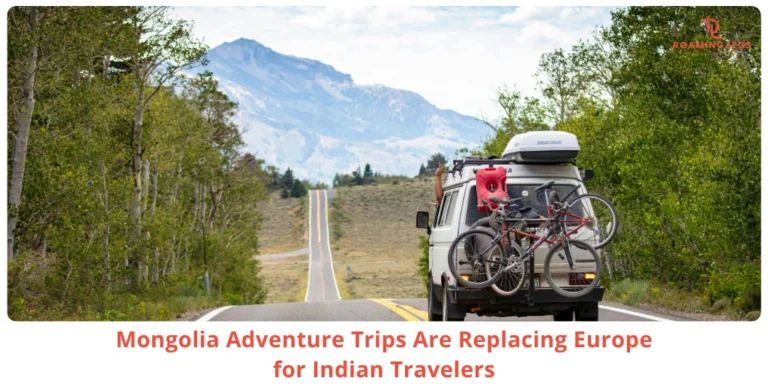
Mongolia receives fewer than 700,000 tourists a year.
France receives 100 million.
That single number tells you everything about the experience.
But beyond the crowd-free landscapes, there are practical reasons why Mongolia is making sense for Indian travelers right now:
It costs less than you think.
A well-organized 10-day Mongolia trip from India costs roughly the same as a mid-range Europe trip — but you get private ger camps, personal guides, and experiences that are simply not available in Europe at any price.
Visa-free entry makes it easy.
No visa stress, no embassy queue.
Just book and go.
The adventure is real, not staged.
You ride actual horses with nomadic families.
You sleep in actual gers on the open steppe.
You watch Mongolian eagle hunters work with trained golden eagles.
None of this is a performance for tourists.
It is genuinely photogenic.
The Gobi Desert dunes, the green steppe under wide skies, the nomadic family portraits — this is the kind of photography that gets noticed.
It is growing in popularity — but slowly.
Right now, you can experience Mongolia before it becomes overcrowded.
In five years, it may look very different.
Best Time to Visit Mongolia from India
| Month | Weather | Crowds | Best For |
|---|---|---|---|
| June | Warm, green steppe | Moderate | General travel, beginners |
| July | Warmest (25–30°C) | High | Naadam Festival (Jul 11–13) |
| August | Warm, comfortable | Moderate-High | Best all-round month |
| September | Cooling, autumn colors | Low | Photography, fewer tourists |
| October | Cold (0–10°C) | Low | Golden Eagle Festival |
| February | Freezing (-20°C) | Very Low | Ice Festival, experienced travelers only |
June
July
August
September
October
February
Our recommendation for most Indian travelers: August is the sweet spot.
Good weather, green landscapes, comfortable ger camps, and you avoid the Naadam peak pricing.
If the Naadam Festival is a priority: Book at least 6 months ahead.
Good ger camps near Ulaanbaatar sell out by January for July.
10-Day Mongolia Itinerary from India (The Route That Works)
This is the itinerary we recommend most often to Indian travelers doing Mongolia for the first time.
It covers the three best regions without rushing.
Day 1–2: Ulaanbaatar Arrive, recover from the flight, visit Gandantegchinlen Monastery in the morning, National Museum in the afternoon.
On Day 2, day trip to the Chinggis Khaan Equestrian Statue and Terelj National Park (about 60 km from the city).
Stay in a city hotel.
Day 3–5: Central Steppe — Karakorum and Orkhon Valley Drive south-west to Karakorum (about 6 hours).
Visit Erdene Zuu Monastery.
Spend two nights at a ger camp in the Orkhon Valley.
Horse riding, nomadic family visits, and wide-open steppe.
This is where Mongolia really begins.
Day 6–8: Gobi Desert Drive south to the Gobi (approximately 6–7 hours or a short domestic flight).
Visit the Flaming Cliffs on Day 6.
Camel trekking and the Singing Sand Dunes on Day 7.
Yol Valley ice canyon on Day 8 morning.
Stay in ger camps in the desert each night.
Day 9: Ongiin Monastery and drive back north Stop at the ruins of Ongiin Monastery — two monasteries that once housed over 1,000 monks, destroyed in the 1930s purges.
Quiet, atmospheric, and genuinely moving.
Day 10: Ulaanbaatar — departure Return to Ulaanbaatar. Last-minute shopping at the Narantuul Market for cashmere and traditional items.
Evening flight out.
Is Mongolia Safe for Indian Travelers?
Yes, Mongolia is safe for Indian travelers — including solo travelers and women traveling in groups.
Mongolia’s crime rate is low by international standards.
The bigger risks are practical ones: road conditions outside cities are rough (most roads are unpaved tracks across the steppe), weather changes quickly, and mobile coverage in rural areas is limited.
Practical safety tips:
- Always travel with a reputable guide outside Ulaanbaatar — not for safety reasons, but because navigation on the steppe is genuinely difficult without local knowledge
- Take comprehensive travel insurance that covers medical evacuation — healthcare outside Ulaanbaatar is basic
- Carry a power bank — electricity in ger camps is limited (solar panels, a few hours of power per day)
- Respect nomadic customs: always ask permission before photographing people or entering a ger, and accept offered food/drink graciously
For solo travelers from India: Mongolia is one of the friendlier destinations for solo travel.
Mongolian people are curious and warm toward visitors, particularly Indians.
The culture of hospitality (offering food, drink, and shelter to strangers) is genuine, not performative.
Mongolia’s 5 Regions — Which One Matches Your Travel Style?
Mongolia is large — roughly 4 times the size of Japan.
Most trips combine 2–3 regions.
Here is what each region offers:
The Gobi Desert
The Gobi is what most people picture when they think of Mongolia.
It is dramatic, stark, and unlike anything in India.
The main highlights are:
- Khongoryn Els (Singing Sand Dunes) — dunes up to 300 meters high, named for the sound the wind makes as it crosses the sand
- Bayanzag (Flaming Cliffs) — red sandstone cliffs where Roy Chapman Andrews discovered dinosaur fossils in the 1920s; the site still yields fossils
- Yol Valley — a narrow ice canyon that holds frozen water even in summer
- Camel riding with Bactrian (two-humped) camels — ₹1,200–₹2,000 per half-day
The Gobi is best between June and September.
Summers are hot (35–40°C in the day) but cool at night. Bring sunscreen and a jacket.
The Central Steppe
The heart of historic Mongolia. This is where the old Mongol Empire was centered.
Highlights:
- Karakorum — the ancient capital of Genghis Khan’s empire, now partially excavated
- Erdene Zuu Monastery — built in 1586, one of the oldest Buddhist monasteries in Mongolia, using stones from Karakorum’s ruins
- Orkhon Valley — a UNESCO World Heritage Site; wide river valley with waterfalls, nomadic camps, and wild horses
- Hustai National Park — home to the Przewalski’s horse (Takhi), the world’s last truly wild horse breed
Horse riding in this region costs ₹2,500–₹5,000 per day depending on the operator.
Northern Mongolia — Lake Khövsgöl
For travelers who want mountains, forests, and a completely different Mongolia from the desert south.
Lake Khövsgöl holds 2% of the world’s fresh surface water and is one of the deepest lakes in Asia.
The water is crystal clear. In winter it freezes solid enough to drive vehicles across.
The Tsaatan people (reindeer herders) live in the forests near the lake.
A 3-day homestay with a Tsaatan family costs approximately ₹16,000–₹33,000 per person and is one of the most unique cultural experiences available anywhere in the world.
Best time: June–September for boat trips and hiking; February for the Ice Festival on the frozen lake.
Western Mongolia — Eagle Hunters and the Altai Mountains
The Bayan-Ölgii province in western Mongolia is home to Kazakh communities who have practiced the art of hunting with trained golden eagles for centuries.
The Golden Eagle Festival in October is the best way to see this tradition — hunters in full traditional dress, eagles perched on their arms, competing in accuracy and speed across the mountain slopes.
This region also has serious trekking in the Altai Mountains, including routes up to 4,000 meters.
Ulaanbaatar
Most Mongolia trips start and end here. It is a proper city — good restaurants, comfortable hotels, and useful as a 1–2 day base.
Worth seeing in Ulaanbaatar:
- Gandantegchinlen Monastery — active Buddhist monastery with a 26.5-meter-tall golden Buddha
- National Museum of Mongolia — excellent overview of nomadic history and Mongol Empire
- Chinggis Khaan Equestrian Statue — 40-meter stainless steel statue on the banks of the Tuul River, an hour outside the city; entry ₹400
How Much Does a Mongolia Trip from India Actually Cost? (Full INR Breakdown)
Mongolia is not as expensive as people assume. Here is a realistic budget for a 10-day trip:
| Expense | Budget Range (Per Person) |
|---|---|
| Return flights from India | ₹55,000 – ₹1,10,000 |
| Guided tour (ger stays, transport, guide, meals) | ₹1,20,000 – ₹1,65,000 |
| Visa fee | ₹0 (visa-free for Indians) |
| Travel insurance | ₹3,000 – ₹6,500 |
| Personal spending (shopping, extras) | ₹8,000 – ₹15,000 |
| Total per person | ₹1,86,000 – ₹2,96,500 |
Return flights from India
Guided tour
Visa fee
Travel insurance
Personal spending
Total per person
For comparison: A 10-day Europe trip from India typically costs ₹2,50,000–₹4,00,000 per person — and that is a tour bus experience with 40 other people.
Mongolia at the same price is a private vehicle, private guide, and a ger camp under the Milky Way.
Basic Ger Camp or Luxury Lodge? Know What Fits Your Mongolia Budget
Mongolia trips can cost anywhere from ₹80,000 to ₹2,00,000+ for the land package alone — and a big reason for that gap is the type of camp you stay in. Basic ger camps share bathrooms and serve simple meals. Luxury ger camps have en-suite bathrooms, gourmet food, and even spa services out in the steppe. Not sure which one is right for you? Just share your travel dates and budget range on WhatsApp, and we'll send you a free personalised camp guide so you know exactly what to expect before you book. It takes two minutes and costs nothing.
Basic Ger Camps
Shared bathrooms, home-cooked meals, and an authentic nomadic experience — great for budget travellers.
Luxury Ger Camps
En-suite bathrooms, gourmet dining, and spa services — comfort in the middle of the Mongolian wilderness.
Real Price Breakdown
We'll show you exactly what ₹80,000 vs ₹2,00,000+ land packages actually include so there are no surprises.
Delivered on WhatsApp
Your personalised Mongolia camp guide lands in your WhatsApp within 24 hours, completely free.
What to Expect in a Ger (Mongolian Yurt) — Honest Review
A ger (pronounced “gare”) is a traditional Mongolian circular tent made of felt and wood.
They have been used by nomads for thousands of years and are genuinely comfortable when set up properly.
What ger camps are actually like:
Most ger camps in tourist areas have 4–8 beds inside each ger, a central wood-burning stove that keeps the interior warm even in cold nights, and separate toilet/shower facilities (usually 50–100 meters away from the gers).
Higher-end camps have attached bathrooms inside the ger, electricity, and WiFi in the common area.
What to expect: It is not a five-star hotel.
The beds are firm.
Nights can get cold.
You will hear wind.
You will see more stars than you have ever seen in your life.
Most travelers say it is the best sleep they have had in years.
Practical tip: Always pack a warm layer for ger nights, even in July.
Temperatures drop significantly after sunset on the steppe.
Food in Mongolia — What Indian Travelers Actually Eat
Mongolian food is meat-heavy.
Mutton and beef are the staples.
Traditional dishes include tsuivan (stir-fried noodles with meat), buuz (steamed dumplings), and khorkhog (meat slow-cooked with hot stones inside a pot).
For Indian vegetarians: It is manageable but requires planning.
Ulaanbaatar has Indian restaurants (BD’s Mongolian BBQ and a few South Asian spots near the city center).
Outside the city, vegetarian options are limited.
Tell your tour operator in advance — good operators can arrange vegetable dishes, eggs, rice, and dairy-based meals (Mongolians use a lot of dairy).
Dairy: Mongolia has excellent dairy.
Airag (fermented mare’s milk) is a cultural staple — it tastes slightly sour and fizzy, with very low alcohol content.
You will almost certainly be offered it at a nomadic family’s ger.
Try it — it is part of the experience.
Tip for Indian travelers: Carry dry snacks from India for the first couple of days while you adjust.
After that, most travelers adapt easily.
Adventure Activities in Mongolia — With Actual Costs
| Activity | Location | Approx. Cost |
|---|---|---|
| Horse riding (full day) | Central Steppe | ₹2,500 – ₹5,000/day |
| Camel trekking | Gobi Desert | ₹1,200 – ₹2,000/half day |
| Eagle hunting experience | Western Mongolia | ₹4,000 – ₹8,000/session |
| Ger stay with nomadic family | Multiple regions | ₹1,600 – ₹4,000/night |
| Reindeer herder homestay | Northern Mongolia | ₹16,500 – ₹33,000/3 days |
| Hiking in Orkhon Valley | Central Mongolia | ₹800 – ₹2,500/day (guide) |
| Sandboarding on Khongoryn Els | Gobi | ₹400 – ₹800 (equipment) |
| Jeep safari across steppe | All regions | Included in most packages |
Horse riding (full day)
Camel trekking
Eagle hunting experience
Ger stay with nomadic family
Reindeer herder homestay
Hiking in Orkhon Valley
Sandboarding on Khongoryn Els
Jeep safari across steppe
What Roaming Legs Travelers Say About Mongolia
“I am a photographer and I have traveled to 22 countries.
Mongolia is the most photogenic place I have ever been.
The light on the steppe at golden hour is something I still think about every day.
“ — Karthik S., Bangalore (traveled August 2025)
“We went as a family — two adults and two teenagers.
I was worried about the kids finding it boring without Wi-Fi and city things.
They didn’t want to leave.
They still talk about the camel riding and sleeping in the ger.
Best family trip we have ever taken.
“ — Priya and Deepak M., Hyderabad (traveled July 2025)
“Nitin and the Roaming Legs team handled everything perfectly.
The ger camp they chose for our Gobi nights was better than some hotels I have stayed in.
The guide was fluent in English and knew the region better than anyone.
We would go back in a second.
“ — Arun T., Chennai (traveled September 2025)
How to Book a Mongolia Tour from India — We Handle Everything
Planning a Mongolia trip from India sounds complicated, but it really is not. From the moment you reach out to us on WhatsApp, Roaming Legs takes care of everything — flights, ger camps, guides, 4WD transport across the steppe, meals, and any special arrangements you need, whether you are vegetarian, travelling as a senior, or planning around a specific festival date. Just share your travel dates and group size, and we will send you a free personalised Mongolia trip plan. No commitment needed — just two minutes on WhatsApp.
Transfers & Transport
Airport pickups and 4WD jeeps across the steppe — every journey is sorted from day one.
English-Speaking Guide
A local guide stays with you throughout the trip — someone who actually knows Mongolia.
Camps, Meals & Entry
All ger camp stays, hotel nights, meals per itinerary, and park entry fees are included.
24/7 Roaming Legs Support
Our team is available around the clock — before, during, and after your Mongolia trip.
Mongolia Travel FAQs for Indian Travelers
Everything Indian travelers ask before booking a Mongolia trip — answered honestly, without the fluff.
1. Is Mongolia visa-free for Indian passport holders?
Yes. Indian citizens can visit Mongolia without a visa for up to 30 days. No advance application is required — entry is on arrival at Chinggis Khaan International Airport in Ulaanbaatar. You must register with Mongolian Immigration within 7 days if staying longer than 7 nights.
2. How many days is enough for a Mongolia trip from India?
Minimum 8 days (to cover Ulaanbaatar, Central Steppe, and the Gobi Desert). Ten days is the sweet spot for a first trip. If you want to add Northern Mongolia or Western Mongolia, plan for 12–14 days.
3. Which airlines fly from India to Mongolia?
There are no direct flights. The most common connections are via Beijing (Air China + MIAT Mongolian Airlines) or Seoul (Korean Air/Asiana + MIAT). The total journey time is 9–13 hours including the layover.
4. Can Indian vegetarians eat comfortably in Mongolia?
It requires planning. Ulaanbaatar has vegetarian-friendly restaurants. Outside the city, vegetarian options are limited. Inform your tour operator in advance — experienced operators like Roaming Legs arrange vegetable-based meals, dairy dishes, and eggs for the rural portions of the trip.
5. What is the best time to visit Mongolia from India?
August is the best overall month — good weather (20–28°C), green landscapes, and comfortable ger camps. July is ideal if Naadam Festival is a priority. October is best for the Golden Eagle Festival in Western Mongolia. Avoid November through March unless you are specifically interested in the winter Ice Festival.
6. How much does a Mongolia trip cost in Indian Rupees?
A 10-day guided Mongolia tour from India typically costs ₹1,86,000–₹2,96,500 per person all-inclusive (flights, accommodation, guide, meals, transport). The range depends on flight class, ger camp quality, and whether you choose group or private departures.
7. Is it safe to travel to Mongolia?
Yes. Mongolia is one of the safest adventure destinations in Asia. Crime rates are low, locals are genuinely hospitable, and tour operators maintain high safety standards in the field. The main risks are rural road conditions and limited healthcare outside cities — both managed by traveling with a reputable operator and taking travel insurance.
8. What should I pack for Mongolia?
Pack layers — mornings and nights are cold even in summer. Essentials include: sunscreen (steppe UV is strong), lip balm, a quality sleeping bag liner (ger camps provide blankets but a liner adds warmth), power bank, cash in USD or MNT (card acceptance is limited outside Ulaanbaatar), and any specific medications since pharmacies are scarce in rural areas.
9. Can I combine Mongolia with another country?
Yes. Popular combinations are Mongolia + China (Beijing is a natural stopover on the way back), Mongolia + South Korea (Seoul stopover), and Mongolia + Kyrgyzstan (both visa-free for Indians, similar landscape adventure). Ask us about combination itineraries.
10. What is G Adventures Mongolia vs booking with an Indian operator?
G Adventures is an international operator with standardized group tours. Booking with Roaming Legs means an India-based team that understands Indian travel preferences (vegetarian food arrangements, festival timing, INR pricing with no hidden conversion fees), 24/7 Indian support, and full customization. Prices are comparable, but the service is more tailored to Indian travelers.