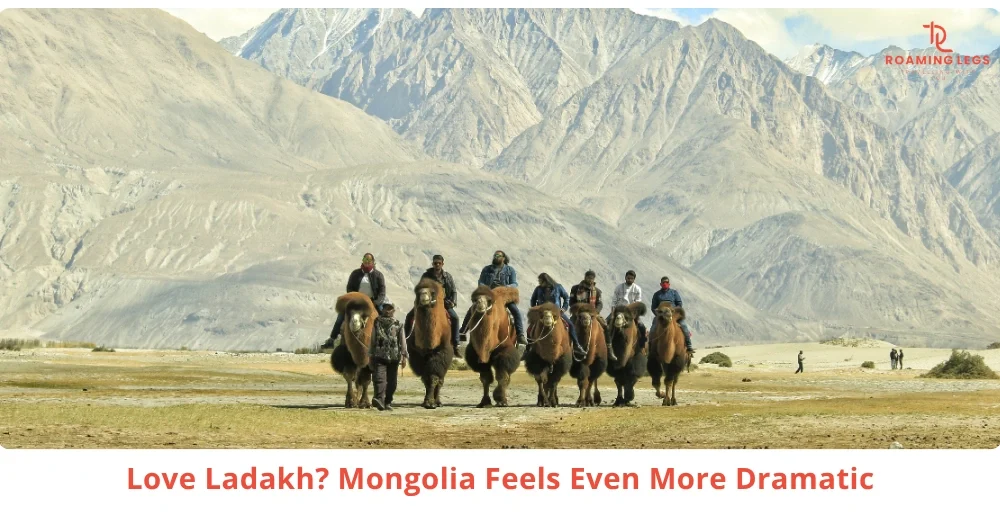
There’s a specific kind of traveler this article is written for.
You’ve been to Ladakh. Maybe Spiti too.
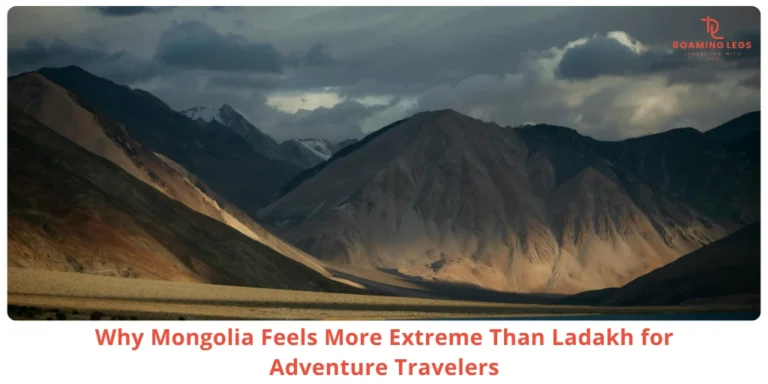
You sat next to Pangong Lake and didn’t feel the urge to say anything.
The silence was enough.
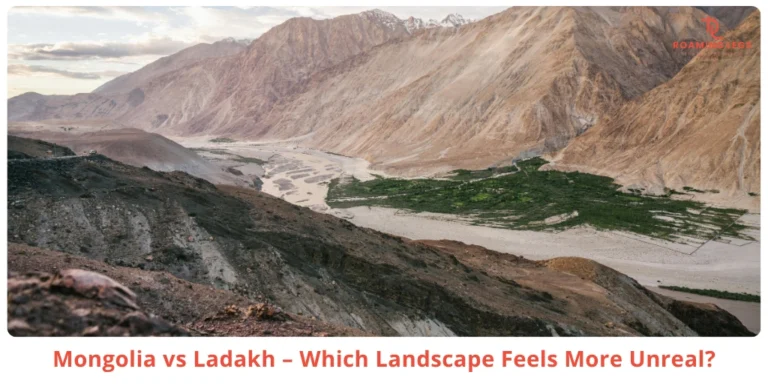
The drive from Leh to Nubra had that stretch — maybe near Khardung La, maybe before it — where you stopped talking mid-sentence because the landscape outside the window made conversation feel unnecessary.
That feeling. That’s the one.
Mongolia gives you that feeling, but it doesn’t stop.
In Ladakh, you get it in flashes — between one mountain pass and the next, at the edge of a lake, on the long road to Hanle.
In Mongolia, it becomes the default state. You drive for five hours and the steppe just keeps going. The horizon stays empty.
The sky takes up more of your vision than you expect.
And at some point, usually on day two or three, you stop waiting for the next viewpoint and start understanding that the drive itself is the thing.
What Makes an Indian Traveler Immediately Recognize Mongolia
Most Indian travelers who’ve done serious mountain trips — Ladakh, Spiti, Zanskar, even parts of Uttarakhand and Sikkim — arrive in Mongolia and feel something familiar within the first hour of leaving Ulaanbaatar.
It isn’t that the landscapes look the same.
They don’t, not exactly. What’s familiar is the emotional logic of it.
The cold that sits differently than city cold.
The light that does something strange to the mountains in the late afternoon.
The way conversations slow down on long drives.
The feeling that you are very small in a very large space, and somehow that feels good rather than frightening.
Ladakh gives you that emotional logic compressed into mountain valleys and high-altitude lake basins.
Mongolia is that same logic scaled up across 1.56 million square kilometres — an area roughly half the size of all of India — with a population of just 3.3 million people.
The country is officially the world’s most sparsely populated sovereign state.
When you drive across the Mongolian steppe for a full day and see almost nothing man-made, that isn’t a remote corner of the country.
That’s just what most of Mongolia looks like.
One couple from Chandigarh who traveled with us to Mongolia in September 2024 said it best on the third day: “It feels like someone turned the volume down on everything.”
They’d done Leh-Manali and Spiti the two years before.
This is what Mongolia tends to do to people who already understand why silence has its own texture.
The Key Difference: Scale
Here is the honest comparison Indian mountain travelers need.
| Experience | Ladakh | Mongolia |
|---|---|---|
| Landscape type | High-altitude Cold desert, mountain valleys | Steppe grasslands, Gobi Desert, mountain ranges |
| Emotional feel | Dramatic, concentrated, mountain-contained | Vast, open, almost disorienting in scale |
| Crowds at popular spots | Growing fast, busy July–August | Low — even peak season feels quiet |
| Road conditions | Mix of paved and rough mountain roads | Largely off-road, 4x4 required for many areas |
| Nights | Hotels, guesthouses, campsites | Ger camps and nomadic family stays |
| Cultural texture | Buddhist monasteries, Ladakhi villages | Nomadic families, horse culture, Buddhist monasteries |
| Best months | June to September | June to September |
| Familiar feeling | High. Many Indian travelers call it a spiritual home. | High. Differently, but quickly. |
Landscape Type
Ladakh:
High-altitude Cold desert, mountain valleys
Mongolia:
Steppe grasslands, Gobi Desert, mountain ranges
Emotional Feel
Ladakh:
Dramatic, concentrated, mountain-contained
Mongolia:
Vast, open, almost disorienting in scale
Travel Experience
Ladakh:
Growing crowds, mountain roads, hotels and campsites
Mongolia:
Quiet landscapes, 4x4 routes, ger camps and nomadic stays
Best Months
Ladakh:
June to September
Mongolia:
June to September
Where in Mongolia Feels Most Like Ladakh — and Where It Goes Beyond
The Gobi Desert: Nubra Valley, But Wider
If you’ve been to Nubra Valley — those sand dunes between mountains, the camels, the flat valley floor surrounded by high peaks — the Gobi Desert will feel emotionally familiar while being completely different in scale.
Nubra is a valley with dunes. The Gobi is a desert the size of multiple Indian states, and it’s not what most people picture.
It’s not an endless sea of sand. It’s rock, gravel plains, scattered dunes, frozen canyons, and red cliffs — constantly shifting in appearance across hundreds of kilometres.
The must-visit sections:
Khongoryn Els (Singing Dunes): Mongolia’s largest sand dune system, stretching 180 kilometres.
You climb them, ride double-humped camels across the base, and at sunset the light turns everything amber-gold. On windy days the dunes make a low, resonant sound — which is where the name comes from.
Bayanzag (Flaming Cliffs): Red sandstone cliffs where paleontologist Roy Chapman Andrews found the world’s first dinosaur eggs in the 1920s.
At sunset, the cliffs turn deep orange-red. This is one of the most visually striking landscapes in all of Asia.
Yolyn Am Gorge: A narrow canyon in the Gurvan Saikhan mountains that stays packed with ice well into summer — sometimes through July. You hike between cliff walls with a frozen river underfoot.
The contrast between icy floor and blazing sun overhead is completely unexpected.
Central Steppe and Orkhon Valley: The Emotional Heart
This is where Mongolia goes somewhere Ladakh doesn’t.
The Orkhon Valley is a UNESCO World Heritage landscape and the geographic heartland of every major Mongolian empire, including Genghis Khan’s.
The ruins of Karakorum — once the capital of the largest contiguous land empire in history — sit here quietly in the grass.
The Erdene Zuu Monastery, built in the 1586 from the stones of the old city, is still active.
But what most travelers remember from this region isn’t the history.
It’s the nights in nomad family gers, watching the family’s daily work unfold around the camp — milking horses, moving livestock, the kids on horseback doing things that would seem extraordinary anywhere else.
Horse riding across open steppe is included in any properly organised tour here, and for riders who’ve done horse treks in Ladakh or Spiti, this feels familiar but freer — there are no paths or boundaries, just grass and sky.
Terelj National Park: Spiti Valley’s Quieter Cousin
Fifty-five kilometres from Ulaanbaatar, Terelj is where forested granite mountains meet river valleys and open meadows.
Turtle Rock — a granite formation shaped, obviously, like a turtle — is the iconic photograph.
Hiking here is lower altitude and more accessible than Ladakh.
The ger camps in Terelj are the most comfortable countryside accommodation in Mongolia, which makes it a good gentle entry point before the more remote stretches.
Ulaanbaatar: The City Part (Don’t Skip It)
Most travelers want to get to the countryside fast, and that instinct is right. But two days in Ulaanbaatar earns its place.
Gandan Monastery — the largest functioning Buddhist monastery in Mongolia — is a genuine working religious site, not a tourist reconstruction.
The Natural History Museum has a full T-Rex skeleton and Gobi dinosaur fossils that are legitimately impressive.
The Zaisan Memorial gives you a panoramic view over the city and the surrounding hills. And the Black Market (Narantuul) is where you buy cashmere — directly from vendors, not at airport prices.
Budget ₹3,000–₹8,000 for good-quality cashmere pieces; the mark-up at hotel shops is significant.
Planning a Mongolia Trip From India? Get a Free Custom Itinerary
Mongolia offers very different experiences depending on what you want to see — the vast Gobi Desert, the energy of the Naadam Festival, traditional nomad stays, or a mix of everything. Your route should match your travel time and interests.
Tell us your travel dates, group size, and the experiences that matter most. We will send you a ready-made 10-day Mongolia itinerary on WhatsApp within 24 hours. Free, with no obligation.
The One Thing Mongolia Has That Ladakh Doesn’t: The Naadam Festival
Every year, on July 11–13, Mongolia holds Naadam — its most important national festival, celebrating the Three Manly Games: wrestling (Бөх), archery (Сур Харваа), and horse racing (Морин Уралдаан).
The opening ceremony at the National Stadium in Ulaanbaatar is genuinely one of the most striking spectacles in all of Central Asia.
Thousands of athletes in traditional costume.
The president opens the ceremony. Traditional music, cavalry formations, and two thousand years of cultural identity compressed into two hours.
Naadam 2026 runs July 11 to 13, marking the 105th anniversary of the Mongolian Revolution.
Stadium tickets range from USD 25 to USD 120 (approximately ₹2,100 to ₹10,000).
They sell out months in advance. Book through an operator with pre-purchased allotments — don’t assume you can get tickets at the gate.
Outside the city, regional Naadams happen throughout July in smaller towns and are free.
The horse racing outside Ulaanbaatar covers a 15–30 km cross-country course ridden by child jockeys — a surreal and completely distinct experience from anything you’ll see in India.
If your dates are flexible, timing a Mongolia trip around Naadam is worth doing. It adds a cultural layer that turns a landscape trip into something more complete.
The Ger: Mongolia’s Version of a Himalayan Homestay
In Ladakh and Spiti, many travelers stay in local homestays — basic rooms, host families, meals shared at a common table.
That experience of living alongside people in a genuinely different daily rhythm is a big part of why people love those trips.
The Mongolian ger (the word yurt is Turkic and rarely used locally) is the same idea, taken somewhere else entirely.
A ger is a circular lattice-frame structure covered in layered wool felt, heated by a central wood or coal stove, and designed to be assembled and dismantled in under an hour.
Nomadic families have lived in them for centuries because they work perfectly for a life built around seasonal movement.
Tourist ger camps sit at permanent locations with shared bathroom blocks, generator electricity (usually off by 11 PM), and wooden beds with proper bedding.
The temperature inside drops once the fire goes out, so you sleep in layers — same as any high-altitude Himalayan night.
The countryside ger experience, staying with actual nomad families, goes further.
You eat what the family eats — mutton, dairy, salted tea with milk.
You watch the daily work of a household built around livestock and land. You sleep to total silence, and outside the door is one of the darkest, clearest night skies on the planet.
This is the level of access to a genuinely different way of life that most international travel destinations can’t offer.
Very few countries let you step this far into a living traditional culture that isn’t performing itself for tourists.
Practical note for vegetarians: In Ulaanbaatar, vegetarian-friendly restaurants are available.
In the countryside, Mongolian food is overwhelmingly meat-based.
Most tourist ger camps accommodate a vegetarian request if flagged in advance through your operator.
Don’t assume — mention it when you book.
Not Sure If Mongolia Is Right for You?
Mongolia is a very different kind of adventure. We have helped Indian travelers who were taking their first international trip as well as experienced travelers who wanted something beyond regular mountain destinations like Spiti and Ladakh.
Share your travel experience and what you are expecting from the trip on WhatsApp. We will give you an honest recommendation on whether Mongolia matches your travel style.
Practical Info: Getting to Mongolia from India
Flights: No direct flights from India to Ulaanbaatar (airport code ULN) currently operate. The most common routes connect through Beijing (Air China), Seoul (Korean Air or Asiana), or Hong Kong. From Delhi, expect 12–16 hours total travel time with one stop. Return fares in 2026:
| From | Via | Approx. Return Fare (INR) |
|---|---|---|
| Delhi | Beijing (Air China) | ₹85,000–₹90,000 |
| Delhi | Seoul (Korean Air/Asiana) | ₹70,000–₹1,00,000 |
| Mumbai | Beijing or Seoul | ₹75,000–₹1,10,000 |
| Bengaluru | Seoul or Hong Kong | ₹80,000–₹1,15,000 |
Delhi → Mongolia
Route:
Via Beijing (Air China)
Return Fare:
₹85,000–₹90,000
Delhi → Mongolia
Route:
Via Seoul (Korean Air/Asiana)
Return Fare:
₹70,000–₹1,00,000
Mumbai → Mongolia
Route:
Via Beijing or Seoul
Return Fare:
₹75,000–₹1,10,000
Bengaluru → Mongolia
Route:
Via Seoul or Hong Kong
Return Fare:
₹80,000–₹1,15,000
Book 8–10 weeks ahead for the lower end of these ranges. July prices spike; June and September offer meaningful savings.
Visa: Indian passport holders can enter Mongolia visa-free for up to 30 days. No e-visa or pre-approval required. You need a valid passport with at least 6 months remaining and proof of return travel. Confirm with the Embassy of Mongolia in New Delhi before travel, as policies can update.
Best months: June to September. June is fresh and uncrowded. July has the Naadam Festival. August is warm with some northern rain. September has autumn colours, cooler nights, and noticeably fewer tourists. Outside this window, most countryside camps close and roads become impractical.
Total trip cost from India (10 days, per person): ₹1,75,000–₹2,50,000 all-in, including return flights, ground transport, ger camps, meals, and guide. The visa is free for Indians, which is a meaningful cost advantage over most long-haul destinations.
A 10-Day Mongolia Itinerary That Works for Indian Travelers
Days 1–2 — Ulaanbaatar Gandan Monastery, Natural History Museum (T-Rex fossil, Gobi dinosaur eggs), Zaisan Memorial panoramic view. Evening dinner at a local restaurant — a bowl of buuz (steamed dumplings) or tsuivan (noodle stir-fry) runs ₹150–₹250. Shopping at Narantuul Black Market for cashmere.
Days 3–5 — Gobi Desert Short domestic flight or overland drive south. Yolyn Am Gorge hike in ice-floored canyon. Khongoryn Els sand dunes — camel ride at sunrise. Bayanzag Flaming Cliffs at sunset. Dinosaur fossil museum. Nights in ger camps under uninterrupted skies.
Days 6–8 — Orkhon Valley and Central Steppe Drive to the UNESCO World Heritage Orkhon Valley. Ruins of Karakorum, ancient capital of the Mongol Empire. Erdene Zuu Monastery (still active, built from the old city’s stone). Nights with nomadic families — horse riding across open steppe, airag (fermented mare’s milk) if you’re brave, total darkness at night.
Days 9–10 — Terelj National Park and Departure Forested granite mountains 55 km from Ulaanbaatar. Turtle Rock hike. One final ger camp night under forest and stars. Return to the city for last shopping. Flight home.
If traveling in July: Replace Day 1–2 Ulaanbaatar sightseeing with Naadam Festival (July 11–13). Book stadium tickets through your operator well in advance.
What Real Travelers Say
“I’d done Leh-Manali three times and Spiti twice.
I went to Mongolia thinking I knew what to expect from landscape travel.
I didn’t. The steppe doesn’t make sense until you’re inside it. The scale of it does something to you that a mountain valley can’t — you feel both very small and very calm at the same time. I came back wanting to go again.” — Abhishek T., Mumbai, September 2024
“The nomad family stay was the part I didn’t expect to affect me. In Ladakh I’d stayed in homestays, but this felt more isolated, more real. No phone signal.
The kids riding horses like it was nothing. The grandmother making tea at the stove.
I sat outside the ger at 2 AM and the Milky Way was literally overhead.
There’s no light pollution for hundreds of kilometres.
It’s something you can’t plan for.” — Sunita and Rohit V., Bengaluru, June 2025