Quick Answer for Indian Travelers
Kazakhstan is the easiest pick — visa-free entry for 14 days, comfortable hotels in Almaty, city plus mountain scenery without any remote logistics.
Kyrgyzstan gives you the best mountain experience per rupee in all of Asia — 30-day visa-free, yurt stays from ₹1,500/night, and a full 10-day trip under ₹90,000.
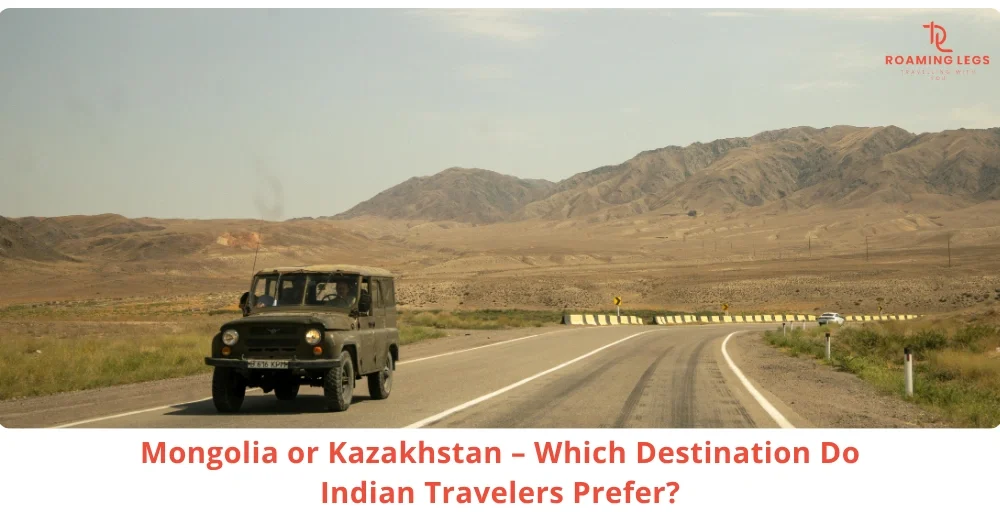
Mongolia is for travelers who want a trip they’ll spend years talking about — rawer, pricier, and more demanding than the other two, but nothing else comes close to what it delivers.
Three countries. One big question.
And nobody wants to spend money on the wrong one.
Mongolia, Kazakhstan, and Kyrgyzstan are all picking up serious interest from Indian travelers right now — and for good reason.
All three are genuinely beautiful, all three are still refreshingly off the typical tourist circuit, and all three sit close enough to India that the flights don’t require a full week of vacation just to get there.
But they are completely different experiences, and picking the wrong one based on Instagram reels or a generic blog comparison will leave you either bored, exhausted, or wishing you’d chosen differently.
Here’s the direct answer if you need one fast: Kazakhstan is easiest for first-timers and families.
Kyrgyzstan is the one for mountain-obsessed travelers on a reasonable budget.
Mongolia is for people who want a trip they’ll spend the next five years talking about.
The rest of this guide is for understanding why.
The One-Line Verdict Per Destination
Quick comparison of three popular Central Asian destinations for Indian travelers.
| Country | Best For | Trip Budget (INR, Per Person, 7–10 Days) | Visa for Indians |
|---|---|---|---|
| Mongolia | Adventure seekers, photographers, nature travelers | ₹1,50,000–₹2,20,000 (incl. flights) | e-Visa required, approved in 3–5 days |
| Kazakhstan | Families, first-time international travelers, comfort travelers | ₹90,000–₹1,50,000 (incl. flights) | Visa-free up to 14 days |
| Kyrgyzstan | Friend groups, budget travelers, mountain lovers | ₹55,000–₹90,000 (incl. flights) | Visa-free up to 60 days |
Mongolia
Kazakhstan
Kyrgyzstan
Mongolia: The Country That Stays With You Long After You’re Back Home
Here’s something honest about Mongolia — it is not a comfortable trip in the way that Dubai or Singapore feels comfortable.
The roads outside Ulaanbaatar are rough.
Distances between places are serious.
The ger camps where you’ll sleep have no heating by Western hotel standards.
And you will eat more mutton than you ever have in your life.
And yet, every single client we’ve sent to Mongolia comes back with the same look.
The one that says: I cannot believe that was real.
The reason is simple.
Mongolia is what the rest of the world used to look like before cities ate everything.
When you drive through the Gobi Desert and the landscape just goes — for hours in every direction — with no buildings, no billboards, no other cars, just sand and sky and silence, it does something to you that no beach resort ever will.
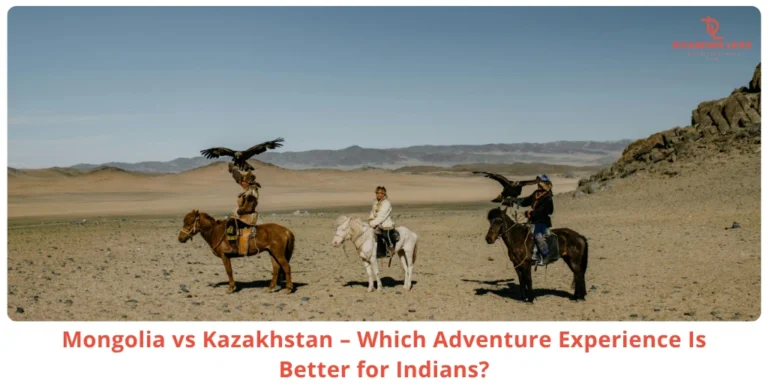
When you spend an afternoon with a Kazakh eagle hunter in Western Mongolia — a man who has trained a golden eagle since it was a chick, hunts with it on horseback, and lives in a ger his family has moved seasonally for generations — you understand that not all travel is created equal.
What makes Mongolia genuinely special for Indian travelers:
The Gobi Desert alone covers about 1.3 million square kilometres — more than three times the size of all of Rajasthan.
The Flaming Cliffs of Bayanzag, where the first dinosaur eggs were discovered, turn deep amber-red at sunset in a way you genuinely cannot photograph properly.
Terelj National Park, just 55 kilometres from Ulaanbaatar, has horseback trails through forested granite valleys that feel nothing like the capital.
And the Naadam Festival — held every July 11 to 13 and celebrating Mongolia’s three traditional sports of wrestling, archery, and horse racing — is the kind of event that books up fast and rewards anyone who plans around it.
The practical reality: Mongolia is best done in 8 to 10 days minimum, because the distances mean you need time to actually be somewhere rather than just transit through.
A typical package from India costs between ₹1,50,000 and ₹2,20,000 per person including return flights, ger camp stays, guided transport in a 4×4 SUV, and meals.
Indian travelers need an e-Visa (₹2,500–₹3,500, approved in 3–5 days), and the best travel window is June to September — the rest of the year, most ger camps close and temperatures drop to -25°C.
Choose Mongolia if you’ve done the standard international destinations and want something that actually challenges your sense of what travel can be.
Tell Us Your Travel Style — We'll Tell You Which Country Fits
Choosing between Mongolia, Kazakhstan, and Kyrgyzstan can be surprisingly difficult because each offers a completely different travel experience. Instead of spending hours comparing destinations, simply share your travel dates, group size, and the kind of holiday you want on WhatsApp. Our team has planned trips for Indian travellers across all three countries and can usually recommend the best destination for you in a single conversation.
Destination Recommendation
Find out which country best matches your interests, travel style, and expectations.
Tailored to Your Group
Recommendations are based on whether you are travelling solo, as a couple, with family, or in a group.
Budget-Based Advice
We shortlist destinations that fit your budget while helping you get the best overall experience.
Free WhatsApp Consultation
Receive personalised destination advice from experienced travel planners before you book anything.
Kazakhstan: The Easiest Way Into Central Asia Without Giving Up Comfort
Kazakhstan is the country most Indian travelers choose when they want to do something genuinely different from Thailand or Bali — but aren’t ready to sleep in a tent in the Mongolian steppe either.
And that’s a perfectly reasonable position to be in.
Almaty, Kazakhstan’s largest city, is genuinely one of the more underrated travel bases in Asia.
It sits directly beneath the Zailiyskiy Ala-Tau mountains — tall, snow-capped, photogenic — and you can go from your hotel in the city centre to hiking at 2,500 metres in about 45 minutes.
The city itself has the kind of café culture, restaurant scene, and clean urban infrastructure that makes Indian travelers feel at ease rather than constantly problem-solving.
Specific experiences worth knowing about:
Big Almaty Lake is a high-altitude reservoir surrounded by mountains at 2,511 metres, with water so blue-green it looks edited.
It’s a 45-minute drive from the city and genuinely stunning, even for travelers who’ve seen mountain lakes before.
Charyn Canyon, often called Central Asia’s answer to the Grand Canyon, is a 3-hour drive from Almaty — rust-red rock formations, a river running through the bottom, and very few other tourists.
Medeu is an outdoor skating rink at 1,691 metres altitude surrounded by mountains; even in summer the views are worth the cable car ride up to Shymbulak ski resort above it.
For families specifically, Kazakhstan is the easiest Central Asian destination by a significant margin. Hotels in Almaty range from international chains like Novotel and Ramada to well-run local properties, all with reliable standards.
The food scene covers everything from Kazakh national dishes like beshbarmak (slow-cooked meat on flat noodles) to good Indian restaurants if the family has picky eaters.
Internal transportation between the airport, city, and day-trip sites is organized and not intimidating.
Visa situation: Indians get 14 days visa-free in Kazakhstan — no pre-approval, no fees, no waiting. Just arrive.
A 5 to 7-day Kazakhstan trip from India costs roughly ₹90,000 to ₹1,50,000 per person including return flights (usually routed through Air Astana or IndiGo via connections).
The best time is April to June and September to October — July and August get hot in the cities, though the mountains stay pleasant.
Choose Kazakhstan if you want real Central Asian character — mountains, steppe, nomadic culture — without giving up comfortable hotels and organized logistics.
Kyrgyzstan: Where the Mountains Are Bigger Than Your Budget Expects
Kyrgyzstan does not get the attention it deserves.
It sits between Kazakhstan and China, covers an area slightly smaller than the Philippines, and has mountain terrain so dramatic that travelers who’ve done Himachal Pradesh and Ladakh still come back surprised by how different it feels.
The Tien Shan mountain range — which means “Celestial Mountains” in Chinese — runs across most of Kyrgyzstan.
About 40% of the country sits above 3,000 metres.
Issyk-Kul, the world’s second-largest alpine lake after Titicaca, is 182 kilometres long, sits at 1,607 metres altitude, and doesn’t freeze in winter despite the surrounding peaks being snow-covered.
Song-Kul is a smaller alpine lake at 3,016 metres where nomadic families still move their herds each summer — you can rent a yurt on its shores for roughly ₹1,500 per night, and the stars on a clear night look like a screensaver someone turned up too high.
What Kyrgyzstan is actually good for:
The Ala Archa National Park is 40 kilometres from the capital Bishkek and has glacier views, hiking trails, and horse-riding routes accessible from a single day trip.
Karakol, a town in the eastern part of the country, is the base for some of the best trekking in Central Asia including the Jeti-Oguz gorge — red sandstone formations locals call the “Seven Bulls” — and Altyn Arashan valley with its natural hot springs.
For friend groups who want road trips, Kyrgyzstan’s mountain highways between Bishkek and Osh cover some of the most cinematic driving territory in Asia.
The budget reality is genuinely impressive for Indian travelers.
A 10-day Kyrgyzstan trip from India — including return flights, yurt stays, guesthouses in Bishkek and Karakol, shared taxi transport between regions, and activities — typically costs ₹55,000 to ₹90,000 per person.
Flights from major Indian cities run about ₹28,000–₹45,000 return if booked 4–6 weeks ahead.
Local food at a chaikhana (tea house) costs ₹300–₹500 for a full meal of lagman or manti.
And the visa situation is possibly the easiest in Central Asia: Indians get 60 days visa-free in Kyrgyzstan.
Walk up, stamp, done.
The honest limitation: Kyrgyzstan’s tourism infrastructure outside Bishkek is basic.
Accommodation in remote areas means guesthouses and yurts, not hotels with gym and breakfast buffet.
This is not a problem if you expect it — it’s actually part of the appeal — but families with elderly members or young children should think about this before booking.
Choose Kyrgyzstan if mountain landscapes, yurt stays, road trips, and genuine budget value matter more to you than urban convenience.
Real Cost Comparison: Where Does Your Money Actually Go?
Compare the major expenses across Mongolia, Kazakhstan, and Kyrgyzstan.
| Expense | Mongolia | Kazakhstan | Kyrgyzstan |
|---|---|---|---|
| Return flights from India | ₹35,000–₹60,000 | ₹25,000–₹45,000 | ₹28,000–₹45,000 |
| Accommodation per night | ₹3,000–₹8,000 (ger camps) | ₹3,500–₹9,000 (hotels) | ₹500–₹2,500 (guesthouses/yurts) |
| Daily food budget | ₹1,200–₹2,000 | ₹1,000–₹2,500 | ₹600–₹1,200 |
| Internal transport | High (4×4 SUV for long routes) | Moderate (taxis, day trips from Almaty) | Low (shared taxis, marshrutkas) |
| Guide/tour requirement | Strong recommendation | Optional for most routes | Optional, CBT treks available |
| Total 7–10 day budget per person | ₹1,50,000–₹2,20,000 | ₹90,000–₹1,50,000 | ₹55,000–₹90,000 |
Return flights from India
Accommodation per night
Daily food budget
Internal transport
Guide/tour requirement
Total 7–10 day budget per person
How Do You Actually Get There from India?
Mongolia (Ulaanbaatar — Chinggis Khaan International Airport)
No direct flights from India.
The most common routes are via Seoul on Korean Air or Miat Mongolian Airlines, via Beijing on Air China, or via Hong Kong.
Total travel time including layover: 8 to 11 hours.
Return fares from Delhi or Mumbai: ₹35,000–₹60,000 per person if booked 6–8 weeks ahead.
Book early for June–July travel — Naadam season fills up fast.
Kazakhstan (Almaty International Airport)
Air Astana operates direct flights from Delhi to Almaty.
You can also connect via Dubai on Emirates/flydubai, or via Sharjah on Air Arabia.
Total travel time: 6 to 8 hours.
Return fares: ₹25,000–₹45,000 per person.
This is the cheapest and shortest routing of the three countries.
Kyrgyzstan (Manas International Airport, Bishkek)
No direct flights from India.
The cleanest route is Delhi to Almaty on Air Astana, then a 1-hour Almaty–Bishkek hop — total around 7–8 hours including layover.
Turkish Airlines via Istanbul is the other option, usually 9–10 hours total.
Return fares: ₹28,000–₹45,000 per person.
If you’re combining Kazakhstan and Kyrgyzstan, you save money by flying into Almaty and crossing overland to Bishkek (3–4 hours by shared taxi, ₹600–₹900 per seat).
Vegetarian Travelers — What to Expect in Each Country
This is one of the most important questions for Indian travelers and most blogs skip it entirely.
Mongolia is the hardest for vegetarians.
Mongolian cuisine is built around meat — mutton, beef, and horse meat — and dairy products like fermented mare’s milk (airag) and dried curds.
In Ulaanbaatar, you’ll find dedicated vegetarian and Indian restaurants without much trouble.
Outside the capital, you genuinely need to tell your guide in advance so they can coordinate with ger camp cooks.
It’s manageable but requires active planning — don’t assume it’ll sort itself out.
Kazakhstan is easier, especially in Almaty. The city has Indian restaurants (Namaste India and Taj Mahal in Almaty are well-known), international cafes, and a good variety of options.
Local Kazakh food leans toward meat and bread, so vegetarians eating outside Indian restaurants should look for Lagman noodle soup (can be made vegetable-based), samsa pastries (request vegetarian), and fresh bread.
Outside Almaty in smaller towns, options narrow significantly.
Kyrgyzstan sits in between.
Local food includes Lagman (noodle soup available in vegetable version), shorpo (broth-based soup), bread, and dairy products.
Bishkek has a small selection of Indian and international restaurants.
Karakol and guesthouses along the Issyk-Kul route can usually prepare simple vegetable dishes if you ask.
Yurt stays at Song-Kul almost always include dairy and bread even if you skip the meat.
For Jain travelers, all three countries require advance communication with your travel operator — don’t leave it for on-the-ground improvisation.
Which Traveler Usually Picks Which Country?
You’ll fit in Mongolia if: You finished the Dubai–Maldives–Thailand circuit and want something that genuinely surprises you.
You care more about the story you come back with than the hotel’s thread count.
You’re okay with long drives across open steppe if the destination at the end involves sleeping under the stars next to a nomadic family.
You’ll fit in Kazakhstan if: You’re traveling with parents or kids and need to know that a doctor is nearby and the hotel has a lift.
You want Central Asia’s mountain scenery without the uncertainty of remote logistics.
This is your first proper international trip outside South/Southeast Asia.
You’ll fit in Kyrgyzstan if: You and your friends want a road trip with mountain backdrops that costs less than a weekend in Goa once you factor in flights.
You’ve done Spiti Valley or Ladakh and want the same raw mountain energy in a different country.
The thought of a yurt stay near a 3,000-metre lake genuinely excites you rather than making you nervous.
Ready to Book? Let Us Put It Together for You
Planning a trip to Mongolia, Kazakhstan, or Kyrgyzstan on your own can easily take more than 30 hours of research. From comparing flight routes and selecting the right accommodation to arranging 4×4 expeditions in Mongolia, checking CBT trek availability in Kyrgyzstan, or planning day trips from Almaty, there is a lot to coordinate. Share your travel dates, group size, and approximate budget on WhatsApp, and our team at Roaming Legs will prepare a personalised itinerary with recommended stays, transport, and experiences, delivered within 24 hours.
Flights & Logistics
Get the best flight routes, transfers, and travel connections planned together.
Handpicked Stays
Stay at carefully selected ger camps, guesthouses, and hotels that offer the best value.
Expert Local Itinerary
Receive a day-by-day itinerary built around the season, your interests, and your travel style.
Delivered in 24 Hours
Your customised Central Asia travel plan is sent directly to WhatsApp, ready for booking.
What Roaming Legs Travelers Say
Ankit Verma, Delhi — Mongolia, July 2025: “We went during Naadam and the opening ceremony at the National Stadium was unlike anything I’ve ever seen.
Three days in the Gobi felt like being on another planet.
Roaming Legs handled the ger camp bookings and 4×4 logistics — I would have spent weeks trying to sort that on my own.”
Pooja and Rahul Mehta, Pune — Kyrgyzstan, June 2026: “We were skeptical about spending ₹65,000 for a 10-day trip, but that really was the final cost.
Song-Kul lake is genuinely one of the most beautiful places I’ve ever been.
The yurt was basic, but the stars that night made up for everything.”
Mongolia vs Kazakhstan vs Kyrgyzstan — FAQs for Indian Travelers
Visas, costs, flights, food, best time to visit, and everything else Indian travelers need to know before choosing between Mongolia, Kazakhstan, and Kyrgyzstan.
1. Which is better for Indian travelers — Mongolia, Kazakhstan, or Kyrgyzstan?
It depends on your travel style and budget. Kazakhstan is best for families and first-time international travelers — visa-free 14-day entry, comfortable hotels like Novotel and Ramada in Almaty, organized day trips to Charyn Canyon and Big Almaty Lake, and Indian restaurants in the city. Kyrgyzstan is best for friend groups and budget travelers who want dramatic mountain scenery — 30-day visa-free, yurt stays at Song-Kul from ₹1,500/night, and a full 10-day trip under ₹90,000 including flights. Mongolia is for experienced travelers wanting a once-in-a-lifetime adventure — the Gobi Desert, Flaming Cliffs, Naadam Festival, and nomadic ger stays that feel completely unlike anything else. It costs more and demands more, but nothing compares to what it delivers.
2. Do Indians need a visa for Mongolia, Kazakhstan, and Kyrgyzstan?
Kazakhstan offers visa-free entry for Indian citizens for up to 14 days — just arrive at Almaty airport with your passport and proof of onward travel, no pre-approval or fees required. Kyrgyzstan offers visa-free entry for Indians for up to 30 days — same process, walk up and stamp. Mongolia requires an e-Visa for Indian citizens. Apply at least 7–10 days before travel at the official Mongolia e-Visa portal (evisa.mn). The cost is approximately ₹2,500–₹3,500 and approval takes 3–5 working days. Always double-check the latest rules 2–3 weeks before travel as policies can change.
3. Which is the cheapest Central Asian country for Indian travelers?
Kyrgyzstan is the most affordable by a clear margin. A 10-day trip including return flights from Delhi typically comes to ₹55,000–₹90,000 per person. Yurt stays run ₹1,500–₹2,500 per night including meals, local food at tea houses costs ₹300–₹600 per meal, and the 30-day visa-free entry means no additional cost. Kazakhstan is the next most affordable at ₹90,000–₹1,50,000 per person for 6–7 days including flights, with better infrastructure but higher accommodation costs. Mongolia is the most expensive at ₹1,50,000–₹2,20,000 because remote areas require guided 4×4 transport which adds significantly to the trip cost.
4. How many days do you need for each country?
For Kazakhstan, 5 to 7 days works well with Almaty as your base — the main day trips to Charyn Canyon, Big Almaty Lake, and Kolsai Lakes are all reachable within a few hours. For Kyrgyzstan, plan for 8 to 10 days minimum to properly cover Bishkek, the Karakol and Issyk-Kul region, and Song-Kul without feeling rushed — the mountain roads between regions take time. For Mongolia, 8 to 10 days is the minimum — a domestic flight to the Gobi plus 2 full days there, then Terelj National Park, plus Ulaanbaatar. Trying to fit Mongolia into 5–6 days means most of your time goes in transit rather than being somewhere meaningful.
5. Which country has better photography opportunities — Mongolia or Kyrgyzstan?
Mongolia wins for scale and cultural uniqueness — the Gobi Desert at sunset, the Flaming Cliffs of Bayanzag turning amber-red in the evening light, the Naadam Festival opening ceremony, and the eagle hunters of Western Mongolia are all images that look completely unlike anything else. Kyrgyzstan wins for mountain beauty and color — Song-Kul at sunrise with mist over the water, the red Jeti-Oguz rock formations against green valleys, and the snowcapped Tien Shan peaks above Issyk-Kul. If you're choosing purely for photography, Mongolia offers more unique and culturally rich images; Kyrgyzstan delivers more dramatic alpine scenery.
6. How do you fly to Mongolia, Kazakhstan, and Kyrgyzstan from India?
Mongolia (Ulaanbaatar): No direct flights from India. Route via Seoul on Korean Air or Miat Mongolian, or via Beijing on Air China. Total travel: 8–11 hours. Return fares: ₹35,000–₹60,000.
Kazakhstan (Almaty): Air Astana flies Delhi–Almaty directly. Also via Dubai or Sharjah on budget carriers. Total: 6–8 hours. Return fares: ₹25,000–₹45,000 — the easiest and cheapest routing of the three.
Kyrgyzstan (Bishkek): No direct flights. Best route is Delhi to Almaty, then a 1-hour hop to Bishkek. Or Delhi to Istanbul to Bishkek on Turkish Airlines. Total: 7–9 hours. Return fares: ₹28,000–₹45,000. If combining Kazakhstan and Kyrgyzstan, fly into Almaty and take a shared taxi to Bishkek (₹600–₹900 per seat, 3–4 hours).
7. Is vegetarian food available in Mongolia, Kazakhstan, and Kyrgyzstan?
Mongolia is the hardest — traditional cuisine is almost entirely meat-based. Ulaanbaatar has vegetarian restaurants, but outside the capital you need to brief your guide in advance so ger camp cooks can prepare alternatives. Kazakhstan's Almaty has Indian restaurants and international cafes; outside Almaty options narrow significantly. Kyrgyzstan has vegetable lagman (noodle soup), bread, and dairy widely available. Yurt stays at Song-Kul usually include dairy-based food even if you skip meat. For Jain travelers specifically, all three countries require advance planning with your travel operator — don't leave it to improvise on the ground.
8. What is the best time to visit Mongolia, Kazakhstan, and Kyrgyzstan?
Mongolia: June to September only — ger camps close outside this window and temperatures drop to -25°C in winter. July 11–13 is Naadam Festival — book everything 3–4 months in advance if you want this.
Kazakhstan: April to June and September to October are ideal. July–August is hot in Almaty city (30–35°C) though the mountains stay pleasant.
Kyrgyzstan: June to September. Song-Kul's mountain road only opens when snow clears, usually late May or early June.
All three countries should be avoided November to March unless you specifically want a winter experience — and for most Indian travelers, you don't.
9. Can you combine two of these countries in one trip?
Yes — Kazakhstan and Kyrgyzstan is the most popular combination for Indian travelers. Almaty and Bishkek are just 200 km apart. You can cross by shared taxi in 3–4 hours (₹600–₹900 per seat) or take a short domestic flight. A 12-day combined trip — 5 days Kazakhstan (Almaty + Charyn Canyon + Big Almaty Lake) then 7 days Kyrgyzstan (Bishkek + Karakol + Issyk-Kul + Song-Kul) — works very well and costs roughly ₹1,10,000–₹1,60,000 per person including flights. Combining Mongolia with either country is harder — it's geographically separate, adds another flight, and Mongolia's logistics already require dedicated planning time.
10. Is a guided tour necessary or can you travel independently?
Kazakhstan: Fully independent travel is easy. Almaty is well-organized, day trips are bookable on arrival, English is spoken in tourist areas, and Grab-like taxi apps work in the city.
Kyrgyzstan: Partially independent. Bishkek and Karakol are manageable alone. For Song-Kul and remote treks, the Community Based Tourism (CBT) network — a local guesthouse-run organization — is reliable and affordable for arranging guides, horses, and yurt stays without needing a full tour company.
Mongolia: A guide is strongly recommended for anything outside Ulaanbaatar. Remote routes require 4×4 transport with a driver who knows the terrain, ger camps need advance booking through local operators, and navigating the steppe without local knowledge is genuinely difficult.
11. Which country is best for a family trip with parents and elderly members?
Kazakhstan is clearly the best choice for families with parents or elderly members. Almaty has international hotel standards — Novotel, Ramada, The Ritz-Carlton — with lifts, room service, and reliable medical facilities nearby. Day trips to Charyn Canyon and Big Almaty Lake involve comfortable road travel with organized stops, not physical exertion. Indian restaurants in the city mean no food stress. Kyrgyzstan is manageable for families with older teenagers who are comfortable with adventure, but guesthouses and yurt stays are basic. Mongolia's remote terrain, rough roads, and limited medical facilities outside Ulaanbaatar make it the wrong choice for families with elderly members.
12. What is the Naadam Festival and is it worth planning around?
Naadam is Mongolia's most important national celebration, held every July 11–13. It commemorates the country's three traditional sports — wrestling (Bökh), archery, and horse racing. The opening ceremony at Ulaanbaatar's National Stadium on July 11 includes a dramatic procession in historical military costumes — nothing about it feels manufactured or tourist-facing. The horse racing happens outside the city across open steppe, with child jockeys aged 5–12 racing distances of 15–30 km. If your travel dates can align with July 11–13, build your entire Mongolia itinerary around it. Accommodation in Ulaanbaatar books up 3–4 months in advance for Naadam week, so plan early.